
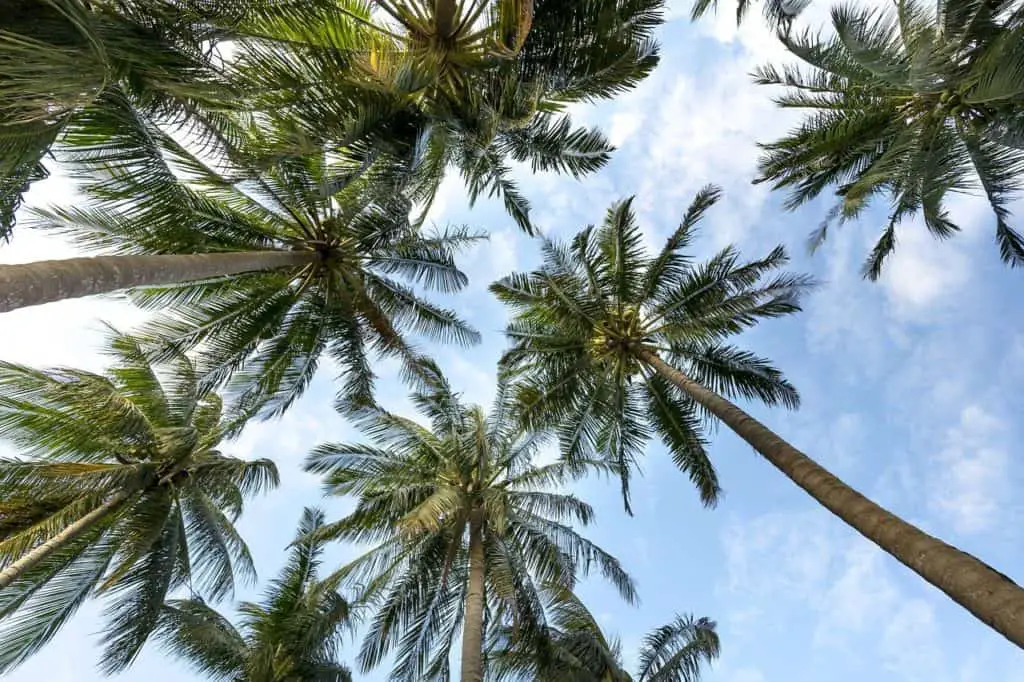
Palm trees turn brown due to watering problems, nutrient deficiencies, cold damage, pest infestations, or fungal disease.
Browning can affect just the leaf tips, the full frond, or the emerging spear at the crown, and each pattern points to a different cause.
Some browning on lower, older fronds is completely normal.
You water, fertilize, and even talk to them on the occasional slow weekend. And still, the fronds go brown.
Palm browning is one of the most common and most misunderstood problems in warm-climate gardening, partly because it looks the same whether the tree is thirsty, drowning, starving, or fighting off a fungal infection.
Treating the wrong cause not only fails to help, it often makes things worse.
This guide walks you through every real cause of brown palm fronds, shows you how to tell them apart visually, and tells you exactly what to do about each one. No vague advice.
No generic ‘consult a professional’ without context. Just a clear, honest path from brown fronds to a healthy tree.
Is It Actually a Problem? Understanding Normal Shedding
Before you reach for the pruning shears or a bag of fertilizer, take a step back and look at where the browning is happening.
Palms grow from a single point at the top called the apical meristem.
New fronds push up from the center, and old fronds at the bottom are constantly dying off to make room.
This is entirely normal and happens in every healthy palm.
If the browning is limited to the lowest fronds on the tree and the upper canopy is a solid, rich green, your palm is almost certainly not sick.
The telltale sign of natural shedding is that the dying fronds hang downward close to the trunk, turn evenly tan or brown from tip to base, and eventually drop off on their own.
Many palm species including royal palms and Christmas palms are self-cleaning, meaning those old fronds detach without any help from you.
The mistake most beginners make is pruning fronds the moment they start to yellow or brown at the tips.
Fronds with any green remaining are still photosynthesizing and, critically, still moving nutrients back into the trunk.
Removing them early robs the tree of resources it would otherwise reclaim.
| Tip: Leave Any Frond That Still Has Green If a frond is partly brown but shows any green on the rachis (the central stem), leave it in place. The palm is actively pulling nutrients from it. Only cut fronds that are 100 percent brown and fully dead. |
8 Real Causes of Brown Palm Fronds
1. Underwatering
A thirsty palm shows browning that starts at the tips and margins of the leaf and works inward.
The affected leaflets feel dry and crispy rather than soft or mushy.
In severe cases the entire frond turns a uniform straw-brown and feels almost papery.
Young palms and container-grown palms are the most vulnerable, but even established outdoor palms can dehydrate during hot, dry spells.
Sandy soils, which drain fast and hold very little moisture, make the problem worse.
Push a finger or a wooden stake 6 inches into the soil near the root zone.
Bone-dry soil at that depth after more than a day without rain is a clear sign.
Fix: water slowly and deeply until moisture reaches 12 to 18 inches down.
Shallow watering just wets the surface and trains roots upward toward hot, drying air rather than downward into stable soil moisture.
2. Overwatering and Root Rot
Overwatering is responsible for more dead palms than drought is, and the symptoms are easy to confuse with underwatering.
Fronds yellow first, then soften and collapse before turning brown. The lower fronds are typically the first to show symptoms.
Soil that stays soggy for more than a day or two after watering, or soil that smells faintly of sulfur or decay, points to waterlogged roots.
Root rot caused by Phytophthora and Pythium fungi thrives in saturated soil.
Once established, these pathogens damage the roots’ ability to move water upward, so even a well-watered palm starts showing drought-like stress at the frond tips.
The fix is improving drainage first, correcting watering frequency second. No amount of watering adjustment will fix the problem while roots are sitting in standing water.
| Tip: The Finger Test vs. the Weight Test For container palms, lift the pot after watering and again two days later. If it still feels heavy, the soil is holding too much moisture and drainage needs to improve. For outdoor palms, check soil 6 inches deep. Moist but not wet is the target, similar to a wrung-out sponge. |
3. Nutrient Deficiencies
This is where most guides oversimplify.
Palms are heavy feeders with specific nutritional needs, and not all nutrient shortages look the same.
Learning to read the visual differences matters because treating the wrong deficiency can trigger another one.
| Nutrient | What You See | Which Fronds Affected |
| Potassium (K) | Orange-yellow spots or streaks, brown tips that spread inward | Older, lower fronds first |
| Magnesium (Mg) | Wide yellow band along frond edges, green center strip remains | Older fronds, progresses upward |
| Manganese (Mn) | Frizzled, scorched look on new growth; leaflets curl and brown at tips | Newest fronds at the crown |
| Nitrogen (N) | Uniform pale yellow-green across the whole frond | Older fronds, spreads upward |
| Iron (Fe) | Yellow fronds with green veins on new growth | Newest fronds |
| Boron (B) | New fronds fail to open fully; tips brown and crinkle | Newest fronds only |
Potassium deficiency is the most widespread problem in palm-growing regions. It is also the most dangerous to mismanage.
Because potassium moves through the palm from older fronds inward, removing any frond that still shows even a trace of green actively worsens the deficiency.
That is a fact most general pruning guides skip entirely.
A practical note: lawn fertilizers cause potassium deficiency in nearby palms more often than most homeowners realize.
Standard turf fertilizers are high in nitrogen and very low in potassium.
Palms growing in lawn areas regularly fed with turf products will show potassium symptoms even if the soil tested adequate before treatment.
Use a fertilizer labeled specifically for palms, with a ratio closer to 8-2-12 or similar, applied during the growing season.
Correcting deficiencies takes months, not weeks, because the entire canopy needs to cycle through before you see improvement.
| Tip: Soil Testing Has Limits for Palms Standard soil tests do not reliably reflect what palms can actually absorb. A soil test might show adequate potassium while the tree shows classic deficiency symptoms, because the available fraction in sandy or alkaline soil is far lower than the total measured. Treat the visual symptoms, not the soil report. |
4. Cold Damage
Cold damage hits fast and looks dramatic. Fronds turn brown overnight or within a couple of days following a frost event.
The browning often has a greasy, water-soaked appearance initially before it dries to a tan or brown.
In mild cold damage only the tips and outer margins brown off. In severe cases entire fronds collapse.
The most critical thing to check after a cold event is the spear, which is the newest, tightly coiled frond emerging from the center of the crown.
Pull it gently. If it comes out with no resistance and smells foul, the growing point has been killed and the palm is unlikely to recover.
If the spear is firm and resists pulling, the palm has survived and damaged fronds can be removed once temperatures stabilize.
Resist the urge to prune brown cold-damaged fronds immediately.
Those dead fronds provide a layer of insulation if another cold snap follows, and they do not further harm the tree by remaining in place.
5. Salt and Mineral Burn
Palms growing near roads, driveways, or coastal areas are regularly exposed to elevated salt levels, whether from road de-icing treatments, salt spray carried on the wind, or irrigation water with high dissolved mineral content.
Salt burn produces browning that is concentrated at the tips and edges and tends to affect fronds somewhat uniformly across the canopy rather than following the older-to-newer progression of nutrient deficiencies.
The affected edges have a sharper transition than drought browning, almost as if the tips were singed.
Tap water high in fluoride or chlorine is a frequent cause in container palms.
Switching to filtered water or allowing tap water to sit open in a container for 24 hours before use gives chlorine time to off-gas.
Flushing the soil monthly with plain water helps clear accumulated mineral deposits from the root zone.
6. Fungal Disease
Several fungal diseases target palms specifically, and the browning patterns they cause differ enough to be distinguishable with some attention.
Ganoderma butt rot (Ganoderma zonatum) attacks the lower 4 to 5 feet of the trunk.
Fronds wilt and collapse from the bottom up, and the trunk may sound hollow when tapped.
A conk, which looks like a bracket-shaped shelf mushroom growing from the base, is the definitive sign.
There is no treatment. Remove and destroy the tree before the spores spread, and do not replant a palm in the same location.
Fusarium wilt (Fusarium oxysporum f. sp. palmarum) progresses extremely fast, killing a palm within 2 to 3 months of the first symptom.
One characteristic sign is browning that affects only one side of a frond, with the other side remaining green.
The rachis often shows a distinctive brown stripe running along its length. There is no cure.
Trees infected with Fusarium wilt must be removed and chipping equipment must be thoroughly disinfected before use on any other tree.
Phytophthora bud rot (Phytophthora palmivora) kills the growing spear. The center frond dies and comes out easily with a pull.
The disease spreads quickly in wet weather. If caught early, systemic fungicide applications may save the tree, but prompt action is essential.
Rachis blight and Graphiola leaf spot cause dark brown or black spots scattered across fronds, often with a yellow halo.
Both are fungal and spread by water splash. These are rarely fatal but do signal that conditions have been consistently too wet.
| Warning: Fusarium Wilt Spreads on Pruning Tools Fusarium wilt is transmitted from tree to tree on contaminated pruning equipment. If you hire a tree service, confirm that they disinfect their tools between each palm. A 10 percent bleach solution or 70 percent isopropyl alcohol wipe between cuts is the minimum standard. Failing to do this has killed entire rows of palms in residential neighborhoods. |
7. Pest Infestation
Pest browning tends to be patchy and uneven rather than the clean pattern of nutrient deficiency or the tip-to-base progression of drought stress.
Spider mites cause a fine, dusty stippling across leaflets that turns bronze or brown. Check the undersides of fronds for fine webbing or tiny moving dots.
They thrive in hot, dry conditions and on stressed trees.
Scale insects appear as small, waxy bumps on fronds and stems. Heavy infestations yellow and brown the foliage as the insects drain sap.
Scrape a bump with a fingernail to confirm it is alive and not just debris.
Palm weevils are more serious. They bore into the crown, targeting stressed or recently pruned palms.
By the time fronds visibly brown, the infestation may already be advanced.
Look for sawdust-like frass near pruning cuts or at the base of the crown.
Neem oil or insecticidal soap handles minor spider mite and scale infestations.
Weevil infestations are harder to treat and may require systemic insecticide applied by a licensed applicator.
8. Transplant Shock
Newly planted palms often brown in the weeks following installation.
The root system, which was either bare-rooted or severely cut to fit a container or ball, cannot yet supply the water demand of a full canopy of fronds.
The tree essentially sheds canopy it cannot support until roots re-establish.
Browning from transplant shock starts at the tips of older fronds and progresses. The upper canopy tends to hold green longer.
The key is not to fertilize a newly planted palm until it shows several inches of new growth from the crown, which signals that roots have begun to establish.
Fertilizing before that point stresses a root system already struggling to function.
The Pruning Trap: What Competitors Get Wrong
Almost every article on this topic ends with advice to ‘cut off the brown fronds.’ That advice is incomplete and, in some cases, actively harmful.
Here is the part most guides skip: palms cannot move nutrients upward from their roots in the same way broadleaf trees do.
They depend on every functioning frond for photosynthesis and on every partially living frond for nutrient recovery.
When you remove a frond that is still partly green, particularly one showing signs of potassium or magnesium deficiency, you eliminate the visual evidence that helps diagnose the problem.
You also remove nutrients the palm would otherwise reclaim.
The 9-to-3 rule, commonly used by professional arborists, means keeping all fronds that sit between the 9 o’clock and 3 o’clock positions when you imagine the canopy as a clock face.
Nothing above that horizontal line should be removed.
Cutting above that level, a practice called hurricane cutting or lion-tailing, actually increases wind damage risk rather than reducing it, because data from multiple hurricane seasons in Florida shows that stripped palms lose their crowns more often than those with a full canopy.
| Tip: Never Prune Before Hurricane Season The University of Florida Extension Service advises explicitly against pruning palms ahead of hurricane season. A full canopy of green fronds flexes and redistributes wind load. A stripped crown sits rigid at the top of the trunk and snaps. Remove only dead and fully brown fronds at any time of year. |
Troubleshooting at a Glance
| Problem | Likely Cause | How to Confirm | Solution |
| Brown tips only, lower fronds | Natural shedding | Upper canopy still fully green | Leave it, normal cycle |
| Brown tips, crispy texture | Underwatering | Soil bone dry at 6 inches | Deep, slow watering |
| Yellow then brown, soft fronds | Overwatering/root rot | Soil stays soggy, faint odor | Improve drainage first |
| Orange spots on older fronds | Potassium deficiency | Symptoms move upward over time | Palm-specific 8-2-12 fertilizer |
| Yellow band on frond edges | Magnesium deficiency | Green center strip visible | Magnesium sulfate application |
| Frizzled new growth, scorched look | Manganese deficiency | Crown fronds affected most | Manganese sulfate soil drench |
| Brown overnight after cold | Frost/cold damage | Recent temperature drop below 32F | Wait, check spear firmness |
| Brown on one frond side only | Fusarium wilt | Brown stripe on rachis | Remove tree, disinfect tools |
| Bracket fungus at trunk base | Ganoderma butt rot | Shelf-like conk visible | Remove and destroy tree |
| Patchy browning, webbing | Spider mites | Webbing on frond undersides | Neem oil or insecticidal soap |
| Brown tips, sharp margins near road | Salt burn | Tree near coast or treated road | Flush soil, use filtered water |
| Browning after planting | Transplant shock | Newly installed within 6-8 weeks | Hold fertilizer, water consistently |
Frequently Asked Questions
Will brown palm fronds turn green again?
No. A frond that has turned fully brown will not recover its green color.
Brown tissue in a palm frond is dead tissue, and palms do not regenerate individual fronds the way broadleaf plants can produce new growth from existing leaves.
The practical response is to let the palm produce new healthy fronds from the crown rather than trying to reverse damage in existing ones.
If only the tips are brown and the rest of the frond is still green, that frond can remain functional for months while the tree grows new growth to replace it.
Should I cut off brown palm tree leaves?
Only remove fronds that are 100 percent brown with no visible green anywhere on the rachis or leaflets.
Cutting partially green fronds removes nutrients the palm is still actively recovering and eliminates evidence that helps diagnose what is wrong.
For fully dead fronds, use a sharp, clean cutting tool and cut close to the trunk without damaging the trunk tissue underneath.
Never use climbing spikes when pruning palms, as they create wounds that attract disease-carrying pests.
Why are only the tips of my palm tree leaves turning brown?
Brown tips with the rest of the frond remaining green usually point to one of three causes: inconsistent watering (either chronic underwatering or cycles of wet and dry), potassium deficiency, or salt and mineral buildup in the soil.
The distinction matters because the fixes are different. Check soil moisture first. If moisture is adequate, look at your fertilizer history.
If you have been using a lawn fertilizer on or near the palm, potassium deficiency is the most likely cause, since turf products are heavily weighted toward nitrogen with very little potassium.
How do I know if my palm tree is dying?
The most reliable indicator is the condition of the central spear, which is the tightly coiled emerging frond at the very top of the crown.
A healthy, firm spear that resists gentle pulling means the growing point is alive and the palm can recover from most problems given correct care.
A spear that pulls out easily and smells foul or shows rotted tissue at its base indicates that the growing meristem has been destroyed, either by cold, Phytophthora bud rot, or weevil damage, and the palm will not recover.
Secondary indicators include all fronds yellowing and drooping simultaneously, the trunk feeling soft when pressed, and a hollow sound when the trunk base is tapped, which may indicate Ganoderma.
Can overwatering cause brown palm fronds?
Yes, and overwatering is one of the most common causes of browning in both indoor and outdoor palms.
When roots sit in saturated soil they are deprived of oxygen, which damages root cells and reduces the roots’ ability to absorb water and nutrients even when surrounded by moisture.
The result is drought-like stress at the frond tips despite the soil being wet.
Fronds yellow before browning in overwatered palms, and the texture is typically soft rather than crispy.
Waterlogged soil also creates ideal conditions for root-rot fungi, which compounds the damage.
What causes brown spots on palm leaves?
Brown spots rather than tip browning or overall frond browning usually point to one of three causes.
Fungal leaf spot diseases, including Graphiola and rachis blight, produce dark brown or black spots often surrounded by a yellow halo, and they spread by water splash, so they are more common after rainy periods or overhead watering.
Potassium deficiency in its early stages produces translucent orange-yellow spotting on older fronds that progresses to brown necrotic patches as the deficiency worsens.
Physical damage from cold, wind, or chemical spray can also create irregular brown patches.
Check whether spots are uniform and spreading, which suggests disease, or confined to older fronds in a regular pattern, which suggests deficiency.
How do I treat nutrient deficiency in palm trees?
The first step is identifying which nutrient is missing by reading the visual pattern carefully, using the frond location and symptom appearance as your guide.
Once identified, use a fertilizer formulated specifically for palms, typically labeled with an 8-2-12 or similar ratio that prioritizes potassium and includes magnesium and manganese.
Apply it according to the manufacturer’s rate for your tree size, spread evenly to the drip line, and water it in well.
Do not overapply, thinking more will correct the problem faster. Excess nitrogen from overfertilizing actually worsens potassium deficiency by competing for uptake.
Expect to wait several months before seeing visible improvement, as the damaged canopy must be replaced by new healthy growth.
Is it normal for an outdoor palm to lose fronds in winter?
Some winter frond loss is normal in palms at the edge of their cold tolerance range.
Palms in USDA zones 9 and 10 that experience occasional cold nights below 40 degrees Fahrenheit often drop older lower fronds as the tree conserves energy.
If the browning is limited to the lower fronds and the crown shows healthy new green growth as temperatures warm in spring, the tree is cycling through normal cold-stress shedding.
Browning that starts at the crown rather than the bottom, or browning that follows a specific frost event and affects fronds across the canopy, is more likely cold damage that requires assessment of the spear to judge recovery.
Key Takeaways
- Check the pattern and location of browning before doing anything. Tip browning on lower fronds is often natural shedding. Crown browning or brown spots on new fronds signal a serious problem.
- Only remove fronds that are 100 percent brown. Removing any frond with visible green removes nutrients and eliminates diagnostic evidence.
- Check soil moisture at 6 inches deep before watering. Aim for moist but not wet, like a wrung-out sponge.
- Use a palm-specific fertilizer with a high potassium ratio, not a standard lawn fertilizer, which worsens potassium deficiency in nearby palms.
- If the central spear pulls out easily and smells rotten, the growing point is dead and the palm cannot recover.
- Ganoderma butt rot and Fusarium wilt have no cure. Remove infected trees immediately and sanitize all tools before use on other palms.
- Hurricane pruning actually increases wind damage risk. Keep a full, rounded canopy and never cut fronds above the 9 o’clock to 3 o’clock line.
- Salt burn, cold damage, and transplant shock all look similar. Ask when the browning started and what changed in the tree’s environment around that time.
Final Thoughts
Brown fronds pulled us all into a spiral of worry at some point.
The instinct to cut, treat, and fix something visible is understandable, but with palms the best initial move is almost always to slow down and read what the tree is telling you.
A palm that is shedding its oldest fronds from the bottom up, with a crown that is green and pushing new growth, does not need intervention.
A palm with browning working up from old to new fronds over several weeks, especially on a property that receives regular lawn fertilizer applications, almost certainly has a potassium deficiency that a palm-specific fertilizer can address over the coming months.
The palms that die under home care are almost always victims of either too much enthusiasm in pruning, the wrong fertilizer, or a disease caught too late.
Getting familiar with the visual patterns in this guide puts you ahead of both problems.
| What’s Next Walk outside and look at your palm right now. Note whether browning starts at the lower fronds or the crown, whether it affects tips only or the full frond, and when it first appeared. Those three observations narrow the cause to one or two possibilities from the list in this guide. If the spear at the crown is firm and fragrant, your palm has time. Start with watering and fertilization before reaching for any other intervention. |
Mariel is a plant enthusiast and writer based in the UK with a passion for houseplants and indoor growing.
She has spent the last few years building an ever-growing collection of indoor plants and learning the hard way which ones will survive her busy schedule.
At Bean Growing she writes about houseplant care, common plant problems, and outdoor gardening.