
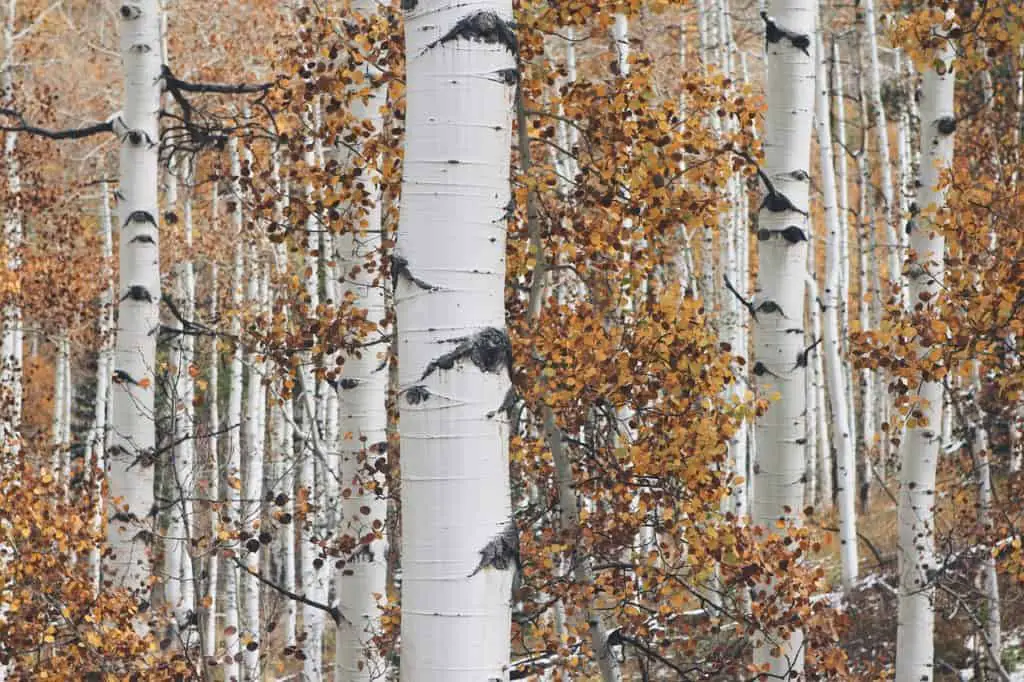
Aspen and poplar are closely related trees in the Populus genus but they are not the same plant.
Aspens are a specific subgroup with trembling leaves, white bark, and clonal root systems. Poplar covers dozens of other species and cultivars.
For US homeowners, the most important practical difference is root behavior, poplars spread aggressively and can damage foundations, driveways, and sewer lines if planted too close.
The first time I stood inside a mature aspen grove in Colorado in mid-October, the sound stopped me before the color did.
Every leaf in that grove was shaking in a breeze I could barely feel on my face, thousands of them chattering together like a very gentle rain.
That experience is something no photograph really captures, and it is honestly why so many people make their first mistake with these trees: they fall in love with aspens in the mountains and then go home to Georgia or Texas and try to plant them in conditions they were never built for.
I have made my own share of planting mistakes with this tree family over the years, and I have talked to enough homeowners who planted hybrid poplars six feet from their septic systems to know that the gap between what nursery tags tell you and what you actually need to know is significant.
This guide is my attempt to close that gap. It covers everything from correct species identification to siting, planting, long-term care, and the problems that catch people off guard, including the ones I got wrong before I got them right.
What Are Aspen and Poplar Trees? Clearing Up the Confusion
Both aspen and poplar belong to the genus Populus, part of the willow family (Salicaceae).
This shared family is why the two trees look so similar when you first encounter them at a nursery, similar bark on young stock, similar leaf shapes, similar growth habits.
The confusion is understandable and I see it constantly, even among experienced gardeners.
Botanically, aspen refers to a small subgroup of Populus species, mainly quaking aspen (Populus tremuloides) across most of the US and bigtooth aspen (Populus grandidentata) in the Northeast, that share a distinctive flat-stemmed leaf that trembles in the slightest air movement.
Poplar, in practical everyday use, covers the remaining Populus species: cottonwood, Lombardy poplar, black poplar, and the various hybrid varieties that nurseries breed specifically for fast screening and windbreak use.
The short version: all aspens are technically poplars in the botanical sense, but when someone at a nursery hands you a poplar, they are almost never handing you an aspen.
They are different plants with different needs, different lifespans, and very different consequences when planted in the wrong spot.
| UK Reader Note In the UK, the native aspen is Populus tremula (European aspen), which behaves very similarly to the North American quaking aspen. The black poplar (Populus nigra) is a genuinely rare native tree in the UK, fewer than 7,000 are estimated to remain, and is the subject of active conservation efforts through the Wildlife Trusts and the Forestry Commission. If you are in the UK and interested in native tree planting, both are worth researching. The Woodland Trust has a free native tree planting scheme worth looking into at woodlandtrust.org.uk. |
Quick Species Reference
| Common Name | Species | Native Range (US) | Typical Height |
| Quaking Aspen | Populus tremuloides | Northern and western US, most of Canada | 20 to 50 ft |
| Bigtooth Aspen | Populus grandidentata | Northeastern US and southeastern Canada | 30 to 60 ft |
| Eastern Cottonwood | Populus deltoides | Eastern and central US | 60 to 100 ft |
| Lombardy Poplar | Populus nigra ‘Italica’ | Originally Italy; widely planted across US | 40 to 70 ft |
| Hybrid Poplar | Populus x (various) | Cultivated; planted widely across all US regions | 40 to 80 ft |
| Fremont Cottonwood | Populus fremontii | Western US, particularly California and Arizona | 40 to 70 ft |
What Aspen and Poplar Have in Common
Before getting into what separates them, it helps to understand why they get lumped together in the first place.
These shared characteristics are real and they shape how you manage both trees.
Growth Rate
Both are genuinely fast. When I first planted a row of hybrid poplars along a property boundary in early spring, they were 4-foot whips from the nursery.
By the end of that same growing season they were over 8 feet tall and filling in nicely. That kind of speed is intoxicating when you need privacy and you need it before next summer.
Quaking aspens are somewhat more measured, typically 1.5 to 2 feet per year once established, but still fast by the standards of most landscape trees.
The caution I would give anyone excited about that growth speed is this: the same energy that drives a hybrid poplar to 8 feet in a season is also driving its root system outward at a rate that will surprise you if you are not paying attention to where you planted it.
Wood Characteristics
Both trees produce soft, lightweight hardwood that is easy to work but not particularly durable.
The wood of both aspens and poplars is fine-grained with a pale, almost white color that takes paint well but absorbs stain unevenly.
I have milled aspen logs from downed trees and the wood planes beautifully, it is almost silky under a sharp blade, but I would not use it for anything structural or anywhere it will take a beating.
Paper mills, matchstick manufacturers, and oriented strand board (OSB) producers are the primary industrial users of both, which tells you something about the wood’s intended level of durability.
Suckering and Clonal Growth
This is the characteristic that surprises homeowners most consistently, and it deserves more attention than it typically gets.
Both aspens and many poplar species reproduce by sending up root suckers, new shoots from lateral roots that can emerge well beyond the original trunk.
What looks like a tidy single tree can, within 3 to 5 years, become a spreading colony of shoots popping up through your lawn, your garden bed, and possibly your neighbor’s yard.
I learned this the hard way with an aspen I planted as a specimen tree in a relatively small backyard.
By year four, suckers were emerging 12 feet from the main trunk in three directions.
The mowing kept them in check in the lawn areas, but the ones that came up inside a nearby raised bed were more of a battle.
I eventually dealt with them, but I wish someone had told me clearly before I planted that this is not an occasional quirk, it is the tree’s primary reproduction strategy.
| Suckering Tip If you want to contain suckering without removing the tree, a physical root barrier installed at planting is far more effective than any reactive management. Heavy-duty polypropylene root barrier panels, sunk 24 to 30 inches deep in a circle around the planting area, redirect roots downward rather than outward. They cost $30 to $60 for enough material to surround a single tree and are widely available at landscape supply stores. Installing them after the fact, once roots have already spread, is almost impossible without damaging the tree. |
Aspen vs Poplar: The Key Differences That Actually Matter
| Characteristic | Quaking Aspen | Poplar (Hybrid / Lombardy / Cottonwood) |
| Mature height | 20 to 50 ft | 40 to 100 ft depending on species |
| Bark appearance | Smooth, chalky white to pale green with dark oval scars | Grey-brown, deeply furrowed on mature trees |
| Leaf stem | Flattened – causes trembling in even faint breeze | Round or slightly flattened; much less leaf movement |
| Fall color | Vivid clean yellow to gold; one of the best of any US tree | Yellow to pale gold; generally less dramatic |
| Root aggression | Moderate; suckers heavily but roots stay relatively shallower | High; deep wide-spreading roots cause infrastructure damage |
| USDA zones | Zones 1 to 7; requires cool climate | Zones 3 to 9 depending on species |
| Lifespan | 40 to 150 years per stem; clonal root system can persist for thousands of years | 15 to 50 years; hybrid poplars often under 30 years |
| Cotton/fuzz | Minimal | Female cottonwood and some poplars produce heavy white fuzz in early summer |
| Pollution tolerance | Low; declines near heavy traffic or industrial areas | Moderate to high; more tolerant of urban conditions |
| Best use | Naturalistic groves, wildlife habitat, mountain landscaping | Fast privacy screens, windbreaks, erosion control on larger properties |
Telling Them Apart in the Field
The bark is your most reliable visual identifier, especially with mature trees. I have walked people through this identification dozens of times and the same sequence always works.
First, look at the bark from 20 feet away. If it is smooth and white or pale green-white with dark eye-shaped marks, you are almost certainly looking at an aspen.
If it is grey-brown and deeply ridged like the bark of an old oak, it is a mature poplar.
Young poplars can look deceptively similar to aspens, with pale bark, but that pale color fades and roughens as they age, while aspen stays smooth and white.
Second, find a leaf and hold the stem between your fingers. Gently blow on the leaf. If it pivots back and forth easily with almost no effort, the petiole is flattened, that is aspen.
If it resists and barely moves, the petiole is round, that is a poplar. It sounds almost too simple but it works consistently.
| UK Reader Note European aspen (Populus tremula) uses exactly this same identification trick, the flattened petiole that makes leaves tremble is the defining characteristic of all true aspens regardless of continent. If you are walking in upland woodland in Scotland or Wales and you spot a tree with white bark and shimmering leaves, that trembling is the giveaway. It is worth stopping for. European aspen groves are genuinely rare and often support species like the aspen hoverfly (Hammerschmidtia ferruginea) found almost nowhere else in the UK. |
Which Tree Is Right for Your Yard? An Honest Assessment
This is the question I get asked most often, and the honest answer is: it depends entirely on where you live, how much space you have, and how honestly you assess both of those things.
I have seen beautiful aspen groves thriving in Colorado backyards and I have seen those same trees planted in Nashville struggling through their third summer of heat stress and looking miserable.
The tree is not the problem in those cases. The mismatch is.
Choose Quaking Aspen If…
- You live in USDA Zones 1 to 7, the Rocky Mountain states, upper Midwest, New England, or Pacific Northwest at elevation.
- Aspen is native to these regions and will establish with far less intervention than any introduced alternative.
- Fall color matters to you. I have seen a lot of fall foliage across the US and nothing quite compares to a large aspen grove at peak color.
- The yellow is clean and almost luminous in a way that cottonwood yellow simply is not.
- You are planting for wildlife. Aspen groves support an exceptional diversity of wildlife, over 500 species of birds and mammals use aspen ecosystems in the western US, including cavity-nesting birds that excavate the soft wood for nest holes.
- You have at least 20 feet of clearance from your house foundation, underground utilities, and driveway. Aspen roots are less aggressive than many poplars but the suckering still needs room to be managed.
- You want a naturalistic planting that fills in and looks established within 3 to 4 years rather than a formal specimen.
Choose a Poplar Species If…
- You need fast screening and you need it this decade, not the next one. Nothing beats a hybrid poplar for raw speed. If you plant 6-foot whips in April, you will have a meaningful screen by October. I have seen it happen.
- You live in USDA Zones 8 or 9 where aspen simply will not perform in the summer heat. For hotter climates, poplars are the practical choice within this genus.
- You are planting for erosion control on a bank or slope where aggressive root spread is actually what you want.
- You are on a larger property, ideally half an acre or more, with enough buffer between your planting area and any structures or utilities to manage root spread safely.
| Critical Siting Warning The minimum recommended setback between any poplar species and your home foundation, basement walls, septic system, or underground water and sewer lines is 30 to 50 feet. Poplar roots actively seek moisture and will penetrate cracked or aged pipes, causing blockages that cost thousands of dollars to repair. I once helped a homeowner troubleshoot a recurring sewer blockage that a plumber had cleared three times in two years. When the line was finally camera-inspected, the camera showed poplar roots filling the pipe from a tree planted 22 feet from the house, well within what a nursery tag would consider a safe distance for a ‘small’ tree. The root system had reached the pipe within 4 years of planting. Plant poplars far from anything they can damage. If your yard does not give you that distance, choose a different tree entirely. |
Neither Tree Is Suitable If…
- Your yard is under half an acre with structures or fences on multiple sides. The root and sucker management requirements simply do not fit.
- Your soil is heavy clay that stays wet for days after rain. Both trees tolerate briefly wet conditions but will develop root rot in chronically waterlogged soil. I have watched hybrid poplars planted in low-lying clay ground decline and die within 3 years, well before anyone expected them to.
- You are in USDA Zones 10 or 11. Neither tree handles subtropical heat and humidity well. Native alternatives like live oak, bald cypress, or Southern magnolia will give you far better results.
How to Plant Aspen and Poplar Trees: Step-by-Step
Step 1: Site Selection and Spacing
Confirm full sun before committing to a location, at least 6 hours of direct sunlight daily.
I once planted a row of aspens along a fence line that I thought got good morning sun, only to realize after the first summer that a neighbor’s large oak cast more shade than I had accounted for.
Growth slowed noticeably and one of the five trees never really recovered. Walk your planting area at different times of day in summer before you break ground.
For a hybrid poplar privacy screen, space trees 6 to 8 feet apart.
For a naturalistic aspen grove, plant initial trees 10 to 15 feet apart and allow the root suckering to fill gaps naturally over time, that is how aspen groves work in nature and it produces a far more convincing result than trying to plant them densely from the start.
| Tip: Call 811 Before You Dig In all 50 US states, calling 811 at least 3 business days before any digging has your underground utilities marked at no charge. It takes 5 minutes. I have been doing landscape work for years and I still call every single time without exception. The one time you skip it is the one time there is a gas line 14 inches down exactly where you planned to dig. |
Step 2: Soil Preparation
Both trees prefer loamy, well-draining soil with a pH between 5.5 and 7.0. Dig your planting hole twice as wide as the root ball and the same depth, no deeper.
The extra width is what matters most; it loosens the surrounding soil so roots can expand laterally without hitting a wall of compacted ground.
In heavy clay, work in one part coarse horticultural grit and one part compost for every three parts of native soil.
Do not add sand alone to clay, without organic matter to go with it, the result is closer to concrete than improved garden soil.
I made that mistake in my first garden and it took two years and a rototiller to fix.
Step 3: Planting Depth
This is the step where well-meaning planters most often go wrong, and it is genuinely hard to undo.
The root flare, the point where the trunk visibly widens before entering the ground, must sit at or just above soil level.
When you buy balled-and-burlapped stock, the flare is often buried under several inches of nursery soil.
Scrape that away before you plant. A tree planted 3 inches too deep will struggle for years before anyone works out why.
Before backfilling, remove all wire cages, twine, and burlap from the root ball. Even natural burlap can form a moisture barrier and restrict root development in heavy soils.
Step 4: Watering at Planting
Water at planting with a slow trickle at the base for 20 to 30 minutes rather than a quick overhead pour.
You want water penetrating to at least 12 inches so there is moisture for roots to grow toward immediately.
One of the more useful things I learned from an experienced nurseryman: push a long screwdriver into the soil beside the root ball an hour after your slow soak.
If it slides in to 10 or 12 inches without much resistance, the water has penetrated properly. If it stops at 4 or 5 inches, you need to water longer.
Step 5: Mulching
Apply a 3-inch layer of wood chip or bark mulch in a ring at least 3 feet wide around the base. Keep it 3 to 4 inches away from the trunk itself, not piled against it.
Mulch does three genuinely useful things: it cuts watering frequency by 40 to 50 percent in summer, it moderates soil temperature during heat waves, and it stops grass and weeds from competing with the root zone in the critical first year.
I never skip this step on a new planting and I notice a real difference in establishment speed when I do it properly versus when I rush it.
| Warning: Volcano Mulching Piling mulch in a cone shape against the trunk, sometimes called volcano mulching and unfortunately a common sight in commercial landscapes, keeps bark permanently moist, invites fungal disease, and creates ideal habitat for rodents that gnaw bark in winter. The mulch ring should be flat, like a donut, with the hole of the donut around the trunk. It looks less dramatic than a mulch volcano but it actually helps the tree instead of slowly harming it. |
Ongoing Care: Watering, Fertilizing, and Pruning
Watering
Deep, infrequent watering produces better trees than frequent shallow watering, and I say this from direct experience of testing both approaches in side-by-side plantings.
Trees watered shallowly and often develop shallow root systems that sit near the surface where they are vulnerable to summer heat and drought.
Trees watered deeply but less often send roots down in search of moisture and end up far more drought-tolerant and structurally stable.
| Tree Age | Frequency in Dry Conditions | Volume Per Session | Method |
| Year 1 – establishment | Once per week | 10 to 15 gallons | Slow trickle at base, 20 to 30 minutes |
| Year 2 | Every 10 to 14 days | 10 to 15 gallons | Soaker hose or slow trickle |
| Year 3 and beyond (established) | Only in extended drought (3-plus weeks dry) | Deep soak to 18 inches | Soaker hose or drip irrigation |
Fertilizing
Neither aspens nor poplars are heavy feeders once they are established in reasonably fertile soil.
In years one and two, a single application of balanced slow-release granular fertilizer (10-10-10 or similar) in early spring supports establishment.
Use half the label rate, both tree types respond to excess nitrogen with overly fast, soft growth that is structurally weak and significantly more susceptible to pest damage.
I made the mistake of full-rate fertilizing a young hybrid poplar row in year two thinking I would accelerate the screening.
The growth was impressive but the stems were visibly soft and one of the trees snapped in a late summer thunderstorm that the others survived fine.
Half-rate for the first two years, then let the tree feed from the soil on its own.
| Fertilizing Tip A soil test from your county Cooperative Extension office, usually $15 to $25, is the only reliable way to know whether your soil actually needs fertilizing and what it needs most. Many soils in the eastern US already have excess phosphorus from decades of lawn fertilizing. Adding more does nothing useful and contributes to runoff. Your local Extension office can also confirm your soil pH, which is the single most important factor governing nutrient availability for any tree. |
| UK Reader Note UK readers can get a basic soil pH test kit from most garden centres for around 5 to 10 pounds. The RHS recommends testing before planting any new trees and publishes free guidance at rhs.org.uk. One timing difference worth noting: in the UK, bare-root tree planting runs October through March during dormancy, whereas US guidance typically focuses on spring planting. Both work, dormant planting actually reduces transplant stress, but the UK planting window is quite different from what most US articles describe. |
Pruning
For the first three years, the most important pruning advice is to resist the urge to do much of it. Let the tree establish its natural architecture.
After year three, late winter pruning, February to early March in most US zones, before any bud break, is the right timing for both aspens and poplars.
The tree is fully dormant, wounds callous over faster with spring warmth coming, and you can see the branching structure clearly without leaves in the way.
Remove dead, damaged, or crossing branches. Never remove more than 25 percent of the live canopy in a single season.
I know that feels conservative when you are looking at a messy tree, but heavy pruning triggers excessive suckering as the tree compensates for lost leaf area.
I have seen a modest pruning session on a mature aspen produce three times the normal number of suckers in the following spring.
For Lombardy poplars specifically, always sterilize pruning tools between cuts with 70 percent isopropyl alcohol. Cytospora canker, the most serious disease of this species, spreads directly through pruning wounds on contaminated blades.
It is a simple step that takes seconds and it genuinely matters.
Common Pests and Diseases
Cytospora Canker
Cytospora canker is the reason I stopped recommending Lombardy poplar as a long-term landscape tree in humid eastern climates.
It is caused by the fungus Cytospora chrysosperma, which enters through wounds, sunscald damage, and pruning cuts.
Infected areas develop sunken, discolored patches of dead bark, sometimes with orange or brown spore pustules visible in wet conditions.
Once it reaches the main trunk and girdles it, the tree is terminal.
There is no chemical treatment that reverses an established canker.
The only management is prevention (avoiding wounds, correct pruning technique, keeping the tree vigorous) and prompt removal of infected wood at least 6 to 8 inches below visible symptoms with sterilized tools.
In my experience watching Lombardy poplars in the Southeast, a tree that shows significant canker symptoms before year 15 rarely recovers even with aggressive pruning.
It is worth knowing this before you plant.
| Lombardy Poplar Lifespan Warning In humid eastern US climates, Lombardy poplar commonly begins significant decline from cytospora canker within 10 to 20 years. I have seen rows of Lombardy poplars that looked spectacular at year 8 and were unsalvageable skeletons by year 18. If you need a long-term privacy screen, plant Lombardy poplars as a temporary measure while a slower-growing, longer-lived alternative, like arborvitae, cryptomeria, or native Eastern red cedar, establishes behind them. When the poplars decline, remove them and the permanent screen is ready. |
Bronze Poplar Borer
The bronze poplar borer (Agrilus liragus) is a metallic wood-boring beetle that targets stressed aspens and poplars across much of the US.
The beetles lay eggs under bark in summer; larvae tunnel through the cambium layer disrupting water and nutrient transport.
The primary visible signs are D-shaped exit holes in bark and progressive crown dieback. Once larvae are inside the wood, there is no effective chemical treatment.
Healthy, vigorously growing trees resist borer attack significantly better than stressed ones.
The practical prevention strategy is maintaining tree health through consistent watering during drought and protecting the trunk from mechanical wounds, lawnmower and string trimmer strikes at the base of the trunk are among the most common borer entry points I see.
A 3-foot mulch ring around the trunk eliminates most of that risk by keeping mowing equipment away from the bark.
Marssonina Leaf Spot
Marssonina leaf spot produces dark brown spots with yellow halos on leaves, followed by early leaf drop in late summer.
It looks alarming the first time you see it, I had a client call me convinced their aspen grove was dying when half the leaves were on the ground in August, but it rarely causes serious long-term harm to otherwise healthy trees.
It is worst in wet summers with poor air circulation through dense plantings.
Management: rake and dispose of fallen leaves in autumn to reduce the overwintering spore load for next season.
Avoid overhead irrigation that keeps foliage wet for extended periods. Fungicide treatment is rarely warranted on established trees; the disease is largely cosmetic.
Aphids
Multiple aphid species target aspens and poplars, clustering on new growth and leaf undersides and causing leaf curl along with sticky honeydew deposits.
Natural predators, ladybugs, lacewings, parasitic wasps, control most aphid outbreaks without any intervention from you, provided you are not applying broad-spectrum pesticides that kill those beneficial insects alongside the aphids.
The most effective long-term aphid management I have seen is simply not spraying anything indiscriminately and letting the natural predator community do its job.
Wood Properties and Practical Uses
Understanding what each wood is actually good for prevents disappointment if you are milling timber from trees on your property or evaluating commercial products made from these species.
| Property | Aspen Wood | Poplar Wood |
| Janka hardness | 350 lbf – very soft | 540 lbf – soft; yellow poplar slightly harder |
| Weight (air-dried) | Approx. 26 lb per cubic foot | Approx. 28 to 30 lb per cubic foot |
| Grain | Fine, even, straight – works beautifully with sharp hand tools | Fine and even; occasionally interlocked |
| Flammability | Low – burns slowly with low flame spread; used for matchsticks specifically for this reason | Moderate – burns somewhat faster |
| Takes paint | Very well – one of the better painting woods | Well, but fuzzy surface grain needs sanding first |
| Takes stain | Poorly – blotchy uneven absorption | Poorly – same blotchy issue |
| Main uses | Matches, paper pulp, OSB (waferboard), animal bedding shavings | Furniture carcasses, crates, pallets, plywood core, paper pulp |
| Splitting tendency | Low – holds nails and screws well | Low to moderate |
Neither wood takes stain well, which is the most common disappointment I hear from people who mill their own timber.
The grain is too fine and the pores too uniformly distributed, stain soaks in unevenly and produces a blotchy result no matter how carefully you apply it.
If you want to use home-milled aspen or poplar lumber for any visible woodworking project, plan to paint it rather than stain it.
Painted aspen or poplar furniture can look excellent. Stained, it rarely does.
| Tip for Homeowners Milling Their Own Timber If you are cutting down aspens or poplars and want to use the lumber, allow a minimum of 12 months of air drying before using it in any indoor application. Stack boards with 1-inch stickers (spacers) between each layer for airflow, store under a roof but with open sides for ventilation, and expect some checking (end-grain cracks) as the wood dries. This is normal and does not affect structural integrity. Using green wood indoors will result in significant warping and twisting as the wood dries in place. |
Wildlife and Ecological Value
This is a topic that most aspen vs poplar comparison articles skip almost entirely, which I think is a significant omission.
The ecological role of these trees is one of the strongest arguments for planting them on larger properties, and for many landowners it is genuinely the deciding factor.
Aspen as a Keystone Species
Quaking aspen is considered a keystone species in western North American ecosystems, meaning it supports a disproportionately large amount of biodiversity relative to the area it covers.
The soft wood is easy for woodpeckers to excavate for nest cavities, and those cavities are subsequently used by dozens of other species including bluebirds, owls, kestrels, and small mammals.
In Rocky Mountain National Park, studies have documented over 100 species of birds and 40 species of mammals using aspen groves as primary or secondary habitat.
Beaver are particularly dependent on aspen and have shaped entire river ecosystems around aspen groves in the western US.
Where aspen is present near water, you are very likely to find beaver activity; where aspen has been overgrazed or removed, beaver populations often decline.
This interconnection between one tree species and a keystone engineer like the beaver ripples out through the entire watershed.
Cottonwood and Riparian Habitat
Eastern cottonwood and Fremont cottonwood are foundational species in riparian ecosystems, the strips of woodland along rivers and streams that support some of the highest wildlife densities in North America.
Baltimore orioles, yellow warblers, and numerous other songbirds nest almost exclusively in cottonwood groves in many parts of the central and western US.
The dense shade of cottonwood canopies keeps stream temperatures cool enough to support cold-water fish species in river systems that would otherwise warm past their tolerance.
The Cotton Problem
Female cottonwood and some female hybrid poplar trees produce large quantities of cottony white seeds in late spring and early summer.
I have seen this firsthand on a property with three mature female cottonwoods near the house, and I can tell you it is not a minor inconvenience.
For about three weeks in late May and early June, the cotton drifted through every open window, clogged the air conditioning filters, and accumulated against the house foundation like a light snowfall.
It also aggravated allergy symptoms noticeably for anyone sensitive to airborne particles.
When selecting a poplar or cottonwood species, always confirm with the nursery that you are buying a male cultivar or a species that does not produce cotton.
Male-only cultivars of eastern cottonwood like Populus deltoides ‘Siouxland’ are widely available and eliminate this problem entirely.
Some municipalities in Colorado, New Mexico, and Arizona have banned cotton-producing poplars under local ordinances, so check local planting regulations before you buy.
| Cotton-Producing Poplar Warning Before purchasing any cottonwood or hybrid poplar, ask the nursery directly whether the tree is a male cultivar. Do not assume, many general-purpose hybrid poplar varieties are sold without specifying sex, and female trees of many Populus species produce heavy cotton. In some US cities, planting cotton-producing poplars is banned outright. A quick question at the nursery saves weeks of frustration every spring for the lifetime of the tree. |
Regional Planting Guide: Which Tree Works Where in the US
| US Region | Best Choice | Key Notes |
| Rocky Mountain states (CO, UT, ID, MT, WY) | Quaking Aspen | Native and thrives; fall color is exceptional; plant on north or east-facing slopes for best heat protection |
| Pacific Northwest (WA, OR) | Quaking Aspen or Hybrid Poplar | Both perform well; hybrid poplars used widely for fast screens in the Willamette Valley |
| Upper Midwest (MN, WI, MI, ND, SD) | Quaking Aspen or Bigtooth Aspen | Both native to this region; aspens naturalize well in marginal soils and disturbed areas |
| Northeast (NY, PA, New England) | Bigtooth Aspen or Hybrid Poplar | Bigtooth aspen native here; avoid Lombardy poplar – canker pressure is high in humid conditions |
| Southeast (GA, AL, MS, SC, FL) | Hybrid Poplar in Zones 7 to 8 only | Aspens will not perform in southern heat and humidity; even hybrid poplars are stressed in Zone 9-plus |
| South Central (TX, OK, AR) | Eastern Cottonwood – male only | Tolerates alkaline soils better than other Populus; always confirm male cultivar to avoid cotton |
| California – coastal and central valley | Fremont Cottonwood (inland riparian areas) / Hybrid Poplar (for screening) | Fremont cottonwood is native to CA riparian zones; both need supplemental irrigation in dry summers |
Troubleshooting Common Problems
Problem 1: Suckers Spreading Across the Lawn
Root suckers emerging across the lawn are the complaint I hear most from homeowners who planted aspens or poplars without a root barrier.
In mown areas, the simplest management is to keep mowing, consistent mowing will eventually exhaust each individual sucker point’s energy reserves, though it can take a full season.
The critical mistake to avoid is applying broadleaf herbicide to lawn suckers without confirming they are disconnected from the main tree’s root system.
If they are connected, which with aspens they almost always are, the herbicide travels through shared roots and can seriously damage or kill the parent tree.
Problem 2: Rapid Dieback After Planting
Transplant shock in the first 60 days is common, particularly with hybrid poplars planted as large whips or in hot, dry conditions.
Leaves wilt, brown, and drop even when soil moisture seems adequate.
The cause is almost always a mismatch between the water demand of a large canopy and the very limited root system of a newly transplanted tree.
Reduce this by pruning back 20 to 30 percent of the canopy at planting, yes, it feels counterintuitive to cut a tree you just paid for, but reducing leaf area lowers water demand immediately and dramatically improves establishment success.
I started recommending this to anyone buying large-grade poplars and the difference in first-year survival is significant.
Problem 3: Yellow Leaves in Summer
Summer yellowing starting on older lower leaves and moving upward is almost always drainage-related or a sign of nitrogen deficiency.
Check soil drainage first, waterlogged soil prevents roots from absorbing nutrients regardless of how much fertilizer you apply.
If drainage is fine and the yellowing follows a pattern of staying green between leaf veins (called chlorosis), the cause is usually iron unavailability in alkaline soil.
A soil acidifier and chelated iron drench will address this; a standard balanced fertilizer will not.
Problem 4: Bark Damage at the Base of the Trunk
Sunscald on the south and southwest side of the trunk is common in young aspens and poplars during their first two winters, particularly in open exposed locations.
The bark heats up on sunny winter days and the temperature differential between the sun-warmed and shaded sides causes cracking.
Prevent this by wrapping trunks with white tree wrap from October through March in Zones 3 through 6.
White reflects heat rather than absorbing it, which is why color matters, brown or dark wrap makes the problem worse rather than better.
| Problem | Likely Cause | How to Confirm | Solution |
| Suckers spreading across lawn | Normal clonal root behavior | New shoots emerging from ground well away from main trunk | Mow consistently; install root barrier at planting for future trees |
| Rapid dieback after transplant | Transplant shock | Wilting despite moist soil in first 60 days | Prune back 20-30% of canopy at planting; deep root-zone watering |
| Yellow leaves in summer | Poor drainage or nutrient deficiency | Check soil: soggy below surface? Yellowing between veins? | Improve drainage; apply chelated iron for alkaline soil chlorosis |
| Cracked bark on south side of trunk | Winter sunscald | Cracks on south or southwest side only | Wrap trunk with white tree wrap October through March |
| Sunken discolored patches on bark | Cytospora canker | Sunken dead bark areas, possible orange pustules in wet weather | Remove infected wood 6-8 inches below symptoms with sterilized tools |
| Heavy white fluff in late spring | Cotton seed release from female tree | Occurs annually in May to June from specific tree species | No fix for existing tree; replace with male cultivar in future |
Frequently Asked Questions
Are aspen and poplar the same tree?
No, though they are closely related. Both belong to the genus Populus, but aspen is a specific subgroup, primarily quaking aspen (Populus tremuloides), defined by trembling leaves, white bark, and a clonal root system.
Poplar covers dozens of other Populus species including cottonwood, Lombardy poplar, and cultivated hybrid varieties.
The simplest way to remember it: all aspens are technically poplars in the genus sense, but when a nursery sells you a poplar, it is almost never an aspen.
How close to a house can I plant a poplar tree?
The recommended minimum setback is 30 to 50 feet from any structure, foundation, basement wall, or underground utility line for most poplar species.
Hybrid poplars, bred specifically for fast growth and therefore with particularly vigorous root systems, should be kept at the upper end of that range, 40 to 50 feet at minimum.
Quaking aspen has somewhat less aggressive root spread and can be planted 20 to 30 feet from structures in most situations, but always check with your local Cooperative Extension office for guidance specific to your soil type and climate.
Shallow sandy soils tend to keep roots closer to the surface and more contained; deep clay soils can allow roots to travel further.
How fast does a hybrid poplar grow?
Under ideal conditions, full sun, consistently moist well-drained soil, adequate nutrition, hybrid poplars can add 5 to 8 feet per year.
That is genuinely exceptional growth and makes them one of the most effective quick-screening trees available in any US nursery.
The tradeoff is a short overall lifespan: most hybrid poplars peak between 20 and 40 years, compared to 100 or more years for slower-growing hardwoods.
The growth rate also slows significantly after year 10 as the tree matures, so the dramatic early gains are not sustained indefinitely.
Do aspen trees spread and become invasive?
Quaking aspen is not classified as invasive anywhere in the US, it is a native species across most of the northern and western US and plays a critical ecological role.
However, it does spread vegetatively through root suckers, which can emerge across a significant area beyond the original trunk.
In a residential yard this requires active management. In a larger naturalistic setting or on rural land, the suckering behavior is actually desirable, it is how aspen groves regenerate after disturbance and fire.
The key is knowing about and planning for the behavior before you plant, not discovering it three years later.
Why are my aspen leaves turning yellow in summer?
The three most common causes are overwatering or poor drainage (waterlogged roots cannot absorb nutrients efficiently), iron chlorosis in alkaline soils (iron becomes unavailable above pH 7.5, causing yellowing between leaf veins while veins stay green), and heat and climate stress in zones that are too warm for the species.
Aspens were not built for the heat and humidity of Zone 8 and above.
If you are in Zone 8 or warmer and your aspens are consistently struggling through summer, the honest answer may be that the tree is in the wrong climate, and no amount of care will fully compensate for that.
What is the lifespan of a poplar tree?
It varies significantly by species. Hybrid poplars grown for screening typically live 20 to 40 years before serious decline.
Lombardy poplars commonly show significant decline within 10 to 20 years in humid climates due to cytospora canker susceptibility.
Eastern cottonwood can live 70 to 100 years under good conditions. Quaking aspen individual stems live 40 to 150 years, but the clonal root system they emerge from can persist for thousands of years, generating new stems as old ones die.
The famous Pando grove in Utah is estimated to be 80,000 years old by some calculations, the stems you see are the temporary part; the roots are the organism.
Can poplar tree roots damage foundations?
Yes, and this is the most practically important thing to understand about these trees before planting near any structure.
Poplar roots are competitive, wide-spreading, and actively seek moisture sources, including cracked or aged pipes and the moist soil adjacent to foundation walls.
They do not typically penetrate intact concrete directly, but they will exploit any existing crack or joint and, over years, can worsen damage significantly.
The most common and expensive damage I hear about is to older clay drain tiles, which poplar roots penetrate and block completely.
Maintaining the 30 to 50 foot setback eliminates this risk before it starts.
Do aspen trees fall over easily?
Individual aspen stems have relatively shallow root systems compared to large hardwoods, which makes them somewhat more susceptible to wind throw, particularly after saturating rain when soil grip is reduced.
However, the interconnected clonal root system of a grove means that a cluster of aspens is considerably more wind-stable than isolated individual stems.
If you are planting aspens as specimen trees in an exposed location, plant them in groups of three or more rather than as isolated singles, both for wind stability and because a small grove simply looks far more natural and convincing than a single aspen standing alone.
Key Success Factors: Your Pre-Planting Checklist
- Confirm your USDA hardiness zone at planting.usda.gov before selecting a species. Quaking aspen is for Zones 1 to 7 only. Most hybrid poplars work in Zones 3 to 9, but verify the specific cultivar tag.
- Measure and mark setback distances from all structures, underground utilities, septic systems, and property boundaries before you dig. Minimum 30 to 50 feet for poplars; 20 to 30 feet for aspens.
- Call 811 at least 3 business days before digging to have underground utilities marked at no charge.
- Test soil pH before planting. Both trees need pH 5.5 to 7.0. Alkaline soils above 7.5 cause chronic chlorosis and should be amended before planting, not after the problem appears.
- Plant at the correct depth with the root flare at or just above soil level. Scrape away any nursery soil covering the flare on balled-and-burlapped stock.
- Mulch correctly: 3 inches deep, at least 3 feet wide, and 3 to 4 inches away from the trunk. Flat ring shape, not piled against the bark.
- Water deeply and infrequently during establishment – a slow 20 to 30-minute trickle once per week far outperforms daily light watering for root development.
- If planting poplars or cottonwoods, confirm with the nursery that you are buying a cotton-free male cultivar before you pay for it.
- Install a root barrier at planting if containment matters to you. Doing it later is nearly impossible without damaging the tree.
- Prune poplars in late winter only, with clean sterilized tools, removing any cytospora canker symptoms promptly and cutting at least 6 to 8 inches below visible infection.
Final Thoughts
Aspens and poplars are not trees for every yard, but in the right conditions and the right location they are genuinely among the most rewarding landscape trees you can plant.
The speed of a well-sited hybrid poplar screen, the wildlife activity in an established aspen grove, the sound of thousands of aspen leaves in a breeze, these are real payoffs that slower-growing alternatives simply cannot replicate on the same timeline.
The regrets I have heard over the years almost always come down to the same two failures: planting poplars too close to something that roots could damage, or planting aspens in climates too warm to support them long-term.
Both are avoidable. Take the time to check your zone, measure your setbacks, get your soil tested, and choose the right species for your actual conditions rather than the most convenient one at the nursery.
Get those fundamentals right and both of these trees will reward you with results that are hard to achieve any other way.
| What’s Next Your next step is to check your USDA hardiness zone at planting.usda.gov and walk your planting site with a measuring tape, marking off the setback distances covered in this guide. If you are in Zones 1 to 7 and want fall color or wildlife habitat, contact a regional native plant nursery about locally sourced quaking aspen, locally grown stock is better adapted to your specific microclimate than general-purpose nursery material shipped from out of region. If you are planting for a privacy screen, take your zone information and site measurements to your local nursery and ask specifically for cotton-free male hybrid poplar cultivars suited to your region. Having those numbers ready before the conversation will save you a lot of back-and-forth. |
Hi, I'm Matt,
An amateur gardener with a houseplant habit that got slightly out of hand.
I started Bean Growing to share what I've learned from a few years of trial, error, and the occasional dead plant.
I grow a mix of houseplants and outdoor shrubs in the UK but try to expand my knowledge to the US. I try to write about what actually works