
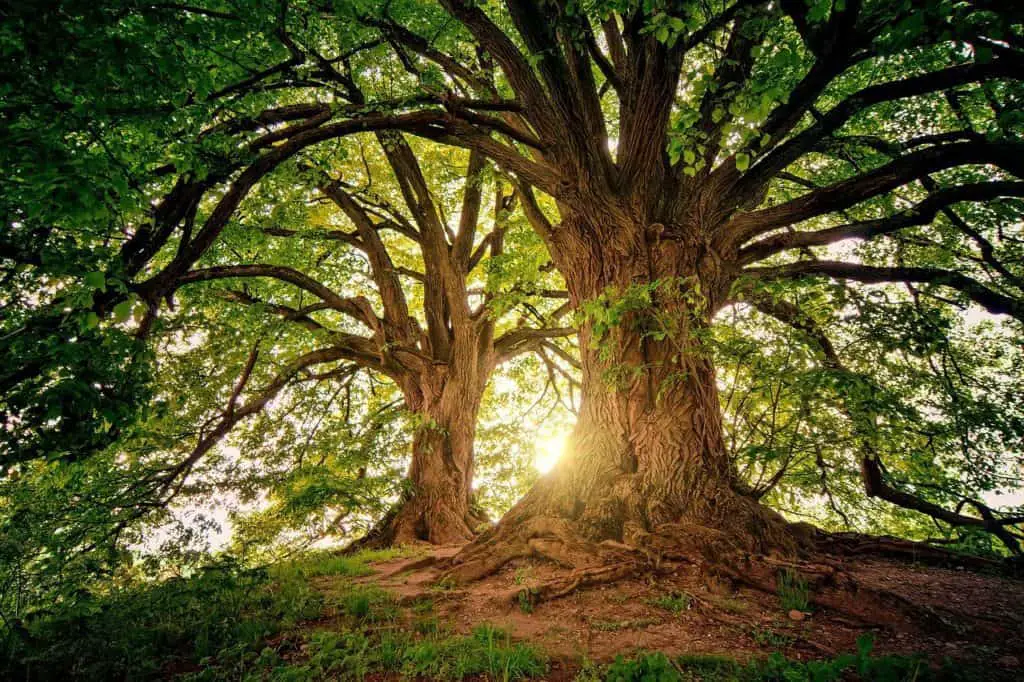
Most oak trees are deciduous and lose all their leaves in autumn, but two important exceptions shape how millions of US gardeners experience oak leaf drop.
Live oaks (Quercus virginiana, Quercus agrifolia) replace their leaves in late winter to early spring rather than autumn, remaining effectively evergreen through winter.
And many oaks, particularly young ones and white oak group species, display marcescence: the leaves die and turn brown but remain attached to the tree through winter, dropping only when spring growth pushes them off. Both behaviors are completely normal.
The genuinely serious concern is oak wilt, a vascular fungal disease that causes rapid browning from the top of the canopy downward and spreads through root grafts between neighboring trees as well as through beetle transmission; it requires immediate professional diagnosis.
I grew up with a large pin oak in the backyard that held its brown leaves all winter every year.
For years I assumed something was wrong with it, not understanding that marcescence in young oaks and lower branches is a normal and well-documented trait.
That tree is still there, healthy and producing acorns every other year, and it still holds its brown lower-branch leaves until spring.
Understanding what is normal in oak behavior removes a significant amount of anxiety from oak ownership, and knowing what the genuinely serious problems look like means you can act when it actually matters.
The Three Oak Leaf Behaviors: What Is Normal
Before getting into species and seasonal details, understanding the three distinct patterns of oak leaf behavior covers the vast majority of questions gardeners have about their trees.
| Behavior | Which Oaks | When It Happens | Normal or Problem? |
| Full deciduous leaf drop | Most oaks: red oak group (red, pin, black, scarlet), white oak group (white, bur, chestnut) | Autumn; October through December depending on species and region | Normal; healthy seasonal process |
| Marcescence (brown leaves held through winter) | White oak group especially; young trees of most species; lower branches of mature trees | Leaves brown in autumn but stay attached; fall when spring buds push them off | Normal; well-documented biological trait; not disease |
| Late winter or spring leaf replacement | Live oaks (Quercus virginiana, Q. agrifolia, Q. chrysolepis); other semi-evergreen oaks | Old leaves fall February through April as new leaves emerge simultaneously | Normal; these species are semi-evergreen, not fully deciduous |
| A note on “evergreen” oaks: Live oaks are often called evergreen, but this is technically imprecise. They do not hold their leaves indefinitely as a true evergreen like a pine does. They hold their leaves through winter and drop them all at once in late winter or early spring just as new growth emerges, creating a brief transition period where both old and new leaves are present simultaneously. The tree is never bare, which is why it appears evergreen, but the individual leaves are replaced annually. |
When Do Oak Trees Lose Their Leaves? Timing by Species and Region
The timing of oak leaf drop varies more than most tree guides acknowledge, with meaningful differences between species and significant regional variation driven by climate.
The table below covers the most common oak species in US landscapes.
| Species | Leaf Drop Period | USDA Zones | Regional Notes |
| Northern Red Oak (Quercus rubra) | October to November | 3 to 9 | One of the most reliable autumn colors; consistently drops by late November across most of its range; full drop earlier in zones 3 to 5 |
| Pin Oak (Quercus palustris) | October to December; brown leaves often held on lower branches through winter (marcescent) | 4 to 8 | Very common street and landscape tree; lower branches consistently marcescent; upper canopy drops cleanly in autumn |
| Black Oak (Quercus velutina) | October to November | 3 to 9 | Similar timing to red oak; vivid fall color; drops relatively cleanly without extensive marcescence |
| Scarlet Oak (Quercus coccinea) | October to November | 4 to 9 | Among the most vivid fall color in the genus; typically a complete drop by late November |
| White Oak (Quercus alba) | October to November; significant marcescence common | 3 to 9 | Often holds brown leaves on lower branches and young trees through winter; upper canopy drops in autumn |
| Bur Oak (Quercus macrocarpa) | October to November | 3 to 8 | Hardy into very cold zones; reliable autumn drop; moderate marcescence |
| Swamp White Oak (Quercus bicolor) | October to November | 4 to 8 | Peeling bark distinctive; clean autumn drop with less marcescence than white oak |
| Chestnut Oak (Quercus montana) | October to November | 3 to 9 | Large coarsely toothed leaves; clean autumn drop; attractive yellow-brown fall color |
| Southern Live Oak (Quercus virginiana) | Late February through April; old leaves dropped as new ones emerge | 7 to 10 | Never fully bare; constant leaf exchange means it appears evergreen year-round; mass leaf drop in March alarms owners who are unfamiliar with this pattern |
| Coastal Live Oak (Quercus agrifolia) | March through May | 9 to 11 | Similar pattern to Q. virginiana but timed slightly later; common throughout coastal California; characteristic appearance is thick canopy year-round |
| Canyon Live Oak (Quercus chrysolepis) | Spring leaf exchange; similar to other live oaks | 7 to 10 | Mountain and canyon live oak of California; semi-evergreen with spring leaf replacement |
| Willow Oak (Quercus phellos) | October to December | 5 to 9 | Unusual narrow willow-like leaves; clean autumn drop; little marcescence; leaves decompose faster than most oaks due to smaller size |
| How climate affects timing within a zone: Two white oaks in the same zone but in different microclimates can drop their leaves two to four weeks apart. A tree in a sheltered south-facing garden position in zone 6 may hold its leaves two to three weeks longer than the same species in an exposed north-facing hillside planting in the same zone. Altitude, urban heat island effects, and proximity to large water bodies all shift timing. The species ranges above are central estimates; expect real trees to vary from these by two to four weeks in either direction. |
Marcescence: Why Oaks Hold Brown Leaves Through Winter
Marcescence is one of the most misunderstood normal behaviors in oak trees.
Gardeners who encounter it for the first time almost universally assume their tree is diseased or dying. It is neither.
What Marcescence Is
Marcescence is the retention of dead or senesced plant organs, in this case leaves, beyond the point where they would normally be shed.
In deciduous trees, leaf drop is triggered by the formation of an abscission layer at the base of the leaf stem, a specialized zone of cells that gradually separates the leaf from the twig and seals the wound.
In marcescent species and individuals, this abscission layer forms incompletely or very slowly, so the dead leaf remains attached until mechanical forces (wind, rain, or the physical pressure of swelling spring buds) push it off.
The leaves are dead; they have no ongoing metabolic function for the tree. But they are physically held in place by the incomplete abscission process. They are not diseased, infected, or abnormal.
Why Oaks Do This: Competing Theories
Botanists have proposed several explanations for why marcescence exists and why it persists in oaks when most other deciduous trees have evolved complete autumn leaf drop.
The most credible current thinking involves several non-exclusive mechanisms:
- Deer and browsing deterrence: Retained dead leaves may deter deer from feeding on nutritious lower branches and buds in winter by making the browse unappealing. This is supported by the observation that marcescence is most pronounced on lower branches that are within browsing reach, while upper branches drop cleanly.
- Physical bud protection: Dead leaves may provide some insulation to developing buds on lower branches in late winter, where temperature fluctuations are more pronounced due to proximity to the cold ground.
- Evolutionary vestige in young trees: Young trees and lower branches, which are developmentally more juvenile, may not yet have fully developed the hormonal signaling that drives complete abscission in mature wood. As a tree ages, the marcescence on upper branches typically disappears while lower branch marcescence persists.
- Nutrient timing: Some researchers have proposed that retaining the leaf through winter and dropping it at the base of the tree in spring, when soil temperatures are rising and decomposition is active, delivers nutrients to the root zone at exactly the moment the tree can use them rather than losing them to leaching over the wet winter months.
Which Oaks Show Marcescence Most Prominently
- White oak group species: white oak, bur oak, chestnut oak, and swamp white oak consistently show marcescence, particularly on younger trees and lower branches
- Pin oak: one of the most consistently marcescent of the red oak group; lower branches reliably hold brown leaves all winter on even mature trees
- Young oaks of virtually any species: marcescence is much more pronounced in the first ten to fifteen years of a tree’s life regardless of species; a young red oak may show extensive marcescence that largely disappears as the tree matures
- Lower branches of mature trees: even species that drop their upper canopy cleanly often retain leaves on lower and inner branches where light is limited and growth is developmentally more juvenile
Marcescence vs Disease: How to Tell Them Apart
| Feature | Marcescence | Disease or Damage |
| Leaf color | Uniform tan, buff, or brown; consistent across the retained leaves | Irregular patchy brown or black; spots with distinct edges; often with yellow halos |
| Leaf texture | Dry, papery, and intact; crinkles when touched but does not crumble | Brittle and crumbling; or unusually soft and dark; mold may be visible |
| Timing | Leaves brown in autumn; retained through winter; fall in spring | Browning during the growing season; or sudden browning that does not follow the autumn pattern |
| Branch condition | Buds at branch tips are firm, plump, and healthy-looking | Buds shriveled, black, or absent; stem may show dieback or cankers |
| Distribution | Consistent pattern: lower branches and young trees most affected; upper canopy drops cleanly | Irregular distribution not following a lower-branch pattern; may start at top of canopy (oak wilt) or appear as patches throughout |
| Year to year | Same pattern every year; consistent and predictable | New or worsening pattern that differs from previous years |
Live Oaks: Why They Drop Leaves in Late Winter and Spring
Live oaks confuse gardeners who expect oaks to shed in autumn. A southern live oak (Quercus virginiana) or coastal live oak (Quercus agrifolia) in late March covered in falling brown leaves, while simultaneously producing a flush of bright new green growth, looks alarming to anyone expecting normal deciduous behavior.
It is not a sign of disease, stress, or damage. It is exactly what these trees do, every year.
The Live Oak Leaf Replacement Cycle
Live oaks are semi-evergreen: they hold their leaves through autumn and winter rather than dropping them in response to decreasing day length and temperature like fully deciduous oaks.
As spring approaches and day length increases, the tree simultaneously initiates new leaf production and drops the old leaves.
The result is a brief but often dramatic leaf fall in late winter or spring, usually accompanied by catkins and the flush of new growth.
Because the old leaves and new leaves overlap for several days to weeks, the tree is never fully bare.
This is why it appears evergreen even though the individual leaves are being replaced annually.
| Region | Old Leaf Drop Period | New Leaf Flush | Notes |
| Gulf Coast (TX, LA, MS, AL, FL panhandle) | Late February to mid-March | Early to mid-March | The most dramatic leaf drop of any US oak; can cover lawns in fallen leaves for weeks; normal and annual |
| Southeastern US (FL, GA, SC, NC coastal) | Early March to early April | Late March to mid-April | Similar pattern to Gulf Coast but slightly later; coastal areas lead inland areas by 1 to 2 weeks |
| Central Texas | February to March | Early to mid-March | Q. virginiana common as a street and landscape tree; annual leaf drop in late winter is a consistent expectation |
| Coastal California (Q. agrifolia) | March to May | April to May | Coastal live oak follows a similar pattern; timing varies significantly with local microclimate along the coast |
| Inland California (Q. agrifolia) | April to May | April to May | Warmer inland temperatures push the cycle slightly later; in some locations the overlap is longer and the leaf drop less dramatic |
| What to do when your live oak drops leaves in spring: Leave the fallen leaves in place as a mulch layer if the tree is healthy, or shred and spread them around the base. Do not prune the tree during or immediately after the leaf exchange; wait until the new foliage is fully established before doing any structural work. The leaf drop period is a moment of transition for the tree and additional stress from pruning at this time is unnecessary. |
Early Leaf Drop: Normal Adjustment vs Warning Signs
Not all early leaf drop in oaks is a problem, and distinguishing between the tree’s self-protective responses to stress and genuinely serious disease is one of the most important skills in oak care.
When Early Leaf Drop Is Normal
- Summer self-thinning in drought: In hot, dry summers, oaks naturally shed older inner leaves that receive less sunlight and are least efficient for photosynthesis. This reduces the tree’s water demand during drought and is a normal stress response. Scattered inner leaf drop during a heat wave is expected.
- Late spring catkin and pollen drop: Oak catkins (the long dangling male flowers) produce significant amounts of plant material that falls in spring; this is sometimes mistaken for early leaf drop. The yellow-green material on the ground beneath an oak in April or May is usually catkins and pollen, not leaves.
- Lower branch shedding on mature trees: As oaks mature, lower branches that become shaded by the expanding canopy above progressively die back and shed their leaves earlier than the rest of the tree. This is normal self-pruning and not a sign of disease.
Diagnostic Table: Early Leaf Drop Causes
| Symptom | Likely Cause | Urgency | Action |
| Scattered inner leaf yellowing and drop during hot or dry weather; upper canopy still full | Drought stress self-thinning | Low | Deep water weekly; 2 to 4 inch mulch layer kept away from trunk; no further action if canopy remains full |
| Brown spots with irregular edges along leaf veins; premature drop in wet spring weather | Anthracnose fungal disease | Low to moderate | Remove fallen leaves; improve air circulation around the canopy where possible; fungicide only if severe and recurring |
| Raised blister-like patches on leaves turning brown; leaf distortion | Oak leaf blister (Taphrina caerulescens) | Low | Cosmetic in most years; rake and dispose of fallen leaves to reduce spore load; rarely requires treatment |
| Rapid browning starting at leaf tips and moving down, beginning in the upper canopy and progressing downward; may affect single branches first | Oak wilt (Bretziella fagacearum) | Critical | Contact a certified arborist immediately; do not prune; see dedicated oak wilt section below |
| Chewed leaf edges; whole leaves missing; bare branches, especially in spring | Caterpillar defoliation (oak leafroller, tent caterpillar, gypsy moth/spongy moth) | Moderate | Established trees recover from a single defoliation event; if repeated in consecutive years, consult an arborist; Bacillus thuringiensis (Bt) spray for caterpillars before defoliation is complete |
| Yellow leaves, honeydew and sticky residue on leaves and surfaces below, ants present | Scale insects or aphids | Moderate | Horticultural oil applied to the canopy in early spring or summer; beneficial insects (parasitic wasps, ladybugs) provide long-term biological control |
| Entire canopy thinning progressively over several years; no obvious disease signs; near construction | Root damage from soil compaction or grade change | Moderate to high | Consult a certified arborist for soil aeration and root zone assessment; avoid equipment within the drip line of any oak |
Oak Wilt: The Serious Disease All Oak Owners Should Know
Oak wilt, caused by the fungus Bretziella fagacearum (formerly Ceratocystis fagacearum), is the most serious disease affecting oak trees in the US and is a genuine emergency when suspected.
It is fatal to red oaks within weeks to months of infection and can kill white oaks over a period of one to several years.
Understanding how it spreads is important because the most common transmission route is not what most gardeners expect.
How Oak Wilt Spreads: Two Routes
Route 1: Root grafts (the primary spread mechanism in established stands). Oak trees whose roots overlap can share water and nutrients through natural root grafts.
When one tree becomes infected with oak wilt, the fungus moves through these root connections to neighboring trees.
This is why oak wilt typically spreads in expanding circles or chains through a grove rather than appearing randomly.
A single infected tree can pass the disease to all neighboring trees within root graft distance, typically 50 to 100 feet, without any above-ground transmission.
Route 2: Sap beetle (picnic beetle) transmission. Oak wilt produces fungal mats under the bark of infected red oaks that emit a sweet, fruity odor attracting sap beetles.
These beetles carry spores on their bodies and can introduce the disease into fresh wounds on healthy trees.
This is why the critical rule is: do not prune oaks during the beetle flight period (generally April through July in the upper Midwest; timing varies by region) and never leave fresh pruning wounds unsealed with pruning paint during this period.
| Do not prune oaks between April and July: In regions where oak wilt is present (primarily the upper Midwest, Texas, and parts of the Southeast), pruning oaks during the primary beetle flight season creates an entry point for the disease. If pruning during this period is unavoidable due to storm damage, seal all wounds immediately with pruning sealant. In the dormant season (November through March) the risk is significantly lower but pruning paint is still recommended for large wounds as a precaution. |
Symptoms of Oak Wilt
| Feature | Red Oaks (Q. rubra, Q. palustris, Q. velutina) | White Oaks (Q. alba, Q. macrocarpa) |
| Symptom progression | Rapid; browning starts at leaf tips and margins, progresses to entire leaf, then branch, then tree; entire tree can be killed within 4 to 6 weeks | Slower; individual branches wilt and die over weeks to months; tree may survive for several years but progressively declines |
| Pattern | Often starts in one or a few upper branches; spreads through canopy; leaves fall while still partly green | Branch by branch dieback; sporadic across canopy; slower and less dramatic than red oak infection |
| Season of visible symptoms | Most dramatic in spring and early summer; can occur any time | Similar seasonal timing; browning may be confused with summer drought stress |
| What to do | Call a certified arborist immediately; do not attempt to treat or prune without professional guidance; trenching to sever root grafts may save neighboring trees | Contact an arborist; treatment options exist but are more complex; early diagnosis improves prognosis |
| Oak wilt distribution in the US: Oak wilt is established throughout the upper Midwest (Minnesota, Wisconsin, Michigan, Iowa, Illinois, Indiana, Ohio), Texas, and parts of the South and Mid-Atlantic. It has been spreading and gardeners in the Great Plains, Pacific Northwest, and West Coast should be aware that their region may be affected. Contact your state extension service for current distribution maps and local guidance. The USDA Forest Service and state forestry agencies maintain updated maps. |
Other Diseases and Pests Causing Leaf Drop
Anthracnose
Anthracnose in oaks is caused by several fungal species (primarily Apiognomonia quercina and related pathogens) and produces brown blotches along leaf veins, distorted or dead patches on leaves, and premature leaf drop.
It is most severe in cool, wet spring weather when spores spread readily through rain splash.
A severe anthracnose infection can defoliate portions of the canopy, which is alarming but rarely fatal to an established oak.
Healthy oaks typically re-foliate after anthracnose defoliation within the same season, which is the key difference from oak wilt where defoliation is permanent and the tree continues to decline.
Management focuses on removing fallen leaves to reduce the overwintering spore population, and improving air circulation around the canopy if possible.
Fungicide treatment is rarely justified in established trees.
Hypoxylon Canker
Hypoxylon canker, caused by Hypoxylon atropunctatum and related species, is a secondary pathogen that colonizes stressed and declining oaks. I
t appears as silvery-grey to dark brown to black crusty patches on bark where the outer bark has sloughed off, revealing a powdery mass of fungal spores beneath.
It is not the primary cause of decline; rather it establishes on trees that are already weakened by drought, root damage, or other stress.
Improving tree vigor through proper care is the most effective response; the canker cannot be chemically treated.
Major Pests Causing Leaf Drop
| Pest | Signs | Timing | Response |
| Spongy moth (Lymantria dispar; formerly gypsy moth) | Egg masses on bark through winter; caterpillars consuming leaves from late April onward; complete defoliation possible in outbreak years | Late April through June for caterpillar feeding | Bt spray is most effective before caterpillars reach 1 inch in length; scrape and destroy egg masses in winter; established oaks typically survive one defoliation; two consecutive years of defoliation may kill weakened trees |
| Oak leafroller (Archips semiferanus) | Leaves rolled and tied with silk in spring; brown caterpillars inside | May to June | Bt spray; most years cosmetic only; established trees recover |
| Scale insects (various) | Waxy or cottony bumps on bark and twigs; sticky honeydew; sooty mold on leaves and surfaces below | Year-round; most damaging in summer | Horticultural oil applied in late winter targets overwintering scales; systemic insecticide for severe infestations |
| Leaf miners (various species) | Winding pale tunnels visible within leaf tissue; affected leaves may turn brown and drop | Spring and summer | Cosmetic in most years; Bt spray effective for young larvae; beneficial insects provide long-term control |
| Two-lined chestnut borer (Agrilus bilineatus) | D-shaped exit holes in bark; galleries under bark; branch dieback progressing downward; most damaging on stress-weakened trees | Adults emerge May to June | Prevention through maintaining tree vigor is most effective; stressed trees are primary targets; no effective chemical treatment once established; consult arborist for severely infested trees |
White Oaks vs Red Oaks: Key Differences in Leaf Behavior
The two major oak groups in eastern North America differ in ways that affect how gardeners interpret normal leaf behavior.
| Feature | White Oak Group (Q. alba, Q. macrocarpa, Q. bicolor, Q. montana) | Red Oak Group (Q. rubra, Q. palustris, Q. velutina, Q. coccinea) |
| Leaf tip shape | Rounded lobes; no bristle tips on leaf points | Pointed lobes with a bristle tip at each point; the most reliable field identification feature |
| Typical leaf drop timing | Mid to late autumn; October through November | Late autumn; November through December; slightly later than white oaks |
| Marcescence | Common; especially in young trees and on lower branches of mature trees; white oak and bur oak particularly prone | Less common overall; pin oak (Q. palustris) is a notable exception with consistently marcescent lower branches; other red oaks typically drop more cleanly |
| Fall color | Variable; often muted red, purple, or brown tones | Often vivid bright red to scarlet; red oak, scarlet oak, and black oak produce some of the most intense fall colors of any temperate tree |
| Acorn maturation | Acorns mature in a single growing season; produced and dropped in the same autumn | Acorns require two growing seasons to mature; acorns present on the tree through winter mature and drop the following autumn |
| Oak wilt susceptibility | More resistant; infection progresses slowly over years rather than weeks | Highly susceptible; infection can kill within 4 to 6 weeks; the most urgent cases of oak wilt are almost always in the red oak group |
| Bark appearance | Light grey to whitish; relatively pale | Dark grey to nearly black; rougher and darker than white oaks at comparable age |
| The two-year acorn cycle: Red oak acorns visible on the tree in autumn were formed the previous spring and are in their second year of development. White oak acorns mature and fall in a single season. This means a red oak in a poor mast year may still have small developing acorns from this year’s crop while last year’s mature acorns fall. Understanding this prevents confusion about why some acorns are large and others tiny on the same tree in autumn. |
Oak Tree Dropping Leaves in Summer: Causes and Responses
Summer leaf drop is the pattern that most consistently alarms gardeners, partly because oaks are expected to be in full leaf through summer and partly because summer drop can signal serious problems alongside normal stress responses.
| Cause | What It Looks Like | Season | How to Respond |
| Drought stress self-thinning | Inner and lower leaves turn yellow and drop; upper and outer canopy remains full; leaves dry and crispy | Mid to late summer in dry years | Deep watering (long slow soak to 18 to 24 inch depth rather than frequent shallow watering); 3 to 4 inch mulch ring from outside drip line to 3 feet from trunk; do not fertilize during drought |
| Anthracnose (post-infection) | Already infected leaves drop prematurely; new growth may emerge to replace; overall canopy looks thinner than usual | Late spring through early summer, following a wet spring | No immediate treatment needed in most cases; tree will typically re-foliate; remove fallen leaves |
| Oak wilt | Rapid browning from leaf tips inward, often starting in upper canopy; dead leaves may remain attached initially then fall; continues until branch or tree dies | Spring through summer; most rapid in red oaks | Certified arborist consultation immediately; do not prune; assess neighboring oaks for root graft connections |
| Construction damage / soil compaction | Gradual canopy thinning over 2 to 5 years following construction; no obvious disease symptoms; decline progresses from branch tips inward | Growing season; slow and progressive | Consult arborist; soil aeration (vertical mulching) within drip line; avoid any further soil disturbance; may take years to determine outcome |
| Caterpillar defoliation | Leaves eaten, not dropping; bare branches; frass (caterpillar droppings) visible; caterpillars visible with inspection | Late spring to early summer | Established trees survive a single defoliation; Bt spray if population is high and tree has been defoliated in previous years; trees typically re-leaf within the same season |
| The 50% rule for oak defoliation: When 50% or more of the canopy has dropped leaves and the cause is unknown or potentially disease-related, consult a certified arborist before taking any action. Pruning, fertilizing, or watering adjustments made without proper diagnosis can delay or complicate the identification of serious diseases like oak wilt. Call an arborist as a first step rather than a last resort. |
What to Do With Fallen Oak Leaves: Mulch, Compost, or Remove?
Oak leaves are one of the most abundant and useful forms of organic matter a garden can receive, but they have specific properties that affect how best to use them.
Oak Leaf Properties Worth Knowing
- High tannin content: Oak leaves contain significant amounts of tannins, which are mildly acidic and can inhibit decomposition and the germination of some seeds if used as a thick mulch. Shredding breaks down the tannin structure and dramatically speeds up decomposition.
- Slow decomposition: Whole oak leaves, particularly from species with thick, waxy leaves, decompose slowly. A thick mat of unshredded oak leaves on a lawn can block light and trap moisture for months, causing lawn damage. Shredded leaves decompose far faster and provide more immediate soil benefit.
- pH effect: Fresh oak leaves are mildly acidic. When used repeatedly as mulch around acid-loving plants (blueberries, rhododendrons, azaleas, camellias) they provide a slight acidifying effect. This is beneficial for these plants but should not be used in large quantities around plants that prefer neutral to alkaline soil.
- Wildlife value: Whole leaf litter is habitat for hundreds of species of insects, spiders, and their predators. A complete lawn cleanup that removes all leaf material also removes the habitat of many beneficial insects. Leaving leaf litter in non-lawn areas, under shrubs, and at the edge of beds provides significant wildlife benefit.
| Use | Method | Best For | Cautions |
| Shredded leaf mulch | Mow over leaves or use a shredder; apply 2 to 3 inches around trees, shrubs, and perennial beds; keep away from stems and trunks | Moisture retention; weed suppression; soil structure improvement; the single best use for most oak leaves | Do not pile against trunk or stems; apply no more than 3 to 4 inches to avoid anaerobic conditions; avoid using thick layers from diseased trees without shredding and composting first |
| Lawn mulching | Run a mulching mower over leaves when they cover less than 50% of the grass surface; the chopped material feeds the lawn directly | Feeding established lawns without raking; most efficient use of light to moderate leaf fall on grass | If leaves form a thick mat (more than 50% coverage) the turf needs protection; shred first or remove excess; do not mulch-mow when leaves are wet |
| Compost | Add shredded leaves as carbon-rich brown material to a compost heap; layer with nitrogen-rich green material (grass clippings, kitchen waste) at roughly 3:1 ratio by volume | Creating finished compost for garden beds; the most nutrient-dense use but requires the most time | Whole oak leaves compost slowly; shred before adding; the heap needs to reach active temperatures to break down tannins; expect 6 to 12 months for finished compost from shredded oak leaves |
| Leaf mold | Stack shredded or whole leaves in a wire cage or corner; keep moist; leave for 12 to 24 months | Soil conditioner; moisture retention amendment; the best possible material for improving heavy clay or sandy soils; almost no additional inputs required | The simplest possible method but requires patience; whole leaves take 18 to 24 months; shredded leaves 9 to 12 months; the finished product is one of the best soil amendments available |
| Remove if diseased | Bag and dispose of leaves from trees with confirmed anthracnose, oak leaf blister, or other fungal diseases | Reducing overwintering spore population; important if the tree showed severe infection in the current season | Do not compost diseased leaves in a home compost heap; the temperatures generated may not be sufficient to kill all pathogens; dispose with yard waste or municipal composting |
Frequently Asked Questions
My oak still has all its leaves in December. Is something wrong?
Probably not. Late leaf retention is common in white oaks, bur oaks, and young pin oaks, and is related to marcescence.
In mild autumns across much of the South and Mid-Atlantic, even fully deciduous red oaks may hold their leaves into December.
If the leaves are brown, dry, and papery (dead but attached), this is marcescence.
If the leaves are still green or half-green in December in a northern climate that has already had several hard frosts, this is unusual and worth monitoring into the following spring; it may indicate an unusually warm microclimate or, rarely, a disease affecting the abscission process.
Why does my live oak drop so many leaves all at once in March?
This is the normal annual leaf replacement event for Quercus virginiana and Quercus agrifolia.
These semi-evergreen oaks hold their leaves through winter and then replace the entire leaf cohort simultaneously in late winter or early spring as new growth flushes out.
The volume of falling leaves in a single week can be surprising and covers lawns and pathways comprehensively.
It is not a sign of stress or disease. Rake or mulch the fallen leaves as you would any autumn leaf drop.
Should I paint or seal oak pruning wounds?
In regions where oak wilt is present, yes. Pruning wounds on oaks provide an entry point for sap beetles that carry oak wilt spores.
In the upper Midwest and Texas in particular, the standard recommendation from extension services and arborists is to seal all oak pruning wounds with pruning paint or shellac immediately after cutting, particularly between April and July when beetle activity is highest.
Outside oak wilt zones, wound sealing is generally not recommended by modern arboricultural practice (wounds heal better unsealed in most other tree species) but remains specifically warranted for oaks in wilt-affected areas.
Can an oak tree recover from defoliation by caterpillars?
Yes. A single complete defoliation event in a healthy established oak is almost never fatal.
Oaks have a well-documented ability to produce a second flush of leaves within the same season after defoliation, often called Lammas growth.
The tree is stressed and somewhat weakened for the season, but recovers its full canopy and typically shows no long-term effects.
Repeated defoliation in two or more consecutive years is more serious and can kill trees that are already under other stresses.
If your oak has been defoliated two years running, consult an arborist about treatment options before the third year.
Are oak leaves bad for the garden?
No, but they need to be managed rather than left as whole thick mats. Unshredded oak leaves in heavy layers block light, trap moisture, and can smother grass and low plants.
Shredded, they are among the best garden mulch and soil amendment materials available: high in carbon, slow to break down, habitat-forming for beneficial insects, and mildly acidifying which benefits a wide range of garden plants.
Run over them with a mulching mower on the lawn, use a shredder for bed and border applications, and pile the rest to make leaf mold.
None of this requires significant effort and the benefit to soil structure is substantial over several years of consistent application.
What is the difference between oak wilt and anthracnose?
Oak wilt and anthracnose both cause leaf browning and drop but differ critically in urgency, spread, and prognosis.
Anthracnose causes brown patches along leaf veins, primarily in cool wet spring weather, and the tree typically re-foliates in the same season with no long-term decline.
It is caused by several fungal pathogens and spreads through rain splash; it is not transmitted between trees except through spores in fallen leaves.
Oak wilt, by contrast, is a vascular disease that blocks the tree’s water-conducting tissues. In red oaks it kills the entire tree within weeks to months.
It spreads through root grafts to neighboring trees regardless of whether they are pruned or damaged.
The key visual distinction is the pattern of browning: anthracnose produces patchy brown areas on individual leaves with the tree otherwise intact; oak wilt produces a rapid wilting and browning that progresses from tips inward across entire branches, starting in the upper canopy and moving down.
If you suspect oak wilt, do not prune the tree and contact a certified arborist immediately.
Oak Care Calendar: Seasonal Tasks
| Season | Normal Oak Behavior | Care Tasks | What to Watch For |
| Winter (Dec to Feb) | Deciduous oaks bare; white oaks and young trees may retain marcescent brown leaves; live oaks holding leaves as new growth prepares | Avoid pruning in oak wilt zones (wait for dormant season pruning to November through March); check for scale insects on bark; plan mulching | Unusual bark lesions; dead branch tips on young trees that were fine last season; white powdery patches on bark (Hypoxylon canker) |
| Early Spring (Mar to Apr) | Bud swell and leaf emergence; live oaks dropping old leaves and flushing new ones; catkins producing pollen; marcescent leaves falling | Mulch ring maintenance; prune only in dormant season (stop by April 1 in oak wilt zones); rake and compost or shred leaf drop under live oaks | Caterpillar egg masses on bark; early signs of anthracnose on emerging leaves in wet weather; any unusual wilting on red oaks should be assessed promptly |
| Late Spring (Apr to Jun) | Full leaf expansion; acorn development beginning; most active growth period | Avoid all pruning in oak wilt zones from April through July; if storm damage requires cutting, seal wounds immediately with pruning paint | Caterpillar defoliation; early oak wilt symptoms in red oaks; leaf miner damage on leaves; scale insect activity |
| Summer (Jun to Aug) | Full canopy; acorn development; heat-related self-thinning of inner leaves in drought years | Deep watering during drought (slow soak to 24 inch depth); maintain mulch ring; do not fertilize during drought | Summer leaf drop beyond normal inner self-thinning; rapid upper canopy browning (oak wilt emergency); two-lined chestnut borer activity in stressed trees |
| Autumn (Sep to Nov) | Autumn color development; leaf drop in deciduous species; acorn drop (white oaks: current year acorns; red oaks: prior year acorns) | Shred or mulch fallen leaves; rake from lawn if thick mat forming; leave undisturbed in non-lawn areas for wildlife; resume pruning after leaf drop | Extent of leaf drop: complete canopy loss before October in a deciduous oak in zones 5 to 7 is early and worth noting |
Final Thoughts
Oak trees are among the most resilient, long-lived, and ecologically valuable trees in the North American landscape.
A mature oak supports hundreds of species of insects, birds, and mammals that depend directly on its leaves, acorns, and bark structure for food, shelter, and reproduction.
Understanding their natural behavior, including the sometimes confusing patterns of marcescence, live oak spring leaf drop, and the genuine diversity of timing across species and regions, makes oak ownership both more confident and more rewarding.
The single most important piece of practical knowledge for any oak owner is to recognize the signs of oak wilt and to understand that the tree should not be pruned between April and July in affected regions.
Every other oak care question has a more considered answer and more time to act. Oak wilt in a red oak does not.
Early identification and immediate professional consultation is the difference between losing one tree and potentially losing a grove.
For everything else, oaks ask for remarkably little. Good soil drainage, protection from construction damage near their roots, freedom from unnecessary pruning, and a ring of shredded leaf mulch around the base are the sum total of what an established oak needs from its owner.
Given these things, an oak planted today may still be shading the same ground in three hundred years.
| What to do right now: Walk around your oak and look at three things: the pattern of any brown or fallen leaves (marcescent lower branches or patchy upper canopy browning are very different situations); the soil within the drip line for signs of compaction or construction disturbance; and the bark for any unusual patches, D-shaped holes, or lesions. Those three observations in five minutes give you the information you need to decide whether to wait and monitor or contact an arborist. |
Mariel is a plant enthusiast and writer based in the UK with a passion for houseplants and indoor growing.
She has spent the last few years building an ever-growing collection of indoor plants and learning the hard way which ones will survive her busy schedule.
At Bean Growing she writes about houseplant care, common plant problems, and outdoor gardening.