
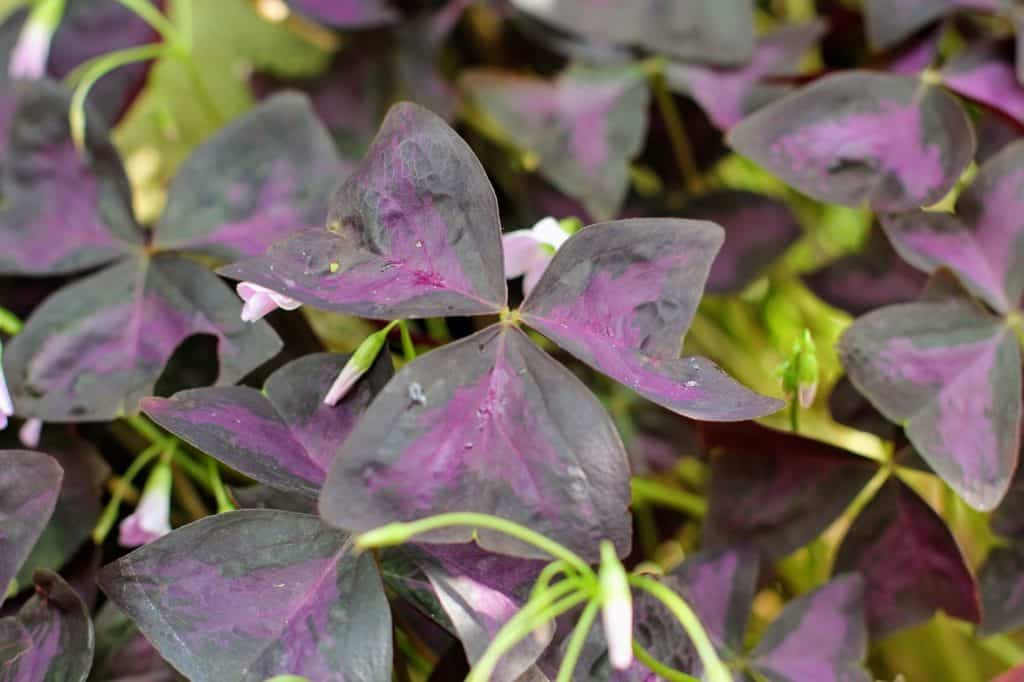
Purple shamrock (Oxalis triangularis) grows from small corms, commonly sold as bulbs, you should plant them pointed-side up at 1 to 1.5 inches deep in well-draining potting mix.
Plant indoors at any time of year; outdoors after the last frost in USDA zones 8 to 11. Shoots emerge in 2 to 4 weeks.
The most important requirement before planting is drainage: these corms rot quickly in waterlogged soil.
Important safety note: all parts of this plant are toxic to cats and dogs and should be kept out of reach of pets.
Oxalis triangularis is one of those plants that rewards you immediately and keeps surprising you.
The deep purple, butterfly-shaped leaves move throughout the day, opening wide in bright light and folding inward at night in a behavior called nyctinasty.
Small pink or white flowers emerge on slender stems above the foliage in spring and often again in fall.
It grows from tiny corms that look more like shrimp than anything you would recognize as a bulb, and a pot full of them can go from bare soil to a dense, dramatic purple display in under a month.
This guide covers everything from identifying your corms correctly before you plant to keeping the plant thriving through its dormancy cycle.
| Toxicity warning for pet owners: Oxalis triangularis contains soluble calcium oxalates throughout all parts of the plant, including leaves, flowers, stems, and corms. The Pet Poison Helpline classifies this plant as toxic to cats and dogs. When ingested, soluble oxalates bind with the body’s calcium, causing hypocalcemia and potential kidney damage. Symptoms include drooling, vomiting, diarrhea, lethargy, and in severe cases changes in urination indicating kidney involvement. The plant is bitter-tasting, which discourages large-quantity ingestion, but any suspected ingestion by a pet should prompt an immediate call to your veterinarian or the Pet Poison Helpline (855-764-7661). Keep this plant out of reach of cats and dogs. It is also toxic to humans in large quantities. |
What Is Purple Shamrock? Key Facts Before You Plant
Oxalis triangularis is a perennial plant native to Brazil and parts of southern South America, belonging to the Oxalidaceae (wood sorrel) family.
It is commonly called false shamrock, purple shamrock, or love plant.
Despite being sold under shamrock-related names and marketed around St. Patrick’s Day, it has no botanical relationship to true shamrocks (Trifolium species), which are native to Ireland and much smaller in scale.
The plant grows from small corms, not true bulbs. A corm is a solid, starchy storage organ (similar to a crocus or gladiolus corm) rather than a layered structure like a tulip or onion bulb.
The distinction matters for planting: corms have a defined top (the slightly pointed or domed end) and a flat base, and the planting depth and orientation rules that apply to true bulbs also apply here.
| Feature | Detail |
| Scientific name | Oxalis triangularis |
| Common names | Purple shamrock, false shamrock, love plant, black oxalis, wood sorrel |
| Native range | Brazil, Bolivia, Argentina, Paraguay |
| Plant type | Rhizomatous herbaceous perennial; grows from corms |
| Mature size | 8 to 12 inches tall and wide |
| USDA hardiness (outdoor) | Zones 8 to 11; grown as a houseplant or annual in cooler zones |
| Leaf color | Deep purple to near-black; some cultivars have a darker central triangle pattern |
| Flowers | Small pink or white five-petalled blooms on slender stems above the foliage |
| Light behavior | Leaves and flowers open in bright light and fold inward at night (nyctinasty) |
| Toxicity | Toxic to cats, dogs, and humans in large quantities; contains soluble calcium oxalates |
| RHS Award | Oxalis triangularis subsp. papilionacea holds the Royal Horticultural Society Award of Garden Merit |
| Nyctinasty: why the leaves move: The opening and closing of Oxalis triangularis leaves in response to light levels is called nyctinasty. This movement is not caused by growth but by changes in turgor pressure in cells at the base of each leaflet. When light levels rise, cells inflate and the leaflets open; when light drops in the evening, cells deflate and the leaflets fold downward. This is a natural biological process and not a sign of stress. Leaves also fold when the plant is disturbed or touched, and in harsh direct sunlight, which is a sign to move the plant to a slightly less intense position. |
Cultivars and Varieties
Oxalis triangularis has two main subspecies commonly sold in the US market, plus a small number of named cultivars. All share the same basic care requirements.
| Cultivar or Subspecies | Leaf Description | Notes |
| O. triangularis subsp. papilionacea (most common) | Deep purple to maroon leaves with a darker triangular center marking; leaves strongly resemble butterfly wings | The most widely sold form in the US; RHS Award of Garden Merit winner; the standard purple shamrock seen in most nurseries and garden centers |
| O. triangularis subsp. triangularis | Lighter green leaves with purple undersides or lighter coloring | Less commonly sold; sometimes labeled simply as Oxalis triangularis without distinguishing the subspecies |
| O. triangularis ‘Mijke’ | Compact form with rich purple foliage | Occasionally available from specialty bulb suppliers; same care as the standard form |
| O. triangularis (green-leafed forms) | Bright green trifoliate leaves; white or pale pink flowers | Sold less frequently as a houseplant; sometimes offered in mixed corm packs alongside the purple form; same care requirements |
When to Plant: Timing for Indoors and Outdoors
| Setting | Best Planting Time | Reason | Notes |
| Indoors as a houseplant | Any time of year | Oxalis triangularis is grown as a year-round houseplant and the corms will sprout regardless of the season when kept at room temperature with adequate light | Spring and fall plantings typically produce the most vigorous initial growth because temperatures and light levels are near the plant’s optimum range; summer plantings in hot climates may trigger a dormancy period sooner than expected if temperatures regularly exceed 80 degrees F |
| Outdoors in zones 8 to 11 (permanent) | Spring, after soil warms to at least 60 degrees F | Corms planted in cold wet soil rot before they can sprout | Wait until after the last average frost date for your area; in zones 10 and 11 fall planting is also successful |
| Outdoors in zones 3 to 7 (summer annual or container) | After last frost; typically late April to early June depending on location | Treat as a tender annual or summer container plant; bring indoors before the first fall frost | Dig corms in fall before the first frost and store in a cool dry location for replanting the following spring; or grow in containers that can be moved indoors |
| Forcing for a specific date (gifts, holidays) | Plant 4 to 6 weeks before desired display date | Shoots emerge in 2 to 4 weeks; a full, lush display takes 4 to 6 weeks from planting | Oxalis is frequently sold for St. Patrick’s Day; plant in late January or early February for a mid-March display |
Choosing and Identifying Your Corms
Purple shamrock corms are sold online and in garden centers, often in small plastic bags or boxes labeled as bulbs.
They are small, typically 0.5 to 1 inch long, and look remarkably unlike a conventional bulb.
New owners frequently mistake them for debris, seeds, or damaged material when they first open the package.
What Healthy Corms Look Like
Healthy corms are firm to the touch, either cylindrical or slightly irregular in shape, with a papery or fibrous outer skin.
They are sometimes described as resembling small shrimp, small pine cones, or irregular pebbles.
Color ranges from pale tan to mid-brown. A small pointed tip or slight dome at one end marks the top; the base is flatter and may show tiny root nubs.
| Feature | Healthy Corm | Reject This Corm |
| Texture | Firm; does not compress when squeezed | Soft, squishy, or hollow-feeling; indicates rot |
| Appearance | Tan to mid-brown papery skin; intact surface | Visible mold (white, grey, or black fuzzy growth); discard |
| Smell | Neutral to faintly earthy | Sour, musty, or strongly unpleasant; indicates internal rot |
| Size | Typically 0.5 to 1 inch; small is normal | Shriveled and desiccated; may still sprout but will produce a weaker plant |
| Top end | Slightly pointed, domed, or dimpled; this is where shoots emerge | If genuinely unsure which end is up, plant sideways; the corm will self-correct |
| If you cannot identify the top: Plant the corm on its side at the correct 1 to 1.5 inch depth. Oxalis triangularis corms will orient themselves and send shoots upward regardless of planting orientation, though correct pointed-end-up planting produces faster and more uniform emergence. Planting sideways adds approximately 1 to 2 weeks to the emergence time but does not damage the corm. |
Soil, Container, and Site Preparation
Potting Mix for Containers
Use a lightweight, well-draining potting mix.
A standard all-purpose potting mix amended with 20 to 30% perlite is the most reliable combination: the potting mix retains enough moisture to support active growth while the perlite ensures excess water drains quickly rather than sitting around the corms.
Pure potting mix without amendment is often too water-retentive and increases corm rot risk.
Do not use garden soil in containers: it compacts, drains poorly, and may introduce pests or pathogens.
| Soil Component | Proportion | Purpose |
| All-purpose potting mix | 70 to 75% | Provides structure, nutrient-holding capacity, and baseline moisture retention |
| Perlite | 20 to 25% | Improves drainage and aeration; prevents soil compaction; reduces rot risk significantly |
| Optional: coarse horticultural sand | Up to 10% | Additional drainage in very humid indoor environments or if using a particularly dense potting mix |
| Optional: slow-release granular fertilizer | Per label instructions | Incorporated at planting provides feeding for the first 2 to 3 months without the risk of liquid fertilizer over-application onto fresh corms |
Container Selection
The single most important container requirement is drainage holes.
Corms sitting in water rot within days. Every container used for Oxalis triangularis must have at least one drainage hole, and the saucer should be emptied within 20 to 30 minutes of watering.
| Container Type | Suitability | Notes |
| Standard plastic nursery pot with drainage holes | Excellent | Lightweight; drains well; the least visually appealing but functionally best; easy to check root health by squeezing the pot sides |
| Terracotta pot with drainage holes | Excellent | Porous walls wick moisture from the soil, reducing overwatering risk; heavier than plastic; ideal for growers who tend to water too frequently |
| Decorative ceramic or glazed pot with drainage holes | Good | Suitable if drainage holes are present; avoid if drainage holes are absent or very small |
| Hanging basket with coco liner | Good for visual display | Dries faster than solid containers; check moisture every 3 to 4 days in summer; the trailing foliage and flowers drape attractively over the edges |
| Any container without drainage holes | Not suitable | Regardless of how carefully you water, water will eventually accumulate at the base and rot the corms; do not use |
| Pot size and blooming: Oxalis triangularis blooms better when slightly root-bound. Use a pot that is just large enough to accommodate the corms with 1 to 2 inches of space on each side. An oversized pot retains excess moisture and may delay flowering. A 4 to 6 inch pot typically accommodates 5 to 8 corms for a full, lush display. A 6 to 8 inch pot accommodates 10 to 15 corms. |
Outdoor Garden Bed Preparation
For outdoor planting in zones 8 to 11, choose a site with well-draining soil and partial shade or dappled light.
Full afternoon sun in hot summer climates will stress or burn the leaves.
Amend heavy clay soil with compost and coarse grit to improve drainage before planting. Sandy soils benefit from the addition of compost to improve moisture retention.
How to Plant Purple Shamrock Corms: Step by Step
- Fill your container to approximately three-quarters full with the potting mix. This leaves room for the corms and the covering layer of soil, plus approximately 0.5 inch of space below the rim to prevent water running straight off the surface when watering
- Settle the soil by watering lightly and allowing excess to drain before placing the corms. Planting into pre-moistened soil is better than watering heavily after planting, which can shift the corms out of position or bury them too deep
- Place corms on the soil surface with the pointed end facing up. Space them 2 to 3 inches apart for a dense, full display. For outdoor planting, space 3 to 4 inches apart to allow for the wider spread of outdoor-grown plants
- Cover with 1 to 1.5 inches of potting mix. This is the correct depth for both indoor container and outdoor garden planting. Planting deeper than 2 inches slows emergence significantly; shallower than 0.75 inch leaves corms vulnerable to drying out
- Firm the soil very gently over the corms. Do not compress or compact the mix; the goal is just to eliminate large air pockets immediately beneath the corm
- Water gently with room-temperature water until water drains from the drainage hole. Allow to drain completely. Do not water again until the top inch of the potting mix is dry
- Place in a bright, indirectly lit position. Warmth accelerates sprouting: a temperature of 65 to 75 degrees F is ideal for the initial sprouting phase
- Expect the first shoots within 2 to 4 weeks. A full, lush display with multiple leaves per stem typically takes 4 to 6 weeks from planting
| Do not overwater before shoots emerge: The most common cause of corm failure is overwatering before sprouting. The corms need moisture to initiate root growth but will rot if the soil stays wet. After the initial settling water, do not water again until the top inch of the potting mix is dry. Check with a finger rather than on a schedule. In a correctly sized pot with good drainage mix, this typically means watering every 4 to 7 days before shoots emerge, reducing to every 5 to 10 days during active growth depending on pot size, season, and room conditions. |
Complete Care Reference
| Care Element | Requirement | Details |
| Light | Bright indirect light; 4 to 6 hours daily | East-facing windows are ideal indoors; west or south windows with a sheer curtain are suitable; avoid harsh direct afternoon sun which causes the leaves to fold and can scorch; outdoors, morning sun with afternoon shade is optimal |
| Watering | When top inch of potting mix is dry | Water thoroughly until it drains freely from the drainage hole; never allow to sit in standing water; reduce to every 2 to 3 weeks during dormancy; always use room-temperature water as cold water can spot or shock the leaves |
| Soil | Well-draining potting mix with 20 to 30% perlite | Do not use garden soil in containers; do not use heavy moisture-retaining mixes designed for tropical plants |
| Temperature | 60 to 75 degrees F (15 to 24 degrees C) preferred | Tolerates down to 50 degrees F short-term; temperatures above 80 degrees F for extended periods trigger early dormancy; protect from cold draughts and heating vents |
| Humidity | 40 to 60%; moderate indoor humidity is adequate | No misting required; standard indoor humidity in most US homes is sufficient; very dry forced-air heating environments may benefit from a pebble tray |
| Fertilizer | Half-strength balanced liquid fertilizer every 3 to 4 weeks in spring and summer | Use a balanced NPK such as 10-10-10 or 20-20-20 diluted to half strength; do not fertilize in fall or winter; do not fertilize during dormancy; do not apply to dry soil |
| Repotting | Every 1 to 2 years, or when roots are visibly emerging from drainage holes | Best done during dormancy; choose a pot only 1 to 2 inches larger than the current; divide corms at this stage if overcrowded |
| Outdoor hardiness | USDA zones 8 to 11 as a perennial | In zones 3 to 7, grow as a summer annual or in containers brought indoors before the first frost; in zones 8 to 9, mulch heavily over winter to protect corms from freezing |
Light: What Bright Indirect Really Means
Oxalis triangularis is a photophilic plant, meaning it is strongly light-responsive. Light intensity directly affects leaf color saturation, compactness, and flowering frequency.
A plant receiving adequate bright indirect light produces dense, deeply colored purple foliage and flowers regularly.
The same plant in low light will produce pale, stretched, widely spaced leaves with little or no flowering.
| Light Condition | Effect on Plant | US Window Guidance |
| Bright indirect: 200 to 400 foot candles; no direct sun on leaves | Ideal; deep purple color, compact growth, regular flowering, leaves open fully during daylight hours | East-facing window (morning sun); within 2 to 4 feet of a south or west window with a sheer curtain |
| Direct morning sun: up to 2 hours of gentle direct sun | Acceptable and often beneficial; enhances color saturation | Unfiltered east window; south window in winter when sun angle is lower |
| Direct afternoon sun: south or west window in summer | Too intense; leaves fold to protect themselves (a defensive response, not a preference); scorch damage if sustained | Filter with a sheer curtain or move plant 3 to 4 feet back from the window |
| Low indirect: more than 6 feet from nearest window | Insufficient; pale, leggy, slow growth; little or no flowering; leaves may stay partially folded even during daylight | North-facing rooms; interior positions with no window proximity; supplement with a grow light |
| Full shade: no meaningful natural light | Plant will decline over weeks; leaves lose color; growth stops | Any position away from windows; replace with a full-spectrum LED grow light providing 12 to 14 hours daily |
| Grow lights work well for this plant: Oxalis triangularis responds very well to supplemental full-spectrum LED grow lights. A light set to 12 to 14 hours per day at low to medium intensity is sufficient to maintain good color, compact growth, and regular flowering. This makes it an excellent plant for north-facing rooms or office desks where natural light is limited. |
Watering: The Most Common Point of Failure
Overwatering is the primary cause of failure with this plant, both before and after sprouting.
The corms store water and nutrients, making them more vulnerable to rot in persistently wet soil than to occasional dryness.
The correct approach is to water when the top inch of the potting mix is dry, water thoroughly, and then allow the soil to drain and dry again before the next watering.
| Growth Stage | Watering Frequency | Soil Target | Notes |
| Before sprouting (weeks 1 to 4) | Every 4 to 7 days; check soil rather than using a schedule | Lightly moist at 1-inch depth; never wet or soggy | This is the highest-risk period for rot; err toward less water; the corms have storage reserves |
| Active growth, spring and summer | Every 5 to 10 days depending on pot size and temperature | Top inch dry before each watering; soil moist at 2-inch depth after watering | Smaller pots and warmer temperatures dry faster; larger pots and cooler rooms dry more slowly; always check before watering |
| Active growth, fall | Every 7 to 14 days as growth slows | As above | Reduce frequency as days shorten and plant begins to slow; do not fertilize after early fall |
| Dormancy | Every 2 to 3 weeks; just enough to prevent corms from complete desiccation | Barely moist; not wet | Do not keep dormant corms bone dry; occasional light moisture prevents corm desiccation; do not fertilize |
| Emerging from dormancy | Resume normal schedule as new growth appears | Top inch dry before watering | Increase frequency gradually as growth develops; introduce fertilizer only after several weeks of active new growth |
| The leaf-droop watering signal: Unlike many plants, Oxalis triangularis gives a clear and reliable signal when it is ready for water: the leaves begin to droop or hang slightly rather than standing upright and open during daylight hours. This mild droop, distinct from the normal nighttime fold, is the plant communicating thirst. After watering, leaves typically recover their upright posture within a few hours. Use this signal as a secondary check alongside the finger depth test. |
Dormancy: Understanding the Plant’s Rest Cycle
Oxalis triangularis enters dormancy periodically throughout its life cycle. T
his is one of the most misunderstood aspects of caring for this plant: dormancy looks exactly like the plant dying, and many owners discard perfectly healthy plants that are simply resting.
Understanding when and why dormancy occurs prevents the most common and most costly mistake in caring for this species.
What Triggers Dormancy
Dormancy in this species is not exclusively a winter response. It can be triggered by any of the following conditions, which is why the timing is less predictable than in conventional bulb species:
- Seasonal change, particularly the shortening days of late summer or fall
- Sustained temperatures above 80 degrees F (27 degrees C), which is a heat-stress dormancy
- Prolonged soil dryness that the corm cannot sustain through its own reserves
- After a period of very active growth and heavy flowering, some plants rest briefly before resuming growth
| Heat dormancy is the most commonly missed trigger: Most guides describe dormancy as a winter or late-summer event. In reality, Oxalis triangularis will also go dormant in response to sustained heat above 80 degrees F regardless of the season. A plant in a hot south-facing window in July, or near a heat vent in winter, may go dormant in what looks like the wrong season. Moving the plant to a cooler position will often shorten the dormancy period and prompt faster re-emergence. |
Signs of Dormancy
- Leaves begin to yellow, wilt, and die back; this is not disease or overwatering
- The plant stops producing new leaves from the centre
- Flowers stop appearing
- Leaves stop opening fully during daylight hours before beginning to yellow
Dormancy Care Step by Step
- Stop fertilizing immediately when dormancy symptoms appear
- Reduce watering to every 2 to 3 weeks, providing just enough to prevent the corms from desiccating completely
- Allow all the foliage to die back naturally; trim dead foliage to soil level once it has fully died back rather than cutting it while still green
- Move the pot to a cooler, dimmer position (55 to 65 degrees F, indirect or low light); this is not essential but shortens the dormancy period and produces better regrowth
- Wait 4 to 8 weeks without rushing; the corms are resting and rebuilding energy reserves for the next growth cycle
- When new growth appears as small pointed shoots breaking the soil surface, resume normal watering and gradually return the pot to a bright position
- Introduce fertilizer at half strength only after 3 to 4 weeks of active new growth, not at the first sign of re-emergence
| Plants often come back fuller after dormancy: A spider plant that has completed a full dormancy cycle and begun active regrowth typically produces more leaves per corm and a denser display than before dormancy. The rest period allows the corms to rebuild carbohydrate reserves. Plants that never go dormant (maintained in stable indoor conditions year-round) are often less vigorous over time than plants that experience a natural rest cycle. |
| Dormancy Phase | What You See | Action Required | Notes |
| Onset | Leaves yellowing; plant looks tired; leaves not opening fully in daylight | Stop fertilizing; reduce watering | Do not increase watering assuming the plant is thirsty; it is not |
| Full dormancy | All foliage dead or fully yellow; pot looks bare | Trim dead foliage to soil level; water only once every 2 to 3 weeks | Do not discard the pot; the corms are alive underground |
| Late dormancy | No visible change; bare soil | Maintain minimal moisture; be patient | Duration is typically 4 to 8 weeks but varies by individual plant and trigger cause |
| Re-emergence | Small pointed purple shoots breaking the soil surface | Resume normal watering; move back to bright light | Do not fertilize yet; wait 3 to 4 weeks of active growth before reintroducing fertilizer |
| Active regrowth | Leaves expanding and opening normally in daylight | Resume normal care; introduce fertilizer after 3 to 4 weeks | Plants are often fuller and more vigorous after a completed dormancy cycle |
Propagation: Dividing Your Corms
Purple shamrock propagates exclusively by division of the corms.
Unlike many houseplants, it does not root from stem or leaf cuttings, and seed propagation is rarely practical for home growers.
Division is simple, produces immediate results, and is the only method needed.
The best time to divide is during or immediately after the dormancy period, when the foliage has died back and the corms are accessible without disturbing active growth.
Division can also be done when repotting during active growth, though this produces more transplant stress.
Division Step by Step
- Wait until the plant has completed its dormancy period or is at least in a resting state
- Remove the entire root ball from the pot and gently brush or shake away the loose potting mix to expose the corms
- Separate the corms by hand. They typically come apart easily with gentle pressure. If clumps are tightly matted, use clean scissors or a sterilized knife to separate them
- Inspect all corms: firm and tan-colored are healthy and should be retained; soft, mushy, or moldy corms should be discarded
- Allow separated corms to air-dry for 1 to 2 hours before replanting; this reduces the risk of introducing moisture into the cut surfaces
- Replant in fresh potting mix at 1 to 1.5 inch depth with the pointed end upward. Use the opportunity to split into multiple pots for new plants, share with friends, or simply return all corms to a larger pot for a denser display
- Water lightly and place in bright indirect light. New growth typically appears within 2 to 4 weeks
| Corms multiply every year: A pot of Oxalis triangularis planted with 10 corms will contain significantly more corms after a full growing season. Annual division at repotting time manages overcrowding, refreshes the potting mix, and provides a steady supply of new plants for gifting. Corms stored during dormancy in a paper bag (not plastic, which traps moisture) in a cool dry location remain viable for up to 6 months. |
Fertilizing: Light Feeding for Best Results
Oxalis triangularis is a light feeder. The most common fertilizing mistake is applying too much nitrogen, which produces lush, dark foliage at the expense of flowering.
A balanced fertilizer (equal parts nitrogen, phosphorus, and potassium) at half the recommended strength supports both healthy growth and regular flowering.
| Season | Fertilize? | Type and Strength | Notes |
| Spring (March to May) | Yes; resume when active growth is established | Balanced liquid 10-10-10 or 20-20-20 at half the label’s recommended dose | Do not start fertilizing until the plant has been in active growth for 3 to 4 weeks after emerging from dormancy or after planting |
| Summer (June to August) | Yes, if plant is actively growing; skip if dormant | Half-strength balanced liquid every 3 to 4 weeks | If plant goes into heat dormancy in summer, stop fertilizing immediately |
| Fall (September to October) | Reduce and stop by October | Half-strength; last application in early September | Feeding into late fall produces soft, nutrient-excess growth that performs poorly through winter |
| Winter (November to February) | No | N/A | Plant is dormant or near-dormant; fertilizing has no benefit and contributes to salt buildup in the potting mix |
| Never apply liquid fertilizer to dry soil: Applying concentrated liquid fertilizer to dry potting mix burns the roots. Always water the plant normally first, allow it to drain, and then apply diluted fertilizer on the next watering. Alternatively, incorporate a slow-release granular fertilizer into the potting mix at planting to avoid this risk entirely. |
Troubleshooting: Four Most Common Problems
Problem 1: Corms Not Sprouting After 4 to 6 Weeks
The most common causes of failure to sprout are corm rot from overwatering, planting too deep, or planting in cold soil below 55 degrees F.
Check the soil moisture first: if it has been consistently damp rather than drying between waterings, gently unearth one corm and assess its condition.
A firm, intact corm that has simply not sprouted may need more warmth; move to a warmer position of 68 to 75 degrees F.
A soft or mushy corm has rotted and should be removed and the remaining corms given drier conditions.
Problem 2: Leaves Going Pale or Yellowing on an Actively Growing Plant
Yellowing on an actively growing plant (not entering dormancy) indicates overwatering, insufficient light, or fertilizer salt buildup in older soil.
Check soil moisture: if the soil is consistently wet or damp, allow it to dry more thoroughly between waterings.
If moisture is correct, evaluate light: is the plant receiving at least 4 hours of bright indirect light daily?
If the soil is more than 18 months old and has not been refreshed, flush thoroughly with clean water to remove accumulated mineral salts and consider repotting.
Problem 3: Plant Not Producing Flowers
The three most common causes of absent flowering are insufficient light, too much nitrogen in the fertilizer, and the plant being in or near dormancy.
Move to a brighter position if light is the likely cause. Switch to a balanced fertilizer rather than one with a higher first number (nitrogen) if fertilizer type is suspect.
If the plant has recently been growing very actively, it may simply be taking a brief rest before the next flowering flush; wait 3 to 4 weeks before intervening further.
Problem 4: Leaves Staying Folded During Daylight Hours
Leaves that remain folded during the day, rather than opening to their characteristic butterfly shape, are responding to insufficient light, temperatures that are too hot (above 80 degrees F), or direct harsh sunlight that triggers the defensive fold response.
Distinguish between these causes: if the plant is near a window with afternoon direct sun, filter or move it.
If the plant is in a dark position, move to brighter light. If the room is hot, move to a cooler location. Leaves should begin opening within 1 to 2 days of the triggering stress being removed.
| Problem | Likely Cause | Immediate Action | Prevention |
| Corms not sprouting after 6 weeks | Overwatering causing rot; soil too cold; planted too deep | Check and remove any rotted corms; move to warmer position; ensure correct 1 to 1.5 inch depth | Water only when top inch is dry; plant after soil warms; do not plant deeper than 1.5 inches |
| Yellowing leaves on actively growing plant | Overwatering; low light; fertilizer salt buildup | Allow soil to dry more; move to brighter position; flush soil with clean water | Depth-test before each watering; maintain bright indirect light; use half-strength fertilizer only |
| No flowers | Insufficient light; excess nitrogen; plant near dormancy | Move to brighter position; switch to balanced fertilizer | Bright indirect light year-round; balanced NPK at half strength only |
| Leaves staying folded during daylight | Too dark; too hot; direct harsh sun | Move to brighter, cooler position; filter direct afternoon sun | Maintain 60 to 75 degrees F; bright indirect light; no direct afternoon sun |
| Pale, stretched, widely spaced leaves (leggy growth) | Insufficient light | Move to a brighter position or add a grow light | Position within 4 feet of a bright window or supplement with grow light 12 to 14 hours per day |
| Wilting leaves that do not recover after watering | Root rot; the roots cannot absorb water even when soil is wet | Remove from pot; inspect roots; cut away all rotten tissue; repot in fresh mix | Correct drainage; water only when top inch is dry; never allow to sit in standing water |
Pests
Oxalis triangularis is not particularly pest-prone, but the three most common houseplant pests can affect it, particularly when brought home from a nursery without quarantine.
| Pest | Signs | Treatment |
| Spider mites | Fine webbing on leaf undersides; pale stippling or bronzing across leaf surfaces; most severe in dry, hot conditions | Increase humidity; spray vigorously with water to dislodge; apply insecticidal soap or neem oil to all leaf surfaces weekly for 3 to 4 weeks |
| Aphids | Small soft-bodied insects on new growth; sticky honeydew residue on leaves and surfaces below; may cause distorted new leaves | Knock off with a strong water spray; apply insecticidal soap or neem oil every 3 to 4 days for 2 weeks |
| Mealybugs | White cottony or waxy deposits at leaf junctions and stem bases; sticky residue | Remove with a cotton swab dipped in 70% isopropyl alcohol; apply neem oil weekly until no new deposits appear; check root zone if foliar treatment does not resolve the problem |
| Quarantine all new plants: Any new plant brought home from a nursery, garden center, or mail-order supplier should be kept away from your existing plants for 2 to 4 weeks. Most houseplant pest infestations arrive on new acquisitions. This single practice prevents the majority of pest problems in an established plant collection. |
Outdoor Growing: Zones, Overwintering, and Summer Display
Oxalis triangularis is hardy as a perennial in USDA zones 8 to 11.
In these zones, established clumps can be left in the ground year-round with a protective layer of mulch in zones 8 and 9 where occasional frost is possible.
In cooler zones (3 to 7), the plant is grown as a summer annual or in containers that are brought indoors before the first fall frost.
| USDA Zone | Winter Approach | Notes |
| Zones 10 to 11 | Leave in ground year-round; no protection required | Year-round growing in the warmest US climates; may still experience dormancy in response to heat or seasonal changes |
| Zones 8 to 9 | Leave in ground with 2 to 3 inches of mulch over the planting area | Mulch protects corms from occasional freezing temperatures; remove mulch in spring as temperatures warm |
| Zone 7 | Borderline; lift corms in fall or heavily mulch and accept some winter loss | Unreliable survival without protection; growing in containers that can be brought indoors is more reliable than in-ground planting |
| Zones 3 to 6 | Lift corms before first fall frost; store and replant in spring | Store corms in a paper bag (not plastic) in a cool, dry location at 45 to 55 degrees F; paper bags allow air circulation and prevent moisture accumulation that causes rot; replant after the last spring frost |
Frequently Asked Questions
How long does it take for purple shamrock to sprout?
Shoots typically emerge within 2 to 4 weeks of planting Oxalis triangularis corms at the correct 1 to 1.5 inch depth with adequate warmth and light.
A full, lush display with multiple stems per corm and good leaf coverage usually takes 4 to 6 weeks from the planting date.
Growth is faster at temperatures of 68 to 75 degrees F and with at least 4 hours of bright indirect light daily. Very cool conditions (below 60 degrees F) significantly slow sprouting.
Can I plant purple shamrock bulbs outdoors year-round?
Year-round outdoor planting is only possible in USDA zones 10 and 11, where temperatures do not drop below the plant’s tolerance threshold.
In zones 8 and 9, in-ground planting is possible with winter mulch protection but some winter loss should be expected in frost years.
In zones 3 to 7, all outdoor cultivation is seasonal: plant after the last spring frost and either lift the corms in fall or accept them as annuals.
Growing in containers provides the most flexibility in all zones cooler than 10.
Why are my purple shamrock leaves not opening?
Leaves that remain folded during daylight hours are responding to one of three triggers: insufficient light (the most common indoor cause), temperatures consistently above 80 degrees F (a heat-stress response), or direct harsh afternoon sunlight (which triggers the same protective fold that normally happens at night).
Identify which condition applies and correct it. Leaves should begin opening within 1 to 2 days of the stressor being removed.
Note that leaves folding at night and on cloudy days is completely normal and requires no intervention.
How do I know if my shamrock plant is dormant or dead?
A dormant Oxalis triangularis has firm, intact corms underground even when all the above-ground foliage has died back completely.
The corms are the diagnostic. Remove the pot from its saucer and gently probe the soil: if you can feel firm, solid corm structures beneath the surface, the plant is dormant and will regrow.
If the corms are soft, mushy, or smell sour, the plant has rotted and will not recover.
A completely bare pot with no signs of life after 10 to 12 weeks of correct dormancy care is worth excavating gently to check.
Is purple shamrock toxic to cats and dogs?
Yes. All parts of Oxalis triangularis, including leaves, flowers, stems, and corms, are toxic to cats and dogs.
The plant contains soluble calcium oxalates which, when ingested, bind with the body’s calcium reserves and can cause hypocalcemia and kidney damage.
Symptoms of ingestion include drooling, vomiting, diarrhea, and lethargy.
The plant’s bitter taste typically deters large-quantity ingestion, but any suspected ingestion should prompt an immediate call to your veterinarian or the Pet Poison Helpline. Keep this plant out of reach of all pets.
How do I get more purple shamrock plants from the one I have?
Division of the corms is the only reliable propagation method for home growers. Stem and leaf cuttings do not root.
During or after dormancy, remove the plant from its pot, gently separate the corms by hand, and replant in fresh potting mix.
Each individual corm will produce a new plant. A single pot of 10 corms purchased in spring can contain 30 to 50 or more corms by the following dormancy period, providing ample material to share or expand your display.
Why is my purple shamrock not blooming?
The three most consistent causes of absent flowering are insufficient light, excess nitrogen in the fertilizer, and the pot being too large.
Move to a brighter position if the plant is not receiving at least 4 hours of bright indirect light daily.
Switch from a high-nitrogen fertilizer to a balanced NPK if fertilizer is a suspected cause.
Ensure the pot is appropriately sized: Oxalis triangularis blooms better when slightly root-bound.
If the plant is actively growing and all conditions are correct, flowering typically begins 6 to 10 weeks after planting or after emerging from dormancy.
Should I deadhead purple shamrock flowers?
Deadheading spent flower stems is beneficial but not essential.
Removing faded flower stalks at the base prevents the plant from directing energy into seed production and encourages the development of new flower stalks.
The process is simple: locate a flower stem where the flowers have faded and gone papery, and cut or pinch it off at the base where it meets the leaf rosette.
New flower stems typically begin developing within days of deadheading. This is particularly worthwhile during the peak flowering period in spring and early fall.
Key Success Factors: Summary Checklist
- Plant corms pointed-end up at 1 to 1.5 inch depth in well-draining potting mix amended with 20 to 30% perlite; never deeper than 2 inches
- Use only containers with drainage holes; empty the saucer within 20 to 30 minutes of every watering
- Water when the top inch of potting mix is dry; check with a finger rather than watering on a schedule; this single habit prevents the majority of corm rot failures
- Position in bright indirect light within 3 to 5 feet of a window; an east-facing window is ideal; filter direct afternoon sun from south or west windows with a sheer curtain
- Maintain temperatures of 60 to 75 degrees F; temperatures above 80 degrees F trigger early dormancy; keep away from cold draughts, air conditioning vents, and cold windowpanes in winter
- Fertilize at half strength with a balanced NPK every 3 to 4 weeks in spring and summer only; stop entirely in fall and winter; never apply to dry soil
- When the plant goes dormant (leaves yellowing, dying back), stop fertilizing, reduce watering to every 2 to 3 weeks, and wait; do not discard the pot; the corms are alive
- Divide corms at each repotting to manage overcrowding, refresh the potting mix, and produce new plants for sharing or expanding your display
- Keep this plant out of reach of cats and dogs at all times; all parts of the plant are toxic to pets
- Quarantine any new plants brought home for 2 to 4 weeks before placing near your existing plant collection
Final Thoughts
Oxalis triangularis is one of the most rewarding plants for a beginner to grow: it sprouts quickly, produces a dramatic display within a matter of weeks, moves visibly throughout the day, and comes back reliably from dormancy year after year.
The corm-based growth system that confuses new owners with its dormancy cycle is also what makes this plant so resilient.
A pot of bare soil with apparently dead corms underground is not a failure; it is the plant doing exactly what it evolved to do.
The two most important things to get right are drainage and watering discipline. Every other variable, light, temperature, fertilizer, pot size, is secondary.
A plant that never sits in wet soil and receives adequate bright indirect light will thrive with minimal further intervention and will continue to produce new corms, new leaves, and new flowers for years.
| What’s next: If your corms are planted and sprouting, the logical next step is your first dormancy cycle: knowing it is coming, recognizing it when it arrives, and having the confidence to leave the bare pot alone for 4 to 8 weeks rather than discarding what appears to be a dead plant. Every grower who has successfully waited out a dormancy cycle and watched the small pointed purple shoots re-emerge from apparently bare soil describes it as one of the most satisfying moments in houseplant growing. |
Mariel is a plant enthusiast and writer based in the UK with a passion for houseplants and indoor growing.
She has spent the last few years building an ever-growing collection of indoor plants and learning the hard way which ones will survive her busy schedule.
At Bean Growing she writes about houseplant care, common plant problems, and outdoor gardening.