
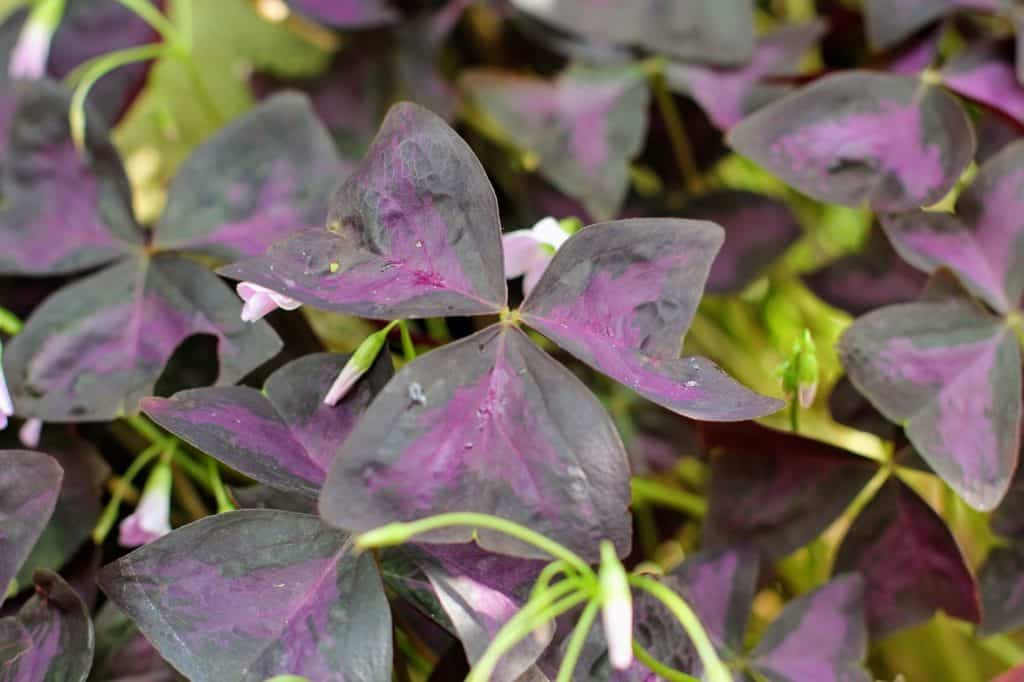
Propagate Purple Shamrock (Oxalis triangularis) by dividing the corm cluster during late dormancy in late winter or early spring, or by separating individual cormels and replanting them narrow end up at 1 to 1.5 inches depth.
Both methods have near-100% success rates. Stem cuttings and leaf cuttings are unreliable for this species and are not recommended as primary methods.
The most important care knowledge for this plant is understanding dormancy: when leaves collapse and the plant appears to die, it is not dead.
Stopping water and leaving it in a cool dark location for 4 to 8 weeks is the correct response.
Purple Shamrock is one of the easiest houseplants to propagate, but several guides consistently get two things wrong: they overstate how well stem and leaf cuttings work, and they underexplain dormancy, which is the aspect of this plant that causes the most confusion and distress.
This guide covers every propagation method with honest success rates, explains corm orientation and depth in the specific detail that actually matters, and gives dormancy the dedicated section it deserves.
Understanding Purple Shamrock Before You Propagate
Oxalis triangularis is a herbaceous perennial native to Brazil that grows from underground corms, not bulbs, not rhizomes, though you will see all three terms used interchangeably in the trade.
A corm is a solid, starchy structure that stores all the nutrients the plant needs to survive dormancy and regenerate new growth.
It looks like a tiny pinecone, roughly pea to marble sized, with a pointed narrower end and a broader flatter base.
The plant was given the RHS Award of Garden Merit and is one of the most reliably rewarding indoor plants available.
It grows actively from spring through early autumn, produces its characteristic deep purple trifoliate leaves that open and close in response to light, flowers in pale pink to white, and then dies back completely for a dormancy period of 4 to 8 weeks before regenerating.
This dormancy cycle is the single most important thing to understand about this plant, both for care and for propagation, and it will be covered in full detail in its own section.
| Toxicity note: Purple Shamrock contains oxalic acid throughout all its parts. It is toxic to cats and dogs if ingested, causing drooling, vomiting, and lethargy. It can also be harmful to humans who have gout, arthritis, or a history of kidney stones, as oxalic acid can exacerbate these conditions. Handle with care and keep out of reach of pets and children. |
Corms, Bulbs, and Rhizomes: Clearing Up the Terminology
Confusion about what this plant actually grows from leads to confusion about how to propagate it correctly.
The three terms used across different guides each imply different structures with different propagation approaches.
| Term Used | What It Actually Is | Propagation Implication |
| Corm (correct) | Solid, starchy, pinecone-shaped underground stem. Has a distinct narrow top and broad base. | Plant narrow end upward. Solid structure means it cannot be peeled apart like a true bulb. |
| Bulb (common but inaccurate) | A true bulb like an onion has distinct layered scales and a papery outer skin. | Oxalis does not have layered scales. Treating it like a tulip bulb leads to incorrect orientation and depth. |
| Rhizome (sometimes used) | A horizontal underground stem that spreads laterally. | Oxalis corms do not spread horizontally in the way a true rhizome does. This term causes confusion about orientation. |
| How to identify the narrow end: When you remove corms from soil, they sometimes arrive without any visible sprouting and orientation can be unclear. Look for the end that tapers to a slight point or comes to a narrower diameter. This is the top. The broader, flatter base is the bottom. If a corm is actively sprouting, the shoots always emerge from the narrow end. If you plant a corm upside down it will still grow, but you will wait significantly longer for shoots to emerge. |
Propagation Methods: Honest Success Rates
| Method | Success Rate | Best Timing | Difficulty | Notes |
| Corm division at dormancy | Near 100% | Late winter to early spring | Very easy | Primary recommended method; the plant naturally produces multiple corms that separate cleanly |
| Cormel separation | Near 100% | During dormancy | Very easy | Small offset corms around the main cluster; plant individually for new pots |
| Active growth division | High | Spring or early summer | Easy | Dividing while plant is growing; slightly more stress but fully viable |
| Stem or petiole cuttings | Low to moderate | Spring, active growth | Moderate | Some success is reported but results are inconsistent; not recommended as a primary method |
| Leaf cuttings | Very low | Not recommended | Moderate | Individual leaves root poorly and do not reliably produce new plants without corm base |
| The honest position on cuttings: BBC Gardeners World and experienced growers consistently describe division and corm separation as the only methods worth relying on. Stem cuttings can root in water or soil under the right conditions, but without a corm developing at the base, the rooted cutting will not survive dormancy and will not regenerate the following season. You may get a temporary plant, not a permanent one. |
Best Time to Propagate Purple Shamrock
Timing propagation to the dormancy cycle is more important with this plant than with almost any other houseplant.
The two windows that produce the best results are late dormancy just before the plant re-emerges, and early active growth in spring.
| Timing | Suitability | What to Do | Notes |
| Late winter (January to February), end of dormancy | Ideal | Remove from pot; separate corms; replant in fresh mix | Best window: corms are rested, fully charged, and about to regenerate. New shoots appear fastest from this timing. |
| Early spring (March to April), first new growth | Excellent | Divide actively growing clumps; pot up separated sections | Plant is in growth mode; divisions establish quickly. Slightly more disturbance than dormancy division but very reliable. |
| Late spring to early summer (May to June) | Good | Division of actively growing plant at repotting | Fully viable; the plant is robust and recovers well. Best done at repotting to avoid unnecessary disturbance. |
| Late summer to early autumn (August to September) | Poor | Avoid unless necessary | Plant approaching dormancy; energy reserves depleting. Divisions have less stored energy and establish more slowly. |
| Winter dormancy (November to December, early dormancy) | Poor | Leave dormant; wait until late winter | Corms are resting and should not be disturbed during early and mid dormancy. |
Understanding Dormancy: The Most Important Section in This Guide
More Purple Shamrock plants are discarded unnecessarily due to misunderstood dormancy than for any other reason.
The plant’s leaves collapse, the stems go limp, the pot looks like it contains nothing but dead material, and the entirely rational response for a new owner is to assume the plant has died and throw it away.
In most cases the plant is perfectly healthy and will regenerate completely if left alone.
Dormancy is not death. It is a programmed survival mechanism.
The corms below the soil surface remain fully viable throughout the dormancy period and are accumulating the energy reserves they need to produce the next season’s growth.
What Triggers Dormancy
- The most common trigger is a combination of shortening days and cooler temperatures in autumn and winter
- Prolonged stress such as overwatering, very low light, or extreme heat can also trigger dormancy outside the seasonal cycle
- Some plants go dormant once or twice a year; others cycle more irregularly depending on their conditions
- A plant that has just been propagated may go dormant briefly as a stress response before re-establishing
What Dormancy Looks Like
- Leaves begin drooping and no longer opening in the morning
- Stems go limp and collapse toward the soil
- Foliage fades in colour and eventually yellows
- The plant appears completely dead above the soil
| Do not throw this plant away: If your Purple Shamrock’s leaves have collapsed and you cannot see any living tissue above the soil, check the pot for firm corms before discarding. Tip the pot gently and look for the small pinecone-shaped corms. If they are firm and not mushy, the plant is dormant, not dead. Mushy, rotten corms that smell of decay indicate genuine plant death, most commonly caused by overwatering during dormancy. |
How to Manage Dormancy Correctly
- When leaves begin to collapse and wilt without recovering, reduce watering to almost nothing
- Allow the foliage to die back completely. Do not cut it while still green
- Once all foliage has died back, remove the dead material by pulling gently or cutting at soil level
- Move the pot to a cool, dimly lit location. A temperature of 10 to 15 degrees C is ideal. A spare bedroom, unheated conservatory, or cool hallway all work well
- Do not water during dormancy unless the corms begin to shrivel, which indicates the pot is too warm and dry. If shrivelling occurs, water very lightly once only
- Leave for 4 to 8 weeks. Some plants rest for as little as 3 weeks; others take up to 3 months. Do not force re-emergence
- Return to a bright, warm position and begin very light watering when new shoots are clearly visible above soil level
- Increase watering gradually over 2 weeks as growth develops rather than resuming normal watering immediately
| Dormancy is your propagation window: The dormancy period is actually the ideal time to propagate. While the plant is dormant, remove it from its pot, separate the corms easily from each other, inspect them all, discard any that are soft or damaged, and replant each group of corms in its own pot with fresh growing medium. By the time the corms re-emerge, each pot will establish independently as a separate plant. |
Method 1: Division at Dormancy (Recommended Method)
This is the simplest, highest-success, lowest-stress method of propagating Purple Shamrock.
It requires no rooting hormone, no special equipment, and no particular skill. The plant does the work itself; you are simply separating what it has already produced.
What You Will Need
- Fresh, well-draining potting mix (standard multi-purpose compost with added perlite at a 70/30 ratio works well)
- Small pots with drainage holes, one per division
- Clean hands or sterilised tool for separating corms
- A bowl of lukewarm water for rinsing corms if needed
Step-by-Step
- Wait until the plant has been dormant for at least 3 to 4 weeks and the foliage has fully died back
- Remove the plant from its pot by tipping gently. The dormant root ball is usually loose and comes away easily
- Shake away as much growing medium as possible to expose the corms clearly
- Examine the corm cluster. You will typically find anywhere from 3 to 20 corms depending on the age and size of the parent plant, ranging from large primary corms to small offset cormels
- Separate corms by gently pulling them apart. Most separate naturally with minimal effort. Use fingers rather than a blade where possible to avoid cutting through a corm
- Inspect each corm. Firm, plump corms are healthy and viable. Soft, mushy, or foul-smelling corms are rotten and should be discarded. Slightly shrunken but still firm corms are fine to plant
- Fill each pot with moistened potting mix to within 2 to 3 cm of the rim
- Plant corms narrow end upward at a depth of 2.5 to 4 cm (1 to 1.5 inches). This is slightly deeper than many guides suggest, but experienced growers consistently find this depth gives better anchorage and more reliable emergence than shallow planting
- Space multiple corms in a single pot at least 2.5 cm apart
- Cover with potting mix, water lightly, and place in a bright, warm position
| How many corms per pot: Planting 3 to 5 corms in a single small pot gives a fuller, bushier plant with a faster visual impact than planting individual corms. If you are propagating to give plants away, grouping 3 corms per pot in a 10 cm pot makes an immediately presentable gift plant rather than a single sparse stem. |
Method 2: Division During Active Growth
If your plant is growing actively and you want to divide it without waiting for dormancy, this method is fully reliable
. It causes slightly more immediate stress than dormancy division because the plant is interrupted mid-growth, but Purple Shamrock recovers readily and will resume normal growth within two to three weeks.
This method is particularly useful when a plant has become pot-bound and is being repotted anyway. Combining repotting with division means you disturb the plant only once.
Step-by-Step
- Water the plant 24 hours before dividing to ensure corms are well hydrated
- Remove the plant from its pot, supporting the base to keep the root ball as intact as possible
- Gently shake and loosen the root ball to expose the corm cluster while leaving as many roots attached as possible
- Identify natural division points where clusters of fronds emerge from separate corm groups
- Pull corm clusters apart gently, keeping a good root mass with each section. If roots are tightly tangled, use clean scissors to cut them rather than tearing
- Each division should have at least 2 to 3 corms, several established roots, and actively growing foliage
- Plant each division in fresh potting mix at the same depth as it was previously growing
- Water thoroughly and place in bright indirect light. Expect some temporary wilting in the first few days as the plant adjusts
| Do not fertilise for 6 to 8 weeks after active growth division: The root system is recovering from disturbance and is sensitive to fertiliser salts. Fresh potting mix contains sufficient nutrition for the establishment period. Premature fertilising causes root burn that sets the plant back further than the division stress itself. |
Corm Orientation and Depth: The Detail That Makes a Difference
This is the aspect of Purple Shamrock propagation most often stated imprecisely in guides, and getting it right produces noticeably faster emergence.
| Aspect | Correct Approach | What Happens if Wrong |
| Orientation | Narrow end upward. Look for the slightly pointed, tapered end of the corm. This is where shoots emerge. | Upside-down corms will still grow eventually. Shoots navigate around the corm to find the surface, but emergence takes 1 to 3 weeks longer. |
| Planting depth | 1 to 1.5 inches (2.5 to 4 cm) below the surface. Cover the corm fully. | Too shallow: corms may heave out of the soil during watering and sit exposed. Too deep: emergence is delayed and rot risk increases in very moist medium. |
| Spacing | At least 1 inch (2.5 cm) between corms in the same pot. | Overcrowded corms compete for nutrients and produce smaller, weaker growth. The pot will also need more frequent dividing. |
| Number per pot | 3 to 5 corms per 10 cm pot for a full appearance; 1 to 2 for a small starter pot. | Single corms in large pots are lost visually and the excess growing medium holds moisture that can cause rot. |
Stem and Leaf Cuttings: What Actually Happens
This section explains what actually happens and why the results are unreliable.
Why Stem Cuttings Are Unreliable
Purple Shamrock stems are thin, succulent, and moisture-sensitive. Unlike many houseplants, the stem tissue does not contain the meristematic cells required for reliable independent root development.
Some growers do achieve rooting, particularly with petiole (leaf stem) cuttings rather than bare leaf cuttings, but the fundamental problem is that a rooted cutting without a corm at its base will not survive dormancy.
When the plant enters its dormant period, all energy retreats into the corm. A cutting that has rooted but has no corm cannot store this energy and will die back without regenerating.
You may enjoy the rooted cutting for one growing season, but it will not become a permanent plant.
When Stem Cuttings Are Worth Trying
If you want to try stem cuttings as an experiment, the best approach is to take petiole cuttings (the stem that connects the leaf to the main plant stem, including a small section of the main stem at its base) in spring during active growth.
Place in water in bright indirect light and wait for root development. Transfer to soil once roots are 1 to 2 cm long and maintain high humidity during establishment.
Be aware that the resulting plant will likely not survive its first dormancy without an established corm.
| The realistic expectation: Corm division and cormel separation require five minutes and produce near-certain success. Stem cuttings require more effort, more patience, and produce uncertain results with a built-in limitation that prevents long-term survival. For any practical purpose, corm-based propagation is the method to use. |
Growing Medium and Pot Choice
Purple Shamrock is not demanding about its growing medium but does need good drainage. Corms sitting in consistently damp, dense soil during dormancy or between waterings are the primary cause of rot.
| Medium Component | Ratio | Purpose |
| Multi-purpose peat-free compost | 60% | Primary growing medium; provides structure and nutrition |
| Perlite | 30% | Improves drainage; prevents compaction over time |
| Coco coir | 10% | Light moisture retention; improves texture without reducing drainage |
Standard multi-purpose compost alone is acceptable but compacts over time, particularly in small pots.
Adding perlite at 30% keeps the medium open and draining throughout the growing season and critically during dormancy when any excess moisture around dormant corms causes rot.
Pot choice: a small terracotta pot for each division is ideal.
Terracotta wicks excess moisture through its walls and dries out between waterings more reliably than plastic, which is particularly important during the transition in and out of dormancy.
Never use a pot without drainage holes for this plant.
Aftercare: The First 8 Weeks After Propagation
Week 1 to 2: Establishment
- Keep in a warm position at 18 to 22 degrees C with bright indirect light
- Water very lightly. The goal is to keep the medium barely damp, not moist. Overwatering newly planted corms is the most common cause of failure
- Do not fertilise. Fresh potting mix contains sufficient nutrition
- Do not move the pot repeatedly to check for progress. Leave it undisturbed
Weeks 3 to 4: First Shoots
- Shoots typically appear 2 to 4 weeks after planting in warm conditions (18 to 22 degrees C)
- In cooler rooms the process takes longer; corms planted at 15 degrees C may take 4 to 6 weeks to emerge
- Once the first shoots are visible, increase watering slightly to keep the top inch of soil just moist
- Begin moving to the brightest indirect light position available. Purple Shamrock opens its leaves in response to light and needs adequate brightness to develop its characteristic deep colour
Weeks 5 to 8: Establishing Normal Care
- Water when the top 2 to 3 cm of soil feel dry. This plant tolerates slight drought better than overwatering
- Begin half-strength fertilising at 6 to 8 weeks. Use a balanced liquid fertiliser at half the recommended dose once a month from spring through summer. Stop completely during dormancy
- The deep purple leaf colour intensifies in bright conditions. Move to a bright windowsill that receives morning light if possible
- If leaves remain pale green or light lilac rather than deep purple, the plant needs significantly more light
Ongoing Care After Establishment
| Care Aspect | Requirement | Common Mistake |
| Light | Bright indirect; morning sun acceptable; no harsh afternoon direct sun | Insufficient light produces pale leaves and slow growth; this plant genuinely needs a bright position |
| Watering | When top 2 to 3 cm of soil feel dry; significantly less in autumn | Overwatering, particularly in autumn as the plant approaches dormancy, is the primary cause of corm rot |
| Temperature | 15 to 21 degrees C ideal; tolerates down to about minus 3 degrees C briefly but damage likely below 5 degrees C | Cold draughts cause leaf collapse that can be mistaken for dormancy; check for temperature stress before assuming dormancy |
| Humidity | Average indoor humidity; no special requirements | None; this is one of the least demanding aspects of its care |
| Fertilising | Half-strength balanced liquid feed monthly, spring to summer only | Over-fertilising produces lush pale growth with poor colour; quarter to half strength is sufficient |
| Repotting | Every 1 to 2 years when corm cluster fills the pot | Waiting too long causes root-binding and reduced vigour; repot and divide at the same time |
Purple Shamrock Varieties Worth Knowing
The standard Oxalis triangularis subspecies papilionacea is the most widely available and produces the classic deep purple foliage. Several other named varieties are available from specialist nurseries:
| Variety | Distinguishing Feature | Propagation Notes |
| Oxalis triangularis subsp. papilionacea (standard purple) | Deep purple to burgundy triangular leaves; pale pink to white flowers; most widely available | All guidance in this article applies directly |
| Oxalis triangularis ‘Mijke’ | Very deep, almost black-purple foliage; slightly smaller habit than the standard form | Same corm-based propagation; corms available from specialist bulb suppliers |
| Oxalis triangularis ‘Cupido’ | Purple leaves with a distinctive green centre to each leaflet | Same method; bicolour pattern is stable through propagation |
| Oxalis tetraphylla (Four-leaf Oxalis) | Four-leaflet form rather than three; often sold alongside triangularis | Same corm-based propagation method; distinct species but identical technique |
Troubleshooting
| Problem | Most Likely Cause | Solution |
| No shoots after 6 weeks | Too cold; corms planted too deep; overwatered | Ensure 18 to 22 degrees C; check depth is 1 to 1.5 inches; reduce watering |
| Soft, mushy corms at planting | Corms stored too damp or at low temperature | Discard affected corms; dry remaining corms in a cool airy spot for 24 hours before replanting |
| Leaves pale lilac rather than deep purple | Insufficient light | Move to brightest available indirect light; morning sun is beneficial |
| Plant collapsed and appears dead | Natural dormancy; most likely not actual death | Check for firm corms by tipping pot; if present, manage as dormancy |
| Corms rotting during dormancy | Overwatered going into or during dormancy | Do not water dormant plants; ensure drainage holes clear; move to cooler drier position |
| Leaves not opening during the day | Too little light; plant stressed | Move to brighter position; check for root health if problem persists |
| Mildew or grey powder on leaves | Too much moisture and poor airflow | Improve ventilation; reduce humidity; remove affected leaves; treat with sulphur-based fungicide if severe |
| Tiny new leaves but slow growth | Low temperature or nutrient depletion | Warm to 18 to 22 degrees C; begin light feeding once established for 8 weeks |
Frequently Asked Questions
My Purple Shamrock leaves have all collapsed. Is it dead?
Almost certainly not. This is the most common Purple Shamrock question and the answer is almost always the same: the plant has entered dormancy.
The leaves collapse, the stems go limp, and the plant appears completely dead. Tip the pot gently and check for firm, solid corms at the base.
If corms are present and firm, the plant is dormant and will regenerate. Move to a cooler, dimmer location, stop watering, and wait 4 to 8 weeks. Begin watering lightly when new shoots appear at soil level.
How long does dormancy last?
Typically 4 to 8 weeks, though some plants rest for as little as 3 weeks and others take up to 3 months.
The length varies between individual plants and depends partly on the temperature and light conditions during dormancy.
Cooler and darker conditions extend dormancy; warmer and brighter conditions shorten it. Do not try to force re-emergence by watering heavily or moving to bright light before shoots appear.
Can I propagate Purple Shamrock from a single leaf?
A single leaf without any stem or corm material will not produce a new plant. Individual leaves may survive briefly in water and occasionally produce a small swelling at the base, but without corm tissue they cannot develop into a self-sustaining plant or survive their first dormancy.
Propagation by corm division is the reliable method.
What is the white powdery substance on my plant’s leaves?
This is most likely powdery mildew, a fungal disease caused by high moisture levels combined with poor airflow. It appears as a grey-white powdery coating on leaf surfaces.
It is not usually fatal if caught early. Improve ventilation, move to a position with better airflow, reduce watering, and remove heavily affected leaves.
In severe cases a sulphur-based fungicide applied according to the label directions will control it. Do not mist this plant, as surface moisture on leaves encourages fungal growth.
How many corms will I find when I divide a mature plant?
A one-year-old plant typically produces 3 to 8 corms. A plant grown and divided over several years can produce 15 to 30 corms in a single dormancy division.
Corm production increases significantly if the plant is given adequate light, appropriate feeding, and allowed to grow without disturbance for a full season before being divided.
Can I store corms over winter?
Yes. If you want to delay replanting or send corms to someone, store them in a paper bag or cardboard box with a small amount of dry peat or coco coir to prevent them desiccating completely.
Keep in a cool, dry location at 5 to 10 degrees C. Do not use plastic bags, which trap moisture and cause rot. Corms stored correctly remain viable for 2 to 3 months.
Corms that have begun to sprout should be planted immediately rather than stored.
Is Purple Shamrock the same as Irish shamrock?
No. True shamrock refers to young clover, typically Trifolium repens or Trifolium dubium, which is the plant associated with Saint Patrick’s Day and Irish symbolism. Purple Shamrock (Oxalis triangularis) is a South American wood sorrel with no botanical relationship to clover. It is sometimes called ‘false shamrock’ precisely because of this naming confusion. The leaf shape similarity is superficial.
Why are my Purple Shamrock leaves closing during the day?
Purple Shamrock leaves are nyctinastic, meaning they open and close in response to light levels. This is completely normal behaviour.
Leaves open when light levels are high and close when light drops, such as in the evening, on dark cloudy days, or if the plant is in a position with insufficient light.
If leaves are closed during what should be bright daytime, the plant needs a brighter position. If leaves close at dusk and reopen in the morning, this is healthy behaviour requiring no intervention.
Final Thoughts
Propagating Oxalis triangularis is one of the genuinely easy wins in houseplant growing. The corms multiply reliably, separate cleanly, and reestablish quickly with minimal intervention.
The only knowledge you need beyond the basic steps is an understanding of dormancy, which turns what looks like plant death into a propagation opportunity rather than a loss.
The single most valuable habit you can build with this plant is to resist the impulse to water it into dormancy and rescue it from what appears to be dying.
Purple Shamrock that is allowed to complete its dormancy cycle fully and then woken gradually produces stronger, more vigorous growth the following season than plants that are kept in continuous growth year-round.
Divide at dormancy, plant narrow end up, keep dry while dormant, and water gradually on re-emergence.
That four-step approach, combined with a bright window and monthly feeding during the growing season, will keep a Purple Shamrock thriving and multiplying for years.
| What’s next: Once your divided corms have established and are growing well, the most satisfying step is growing the plant to its full potential before the next division cycle. A single 10 cm pot with 4 to 5 corms, given a bright east-facing windowsill and monthly feeding from March to September, will produce a full, dramatic mound of deep purple foliage that looks completely different from an underfed plant in poor light. The colour intensity and leaf size in good conditions are genuinely striking. |
Mariel is a plant enthusiast and writer based in the UK with a passion for houseplants and indoor growing.
She has spent the last few years building an ever-growing collection of indoor plants and learning the hard way which ones will survive her busy schedule.
At Bean Growing she writes about houseplant care, common plant problems, and outdoor gardening.