
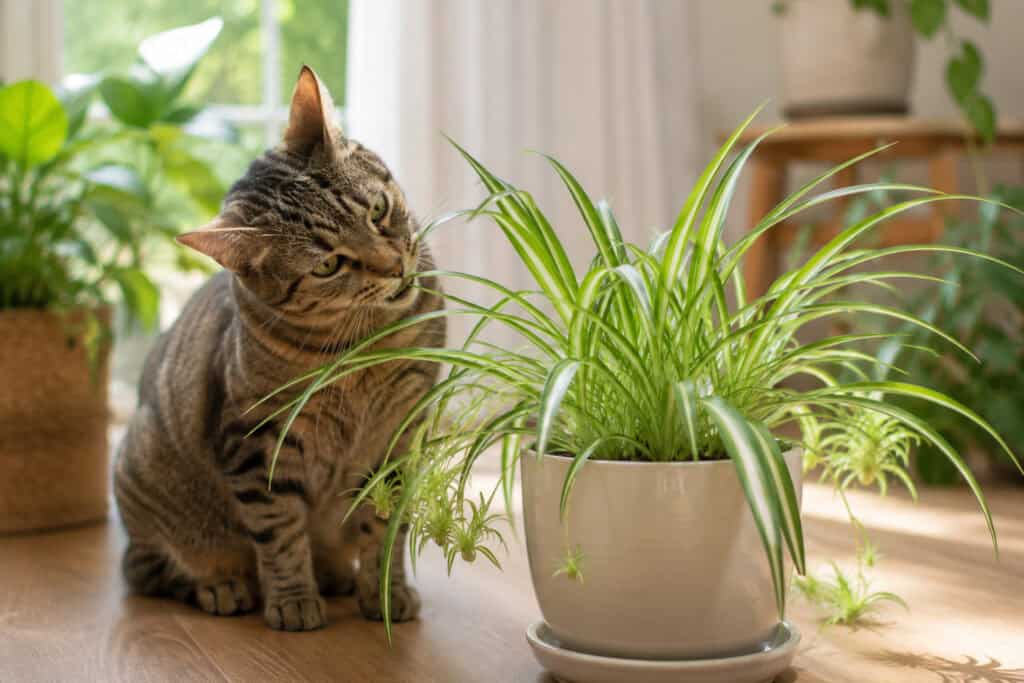
Spider plants (Chlorophytum comosum) are not toxic to cats. The ASPCA classifies them as non-toxic to dogs, cats, and horses.
However, spider plants contain saponins that can irritate the digestive tract, and cats that eat a large amount may vomit or develop diarrhoea, so ingestion of large quantities is the real risk, even though the plant itself is not classified as poisonous.
| Quick answer Toxicity: non-toxic to cats, dogs, and horses per the ASPCA. This is not a plant to worry about the way you would worry about lilies or sago palms. Real risk: eating a large amount can cause vomiting, diarrhoea, and mild stomach upset from saponins, plus unusual, slightly glazed behaviour that some owners describe as catnip-like. Bigger risk: fertiliser pellets or perlite in the potting soil, not the leaves themselves. Best fix: place the plant somewhere genuinely out of reach and give your cat safe cat grass or catnip as an alternative to chew. When to call the vet: repeated vomiting beyond a few hours, diarrhoea lasting more than a day, or a painful, distended abdomen. |
You spent weeks hunting for a houseplant that was low-maintenance, attractive, and safe for your cat. You chose a spider plant.
Then you watched your cat shred it within 48 hours, looking happily dazed in the process. Sound familiar?
Most cat owners who search this topic are not really asking whether spider plants are deadly. They already know the plant is not a lily or a sago palm.
What they want to know is: why does my cat keep going back to it, is that strange behaviour normal, what actually happens if the cat eats a lot of it, and do I need to worry?
The short answer is reassuring. The longer answer is more interesting, because the relationship between cats and spider plants gets discussed in some very confident-sounding claims online that are worth checking carefully.
There is a real distinction between ‘non-toxic’ and ‘completely harmless’, a few situations where you should pay closer attention than most guides suggest, and if you are weighing this plant up against another one you already own, our guide on whether monstera is toxic to pets covers the same ground for that species.
What ‘Non-Toxic’ Actually Means for Spider Plants and Cats
The word ‘non-toxic’ has a specific meaning in veterinary classification.
It means the plant does not contain compounds known to cause organ damage, systemic poisoning, or life-threatening illness.
It does not mean the plant is harmless in all circumstances, and this distinction matters for spider plants in particular.
The ASPCA lists Chlorophytum comosum as non-toxic to cats, dogs, and horses.
The Veterinary Information Network, used as a reference by practising vets, categorises it under plants with minimal or no known toxicity, and in the UK the Veterinary Poisons Information Service takes the same view.
These classifications are based on clinical case data and decades of reported incidents, and they are reliable.
What those classifications do not cover is the gastrointestinal response that can follow when a cat eats a significant amount of the plant, since spider plants contain compounds that produce effects in cats even at non-toxic doses.
First, they contain saponins. These are natural detergent-like compounds found in many plants, produced as a defence against animals that might eat them.
Saponins irritate the lining of the digestive tract, which is why a cat that eats enough spider plant will often vomit or develop diarrhoea.
The irritation is real, but it resolves on its own and does not cause lasting damage.
The practical takeaway: a cat that sniffs or nibbles a spider plant leaf occasionally is at no meaningful risk.
A cat that eats a large quantity of the plant in one sitting may vomit and feel unwell for a few hours.
Neither scenario requires an emergency vet visit unless symptoms are severe or do not resolve within a day.
| Warning: fertiliser in the soil is a separate risk The plant itself is non-toxic, but the potting soil is not always safe. Commercial potting mixes often contain slow-release fertiliser pellets, and some contain perlite. If your cat digs in the soil or eats it, fertiliser residue can cause genuine gastrointestinal illness that is more serious than anything the plant leaves would cause. If your cat regularly investigates the soil, repot into a fertiliser-free organic mix and cover the surface with smooth river stones large enough that the cat cannot swallow them. |
Why Cats Are So Drawn to Spider Plants
This is the part most guides handle either too dismissively or too confidently, so it is worth being straightforward about what is established and what is not.
You will read that cats like the dangling spiderettes because they resemble toys, or that the grassy texture appeals to a cat’s instinct to chew vegetation. Both are true to some degree.
You will also read, on a lot of pet and gardening sites, that spider plants contain compounds ‘related to opium’ that produce a mild hallucinogenic effect similar to catnip.
This claim gets repeated constantly, but it is worth some scepticism.
No peer-reviewed study has isolated a specific opioid-like or hallucinogenic compound in Chlorophytum comosum, and some veterinary and horticultural sources treat the ‘hallucinogenic spider plant’ idea as an unverified internet myth rather than an established fact.
Treat it as a widely circulated folk explanation, not a confirmed one.
What is better supported is the behavioural side. Cats are obligate carnivores whose digestive systems cannot properly process plant fibre, but domestic cats still eat grass and plant material, and research suggests this is partly a holdover from when their wild ancestors used indigestible vegetation to help purge intestinal parasites.
Younger cats tend to eat more vegetation than older cats, likely because their developing immune systems trigger the behaviour more frequently.
If you have a kitten that is particularly interested in your spider plant, age is probably a bigger factor than any chemical explanation.
The shape of the plant also matters a great deal. The long, slender, arching leaves and the dangling spiderettes on long stems look and move like prey from a cat’s perspective, which is basic feline predatory instinct responding to something that moves like a small animal, not anthropomorphism.
Put together, an unusually strong grass-eating and play instinct is a simpler and better-supported explanation for the spider plant obsession than the frequently repeated hallucinogen claim, even if some individual cats do seem to behave in an unusually excitable way around the plant.
What Happens If Your Cat Eats Spider Plant Leaves
The response depends almost entirely on how much the cat eats. Here is how to think about it in practice.
Small amount, occasional nibble
Most cats will show no symptoms at all. Some cats with sensitive stomachs may produce a small amount of foamy vomit, which is the same response you would see if they ate a small amount of grass.
This is the digestive system clearing plant matter it cannot process, not a toxic reaction. If your cat vomits once and then seems completely normal, no action is needed beyond keeping an eye on them.
Moderate amount, repeated eating
A cat that eats a significant portion of the plant may develop vomiting and diarrhoea that lasts a few hours.
The cat may also appear slightly restless, overstimulated, or unusually affectionate for a while, which most owners describe anecdotally rather than anything confirmed in veterinary literature.
Withhold food briefly to let the stomach settle, make sure fresh water is available, and monitor closely. Most cats recover fully within a few hours without any intervention.
Large amount, prolonged access
This is the scenario that warrants veterinary attention.
A cat that consumes a large volume of spider plant leaves may develop diarrhoea severe enough to cause dehydration, which requires fluid therapy.
In rare cases, a large mass of plant material can form a partial blockage in the stomach that does not pass on its own.
Signs of a more serious problem include repeated vomiting that does not stop after a few hours, visible discomfort when the abdomen is touched, refusal to drink water, or progressive lethargy rather than improvement.
To be clear, reaching this threshold requires a cat to eat a substantial amount of the plant in a short period.
It is possible, particularly with kittens or cats that have unrestricted access, but it is not the typical outcome.
| Symptom | Likely Cause | Action |
| Single vomiting episode, cat normal afterward | Gut clearing plant matter | Monitor at home, no treatment needed |
| Mild diarrhoea, resolves within a few hours | Saponin irritation | Monitor, ensure water access |
| Restless, overstimulated, or unusually affectionate behaviour | Anecdotally reported reaction, not fully confirmed in studies | Monitor, keep cat calm, resolves on its own |
| Repeated vomiting over several hours | Large ingestion, stomach irritation | Call vet for advice |
| Diarrhoea lasting more than 24 hours | Possible dehydration risk | Vet visit recommended |
| Distended abdomen, pain response, refusal to drink | Possible blockage | Emergency vet visit |
The Hidden Risk Most Articles Miss: Fertiliser and Soil
Here is something the majority of ‘are spider plants toxic to cats’ articles either skip entirely or mention in a single sentence.
The plant is non-toxic, but what is in the pot often is not.
Commercial potting mixes sold for houseplants frequently include slow-release fertiliser pellets mixed into the soil.
Our guide to the best soil for a spider plant shows how to build a suitable, fertiliser-free mix from scratch if you would rather avoid this problem entirely.
These pellets are usually coated to look like small stones or granules.
If your cat digs in the pot, chews on the soil, or drinks from a drainage tray that has collected water from the soil, they may ingest fertiliser compounds that are not on anyone’s ‘non-toxic plant’ list.
The symptoms of fertiliser ingestion overlap with those from eating the plant itself, which is why this distinction matters practically.
If your cat ate a few spider plant leaves and seems fine, that is one situation.
If your cat has been digging in the soil and now appears unwell, that is a different situation that may warrant a call to your vet.
The fix is straightforward: repot your spider plant into an organic, fertiliser-free potting mix, then cover the soil surface with river stones, roughly an inch (2.5cm) in diameter, to discourage digging.
The stones need to be large enough that the cat cannot pick them up and carry them off, but not so large they disrupt watering.
Perlite is another ingredient to be aware of. The white granules mixed into most commercial potting soil are perlite, a type of volcanic glass used to improve drainage.
It is not toxic if ingested in small amounts, but it is a lung irritant if inhaled in quantity, and cats that dig enthusiastically in dry soil can kick up perlite dust.
This is a minor concern for most cats, but worth knowing if yours has any respiratory sensitivity.
How to Keep a Spider Plant When You Have a Cat
The goal here is not to make the plant inaccessible at all costs. That approach often fails because cats are persistent, and an inaccessible plant can become an obsession.
The more effective approach is to make the plant less interesting while giving the cat appropriate alternatives.
Placement that actually works
Hanging baskets are the most commonly recommended solution, and our comparison of growing a spider plant in a pot versus a hanging basket covers the practical side of this in full, but there is one important caveat here specifically: the hanging location must be out of reach of any furniture, shelf, or surface the cat uses as a launch point.
A basket hung at cat-jumping height from a nearby shelf is not protected.
Cats are capable climbers and accurate jumpers. If there is a plausible route to the plant, assume the cat has found it.
True ceiling hooks in a room with no furniture near the hanging point are reliable. High shelves in rooms where cats are not allowed are reliable.
Windowsills, open shelving, and spots where the spiderettes hang down to accessible levels are not reliable, regardless of how high the pot itself is positioned.
Deterrents that help versus those that do not
Bitter apple sprays applied to the leaves deter some cats but not all, and a cat that is strongly motivated will simply drool more and keep chewing.
Citrus-based sprays applied around the pot, not on the plant, are more reliable for discouraging soil digging. The smell of citrus is aversive to most cats and does not damage the plant.
Physical barriers such as decorative chicken wire or mesh around the base of the pot can discourage digging without affecting the plant itself, which is worth considering if the soil is your main concern.
Providing alternatives
The most effective long-term approach is giving a cat that wants to chew vegetation something better to chew.
Cat grass, grown from wheat, oat, barley, or rye seeds, is safe for cats, satisfies the grass-eating instinct, and is entirely unrelated to any chemical explanation for the spider plant’s appeal.
The key is placement: put the cat grass in a spot where the cat already likes to rest, not hidden away in a corner. Make it the obvious choice.
Catnip and valerian-based toys give a cat a genuine, well-documented alternative source of that overstimulated, playful reaction, which may reduce how often it goes looking for the same thing from your houseplants.
This is not a guaranteed solution, but many cat owners find it noticeably reduces the spider plant obsession.
| Tip: the first two weeks are critical When you bring a new spider plant home, the cat’s initial encounter with it sets a pattern. If the cat gets unrestricted access in the first few days and develops a strong habit of visiting it, breaking that habit becomes much harder. Keep the plant completely out of reach for the first two weeks, introduce cat grass at the same time, and you give yourself a much better chance of the cat accepting the arrangement long-term. |
Make Sure You Have the Right Plant: Name Confusion Matters
This section addresses a risk that most guides acknowledge briefly and then move past too quickly.
Several unrelated plants share common names with spider plants, and some of them are toxic to cats.
Buying a plant labelled ‘spider plant’ from a market, a car boot sale, or an online seller without verifying the scientific name is a real source of confusion, and our guide to the different types of spider plant cultivars is a good place to check what you actually have.
The spider plant you want is Chlorophytum comosum. It has long, arching leaves that are solid green or green with a white or cream central or marginal stripe, depending on the variety.
The leaves emerge from a central rosette, and mature plants produce long stolons (runners) with small plantlets at the ends. These plantlets are the ‘spiders’ the plant is named for.
Plants that are sometimes called spider plant but are different species include Chlorophytum orchidastrum (sometimes sold as ‘fire flash’ spider plant), which is also in the same family and similarly non-toxic, and various aspidistra or tradescantia varieties that may be mislabelled.
The concern is less with these look-alikes specifically and more with the broader habit of buying plants without checking their scientific names.
Any time you introduce a new plant into a home with cats, verify the scientific name against the ASPCA toxic plants database before it lands on your windowsill.
| UK Reader Note: classification and common name differences In the UK, Chlorophytum comosum is sometimes sold under the name ‘spider ivy’ as well as ‘spider plant’. Both refer to the same species, and the ASPCA’s non-toxic classification applies. The UK’s Veterinary Poisons Information Service (VPIS) similarly lists Chlorophytum comosum as causing only mild gastrointestinal effects, and the RHS does not classify it as harmful to pets. If you are unsure about a plant’s identity, the RHS Plant Finder database allows you to verify scientific names against common ones. |
Common Houseplants That Are Actually Toxic to Cats
Understanding why spider plants are safe is more useful when you also know which plants are not.
The contrast helps you make smarter decisions about your whole indoor garden, not just this one plant.
| Plant | Scientific Name | Toxicity to Cats | Primary Risk |
| All lily species | Lilium and Hemerocallis spp. | Severely toxic | Acute kidney failure, often fatal without rapid treatment |
| Pothos | Epipremnum aureum | Toxic | Oral irritation, vomiting, difficulty swallowing |
| Sago palm | Cycas revoluta | Severely toxic | Liver failure, high mortality rate |
| Snake plant | Dracaena trifasciata | Mildly toxic | Vomiting, diarrhoea, drooling |
| Aloe vera | Aloe barbadensis | Mildly to moderately toxic | Vomiting, diarrhoea, lethargy |
| Peace lily | Spathiphyllum spp. | Toxic | Oral irritation, drooling, vomiting |
| ZZ plant | Zamioculcas zamiifolia | Mildly toxic | Oral irritation from calcium oxalate crystals |
| Spider plant | Chlorophytum comosum | Non-toxic | Mild GI upset only if eaten in quantity |
The plants to watch most carefully are the true lilies. Easter lilies, tiger lilies, Asiatic lilies, and daylilies can cause kidney failure in cats after ingestion of even a small amount of the plant, including pollen.
A cat that walks through a vase of lilies and then grooms pollen from its fur has already ingested enough to cause serious injury. If you have cats, lilies should not be in your home, full stop.
Frequently Asked Questions
Can spider plants make cats sick?
Yes, spider plants can cause mild illness if a cat eats a significant amount of the plant. The plant contains saponins, which irritate the digestive tract.
This does not cause organ damage or systemic toxicity, but a cat that eats enough of the plant may vomit or develop diarrhoea. These symptoms are usually self-limiting and resolve within a few hours.
Spider plants are classified as non-toxic by the ASPCA, which means they will not cause the serious, life-threatening illness associated with truly toxic plants like lilies or sago palms.
Why is my cat obsessed with eating my spider plant?
The best-supported explanation is behavioural rather than chemical: cats have a natural instinct to chew vegetation, partly linked to managing intestinal parasites, and the long, dangling leaves and spiderettes move like prey, which triggers feline predatory instinct.
You will see the claim that spider plants are mildly hallucinogenic, similar to catnip, repeated across many pet and gardening sites, but no confirmed scientific study backs this up, so it is best treated as an unverified explanation rather than an established fact.
Whatever the exact cause, the practical fix is the same: reduce access and offer cat grass or catnip as an alternative.
What should I do if my cat ate a spider plant?
First, assess how much the cat ate. A nibble or small bite from a single leaf is unlikely to cause any symptoms.
If the cat has eaten a substantial portion of the plant, monitor it closely for the next several hours, watching for vomiting, diarrhoea, or signs of lethargy.
A single vomiting episode followed by normal behaviour does not require a vet visit.
If vomiting or diarrhoea continues for more than a few hours, if the cat becomes lethargic and does not improve, or if the abdomen appears painful or distended, contact your vet.
In the UK you can also call the VPIS via your vet, or in the US the ASPCA Animal Poison Control Center on (888) 426-4435, for guidance.
Are spider plant spiderettes (baby plants) more dangerous than the leaves?
No, the spiderettes are not more toxic than the leaves. All parts of Chlorophytum comosum, including the leaves, stems, stolons, and plantlets, contain the same compounds at broadly similar concentrations.
The spiderettes are particularly attractive to cats because they dangle and move, but eating one carries the same mild risk as eating a section of leaf.
Is spider plant pollen dangerous to cats?
Spider plants rarely flower indoors, and when they do, the tiny white blooms produce minimal pollen in typical household conditions.
Unlike true lilies, where even pollen contact with the skin or fur can trigger kidney failure after grooming, spider plant flowers carry no known significant risk to cats.
No confirmed cases of spider plant pollen causing serious illness in cats have been recorded in veterinary toxicology databases. If your spider plant does flower, this is not a cause for concern.
Are spider plants safe for kittens specifically?
Spider plants are not more toxic to kittens than to adult cats.
However, kittens have smaller body mass and less developed digestive systems, which means the same amount of plant material produces a stronger response proportionally.
Kittens are also more likely to eat plants out of curiosity. If you have a kitten and a spider plant, keeping the plant completely out of reach is more important than it would be with a settled adult cat.
What safe plants can I grow as alternatives if I want to give my cat something to chew?
Cat grass is the most practical alternative: a general term for grasses grown from wheat, oat, barley, or rye seeds, all of which are safe for cats and easy to grow indoors in small containers.
Catnip (Nepeta cataria) and valerian are both safe, well-documented options for cats that enjoy an excitable reaction to a plant.
Silver vine (Actinidia polygama) is increasingly available and produces a stronger response in cats that do not react to catnip.
All of these give cats an appropriate outlet for plant-chewing and play behaviour without the stomach-upset risk of a large spider plant binge.
My cat ate a spider plant and is acting strange. Is this normal?
Unusual behaviour after eating spider plant, such as restlessness, rolling, or being more vocal than usual, is widely reported by cat owners, though it is not something confirmed in controlled veterinary studies.
If unusual behaviour resolves within a few hours and is not accompanied by vomiting, diarrhoea, or distress, it is not typically a cause for concern.
If the cat loses the ability to walk normally, breathing changes, or the cat becomes completely unresponsive rather than just calm and unusually chilled out, contact your vet, since these would indicate something other than a normal plant response.
Key Takeaways
- Verify the scientific name Chlorophytum comosum to confirm you have a true spider plant, not a different species sold under the same common name.
- The plant is non-toxic to cats according to the ASPCA, but ‘non-toxic’ does not mean ‘harmless in all quantities.’ Cats that eat large amounts may vomit or develop diarrhoea.
- The widely repeated claim that spider plants are mildly hallucinogenic to cats is not confirmed by any scientific study, so treat it as an interesting theory rather than a fact.
- Check your potting mix for slow-release fertiliser pellets, which are a separate hazard. Repot into fertiliser-free soil and cover the surface with river stones if your cat digs in the soil.
- Hang the plant from a ceiling hook in a location with no nearby furniture the cat can use as a launch point. Other placement methods are less reliable than they appear.
- A single vomiting episode after eating spider plant, followed by normal behaviour, does not require a vet visit. Continuous vomiting, diarrhoea lasting more than a day, or abdominal pain does.
- Remove true lilies, sago palms, and pothos from your home entirely if you have cats. These plants cause serious harm that spider plants do not.
Conclusion
Spider plants sit in an unusual middle ground that most pet-safety articles handle too simply.
They are genuinely non-toxic, and that is a meaningful reassurance if you have been worried about your cat’s access to the plant, but they are not without effect on cats, and that distinction deserves honest explanation rather than a repeated internet myth.
Your cat’s interest in the plant is not random, even if the exact chemical explanation is overstated online.
Understanding what is and is not established helps you make better practical decisions: where to place the plant, what to offer as an alternative, and when your cat’s behaviour genuinely needs a vet’s attention.
The cats that get into real trouble with spider plants are almost always those with prolonged, unrestricted access.
A cat that nibbles once in a while is in no danger. A cat that demolishes an entire hanging basket over the course of an afternoon and repeats this weekly may eventually produce symptoms that need managing.
If you have been on the fence about whether the spider plant needs to come down from the shelf, the answer is usually no, especially given its genuine air-purifying benefits.
A bit of thoughtful placement and a pot of cat grass on the windowsill solves most problems before they start.
What’s Next
If your cat is regularly attracted to houseplants, the next step is building a small indoor cat grass station.
Start with a shallow pot, organic potting soil without fertiliser, and a mixed seed packet containing wheat, oat, and barley.
Plant the seeds thickly, water well, and place the pot in a sunny window. Seeds typically germinate within three to five days.
Once the grass reaches two to three inches (5 to 7.5cm) tall, introduce the pot to your cat in the same location where it usually shows interest in your spider plant.
This gives the cat an appropriate target and reduces pressure on your other plants considerably.
Mariel is a plant enthusiast and writer based in the UK with a passion for houseplants and indoor growing.
She has spent the last few years building an ever-growing collection of indoor plants and learning the hard way which ones will survive her busy schedule.
At Bean Growing she writes about houseplant care, common plant problems, and outdoor gardening.