
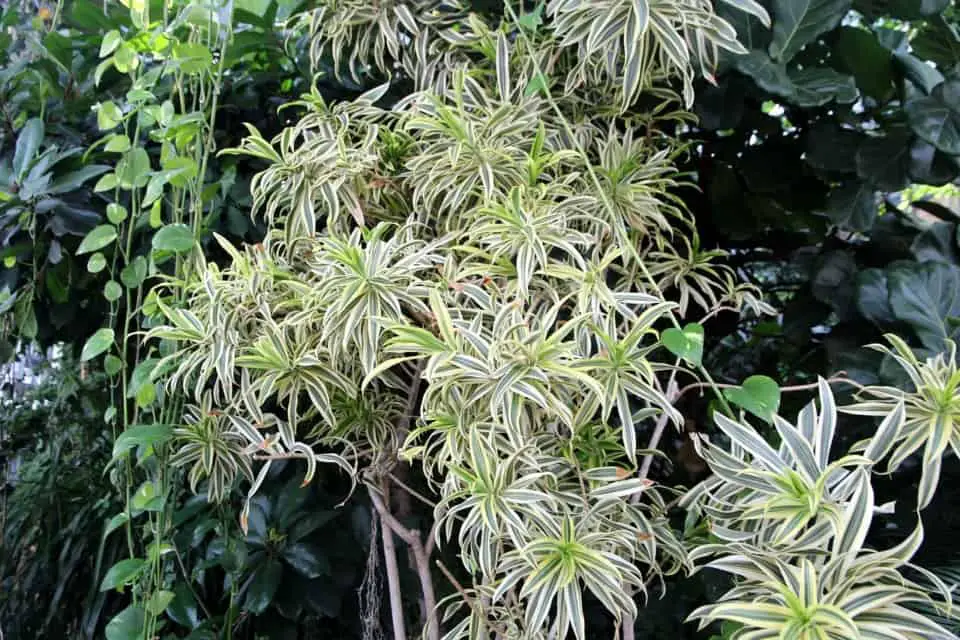
Spider plants (Chlorophytum comosum) are grouped into three main types: variegated, solid green, and curly.
Variegated varieties feature striped leaves in green and white or cream, solid green types have uniform dark foliage, and curly types share the striped pattern but with distinctive twisted leaves.
All three thrive in indirect light and well-draining soil. The critical variable is light: variegated types need more brightness to maintain their markings, while solid green varieties tolerate lower conditions.
You picked up what looked like a plain green-and-white plant, brought it home, and six months later it has turned almost entirely green with no stripes in sight.
Or you saw a photo of a compact, curly-leaved version online and now you are wondering whether it needs different care from the one already sitting on your shelf.
These are the questions most guides skip. They list the varieties, show a photo, and move on.
The reality is that understanding which type of spider plant you have does more than satisfy curiosity.
It changes how you position the plant, how often you expect babies, and why your variegation might be fading no matter how carefully you water.
This guide covers every main type you are likely to encounter, the one detail almost every variety list gets wrong about solid green plants, and the specific situation where light level determines whether your plant looks like its photo or a pale imitation of it.
The Three Main Categories of Spider Plant
Before getting into individual cultivars, it helps to understand how spider plants are grouped.
All the varieties sold as houseplants are forms of Chlorophytum comosum, native to coastal and tropical southern Africa.
Breeders have selected for leaf color, stripe pattern, and leaf texture over decades, producing dozens of named cultivars.
In practice, they fall into three groups based on how the leaves look.
Variegated types are by far the most common in garden centers and grocery stores. Their leaves carry lengthwise stripes of white, cream, or pale yellow against green.
Solid green types have no stripes at all, which makes them slightly rarer to find in standard retail but genuinely more vigorous in low-light situations.
Curly types share the striped look of variegated varieties but with leaves that spiral or twist along their length, giving the plant a very different overall shape.
That last point matters more than it sounds. The curling habit is not caused by stress, underwatering, or any problem with the plant.
It is a stable genetic trait. A common mistake beginners make is assuming their Bonnie cultivar is struggling because it looks different from the spider plants pictured in care guides.
It is not. That is exactly what it is supposed to look like.
Variegated Spider Plants: The Most Common Group
Walk into almost any plant shop and the spider plant you see will be a variegated type.
Within this group, there are real differences worth knowing about, particularly between the two most widely sold cultivars.
Chlorophytum comosum ‘Vittatum’
Vittatum is the classic. It has mid-green leaves with a broad creamy white stripe running down the center of each blade.
The stems that carry the baby plants are white. Leaves reach 20 to 45 cm (8 to 18 inches) long and arch outward from a central growing point.
One thing that surprises new owners: Vittatum grows more slowly than the solid green types.
This is because the white center of each leaf contains no chlorophyll and cannot contribute to photosynthesis.
The plant is essentially carrying ornamental tissue that looks attractive but does no productive work.
In a brightly lit spot, this is not a problem. In a dim corner, the plant will be noticeably sluggish.
Vittatum produces plantlets generously in good conditions, which is part of why it became so popular in the first place.
It and the Variegatum cultivar below both hold the Royal Horticultural Society Award of Garden Merit.
Chlorophytum comosum ‘Variegatum’
Variegatum looks similar at first glance but the stripe pattern is reversed: darker green leaves with white margins rather than a white center.
The stems carrying the plantlets are green rather than white. Leaves tend to be slightly broader than Vittatum and the plant is generally more compact.
One frequently missed detail: Variegatum produces fewer plantlets than Vittatum. If you bought your spider plant specifically hoping for a cascade of babies to propagate and share, Vittatum is the better choice.
If you prefer a tidier plant that does not send out runners in every direction, Variegatum suits that situation better.
Chlorophytum comosum ‘Milky Way’
Milky Way features narrow leaves with green margins and a very broad white to cream center, giving it a lighter overall appearance than either Vittatum or Variegatum.
The leaves look almost pale in comparison. It grows well in bright indirect light but because the white portion dominates so much of each leaf, it is more sensitive to low-light conditions than either of the above.
Place it too far from a window and the margins will stay green while the center loses its definition and turns yellowish-grey.
Chlorophytum comosum ‘Ocean’
Ocean has shorter, wider leaves than Vittatum with green centers and white to cream edges, giving it a slightly spiky, upright appearance rather than the long trailing habit most people picture.
It works particularly well in bathrooms and kitchens where humidity is higher, because the leaf structure holds moisture slightly better than the longer, thinner-leaved types.
Ceramic or glazed pots suit Ocean well because they retain moisture more effectively than terracotta.
Chlorophytum comosum ‘Reverse Variegatum’
As the name signals, this one flips the standard striping: pale yellow or cream margins with a forest green center.
It grows upright rather than trailing, which makes it look striking in a hanging basket where the leaf tips face outward rather than drooping down.
It is less common than Vittatum or Variegatum but worth seeking out if you want something that reads as genuinely different from the plant everyone else has on their shelf.
Chlorophytum comosum ‘Picturatum’
Picturatum has a central yellow stripe rather than white. The yellow tends to fade toward cream in lower light, so keeping this one in a bright spot is important if maintaining the color is a priority.
It is less widely stocked in US garden centers but available through specialist online sellers.
Solid Green Spider Plants: The Overlooked Category
Here is the detail most variety guides get wrong or gloss over: solid green spider plants are not simply a plain alternative to variegated types.
They are, in a measurable way, more vigorous. Every cell in a solid green leaf contains chlorophyll and contributes to photosynthesis.
The plant is not carrying any ornamental but non-productive tissue. In practical terms, this means faster growth, stronger roots, and better performance in lower light situations.
Chlorophytum comosum ‘Shamrock’
Shamrock is the easiest solid green variety to find. Long, thin, deep green leaves with a slight gloss, growing upright before arching.
It produces plantlets, though often fewer than a well-lit Vittatum.
The reason this matters: if your home has genuinely limited natural light, north-facing windows, or heavy shade from nearby buildings, Shamrock will outperform any variegated type in those conditions.
The variegated varieties will survive in lower light, but they will grow slowly, produce almost no babies, and may begin to lose the crispness of their stripe pattern.
A common beginner mistake is choosing a variegated spider plant because it looks more interesting in the shop, then being frustrated when it barely grows in a dark apartment.
Shamrock in a lower-light situation will be more rewarding than a struggling Vittatum in the same spot.
Chlorophytum comosum ‘Hawaiian’
Hawaiian is genuinely unusual in its behaviour. The mature plant itself is solid green, but the plantlets it produces are variegated.
Those plantlets, when potted up and grown on, lose their variegation as they mature and become solid green again, before in turn producing variegated babies.
This cycle of variegation appearing in the young growth and disappearing in the adult plant is not a problem or a sign that something is wrong.
It is simply how this cultivar behaves.
This consistent pattern also explains why some growers report that their previously all-green spider plant suddenly produced striped babies after moving it to a brighter window.
If the plant was a Hawaiian, the extra light may have triggered plantlet production that had been suppressed in lower conditions.
Curly Spider Plants: A Genuine Genetic Trait, Not a Sign of Stress
Curly spider plants are consistently misidentified by beginner growers as either a stressed plant or a different species.
Neither is accurate. The curling habit is a stable genetic characteristic that appears reliably in offspring and holds up regardless of care conditions.
Chlorophytum comosum ‘Bonnie’
Bonnie is the most widely available curly cultivar. Dark green leaves with a creamy central stripe that curl and twist along their length, giving the plant a compact, bouncy appearance.
It stays smaller than most other spider plants, which makes it a good choice for windowsills, smaller rooms, and compact spaces where a full-size Vittatum would quickly overwhelm the area.
The babies it produces are also curly, which surprises some growers who assume the curl will straighten out when the plantlet is repotted. It does not.
Propagation from Bonnie reliably produces more Bonnie-type plants. One thing to watch: because the leaves curl inward slightly, they collect dust more readily than flat-leaved varieties.
Wipe them with a damp cloth every few weeks to keep them looking their best and to allow adequate light absorption.
Chlorophytum comosum ‘Green Bonnie’
Green Bonnie carries the same curling leaf habit but without the central stripe. Solid, rich green curled leaves.
Even harder to find than standard Bonnie, but worth tracking down through specialty online sellers if the compact curly look appeals and you want something that performs better in lower light than the striped version.
Related Plants Often Sold Alongside Spider Plants
Two plants consistently appear in spider plant variety articles as though they are Chlorophytum comosum cultivars.
They are not, and knowing the difference saves real confusion when care advice does not match what you are experiencing.
Fire Flash (Chlorophytum amaniense)
Fire Flash is a genuinely different species, not a cultivar of C. comosum. It has broad dark green leaves and dramatically orange midribs and leaf stems, which is where the name comes from.
It does not produce hanging plantlets in the way C. comosum does.
It grows more slowly, prefers higher humidity, and does not tolerate the same degree of watering inconsistency that standard spider plants handle without complaint.
Placing Fire Flash in a standard spider plant care routine and expecting the same results is a reliable way to end up with a struggling plant.
Propagate Fire Flash by division rather than by rooting plantlets, because there are no plantlets to root.
If you have been following spider plant care advice for a plant that looks like Fire Flash, consider adjusting your watering and humidity levels and see whether it responds.
Chlorophytum bichetii (Bichetii Grass)
Often sold as a compact spider plant, Bichetii Grass has narrower leaves with white margins and a more upright, non-trailing habit. It produces no hanging runners or plantlets at all.
It works better as a ground cover or compact tabletop plant than as a hanging basket specimen.
If your so-called spider plant is refusing to produce any babies despite good care, check whether it might be C. bichetii rather than C. comosum.
Variety Comparison at a Glance
Use this table to identify what you have or to choose which variety suits your situation before you buy.
| Variety | Stripe Pattern | Leaf Shape | Baby Production | Light Needs | Best For |
| Vittatum | White center, green edges | Long, arching | Generous | Bright indirect | Hanging baskets, propagating |
| Variegatum | Green center, white edges | Broad, arching | Moderate | Bright indirect | Tidier display, fewer runners |
| Milky Way | Wide white center, green margins | Narrow, arching | Moderate | Bright indirect | Bright rooms, bold contrast |
| Ocean | Green center, white edges | Short, upright | Moderate | Bright indirect | Bathrooms, humid rooms |
| Reverse Variegatum | Green center, cream-yellow margins | Upright, arching | Moderate | Bright indirect | Hanging baskets, variety hunters |
| Shamrock | None (solid green) | Long, glossy | Moderate | Low to bright | Lower-light rooms, faster growth |
| Hawaiian | None (green adult, variegated pups) | Long, arching | Moderate | Low to bright | Watching variegation cycle |
| Bonnie | Cream center, green edges | Short, curly | Moderate | Bright indirect | Compact spaces, windowsills |
| Green Bonnie | None (solid green, curly) | Short, curly | Moderate | Low to bright | Low light, compact spaces |
| Fire Flash* | None (orange midribs) | Broad, upright | None (different species) | Bright indirect, high humidity | Statement piece, experienced growers |
*Fire Flash is Chlorophytum amaniense, not a C. comosum cultivar.
Why Your Spider Plant Is Losing Its Stripes (And What Actually Fixes It)
This is the most searched spider plant problem and the one most guides answer incompletely.
When a variegated spider plant produces solid green growth or when the stripes become faint and washed out, there are two different things happening, and they have different causes.
Fading stripes in new growth almost always come down to light. Variegation in Chlorophytum comosum is a stable genetic trait, but the plant modulates how much of each leaf surface is pigmented based on available light.
In lower light, the plant tends to produce more green tissue, which is photosynthetically productive.
In bright indirect light, the contrast between white and green sharpens and the stripe pattern becomes more defined.
Moving a washed-out Vittatum to a brighter spot will produce noticeably crisper new leaves within one or two growing cycles. The existing leaves will not change, but the new growth will.
Plantlets reverting to solid green is a different situation. When a variegated plant produces all-green babies, one of two things is happening.
Either the parent plant is under stress and the babies reflect that, or the plantlet was produced when the parent was in a period of low light and the genetics expressed more green than white in that particular runner.
Propagate from healthy, well-lit, clearly striped plants and the babies will generally carry the same pattern.
Propagate from a plant sitting in a dim room and the babies may come out mostly green.
| Tip: Getting Variegation to Sharpen Move the plant to a spot with bright indirect light from a window rather than artificial light alone. Wait for two to three new leaves to emerge before judging the result. Existing leaves will not change. If the room genuinely cannot provide adequate natural light, switch to a solid green variety like Shamrock, which will perform better in those conditions and never disappoint you with fading stripes. |
Matching Each Type to Your Light Conditions
The single most useful decision you can make before choosing a spider plant variety is an honest assessment of the light levels in the room where it will live.
Most advice says ‘bright indirect light’ and leaves it there. That is not specific enough to be useful.
East-facing windows provide gentle morning sun that suits all spider plant varieties well. Vittatum and Variegatum will produce crisp stripes. Bonnie will stay compact and vigorous.
West-facing windows give afternoon light that is often stronger. A sheer curtain prevents leaf scorch, which shows up as bleached, papery patches along the leaf center or tips.
South-facing windows with direct sun will scorch the leaves of any spider plant variety within a few weeks. Pull the plant back at least two to three feet from the glass or use a curtain to diffuse the light.
North-facing windows or interior positions are where the type choice really matters. Solid green varieties like Shamrock or Green Bonnie will manage here. Variegated types will survive but will grow slowly, produce almost no babies, and the stripe contrast will soften over time.
| UK Reader Note: RHS Award Varieties and Seasonal Care Both Vittatum and Variegatum hold the RHS Award of Garden Merit, confirmed in 2017. In the UK, spider plants can be grown outdoors during summer in sheltered positions but should be brought inside before the first frost. RHS hardiness rating H1c (minimum 5 degrees Celsius, equivalent to USDA Zone 11) means they are not hardy outdoors in UK winters. Seasonal light levels are a genuine issue in northern UK regions. From October to February, even a south-facing windowsill may not provide enough brightness to maintain crisp variegation. Supplementing with a grow light during these months helps, or switching to a solid green variety as the primary houseplant for autumn and winter. |
Safety and Toxicity
| Warning: Spider Plant and Pet Safety Chlorophytum comosum (all common varieties including Vittatum, Variegatum, Bonnie, Shamrock, and Ocean) is classified as non-toxic to cats, dogs, and humans by the ASPCA. However, cats that chew on the leaves may experience mild gastrointestinal upset including vomiting or diarrhea. This is not caused by toxicity but by the irritating texture of the leaf tissue. Keep plants out of reach if your cat is a persistent chewer. Fire Flash (Chlorophytum amaniense) shares the same non-toxic classification, though it is a separate species. If your pet consumes a large quantity of any plant material and shows signs of distress, contact your veterinarian. |
How to Choose the Right Spider Plant Type for Your Home
Most people choose a spider plant based on what is available at their nearest garden center, which usually means Vittatum by default.
That is a fine starting point, but it is worth knowing what you are choosing and why, rather than simply taking whatever is on the shelf.
For the easiest possible start: Vittatum. It is forgiving, produces plenty of babies for propagating, and looks striking in a hanging basket or on a high shelf where the runners can trail.
For a low-light room: Shamrock or Green Bonnie. Do not waste money on a variegated type for a genuinely dim space. It will survive but barely thrive, and you will end up frustrated with the lack of growth and babies.
For a small space or windowsill: Bonnie. Its compact curly habit means it does not sprawl the way full-size varieties do.
For something genuinely different from the standard variety: Reverse Variegatum or Milky Way if you want a variegated look that is not the standard stripe, or Hawaiian if you want the interest of watching the variegation cycle through generations of baby plants.
For a statement plant that draws questions: Fire Flash, with the understanding that it is a different species with slightly different care needs and no trailing babies.
If you are new to spider plants and want to understand the full care routine before choosing a variety, a spider plant care guide for beginners will walk you through watering frequency, soil choice, and repotting timing.
Once you have your variety picked out, a guide to propagating spider plant babies covers exactly how to root the plantlets so that one plant quickly becomes several.
Frequently Asked Questions
How many types of spider plants are there?
There are more than 200 described varieties of Chlorophytum comosum, though only a small number are widely cultivated as houseplants.
In practice, most growers will encounter three main groups: variegated types (striped leaves), solid green types (uniform foliage), and curly types (twisted or spiraled leaves).
Within those groups, the most commonly sold named cultivars are Vittatum, Variegatum, Shamrock, Bonnie, Ocean, Milky Way, Reverse Variegatum, and Hawaiian.
Fire Flash and Bichetii Grass are often included in spider plant variety lists but are technically different species.
What is the most common type of spider plant?
The most common type is Chlorophytum comosum ‘Vittatum’, the variegated variety with mid-green leaves and a broad creamy white stripe down the center of each leaf.
It is sold in the vast majority of garden centers, grocery stores, and plant shops across the United States.
It is popular partly because of its striking appearance and partly because it produces plantlets generously, making it easy to propagate and share.
If you have a spider plant and do not know which variety it is, it is most likely Vittatum.
What is the difference between Vittatum and Variegatum?
The key visual difference is the direction of the striping. Vittatum has mid-green leaves with a broad white stripe down the center, while Variegatum has darker green leaves with white along the outer margins.
The flower stems and running stolons in Vittatum are white; in Variegatum they are green. Variegatum also tends to be more compact and produces fewer plantlets than Vittatum.
If you want a spider plant that cascades with lots of babies, choose Vittatum. If you want a tidier plant with less sprawl, Variegatum suits that situation better.
Can spider plants grow in low light?
All spider plant varieties will tolerate low light and survive in it, but the impact varies significantly by type.
Solid green varieties like Shamrock and Green Bonnie genuinely perform well in lower-light positions because every part of their leaves produces chlorophyll.
Variegated types lose efficiency in low light because the white areas of their leaves produce no usable energy.
In genuinely dim conditions, variegated spider plants will grow very slowly, produce almost no baby plants, and may gradually lose the sharpness of their stripe pattern.
For a room with limited natural light, a solid green variety is the better choice, not because variegated ones cannot survive, but because they will not thrive.
Why is my spider plant turning all green?
There are two separate situations that look similar but have different causes.
If the leaves on your variegated plant are losing their white stripes and becoming mostly green, the most likely cause is insufficient light.
Moving the plant to a brighter position will produce crisper markings in new growth, though existing leaves will not change.
If your variegated plant is producing all-green babies despite the mother plant looking healthy and striped, this can happen when plantlets are produced under low-light conditions or when the parent plant is under mild stress.
To get variegated babies, propagate from healthy, well-lit, clearly marked plants.
Is the Bonnie spider plant a different species or just stressed?
Bonnie is a stable, named cultivar of Chlorophytum comosum with a genuine genetic curling trait.
It is not a stressed version of a standard spider plant, and the curling does not straighten out once care improves.
This is a widely repeated misconception, likely because the leaves look different enough from the standard flat-leaved varieties that new owners assume something is wrong.
Bonnie’s babies will also be curly when grown on, which confirms the trait is hereditary and not environmental.
If a spider plant in your care is producing twisted or curled leaves, check whether it was sold as Bonnie rather than assuming the plant is in distress.
What is the difference between a spider plant and Fire Flash?
Spider plants in the houseplant trade are all varieties of Chlorophytum comosum, native to southern Africa.
Fire Flash is Chlorophytum amaniense, a related but distinct species. The most obvious visual difference is the dramatic orange midribs and leaf stems that give Fire Flash its name.
Unlike C. comosum varieties, Fire Flash does not produce trailing runners or hanging plantlets.
It is propagated by division rather than by rooting babies. Fire Flash also prefers higher humidity and is less forgiving of irregular watering than C. comosum.
If you follow standard spider plant care advice for a Fire Flash, you will likely find it deteriorates faster than expected, particularly in low humidity environments.
Which spider plant variety is best for propagating?
Vittatum produces the most plantlets of the commonly available cultivars and is the best choice if propagating is a priority.
Variegatum produces fewer runners, making it less productive for propagation. Solid green varieties like Shamrock produce plantlets but often less abundantly than a well-lit Vittatum.
Bonnie produces plantlets reliably and they will carry the curly trait. The most important factor for generous plantlet production, regardless of variety, is adequate light.
A Vittatum in a dim room will produce almost no babies, while the same plant in a bright spot may produce dozens across a growing season.
For anyone wanting to propagate spider plant babies efficiently, positioning the plant in good indirect light matters more than choosing any particular cultivar.
Key Takeaways
- Identify which of the three main groups your plant belongs to (variegated, solid green, or curly) before adjusting care, because the groups have genuinely different light requirements.
- If your room has limited natural light, choose a solid green variety like Shamrock rather than a variegated type. Variegated plants survive in low light but grow slowly, lose stripe definition, and produce almost no babies.
- Vittatum is the best choice for generous plantlet production. Variegatum suits those who want a tidier, less prolific plant.
- Bonnie’s curly leaves are a genetic trait, not a stress response. Do not try to correct them with care adjustments.
- Fading variegation in new growth is almost always a light issue. Move the plant to a brighter spot and assess new growth after two to three leaves emerge.
- Fire Flash and Bichetii Grass are not cultivars of Chlorophytum comosum. They are different species with different care requirements and will not respond well to standard spider plant advice.
- Propagate variegated spider plants from healthy, well-lit, clearly striped parent plants to get babies that carry the same stripe pattern.
- All common spider plant varieties are non-toxic to cats and dogs, though leaf chewing may cause mild gastrointestinal upset in sensitive animals.
Final Thoughts
The question of which spider plant you have is not just a matter of naming it correctly for the sake of it.
It changes what you expect from the plant, where you put it, and whether it thrives or merely survives in the spot you have chosen.
Most of the frustration people experience with spider plants, the fading stripes, the slow growth, the lack of babies, comes not from poor care but from placing the wrong variety in the wrong conditions.
Start with an honest look at your light levels. Then choose the type that suits them, rather than the one that looked most appealing on a shelf under bright shop lighting.
A solid green Shamrock in a north-facing room will reward you far more than a striped Vittatum struggling in the same position.
Spider plants as a group are genuinely forgiving. Within that group, choosing the right type makes the difference between a plant that is merely alive and one that fills a basket with babies by midsummer.
| What’s Next Take a close look at the room where your spider plant lives and rate its light honestly: bright indirect (can read a book comfortably without extra lighting), moderate (slightly dim but functional), or low (noticeably dark). Then check your plant against the comparison table in this article. If the type does not match your light level, consider either moving the plant or swapping it for a variety better suited to that position. That one decision will make more difference to your results than any fertiliser or watering schedule adjustment. |
Mariel is a plant enthusiast and writer based in the UK with a passion for houseplants and indoor growing.
She has spent the last few years building an ever-growing collection of indoor plants and learning the hard way which ones will survive her busy schedule.
At Bean Growing she writes about houseplant care, common plant problems, and outdoor gardening.