
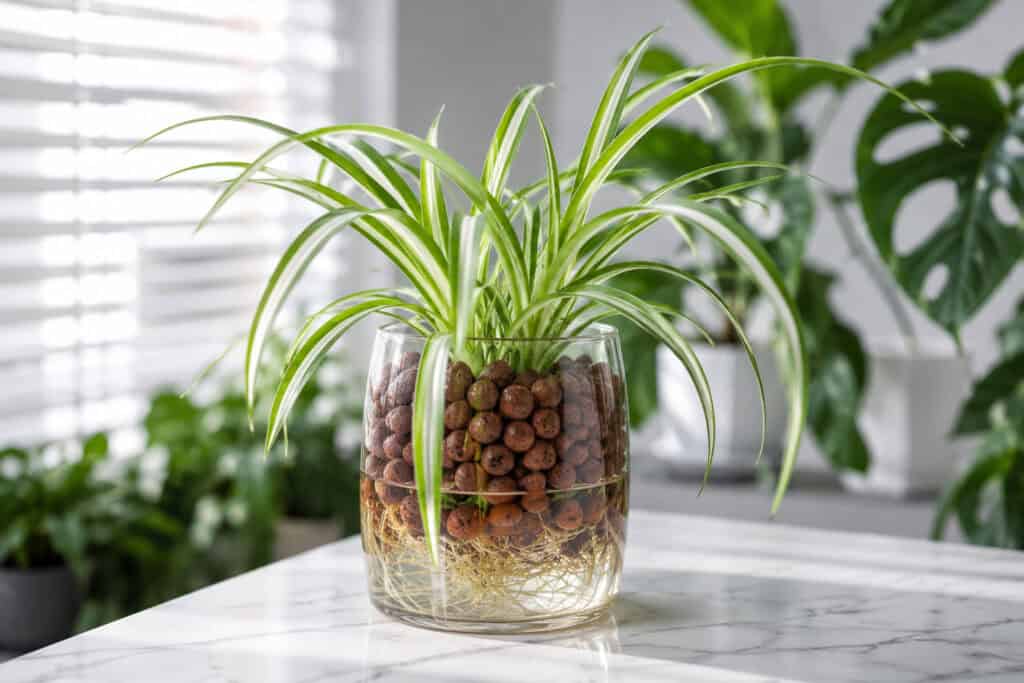
Spider plants (Chlorophytum comosum) grow well in LECA (Lightweight Expanded Clay Aggregate), a semi-hydroponic method that uses porous clay pebbles and a water reservoir instead of soil.
The plant self-waters through capillary action, and old soil roots are shed and replaced by new water roots.
Key variables include reservoir depth, hydroponic nutrient concentration, water pH (6.0 to 6.5), and regular flushing. Critical warning: never use standard houseplant fertilizer in a LECA setup.
If you have tried growing a spider plant in soil and watched it sulk in a soggy pot, develop brown tips you cannot explain, or attract fungus gnats every summer, you are not alone.
Our guide to spider plant overwatering signs covers that soil-based struggle in detail, and it is worth reading if you are still deciding whether to switch systems entirely.
Most of the frustration people experience with spider plants in traditional soil comes down to one problem: too much water with nowhere to go.
LECA changes that completely. It is one of the most forgiving setups you can try, and spider plants take to it surprisingly well once you understand how the system actually works.
Our spider plant care guide covers soil-based care if LECA turns out not to be the right fit for your setup.
This is not just a matter of swapping out the growing medium.
There are real differences in how you feed the plant, how you manage the water level, and what happens to the roots during the transition that most guides skip over entirely.
This article covers the full picture: why spider plants are well suited to LECA, how to set up the system correctly, what to expect during the soil-to-LECA transition, and the specific mistakes that cause most setups to fail.
By the end, you will have a clear and honest picture of what growing a spider plant in LECA actually involves.
Why Spider Plants Are a Strong Match for LECA
Spider plants are native to the coastal regions of South Africa, where they grow in well-draining, aerated soil and experience natural wet-dry cycles.
Their tuberous, fleshy roots store water, which means they are built to handle fluctuating moisture levels.
That same root structure makes them more tolerant of a hydroponic setup than many houseplants.
When placed in LECA over a reservoir, Chlorophytum comosum adapts efficiently because it can draw water as needed rather than sitting in saturated soil.
One thing worth knowing: spider plants are thirsty compared to succulents and drier-preference plants like sansevieria.
In LECA, that actually works in your favor. Where a snake plant might struggle if the reservoir stays consistently full, a spider plant drinks the water fast enough that the roots rarely sit stagnant.
The higher moisture turnover keeps the system fresh.
The main benefits of growing a spider plant in LECA are specific and measurable, not just theoretical.
Overwatering is the single most common way to kill a spider plant in soil, and LECA makes it structurally difficult to overwater because capillary action only draws water up to the roots rather than saturating the medium from above.
Fungus gnats, which breed in moist organic soil, have no habitat in an inorganic LECA setup.
And because the pebbles never compact or break down, root health stays consistently good over years without repotting, which sidesteps the entire issue covered in our guide to a pot bound spider plant.
What You Need Before You Start
The equipment list is short. You do not need specialist hydroponic gear to get started. Here is what works and why each item matters.
| Item | Why It Matters |
| LECA pebbles | The growing medium. Rinse thoroughly and soak for 24 hours before use so the pebbles are fully hydrated and capillary action works correctly from day one. |
| Net pot or inner pot | Holds the plant and LECA. Gaps or holes allow roots to extend down into the reservoir below. |
| Outer cachepot or reservoir | Holds the nutrient solution. Opaque is better than clear once the plant is established, as light exposure causes algae growth in the reservoir. |
| Hydroponic nutrient solution | Essential, not optional. Standard houseplant fertilizer lacks calcium and magnesium that soil normally provides. Without a dedicated hydroponic formula, the plant will develop yellowing leaves within weeks. |
| pH meter or test strips | Spider plants absorb nutrients most efficiently at a water pH of 6.0 to 6.5. Outside this range, nutrients become unavailable regardless of how much fertilizer you use. |
| EC meter (optional but useful) | Measures nutrient concentration. Keeping electrical conductivity between 1.0 and 1.5 mS/cm prevents both underfeeding and fertilizer burn. |
| Filtered or distilled water | Spider plants are highly sensitive to fluoride in tap water. In a LECA system, fluoride accumulates faster than in soil because there is no organic buffer to bind it. Filtered or distilled water eliminates the problem entirely. |
Tip: The Water Choice That Makes the Biggest Difference
Most guides treat water quality as an afterthought. In a LECA setup, it is the single most important variable.
Tap water in many US cities contains fluoride, and LECA pebbles act like sponges for mineral salts, concentrating them over time.
Spider plants push these minerals to their leaf tips through a process called fluoride translocation, where the tissue at the tip dies and turns crispy brown.
Switching to filtered or distilled water from the start prevents this entirely and removes the most common reason spider plant tips turn brown in hydroponic setups.
Transitioning a Spider Plant from Soil to LECA
This is the part most guides handle too quickly, and it is where the most setups fail. The transition from soil to LECA is not just a physical repotting.
It triggers a fundamental change in how the plant’s root system works.
Soil roots and water roots are structurally different. Soil roots are built to pull moisture from air pockets and organic particles.
They are not adapted to a continuously moist environment, and when you place them into a LECA reservoir setup without preparation, many will rot.
This is normal, expected, and not a sign of failure. The plant needs time to grow a new set of roots adapted to drawing water from a reservoir.
These water roots look different: they are smoother, thicker, and often develop fine root hairs that improve moisture absorption in a hydroponic environment.
The mistake most beginners make is misreading this root-shedding as something going wrong. It is not.
But you can reduce the stress on the plant and make the transition more reliable by following the steps below carefully.
Step 1: Remove All Soil from the Roots
Lift the spider plant out of its current pot and shake off as much loose soil as possible. Then rinse the roots thoroughly under lukewarm water.
The goal is to remove every trace of potting mix from the root system. Any soil left on the roots will stay continuously wet once in LECA and will eventually rot, often infecting the surrounding healthy roots in the process.
If any roots look brown, soft, or mushy during this step, trim them cleanly with sterile scissors.
You want only firm, pale roots going into the new medium.
Some growers spray the cleaned roots with a diluted 3% hydrogen peroxide solution at this stage to kill any residual pathogens before replanting.
Step 2: Water Propagation Phase (Recommended for Large Plants)
For a mature, well-established spider plant with an extensive soil root system, jumping straight from soil into LECA increases the risk of a prolonged transition slump.
A better approach is to place the cleaned plant into a container of plain water for two to three weeks first, using the same principle covered in our guide to propagating spider plants in water.
Keep the container in bright, indirect light. During this time, the plant will shed its old soil roots and begin producing water roots from the base.
Once you see white, actively growing water roots that are at least one to two inches long, the plant is ready to move into LECA.
You can skip this water propagation phase for young plants or small divisions, as they transition more easily than mature specimens.
Step 3: Prepare and Pre-Soak the LECA
Rinse the LECA pebbles in a colander under running water until the water runs completely clear.
Then soak them in clean water for at least 24 hours before planting. This is not just about cleanliness.
Dry LECA pebbles do not wick well because the internal pores are empty.
Pre-soaked pebbles have active capillary action from the start, which matters during the critical first weeks when the plant is establishing new roots.
Step 4: Pot the Plant
Add a base layer of pre-soaked LECA to the inner pot, about one-third full.
Position the spider plant on top, then fill LECA in around the roots carefully, making sure the crown of the plant sits above the pebble line.
Pressing LECA too tightly around the roots restricts the airflow that makes the system work, so pack loosely and let the pebbles settle naturally.
Place the inner pot into the outer cachepot. Add your prepared nutrient solution to the outer pot, filling it to a level that sits just below the bottom of the inner pot or touches only the lowest layer of LECA.
The correct starting position for the water line is critical and is covered in detail in the next section.
Step 5: Monitor the First Four to Six Weeks
The first month is the adjustment period. During this time, the plant may look slightly stressed: leaves might droop a little, growth will slow, and you may notice some old roots darkening and dying off.
This is the root transition happening. As long as the crown stays firm and upright and you begin to see new pale roots emerging, the plant is adapting successfully.
Keep the setup in bright, indirect light during the transition.
Higher light intensity drives photosynthesis, which in turn supports root development, so it’s worth reviewing our spider plant light requirements guide if you’re unsure your spot is bright enough.
A low-light corner will slow the transition noticeably.
Getting the Water Level Right
This is the most commonly misunderstood aspect of LECA growing, and getting it wrong in either direction causes problems.
The water line in the outer reservoir should sit just below the base of the inner pot during the establishment phase.
The LECA wicks moisture upward through capillary action, keeping the root zone consistently moist without drowning the roots.
If the water line sits above the bottom of the inner pot, the base-level roots will be submerged in standing water with no access to oxygen.
This causes exactly the kind of root rot that LECA is supposed to prevent.
Once the plant is established and roots have grown down through the LECA and into the reservoir, you can allow the water line to rise slightly.
Roots that grow directly into the reservoir have adapted to that environment, just like in a Kratky-style passive hydroponics setup. But do not force this by flooding the reservoir early.
A practical rule for ongoing maintenance: refill the reservoir when it is one-quarter full or less.
Letting it run completely dry is stressful for an established plant but unlikely to cause serious damage for a day or two.
Leaving it overfull for extended periods is more likely to cause long-term root damage.
| Tip: Use a Clear Inner Pot During the Transition Using a transparent nursery pot as your inner container during the first month lets you watch the water line and observe root development without disturbing the plant. Once the plant is fully transitioned and you see healthy roots filling the LECA, you can move it to a more decorative opaque cachepot. The inner pot with drainage holes goes inside the cachepot, and the water level sits in the outer container. |
Feeding Your Spider Plant in LECA
LECA provides zero nutrients. Every mineral the plant needs must come from the water you add to the reservoir.
This is where most people using LECA for the first time make a costly mistake: reaching for a standard houseplant fertilizer and adding it to the reservoir.
Standard houseplant fertilizers, including the kind covered in our guide to fertilising a spider plant for soil-grown plants, are formulated for use in soil, where the growing medium itself provides calcium, magnesium, and a range of trace minerals.
These are missing from most bottled houseplant feeds because soil was never supposed to be the only source.
In a soilless system, that gap shows up quickly: leaves turn pale yellow, new growth comes in small and weak, and the plant gradually deteriorates even though it appears to be receiving regular feeding.
The solution is a dedicated hydroponic nutrient formula.
Look for products specifically labeled for hydroponic use, as these are formulated to provide a complete mineral profile including calcium, magnesium, iron, and other trace elements.
General Hydroponics FloraSeries, the Foliage Focus line from Growth Technology, and similar products are widely available and work well.
Mix the nutrient solution at the dilution rate recommended on the label for the specific type of plant.
EC and pH: The Two Numbers That Matter
Electrical conductivity (EC) measures the concentration of dissolved nutrients in your reservoir water.
For spider plants in LECA, maintain an EC of 1.0 to 1.5 mS/cm. Below this range, the plant is being underfed.
Above it, fertilizer salts accumulate faster, increasing the risk of burn and the need for more frequent flushing.
pH determines whether the plant can actually absorb the nutrients in the water.
Spider plants in LECA access nutrients most efficiently at a pH of 6.0 to 6.5. Above 6.5, certain minerals become chemically unavailable regardless of how much nutrient solution you use.
This is called nutrient lockout, and it is one of the most common causes of unexplained yellowing in otherwise well-maintained hydroponic setups.
You do not need to obsess over these numbers daily. Check pH and EC each time you refill the reservoir, adjust if needed, and develop a routine.
After a few weeks, the routine becomes quick and almost automatic.
| Tip: Do Not Fertilize Immediately After Transitioning After moving a spider plant from soil to LECA, wait until you see new white roots actively growing before introducing nutrient solution. Feeding too early stresses a root system that is already in shock from the transition. Start with plain pH-adjusted water for the first two to three weeks, then introduce nutrients at half the recommended strength before building up to a full dose. |
Flushing: The Maintenance Step Most Guides Underexplain
Flushing is the process of running clean water through the LECA to remove accumulated mineral salts.
In a LECA system, these salts build up over time from fertilizer residue, tap water minerals, and plant waste.
If left unchecked, the white crusty deposits you will start to notice on the surface of the pebbles and the top of the pot are a visible sign of this buildup.
Spider plants are uniquely sensitive to this kind of accumulation. They are one of the most fluoride-sensitive houseplants available, and LECA concentrates fluoride from water far faster than organic soil does.
Even if you switch to filtered water, residual minerals from the nutrient solution itself will eventually accumulate. Flushing prevents this from reaching levels that cause leaf tip damage.
Flush the LECA roughly every four weeks.
The simplest method is to take the inner pot to a sink or shower and run clean water through the pebbles for several minutes, allowing it to drain freely from the bottom.
This resets the mineral balance and gives you a cleaner starting point when you refill the reservoir with fresh nutrient solution.
If you notice brown tips developing despite good water quality and proper pH, increase flushing frequency to every two to three weeks.
Light, Temperature, and Placement
Spider plants do not have demanding light requirements, but they are not no-light plants either.
Our guide to whether spider plants can grow in low light covers the soil-grown baseline, but LECA raises the stakes slightly.
In a LECA setup, adequate light is more important than in soil because photosynthesis drives the plant’s ability to take up water and nutrients through its new root system.
The ideal placement is near a bright window with indirect light. A north or east-facing window in most US homes provides enough light year-round without the intensity of direct afternoon sun.
South and west-facing windows can work if the plant is set back two to three feet from the glass. Direct sun, especially through south-facing glass in summer, will bleach the variegated leaves and stress the root system.
Spider plants prefer temperatures between 60 and 80 degrees Fahrenheit.
They will tolerate conditions outside this range temporarily, but consistent cold below 50F damages the tuberous roots, and the plant will stop drinking from the reservoir in cool conditions, which can lead to stagnant water sitting in the pot longer than it should.
Avoid placing LECA setups near drafty windows or air conditioning vents for this reason.
Humidity above 40 percent suits spider plants well. In very dry indoor environments, particularly in heated homes during winter, the leaf tips may brown even in a well-maintained LECA system.
The LECA helps with root-zone moisture, but the leaves still transpire and need some ambient humidity.
A small humidifier nearby, or grouping the plant with other LECA-grown plants, raises local humidity without major effort.
Growing Spiderettes in LECA
Spider plants produce dangling offshoots called spiderettes on long arching stems called stolons, the same reproductive habit covered in our guide to a bushier spider plant.
These small plantlets are one of the easiest things to propagate in LECA, and starting them in LECA rather than transitioning a mature plant removes the root-system adjustment challenge entirely.
The most reliable method is to root the spiderette in water first, following the same steps in our spider plant propagation guide.
Select a spiderette that already has small roots emerging from its base, as these have higher success rates than those without visible roots.
Place it in a small jar of clean, pH-adjusted water with the base just touching the water surface and keep it in bright indirect light. Change the water every few days to prevent stagnation.
Within one to two weeks, you will see white roots developing. Once they reach one to two inches in length, the spiderette is ready for LECA.
Fill a small net pot with pre-soaked LECA, nestle the spiderette in with its roots pointing down, and set it in a small reservoir with the water line just below the base of the pot.
From this point, it grows into the system naturally with no transition shock, because it has only ever known water roots.
| Tip: Start Spiderettes Small to Make Everything Easier The smaller and younger the plant going into LECA, the easier the transition. Starting with a spiderette rather than dividing a mature plant is the lowest-stress path to a healthy LECA spider plant. You get to observe the root development from the beginning, there is no old soil root system to worry about, and the plant reaches a stable equilibrium much faster. If you want to experiment with LECA and have access to spiderettes, start there rather than with the mother plant. |
Troubleshooting Common Problems
Brown Leaf Tips
This is the most common complaint from people growing spider plants in LECA, and it usually has one of three causes, alongside the wider set of causes in our spider plant brown tips guide.
First, fluoride accumulation in the LECA from tap water or the fertilizer formula. Second, insufficient flushing, allowing mineral salts to build to levels that burn leaf tissue.
Third, water pH that is too high, locking out calcium and causing tip necrosis that resembles fluoride damage.
Work through these in order.
Switch to filtered or distilled water first, increase flushing frequency, then check and adjust the reservoir pH.
If tips are browning despite all of this, check whether your nutrient solution contains boron, which also causes tip burn in sensitive plants like spider plants.
Switch to a formula with lower boron content if needed.
Yellow Leaves
Uniform yellowing across new growth points to a nutrient deficiency, most often a shortage of calcium, magnesium, or iron.
Our guide to spider plant leaves turning yellow covers the soil-based causes, which mostly do not apply here.
This happens almost exclusively when people use standard houseplant fertilizer instead of a hydroponic formula.
Switch to a complete hydroponic nutrient solution and the yellowing will stop within two to three weeks as new growth comes in healthy green.
If only older, lower leaves are yellowing while new growth is healthy, this is more likely natural senescence, meaning the plant is cycling out its oldest leaves.
This is normal and not a nutrient problem.
Roots Rotting During Transition
Some root loss during the soil-to-LECA transition is normal.
But if the crown of the plant becomes soft or mushy, or if an unpleasant smell develops, root rot has progressed beyond the expected adjustment.
Remove the plant from the LECA immediately, trim all soft and discolored roots to firm, white tissue, rinse the LECA, and restart the setup with the plant back in plain water for two weeks before returning it to LECA.
This resets the process and usually saves the plant.
Algae in the Reservoir
Green algae growing on the reservoir walls or the outer pot is caused by light reaching the nutrient solution.
Algae itself is not immediately harmful to the plant, but heavy buildup consumes dissolved oxygen and can eventually outcompete the plant for nutrients.
Switch to an opaque outer pot and the problem stops. If algae has already established in the system, empty the reservoir, clean it with a diluted hydrogen peroxide solution, and refill with fresh nutrient water.
Plant Leaning or Unstable
A spider plant that leans or tips in LECA is either underpotted for its size or has not yet developed enough water roots to anchor itself through the pebbles.
Add more LECA around the base and press gently to stabilize, or move the plant to a slightly wider pot.
This resolves itself as roots fill the medium.
| Problem | Likely Cause | How to Confirm | Solution |
| Brown, crispy leaf tips | Fluoride buildup or salt accumulation in LECA | White crust visible on LECA surface; brown confined strictly to leaf tips | Switch to filtered water; flush LECA monthly; check pH |
| Yellow new leaves | Missing calcium/magnesium from standard fertilizer use | New growth pale; older leaves still green | Switch to a complete hydroponic nutrient formula |
| Root rot during transition | Soil left on roots; reservoir too high; poor root cleaning | Mushy crown; foul smell; widespread black roots | Remove plant; trim all soft roots; restart in plain water |
| Green algae in reservoir | Light reaching the nutrient solution | Green slime or coating on inner walls of outer pot | Switch to an opaque outer pot; clean reservoir with diluted hydrogen peroxide |
| Plant leaning or wobbling | Insufficient roots in LECA or pot too small | Plant tips when gently pressed; visible lack of root anchoring | Add more LECA around base; upsize pot; wait for roots to fill medium |
| No growth after 6 weeks | Too little light; pH too high; root transition stalled | No new leaves; roots appear dark or absent | Move to brighter location; check and adjust pH to 6.0 to 6.5; trim dead roots |
LECA vs. Pure Water vs. Soil: Which Is Best for Spider Plants?
All three methods can work for spider plants, but they suit different growers and different goals.
Understanding where each one fails helps you choose based on your actual situation rather than what is trending.
| Factor | LECA / Semi-Hydro | Pure Water | Potting Soil |
| Overwatering risk | Low | None | High |
| Root visibility | Good (clear pots) | Excellent | None |
| Pest risk | Low | Very low | Moderate to high |
| Nutrient management | Required | Required | Simpler |
| Initial setup complexity | Moderate | Simple | Minimal |
| Long-term maintenance | Low once established | Moderate (water changes) | Moderate (watering, repotting) |
| Best suited for | Growers who want low maintenance once set up and better root health than soil | Propagating spiderettes or temporary growing | Complete beginners who prefer a familiar medium |
Pure water growing is sometimes recommended as the simplest hydroponic approach, and for propagating spiderettes it genuinely is.
But long-term, spider plants in plain water without nutrients will eventually show signs of deficiency, and the lack of any physical medium to anchor the roots means the plant stays permanently fragile. LECA solves both issues.
Soil remains the easiest starting point for complete beginners, but it carries inherent overwatering risk and is harder to recover from once root rot sets in. Our best soil for a spider plant guide is the place to start if soil is still the right choice for you.
For anyone who has struggled repeatedly with soil-grown spider plants, LECA is worth the learning curve.
Seasonal Adjustments in a LECA Setup
Spider plants slow down noticeably in fall and winter. Shorter days reduce the light available for photosynthesis, which in turn slows water uptake from the reservoir.
During this period, the reservoir will last longer between refills, and the plant needs less nutrient solution.
In practice, this means checking the reservoir every one to two weeks in summer but potentially stretching that to two to three weeks in winter.
Avoid the temptation to keep adding nutrient solution at the same rate year-round, as this leads to salt buildup in the LECA during the months when the plant is drinking least.
Reduce fertilizer concentration by about 25 to 30 percent from October through February and return to full strength in March as new growth resumes.
Continue flushing on the same monthly schedule regardless of season, since salt accumulation slows but does not stop in winter.
| Info: Related Growing Guides For readers who want to explore other low-maintenance semi-hydroponic setups, pothos in LECA and philodendrons in LECA follow very similar principles and work well alongside spider plants in a mixed LECA collection. The core system setup, nutrient requirements, and flushing schedule are nearly identical. |
| Warning: Spider Plants and Pets Chlorophytum comosum is classified as non-toxic to dogs and cats by the ASPCA. However, the plant contains saponins and mildly hallucinogenic compounds that can attract cats and cause mild gastrointestinal upset if chewed, including temporary vomiting or diarrhea. Cats in particular are sometimes drawn to spider plants. If you have cats that show interest in the plant, hang it in a hanging cachepot or position it somewhere out of reach. The plant is not dangerous in the way that true toxic plants are, but repeated chewing is unpleasant for the cat and damaging to the plant. |
UK Reader Note: Water Quality and LECA
Water hardness varies significantly across the UK, and areas with hard water (such as much of London, the South East, and the East Midlands) have high mineral content including calcium and magnesium.
In a LECA system, hard tap water accelerates salt buildup in the pebbles substantially faster than soft water areas in Scotland, Wales, and the North West.
UK growers in hard water regions should flush their LECA every two to three weeks rather than monthly, and filtering or using collected rainwater makes a meaningful difference.
RHS: How to grow houseplants notes that tap water fluoride can be toxic to sensitive plants with effects accumulating over time, and spider plants are among the most sensitive commonly grown in UK homes.
Frequently Asked Questions
Can you grow a spider plant in LECA long-term, or is it just for propagation?
Spider plants grow very well in LECA as a permanent long-term setup, not just for propagation.
Once the plant completes the soil-to-water root transition, which typically takes four to eight weeks, it settles into the system and often grows more vigorously than it did in soil.
Mature specimens kept in LECA for several years develop extensive root systems that fill the container, and the plant continues to produce stolons and spiderettes normally.
The main ongoing requirements are a complete hydroponic nutrient solution, pH-adjusted water, and monthly flushing of the pebbles.
Beyond that, long-term LECA care is genuinely lower maintenance than soil, and it sidesteps the periodic repotting covered in our how and when to repot a spider plant guide almost entirely.
Do you need a special fertilizer for spider plants in LECA?
Yes, and this is non-negotiable. Standard houseplant fertilizers are formulated for use in soil, where the growing medium supplies calcium, magnesium, and trace minerals that the fertilizer does not.
In a LECA setup, the medium provides nothing. Using a standard fertilizer will result in visible deficiencies within a few weeks, typically showing as pale yellow new leaves.
You need a dedicated hydroponic nutrient formula that provides a complete mineral profile, including calcium, magnesium, iron, and micronutrients.
Look for products marketed for hydroponic use. Mix at the recommended hydroponic dilution rate, not the soil application rate, as hydroponic concentrations are typically lower.
How often should you change the water in a LECA spider plant setup?
You do not change the water on a fixed schedule the way you would with a vase of cuttings in pure water.
Instead, you refill the reservoir with fresh nutrient solution when it runs low.
In a semi-hydroponic LECA setup, the reservoir typically needs topping up every one to two weeks in summer and every two to three weeks in winter, depending on the size of the plant and the pot.
Every four weeks, perform a full flush by running clean water through the LECA to remove accumulated mineral salts.
After flushing, refill the reservoir with fresh nutrient solution rather than returning the flushed water.
Why are my spider plant’s leaf tips turning brown in LECA?
Brown leaf tips in a LECA spider plant setup are almost always caused by fluoride accumulation, salt buildup in the pebbles, or pH that is too high.
Spider plants are among the most fluoride-sensitive houseplants, and LECA concentrates minerals faster than organic soil because it has no natural buffer.
The first step is to switch from tap water to filtered or distilled water. The second is to increase flushing frequency to clear accumulated salts.
The third is to check and adjust the reservoir pH to between 6.0 and 6.5.
If tips continue browning after all three steps, check whether your nutrient formula contains boron, which also causes tip necrosis at elevated levels.
What happens to the roots when you move a spider plant from soil to LECA?
When a soil-grown spider plant is moved to LECA, its existing soil roots begin to die off over several weeks.
This happens because soil roots are structurally adapted to draw moisture from organic particles and air pockets in potting mix.
They are not built to function efficiently in a constantly moist, soilless environment. As the soil roots shed, the plant simultaneously grows a new type of root system called water roots.
These are typically smoother, thicker, and paler than soil roots, and they are adapted to draw water from a reservoir environment.
The presence of fine root hairs on water roots improves moisture uptake in hydroponic conditions.
The transition looks alarming the first time you see it, but it is a normal and necessary process.
Can you use tap water for spider plants in LECA?
You can, but it comes with significant risks that are compounded in a LECA system.
Most US municipal water supplies contain added fluoride and chlorine, and some use chloramine (a combined chlorine and ammonia compound) that does not evaporate like regular chlorine.
Spider plants are highly sensitive to fluoride, which accumulates in the LECA over time and eventually causes brown leaf tip damage through a process called fluoride translocation.
In a LECA setup, these minerals concentrate faster than in soil because there is no organic material to bind them.
If you must use tap water, at minimum let it sit uncovered for 48 hours to allow chlorine to dissipate, and increase flushing frequency to every two weeks.
Filtered or distilled water eliminates the risk entirely and is the recommended approach.
How much light does a spider plant need in a LECA setup?
Spider plants in LECA need bright, indirect light for the system to work effectively.
Light drives photosynthesis, which in turn powers the plant’s ability to take up water and nutrients from the reservoir.
In low-light conditions, the plant slows its water uptake, nutrients accumulate in the reservoir instead of being used, and the salt buildup accelerates.
A north or east-facing window suits spider plants well. South or west-facing windows work if the plant is placed a few feet back from the glass to avoid direct sun exposure.
Variegated spider plants with white-striped leaves need slightly more light than solid green varieties to maintain their coloring, a distinction covered across the different types of spider plants.
Can spider plant spiderettes be rooted directly in LECA?
Yes, but rooting them in water first and transferring once roots are one to two inches long gives more reliable results than placing rootless spiderettes directly into LECA.
The reason is timing: a rootless cutting placed directly into LECA can dry out at the base before it develops enough root contact with the moist pebbles to sustain itself.
When you pre-root in water, the plant arrives in LECA already adapted to a water environment and establishes quickly.
Select spiderettes that already have small root nubs visible at the base, as these root faster than those without. Within two weeks in water, they are typically ready to transfer.
Key Takeaways
- Soak LECA pebbles for 24 hours before planting and rinse until the water runs clear so capillary action works correctly from day one.
- Use filtered or distilled water throughout. Tap water fluoride accumulates in LECA faster than in soil and is the most common cause of brown tips in this setup.
- Never use standard houseplant fertilizer in a LECA setup. Switch to a complete hydroponic nutrient formula that includes calcium, magnesium, and trace minerals.
- Keep the reservoir water line just below the base of the inner pot during the establishment phase. Submerging the base of the pot causes root rot, not better growth.
- Wait for visible water roots before starting nutrient feeding. Use plain pH-adjusted water for the first two to three weeks after transitioning from soil.
- Maintain reservoir pH between 6.0 and 6.5. Above this range, nutrients become unavailable regardless of how much fertilizer you add.
- Flush the LECA with clean water every four weeks to remove mineral salt buildup. Increase to every two weeks if brown tips appear despite correct water quality.
- Expect old soil roots to shed during the transition. This is normal. Healthy water roots will replace them within four to eight weeks.
- Reduce nutrient concentration by 25 to 30 percent in fall and winter when the plant drinks less and salt accumulation risk increases.
- Use an opaque outer pot once the plant is established to prevent algae growth in the reservoir from light exposure.
Final Thoughts
The reason so many people struggle with spider plants in soil comes back to a single problem: water.
Too much, sitting in a medium that holds it longer than the roots can tolerate. LECA removes that problem structurally, giving the roots access to moisture on their own terms while keeping the root zone well-oxygenated.
The transition does take patience. The first four to eight weeks can look unsettling as old roots die back and new ones slowly take hold.
But once the plant is established in LECA, it tends to stay healthy for years with less ongoing effort than soil-grown specimens require.
The clarity of being able to see exactly how much water is in the reservoir, and knowing the root zone is not waterlogged, genuinely changes how confident you feel about the plant.
Spider plants in LECA are not a trend worth trying once and discarding. For growers who have lost plants to overwatering or fought recurring fungus gnats in soil, it is a straightforwardly better system once the setup is correct.
What’s Next
If your spider plant is newly transitioned to LECA and still in the adjustment phase, the most useful next step is to pick up a digital pH meter and test your reservoir water before the next refill.
pH is the most overlooked variable in LECA setups and the most common reason plants plateau after a promising start. A
reading outside the 6.0 to 6.5 range explains more unexplained problems than almost any other factor in semi-hydroponics.
For the fuller soil-based picture to compare against, our spider plant care guide covers watering, light, and repotting for traditional setups.
Mariel is a plant enthusiast and writer based in the UK with a passion for houseplants and indoor growing.
She has spent the last few years building an ever-growing collection of indoor plants and learning the hard way which ones will survive her busy schedule.
At Bean Growing she writes about houseplant care, common plant problems, and outdoor gardening.