
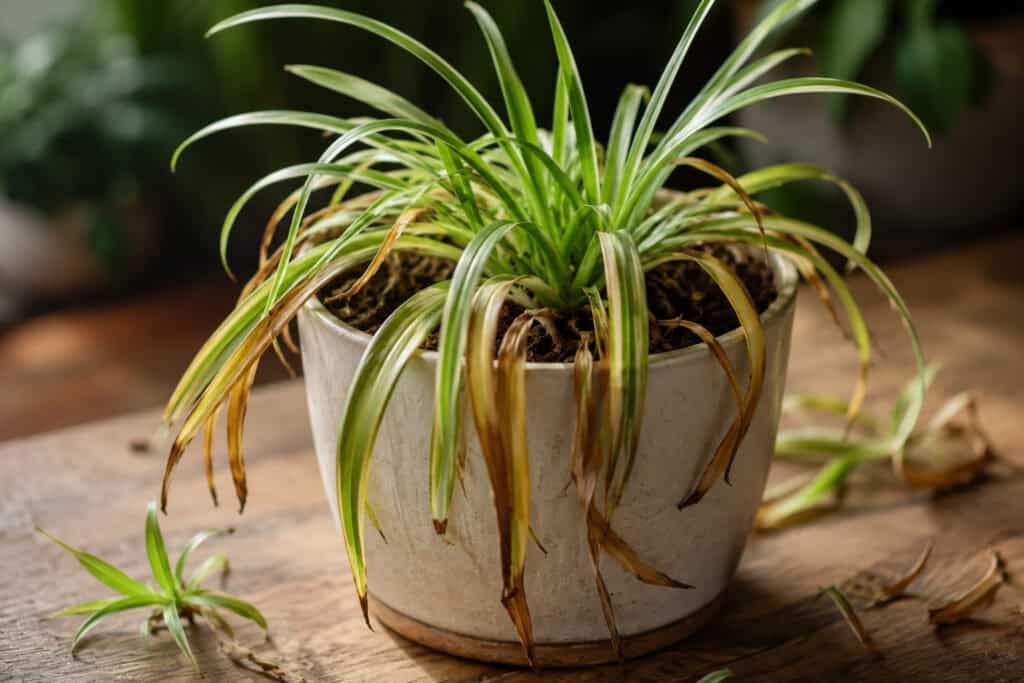
Spider plant overwatering signs include yellowing leaves starting at the base, limp or drooping foliage despite wet soil, soft mushy stems, brown leaf tips accompanied by yellowing, waterlogged or foul-smelling soil, visible mold on the soil surface, fungus gnats hovering around the pot, and brown mushy roots.
Overwatering is the most common cause of spider plant decline. Without prompt action, it leads to root rot and plant death.
You watered your spider plant, gave it a bright spot by the window, and a few weeks later the leaves are limp and yellow.
You water it again because surely that will help. It does not help. It makes everything worse.
This is the trap almost every new spider plant owner falls into, and it is surprisingly easy to do.
Spider plants (Chlorophytum comosum) have a reputation for being nearly indestructible. That reputation is mostly earned, but it creates a blind spot.
Our spider plant care guide covers the basics that keep most plants out of trouble in the first place, but overwatering is specific enough to deserve its own breakdown.
People assume that if something is wrong, the plant must need more water. In reality, too much water is the single most common reason spider plants deteriorate, and the signs are easy to misread if you do not know what you are looking at.
This guide walks through every overwatering sign in detail, explains what is actually happening inside the plant at each stage, and shows you how to distinguish overwatering from underwatering so you do not accidentally make a struggling plant worse.
You will also find a clear recovery plan covering everything from adjusting your watering habit to treating root rot.
Why Spider Plants Are Particularly Vulnerable to Overwatering
Spider plants are native to tropical and southern Africa, where they grow in environments with distinct wet and dry periods.
Their roots evolved to handle brief droughts comfortably. Those same roots are not built to sit in constantly moist soil.
The roots need oxygen to function. Waterlogged soil eliminates the air pockets that provide it. When roots are deprived of oxygen, they suffocate and begin to die.
Dead roots cannot absorb water or nutrients. The plant then shows stress symptoms that look exactly like drought stress, which is where the confusion begins.
Spider plants also store water in their fleshy, tuberous roots. This means they can tolerate short dry spells far better than short wet spells.
A plant that dries out briefly will recover quickly. A plant that sits in wet soil for even a week can develop problems that take months to reverse.
In low-light conditions, which are common indoors, the soil dries much more slowly than most growers expect.
Checking our spider plant light requirements guide alongside your watering routine helps explain why the same schedule can be right in one room and wrong in another.
A plant sitting in a dim corner in winter may only need watering once every two to three weeks.
Watering it on a fixed weekly schedule without checking the soil first is one of the most reliable ways to overwater it.
The 8 Signs of an Overwatered Spider Plant
These signs typically appear in rough sequence as overwatering progresses from mild to severe.
Catching them early gives you the best chance of a full recovery without having to treat root rot.
1. Yellowing Leaves Starting at the Base
Yellowing is the first visible signal that something is wrong, and its location on the plant tells you a lot.
When overwatering is the cause, the lower leaves closest to the soil turn yellow first.
They shift from deep green to pale green and then to full yellow, sometimes in a matter of days if the soil has been wet for a while.
What is actually happening: the roots in waterlogged soil cannot absorb nutrients because they are oxygen-deprived and beginning to break down.
Without nutrients reaching the leaves, the plant breaks down chlorophyll and the green colour disappears. This biological process is called chlorosis.
The important distinction: if only the oldest, lowest leaves are yellowing slowly and the rest of the plant looks healthy, that is normal aging.
Our guide to spider plant leaves turning yellow walks through the full range of causes if overwatering does not turn out to be the explanation.
If yellowing is spreading upward across multiple leaves at once, overwatering is the most likely cause. Check the soil immediately.
Yellow leaves caused by overwatering will also feel slightly soft or limp rather than firm and crisp.
If you hold an affected leaf and it bends easily rather than holding its arch, that softness is another indicator of water stress.
2. Wilting or Drooping Leaves Despite Wet Soil
This is the sign that confuses people most, and it is the one most likely to cause them to make the problem worse.
A wilting plant looks like it needs water. You feel the leaves, they are soft and droopy, so you water it.
But the soil is already wet, and adding more water makes the situation worse.
Wilting from overwatering is caused by root damage, not by drought. The roots can no longer move water and nutrients into the plant effectively because they are compromised.
Our guide to spider plant leaves drooping covers the drought-related causes of the same visible symptom, which is worth ruling in or out alongside the soil test below.
The plant is wilting for the same reason a plant wilts in drought, except the problem is not a lack of water in the soil. The problem is a lack of functional roots.
The test: push your finger two inches into the soil before you do anything else. If the soil feels damp, do not water.
If the leaves are drooping despite the soil being wet, overwatering is almost certainly the cause.
If the soil is dry and the leaves are drooping, then it is drought stress, and watering is the right response.
3. Soft, Mushy, or Swollen Stem Tissue
Run your fingers along the lower stems and the base of the plant. Healthy spider plant stems are firm and slightly waxy.
Overwatered stems feel soft, almost spongy, and may look slightly swollen or bloated. In more advanced cases, they can feel genuinely mushy and may bend without resistance.
This texture change is caused by a process called edema. Plant cells absorb more water than they can process, causing them to swell and eventually rupture.
The damaged cells create the soft, water-logged texture you feel. In severe cases, you may see small blister-like bumps on stems and the undersides of leaves, which later collapse into brown, corky patches.
Mushy stem tissue near the soil surface is a serious warning. It means the problem has been developing for long enough that cell damage is visible, and root rot may already be present below the surface.
4. Brown Tips with Yellowing at the Base of the Leaf
Brown leaf tips on spider plants are common and can have several causes including low humidity, fluoride in tap water, and excess fertilizer.
Our dedicated guide to spider plant brown tips covers all of them in detail.
On their own, they do not necessarily mean overwatering. The pattern matters.
When overwatering is the cause, brown tips appear alongside yellowing at the leaf base.
The tip browns while the rest of the leaf turns yellow. This combination is more specific to overwatering than brown tips alone, which can simply reflect water quality issues.
With underwatering or low humidity, you get dry, crispy brown tips but the rest of the leaf stays green and firm.
With overwatering, the tip browns while the surrounding leaf tissue goes soft and yellow.
That distinction is worth memorising because brown tips alone will send a lot of people in the wrong direction.
5. Brown Spots on the Leaves
Brown spots that appear on the middle or body of a leaf, rather than just at the tip or edge, are a more specific indicator of overwatering damage.
They typically start as small, rust-coloured specks and expand into irregular brown patches.
They may appear water-soaked at first, with a slightly translucent or dark quality to the affected tissue, and they are often surrounded by a yellow halo.
These spots form where leaf cells have been overwhelmed by excess water and have ruptured.
In some cases, particularly on the undersides of leaves, you will see the raised blister texture that precedes the browning.
If you notice soft, slightly raised patches on the undersides of leaves, check the soil moisture and check them again in a few days.
That blistering is an early warning before the brown spots become visible on the upper surface.
6. Waterlogged Soil and Unpleasant Smell
Healthy potting soil has a clean, earthy smell. Overwatered soil that has been wet for an extended period smells sour or rotten.
Getting the mix right in the first place makes this far less likely; our guide to the best soil for a spider plant covers what a well-draining mix should actually contain.
That unpleasant smell is produced by anaerobic bacteria thriving in the oxygen-depleted soil, and it is often the earliest indicator of root rot developing below the surface.
Press your finger into the soil. If it feels wet or soggy more than three days after you last watered, your drainage is insufficient or you are watering too frequently.
Healthy spider plant soil should feel barely moist at two inches deep a couple of days after watering, not wet.
Check for a white crusty layer on the soil surface or the inner walls of the pot.
This is mineral salt buildup from tap water and fertilizer, and it does not cause direct overwatering harm, but it indicates that the plant has been in the same soil for a long time without a refresh.
Old, compacted soil drains poorly and holds water far longer than fresh mix, which makes overwatering much more likely even when your watering frequency seems reasonable.
7. Mold or Fungal Growth on the Soil Surface
White or grey fuzzy growth on the surface of the soil is mold, and it grows when soil stays wet long enough for fungal organisms to establish.
It is not directly harmful to your spider plant in small amounts, but it is a clear signal that the soil is staying wet for too long between waterings.
Do not mistake this for the white mineral crust mentioned above. Mineral deposits are chalky and dry.
Mold is fuzzy and grows in patches. If you see mold, reduce your watering frequency immediately and improve airflow around the pot.
Mold on the surface means the conditions for root rot are already present below.
8. Fungus Gnats Flying Around the Pot
Fungus gnats are small, dark flies that look like tiny mosquitoes. They hover around the soil surface and lay their eggs in moist soil.
Their larvae feed on organic matter and, in heavier infestations, on plant roots. The adults are more annoying than harmful, but their presence is a reliable indicator that your soil is staying wet.
If you have fungus gnats, your soil is not drying out sufficiently between waterings.
This is true regardless of whether you are watering frequently or not, because the problem can also come from poor drainage, a pot without drainage holes, or a drip tray left full of water after watering.
Addressing the moisture level in the soil will resolve the gnat problem over time as you eliminate their breeding environment.
Root Rot: The Hidden Stage of Overwatering
Root rot is what happens when overwatering continues long enough for fungi and bacteria to colonise the root system.
It is the most serious consequence of overwatering, and it is dangerous precisely because you cannot see it without removing the plant from its pot.
BBC Gardeners’ World: Root rot in house plants covers the same underlying mechanism across houseplants more broadly, if you want a second reference point.
Healthy spider plant roots are white to pale cream, firm to the touch, and slightly bouncy when you press them.
They have a faint, clean scent. Roots affected by rot are brown to black, soft, and mushy. They smell foul.
In severe cases, the outer layer of the root slides off when you touch it, leaving a stringy core.
If your plant is showing multiple overwatering signs and is not improving after you have stopped watering, remove it from the pot and inspect the roots directly.
This is the only way to confirm root rot. Looking at the outside of the pot or checking soil moisture alone will not tell you whether the root system is compromised.
One thing many guides do not mention: partial root rot is very common, and partial root rot is treatable.
A plant does not need a fully intact root system to recover.
If you find a mix of healthy white roots and some brown mushy ones, the plant has a good chance of survival once you remove the damaged roots and repot into fresh, well-draining soil.
| Tip: When to Check the Roots If two or more overwatering signs are present at the same time, check the roots rather than waiting. The sooner you find and remove rotted roots, the better the recovery odds. A quick unpotting, even just to look, takes two minutes and could save the plant. |
Overwatered vs. Underwatered: How to Tell the Difference
The two conditions share several visible symptoms, which is exactly why getting the diagnosis wrong is so common. Here is a direct comparison of the most confusing signs:
| Sign | Overwatered | Underwatered |
| Leaf colour | Yellow, pale, soft | Green but dull or washed out |
| Leaf texture | Soft, limp, slightly swollen | Dry, papery, or brittle |
| Brown tips | Brown tips with yellowing below | Dry, crispy brown tips; rest of leaf stays green |
| Wilting | Drooping with wet soil | Drooping with dry soil |
| Soil condition | Wet, heavy, may smell sour | Dry, pulling away from pot edges |
| Stems | Soft, mushy at base | Firm but thin or shrivelled |
| Leaf drop | Both new and old leaves drop | Mainly old leaves or no new growth |
| Soil smell | Sour or rotten odour | Dry, neutral, or dusty |
The fastest diagnostic: push your finger two inches into the soil. Wet soil combined with any of the overwatered signs above confirms overwatering.
Dry soil with those same symptoms suggests drought stress, and watering is the right response.
One nuance that most guides miss: a plant can show signs of both at the same time if it has been oscillating between flooding and neglect.
In that case, the root system is damaged from root rot and the plant cannot take up water even when it is available.
The soil may be wet but the plant behaves as though it is dry. Fix the drainage and root rot first, and the other symptoms will resolve.
What Most Overwatering Guides Get Wrong
Several pieces of advice circulate widely about spider plant overwatering that are either incomplete or misleading in practice. Here is an honest assessment.
‘Let the top inch of soil dry out before watering’
This is correct in principle but the depth matters enormously depending on pot size and plant maturity.
For a small pot holding a young plant, one inch is reasonable. For a larger pot, the top inch can be completely dry while the bottom half of the soil is still saturated.
Relying solely on surface dryness in a deep pot will result in overwatering.
Better advice: check two inches deep in small pots and three inches deep in large pots. Our guide to watering a spider plant goes through this test in more detail, including how to adapt it by season.
The soil at that depth should feel barely moist at most, not cool and wet.
A wooden chopstick inserted into the soil and held for ten seconds will come out damp if moisture is present at depth, which is a reliable test without needing a moisture meter.
‘Water once a week’
A fixed schedule is the most common cause of overwatering. A spider plant in a warm, sunny room in summer may need watering every five to seven days.
The same plant in a north-facing room in winter may only need watering every two to three weeks.
Season, light level, pot material, and humidity all affect how quickly the soil dries.
Clay pots dry out faster than plastic or glazed ceramic because they are porous and water evaporates through the walls.
A plant in a clay pot may genuinely need weekly watering in summer. The same plant moved to a plastic nursery pot and placed in lower light may need watering half as often.
Treat every care tip that references a specific frequency as a starting point, not a rule.
‘Pebbles in the bottom of the pot improve drainage’
This advice is extremely common and it is incorrect. Placing a layer of pebbles or gravel at the bottom of a pot does not improve drainage.
Water moves through soil by capillary action, and it will not pass into the coarser pebble layer until the soil above it is fully saturated.
The result is that the bottom layer of soil stays wetter for longer than it would without the pebbles, which increases the risk of root rot.
What actually improves drainage: a pot with adequate drainage holes, a well-draining potting mix, and allowing the pot to drain completely after watering before returning it to its saucer.
How to Fix an Overwatered Spider Plant
Step 1: Stop Watering and Move the Plant
The first step is to stop adding water immediately. Move the plant to a spot with bright indirect light and good air circulation.
Avoid full sun, which can scorch stressed leaves. Good airflow will help the soil dry faster and reduce the risk of mold and rot spreading.
Step 2: Check Drainage
Tip the pot and look at the drainage holes. If they are blocked with compacted soil or roots, clear them.
If the pot has no drainage holes, that is a significant part of the problem. Remove the plant and repot it into a container with drainage holes as soon as possible.
Empty the drip tray if it is holding water. A saucer full of water will keep the bottom of the pot permanently wet regardless of how infrequently you water from above.
Step 3: Remove the Plant and Inspect the Roots
If the plant is not improving after a few days, or if the soil smells bad, remove the plant from its pot.
Shake away as much of the old soil as you can without being rough with the roots. Look at each root closely under good light.
Cut away any roots that are brown, black, mushy, or that smell bad. Use clean, sharp scissors and sterilise them between cuts with diluted bleach or rubbing alcohol if the rot looks severe.
Keep every root that is firm, pale, and intact.
Step 4: Treat the Roots
Once you have removed the damaged roots, let the remaining root system air dry for 30 to 60 minutes.
If you have activated charcoal or cinnamon powder available, dust the cut ends lightly.
Both have mild antifungal properties and can help reduce the chance of the rot spreading to healthy tissue.
Step 5: Repot in Fresh Soil
Choose a pot that is appropriate for the size of the remaining root system. After cutting away damaged roots, the plant may need a smaller pot than it was in before.
Our general guide to how and when to repot a houseplant covers the process step by step if you want the fuller picture beyond recovery repotting.
A pot that is too large will hold more soil than the roots can dry out, which recreates the overwatering conditions.
Use a well-draining potting mix. A standard indoor potting mix with added perlite at a ratio of roughly 3:1 potting mix to perlite works well.
This improves drainage and aeration significantly compared to a standard mix alone. Avoid heavy, peat-dominant mixes that retain moisture for extended periods.
Step 6: Adjust Your Watering Going Forward
After repotting, wait two to three days before watering lightly. The plant will be stressed and does not need an immediate thorough soaking.
Water sparingly for the first few weeks and allow the soil to dry to the depths described above before adding more.
Check the plant every few days and watch for new growth. New leaf growth is the clearest sign that the root system is recovering and functioning again.
Do not fertilize until you see active new growth, as fertilizing a stressed plant with compromised roots can cause further damage.
Once growth resumes, our guide to how to fertilise a spider plant covers how to restart feeding safely.
Recovery Timeline: What to Expect
| Timeframe | What You Should See | What to Do |
| Days 1-3 | No visible change; soil beginning to dry | Do not water; ensure good airflow |
| Days 4-7 | Leaves may still look poor; soil drying out | Check soil depth; water lightly only if very dry |
| Week 2 | Colour may stabilise; no further yellowing | Continue monitoring; remove any newly yellowed leaves |
| Weeks 3-4 | New small leaves may begin emerging | Resume normal watering routine; still no fertilizer |
| 6-8 weeks | Active growth resumes; plant looks fuller | Resume light fertilising if growth is strong |
| 3-4 months | Full recovery with healthy new foliage | Normal care routine |
Recovery speed depends heavily on how much of the root system was healthy when you intervened.
A plant caught early, before significant root rot, can look noticeably better within two weeks.
A plant that lost most of its roots will take much longer and may look worse before it looks better as it sheds damaged leaves to conserve energy.
How to Prevent Spider Plant Overwatering
Prevention is genuinely simpler than recovery. The habits below address the root causes of overwatering rather than just telling you to water less.
Use the Soil Test, Not a Schedule
Water only when the soil feels dry at two to three inches of depth. Make this the non-negotiable first step before every watering.
Season, light level, and pot type will all change how often that depth of soil dries out, so the test naturally adjusts for you.
A moisture meter can help if you find the finger test difficult to read, but it is not necessary.
Choose the Right Pot and Soil
Terra cotta pots are genuinely useful for spider plants that tend to get overwatered, because the porous walls allow excess moisture to evaporate.
They dry out faster and provide more forgiveness for owners who tend to water frequently.
Standard potting mix alone is often too moisture-retentive for spider plants kept indoors in lower light.
Adding perlite to the mix at a rough ratio of one part perlite to three parts potting mix improves drainage noticeably.
Avoid mixes marketed for tropical plants, as these are often formulated to retain moisture for longer periods.
Always use a pot with drainage holes, and always empty the drip tray within an hour of watering.
Never leave a spider plant sitting in standing water for extended periods.
Adjust for Season and Light
Reduce watering frequency in autumn and winter, even if the plant is in the same spot. Lower light and cooler temperatures both reduce the plant’s water uptake and slow soil evaporation.
A plant that needed weekly watering in July may only need watering every two to three weeks in January.
If you move a spider plant to a lower-light location, reduce watering frequency immediately. Do not wait for signs of overwatering to appear.
The soil will take longer to dry at the new light level, and the plant’s water needs will also decrease.
| Warning: Spider Plant Safety for Pets and Children Spider plants (Chlorophytum comosum) are classified as non-toxic to humans by the ASPCA and are generally considered safe in homes with children. However, they are listed as mildly toxic to cats and dogs. The plant contains compounds similar to opioids that can cause mild gastrointestinal upset if ingested in quantity, including vomiting and diarrhea. Cats are often attracted to the plant and may chew on the leaves. Keep the plant out of easy reach of pets, or choose a hanging position. If a pet ingests a significant amount, contact your veterinarian. |
Troubleshooting Summary
| Problem | Likely Cause | How to Confirm | Solution |
| Yellow leaves at base | Overwatering or root rot | Soil wet more than 3 days after watering | Stop watering; check roots; improve drainage |
| Wilting with wet soil | Root damage or root rot | Soil still moist; leaves soft and limp | Unpot and inspect roots; remove rot; repot fresh mix |
| Soft mushy stems | Advanced overwatering; edema | Stem feels spongy or collapses when pressed | Unpot immediately; treat root rot; repot |
| Brown tips + yellow leaves | Overwatering (vs. low humidity alone) | Yellowing below the brown tip; wet soil | Reduce watering; check drainage; trim affected leaves |
| Brown spots on leaves | Cell rupture from excess water | Water-soaked appearance; surrounding yellow halo | Stop watering; let soil dry; improve drainage |
| Mold on soil surface | Soil staying wet too long | Fuzzy white or grey growth on soil | Reduce watering; improve airflow; scrape mold off surface |
| Fungus gnats | Consistently moist soil | Tiny dark flies hovering near soil | Let soil dry more between waterings; use sticky traps |
| Foul smell from soil | Anaerobic bacteria; root rot beginning | Sour or rotten odour from soil | Unpot; inspect and treat roots; repot immediately |
UK Reader Note: Seasonal Watering and Heating
UK growers should be particularly cautious about overwatering in winter.
Central heating systems reduce indoor humidity and warm the air, which can mislead you into thinking the plant needs more frequent watering.
The soil will still dry slowly in lower winter light levels despite the warmth. Check soil depth before every watering from October through March.
Spider plants kept near radiators may develop dry, crispy tips from low humidity, which can be confused with overwatering signs, so it’s worth cross-checking against spider plant brown tips.
A pebble tray with water placed near the plant will raise humidity without wetting the soil.
Frequently Asked Questions
How do I know if my spider plant is overwatered or underwatered?
The most reliable way to tell is to check the soil at two to three inches of depth.
If the soil is wet or damp and the plant is wilting or showing yellow leaves, overwatering is almost certainly the cause.
If the soil is dry and the plant is wilting, the plant needs water.
Beyond the soil test, pay attention to leaf texture: overwatered leaves feel soft and slightly swollen, while underwatered leaves feel dry, papery, or slightly shrivelled.
Brown tips accompanied by yellowing on the rest of the leaf point to overwatering. Dry, crispy brown tips on otherwise green, firm leaves point to underwatering or low humidity.
Can an overwatered spider plant recover?
Yes, most overwatered spider plants recover fully if the problem is caught before the root rot becomes severe.
The key variable is how much of the root system remains healthy.
A plant with some brown roots alongside healthy white ones can be treated by removing the damaged roots and repotting in fresh, well-draining soil.
If pups are already growing, our guide to propagating spider plant pups is worth reading before you start cutting roots, since it’s often safer to secure the offspring first.
Recovery typically takes four to eight weeks of careful watering before the plant shows strong new growth.
Plants that have lost the majority of their root system have a lower chance of recovery, but it is still worth attempting treatment, especially if there are healthy plantlets on the mother plant that can be propagated as insurance.
Should I repot an overwatered spider plant?
Repotting is necessary when root rot is confirmed, when the soil smells bad, or when the current soil is dense and water-retentive.
It is not always required for mild overwatering with no root rot.
In mild cases, stop watering, improve drainage by clearing the holes, and let the soil dry out completely before watering again.
If the soil smells sour, if more than a few roots are mushy and brown, or if the plant is not improving after a week of corrective treatment, repot into fresh, well-draining potting mix.
When repotting, choose a pot that fits the remaining root system rather than scaling up to a larger one, which would hold excess soil and slow drying.
Why are my spider plant leaves turning yellow even though I water it correctly?
Yellowing has several causes beyond overwatering, and our spider plant leaves turning yellow guide covers the full list. Nutrient deficiency, particularly nitrogen deficiency, produces yellowing that starts on older leaves.
Direct or very strong indirect sunlight can bleach leaves to a pale yellow-green.
Root-bound plants whose roots have filled the pot can also develop yellowing as the compressed roots struggle to take up nutrients efficiently.
If you suspect this, check our guide to why a spider plant stops growing, which covers pot-bound roots alongside the other common causes of stalled growth.
If you are confident the soil moisture is correct, check the pot to see if roots are circling or emerging from the drainage holes, and check the light level.
A yellowing plant in a bright, south-facing window may be getting too much direct light. A yellowing plant that has not been repotted in two or more years may simply need fresh soil and more root space.
What does root rot look like in a spider plant?
Healthy spider plant roots are white to pale cream, firm to the touch, and smell clean or faintly earthy.
Roots affected by rot are brown to black, soft, mushy, and smell unpleasant. In advanced cases, the outer cortex of the root slides off when you press it, leaving a thin, stringy inner core.
To check for root rot, remove the plant from its pot, shake away the soil gently, and examine the roots in good light.
You may find that only the roots in the lower portion of the pot are affected, while the upper roots closer to the surface are still healthy.
Remove every root that is soft, dark, or smells bad, and keep everything that is firm and pale.
How often should I water a spider plant to avoid overwatering?
There is no single correct watering frequency because the right interval depends on your home’s light levels, temperature, humidity, pot size, pot material, and the time of year.
Rather than following a fixed schedule, water only when the soil feels dry at two to three inches of depth, as covered in our spider plant watering guide.
In a warm, bright room in summer, this may happen every five to seven days. In a cooler, lower-light room in winter, this may happen every two to three weeks.
Using a terracotta pot with a well-draining potting mix that includes perlite will help the soil dry at a pace that suits the plant’s natural preference for slightly drier conditions between waterings.
Can I save a spider plant with severe root rot?
A spider plant with severe root rot can sometimes be saved, but the odds depend on how much healthy root tissue remains.
Remove the plant from its pot and examine the roots carefully. Cut away every root that is brown, black, soft, or smells bad using sterilised scissors.
If any white, firm roots remain, the plant has a chance. Treat the cut ends with cinnamon or activated charcoal, let the root system air dry briefly, and repot in fresh, well-draining potting mix in a clean pot.
Water very lightly and place in bright indirect light. Do not fertilize until new growth appears. As an additional precaution, propagate any healthy spiderettes from the mother plant into their own pots.
Even if the parent plant does not fully recover, the offspring can be grown on successfully.
Do spider plant brown tips mean overwatering?
Not necessarily. Brown tips on spider plants have several causes, and overwatering is only one of them, as our spider plant brown tips guide explains in full.
Fluoride and chlorine in tap water are a more frequent cause of brown tips than overwatering, particularly when the browning is confined to just the leaf tip and the rest of the leaf remains green and firm.
Low humidity and excess fertilizer salt buildup can also cause tip browning.
Overwatering becomes the likely explanation when brown tips are accompanied by yellowing of the leaf below the tip, soft leaf texture, or wet soil.
If the tips are brown but the leaves are otherwise green, firm, and the soil dries out at a normal pace, try switching to filtered water or leaving tap water to sit overnight before using it.
Key Takeaways
- Check soil moisture at two to three inches deep before every watering. The surface drying out does not mean the deeper soil is ready.
- Wilting with wet soil means root damage, not drought. Do not add more water. Diagnose and treat the root cause.
- Brown tips alone do not confirm overwatering. Look for brown tips combined with yellowing and soft leaf texture.
- Pebbles in the pot bottom do not improve drainage and can make root rot more likely. Use a well-draining mix with perlite instead.
- If two or more overwatering signs appear together, unpot and check the roots. Early root inspection and treatment dramatically improves recovery odds.
- Reduce watering in autumn and winter even if the plant is in the same location. Lower light means slower soil drying.
- Always empty the drip tray within an hour of watering. A tray full of water keeps the root zone permanently wet regardless of watering frequency.
- Partial root rot is treatable. Remove damaged roots, repot in fresh mix, and the plant has a strong chance of full recovery.
Conclusion
The instinct to water a struggling plant is difficult to override.
Every visual cue a stressed spider plant gives, the drooping leaves, the faded colour, the general air of unhappiness, looks like a plant that needs more of something.
The counterintuitive truth is that in most cases, less is what it needs.
Spider plants are genuinely forgiving once you understand what they actually want: slightly dry soil between waterings, good drainage, and enough light to use the water they are given.
Those three conditions make overwatering much harder to accidentally do and make recovery from it much faster when it does happen.
Learning to read the signs early, before root rot takes hold, is the skill that separates growers who consistently have healthy spider plants from those who cycle through plants and cannot work out why.
The soil test takes ten seconds. Done consistently, it is the one habit that makes everything else easier.
What’s Next
If you have identified overwatering in your spider plant, the immediate next step is to gently remove it from its pot and examine the roots today.
You do not need special equipment. A few minutes of inspection will tell you exactly how far the problem has progressed and whether you need to treat root rot or simply adjust your watering routine going forward.
See our complete spider plant care guide for the full watering schedule, light requirements, and repotting guidance to keep your plant healthy long-term.
Mariel is a plant enthusiast and writer based in the UK with a passion for houseplants and indoor growing.
She has spent the last few years building an ever-growing collection of indoor plants and learning the hard way which ones will survive her busy schedule.
At Bean Growing she writes about houseplant care, common plant problems, and outdoor gardening.