
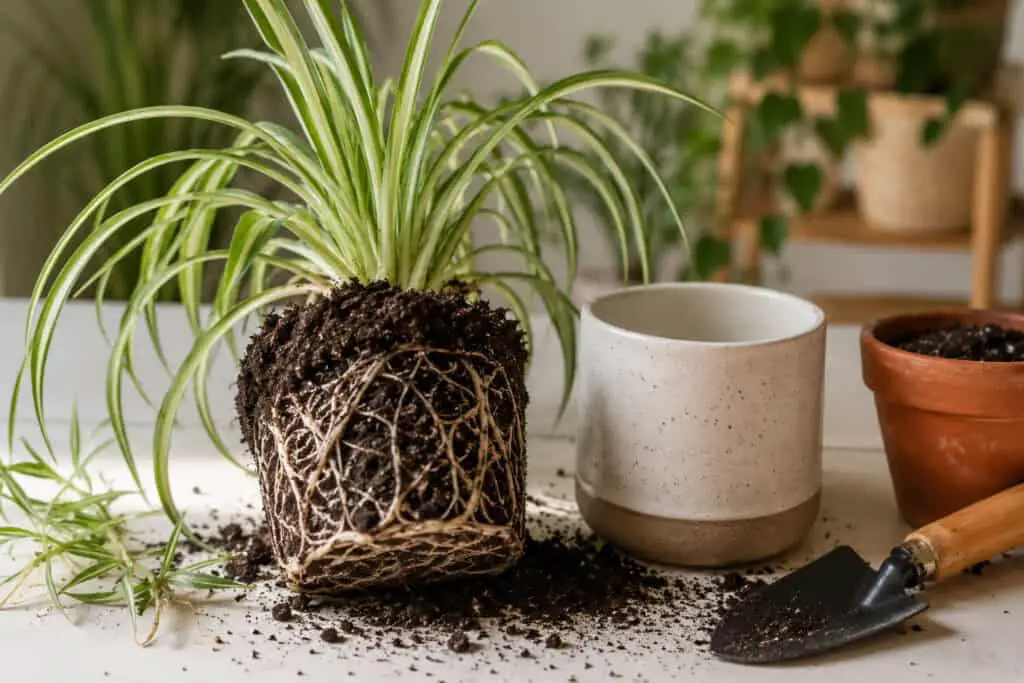
Spider plants (Chlorophytum comosum) need repotting when roots become visibly crowded, push through drainage holes, or lift above the soil surface.
Repot every one to two years, ideally in early spring before active growth begins. Choose a pot one to two inches wider than the current one.
Avoid repotting in winter when the plant is resting. Oversizing the new pot significantly increases the risk of root rot.
You check the drainage holes and something catches your eye. There are thick, pale roots spilling out from the bottom, and the soil feels bone dry barely a day after you watered.
Sound familiar? Most beginners assume this means the plant is sick. It isn’t. It means your spider plant has outgrown its pot and needs more room.
Spider plants are surprisingly forgiving in most areas of their care, but repotting is the one task where timing and pot choice genuinely matter.
Get it right and the plant bounces back fast, often sending out a flush of new babies within a few weeks.
Get it wrong and you’re left dealing with either a waterlogged, rotting mess or a plant that sits completely stalled for months.
This guide walks through when to repot, what to look for, and what most advice online gets wrong about pot size and timing.
Why Spider Plants Need Repotting at All
Chlorophytum comosum has a root system unlike most common houseplants. Those thick, tuberous roots store water and nutrients, which is part of why spider plants handle neglect so well.
But that same vigorous root structure fills a pot faster than you might expect. Once the roots have consumed most of the available space, a few things start going wrong all at once.
The soil degrades. Organic matter breaks down over time, leaving a compacted, nutrient-poor mix that drains either too fast or too slowly.
New root growth has nowhere to go, so the plant redirects energy away from leaves and babies and toward just surviving. Watering becomes less effective because the roots leave little room for moisture to be retained evenly.
| The goal Repotting solves all of this in one step: fresh soil restores drainage and nutrients, and a slightly larger container gives the roots room to spread without sitting in excess moisture. Not just a bigger pot, but a better growing environment. |
Signs Your Spider Plant Needs Repotting
The most reliable way to know when to repot a spider plant is to watch the plant itself rather than follow a fixed schedule. Conditions vary too much from home to home.
A spider plant in a warm, bright spot will fill a pot in under a year. The same variety in a cooler room with lower light might take two years or more.
Look for these specific signals:
Roots Emerging from Drainage Holes
This is the clearest sign. When you see pale, fleshy roots looping out of the bottom of the pot, the root ball has fully colonised the container and started looking for more space.
At this stage the plant is not in crisis yet, but it’s ready to move. Don’t wait until the roots are circling the base of the pot in a thick tangle.
| One detail most guides skip Check whether the roots at the drainage holes are actively growing and pale white or cream, or whether they’re dry, brown, and papery. Dry, dead-looking roots at the drainage holes sometimes mean the plant already experienced a period of stress, and a deeper inspection of the root ball is worth doing before you repot. |
Roots Visible Above the Soil
When roots push up above the soil surface, it means the root ball has expanded so much that it’s lifting the plant.
You might notice the crown of the plant sitting noticeably higher in the pot than it used to, or firm, pale roots forming a slight mound just under the soil surface.
This is a more urgent sign than roots at the drainage holes.
Water Runs Straight Through
If you water your spider plant and the water flows through the drainage holes almost immediately without the soil absorbing much of it, the roots have displaced most of the growing medium. There’s simply not enough soil left to hold water.
This leads to underwatering even when you think you’re watering normally, and the leaves will start to show it with pale or slightly yellowing tips before anything more dramatic appears.
Soil Dries Out Unusually Fast
A related sign: if you’re watering far more often than usual and the soil still feels dusty within a day or two, the roots are doing the drying, not evaporation.
This happens because roots filling the pot create enormous demand. In summer, a pot-bound spider plant can need water every two to three days. Once you notice this pattern, it’s time to check the drainage holes.
Stalled Growth or No New Leaves
Spider plants in good conditions produce new leaves steadily and send out runners with babies through spring and summer.
If yours has gone quiet with no new growth for more than a couple of months during the growing season, and light and watering are not the issue, the root system is likely the bottleneck.
Stunted growth combined with any of the root signs above is a reliable double confirmation.
Cracking or Bulging Pot
Spider plant roots are strong enough to split terracotta and crack thin plastic pots.
If you see hairline cracks appearing in the pot or the sides bowing slightly outward, the plant has been root-bound for some time and needs to be moved without further delay.
This is more common in ceramic and terracotta containers than in thick plastic nursery pots.
The Best Time to Repot a Spider Plant
Early spring is the ideal window, typically March through April in most of the UK. This is when spider plants come out of their slower winter period and start actively growing again.
Repotting at this point means the plant can channel its energy into establishing new root growth quickly in the fresh soil, rather than sitting in a disturbed root environment with nothing to drive recovery.
Late spring and early summer work well too. If you missed the spring window, don’t panic. Repotting in May or June still gives the plant a full growing season to recover and settle in.
| Tip: Read the Plant Before You Read the Calendar A spider plant that’s showing strong root signs in October should still be repotted even though the timing isn’t ideal. Root rot risk from compacted, poorly draining soil outweighs the stress of an off-season repot. Spring timing is a preference, not a rule. The plant’s condition always takes priority. |
Winter repotting is the one situation to genuinely avoid unless there’s an emergency such as root rot.
During winter, spider plants slow down and don’t actively extend new roots.
A plant repotted in December or January will sit in damp, largely unused soil for weeks, which creates ideal conditions for root rot.
If you must repot in winter due to a broken pot or disease, use a particularly well-draining mix and water more carefully than usual until spring.
The Pot Size Problem: Where Most People Go Wrong
The single most common repotting mistake is choosing a pot that’s too large. It seems logical: give the plant more room and it’ll grow more.
But with spider plants, oversizing the container creates a problem that can be harder to fix than being pot-bound.
When you move a spider plant into a pot that’s significantly larger than its current root ball, all that extra soil stays wet for a long time between waterings because the roots can’t absorb moisture from the outer sections quickly.
This creates persistently damp conditions in the parts of the pot the roots haven’t yet reached, and that’s exactly where root rot starts.
The right move is to go up by one pot size only, meaning a pot that’s one to two inches wider in diameter than the current container.
That small increase in space is enough for the roots to spread without leaving large volumes of unused soil sitting wet.
| Current Pot Size | Correct Next Pot Size | Why |
| 4 inches | 6 inches | One size up gives roots room to grow without excess soil volume |
| 6 inches | 8 inches | Maintains proper soil-to-root ratio for predictable watering |
| 8 inches | 10 inches | Same principle; at this size consider dividing instead |
| 10 inches or larger | 12 inches or divide the plant | Large root balls often benefit more from dividing than upsizing |
If your spider plant is large and heavily root-bound, dividing it is often a better option than moving to an enormous pot.
You can remove the plant from its pot, gently separate the root mass into two or three sections, and pot each division into a correctly sized container.
Each new plant will establish quickly, and you end up with more plants without the risk that comes from oversizing.
For more on how to divide and propagate spider plants, including the right point to cut a runner from a baby plantlet, see our complete guide to propagating spider plants.
Choosing the Right Pot Material
Pot material affects how quickly soil dries between waterings, which directly affects how easy your spider plant is to manage after repotting.
| Pot Material | Drying Rate | Best For | Watch Out For |
| Terracotta | Fast | Growers who tend to overwater; bright, warm spots | Roots can crack thin terracotta as they expand |
| Plastic nursery pot | Slow | Forgetful waterers; cooler rooms with lower light | Holds moisture longer; increase drainage material in the mix |
| Glazed ceramic | Moderate | Most indoor conditions | Heavy; no flex if roots expand aggressively |
| Hanging basket | Fast | Displaying trailing growth and babies | Dries quickly; check moisture more frequently |
| One piece of advice to ignore Multiple sources recommend terracotta as the universal best choice for spider plants. That’s too simple. Terracotta works well if you’re in a warm climate or a bright room where the soil dries evenly and regularly. In a cooler, darker home where the soil stays damp longer, terracotta’s wicking effect won’t be enough to compensate, and the plant is no better off than in plastic. Match the pot material to your conditions, not to what sounds generally correct. |
The Best Soil Mix for Repotting
Spider plants aren’t fussy about soil, but the mix needs to drain reliably.
Our full guide on the best soil for a spider plant covers this in more depth, but the core principle is straightforward: a compacted, moisture-retaining mix will eventually cause root rot no matter how carefully you water.
A standard indoor potting mix works as a base. The improvement most worth making is adding perlite, roughly one part perlite to three or four parts potting mix.
Perlite is those small white particles you sometimes see pre-mixed into bagged soil. It keeps the mix from compacting over time and ensures water moves through without pooling around the roots.
Avoid potting mixes that contain a lot of bark or compost and market themselves as moisture-retaining blends.
Those are better suited to plants like ferns that need consistently damp conditions.
Spider plants want soil that holds some moisture but dries out at a reasonable pace, usually within a week or so depending on the season and light level.
| Tip: A Small Adjustment That Makes a Big Difference If your tap water is heavily chlorinated or fluoridated, let it sit out overnight before using it to water after repotting. Spider plants are known to be sensitive to fluoride, which can show up as browning leaf tips. This is one of those small steps that seems unnecessary until you’ve seen the difference it makes in leaf quality over a few months. |
How to Repot a Spider Plant: Step by Step
Step 1: Water the Plant One to Two Days Before
Water your spider plant thoroughly one to two days before repotting. You want the root ball slightly moist, not soaking wet and not bone dry.
Our guide to watering a spider plant covers this balance in more detail.
Moist soil holds its shape when you remove the plant, which makes it easier to inspect the roots and reduces the risk of breaking them.
Repotting a completely dry plant is harder to manage and adds unnecessary stress.
Step 2: Prepare the New Pot
Fill the bottom of the new pot with an inch or two of fresh potting mix so the plant will sit at roughly the correct height once placed.
The crown of the plant should end up about an inch below the rim of the pot, leaving space for watering without overflow.
Do not add drainage material like gravel or stones at the bottom; this is a persistent myth. It actually raises the water table inside the pot rather than improving drainage.
Step 3: Remove the Plant from Its Current Pot
Tip the pot on its side and gently squeeze the sides if it’s plastic. This breaks the seal between the root ball and the pot wall.
Slide the plant out by supporting the base of the plant, not pulling the leaves.
If the plant is completely stuck, run a dull butter knife or a flat tool around the inside edge of the pot to free the roots from the wall. This is particularly necessary with terracotta.
Step 4: Inspect and Trim the Roots
Once the plant is out, take a look at the root ball. Healthy spider plant roots are pale white to cream coloured and firm to the touch.
Soft, dark brown, or mushy roots indicate rot, and those need to be trimmed away cleanly with sterilised scissors or pruners before repotting.
Cutting into healthy tissue slightly beyond any soft section is fine; spider plants recover well from root pruning.
If the root ball is severely matted and tangled, gently tease the outer roots apart with your fingers or a stick.
You don’t need to break up the entire ball, just loosen the outer layer so roots are able to spread into the new soil rather than continuing to circle.
Circling roots that stay in a tight spiral won’t expand into the new container effectively.
Step 5: Place and Fill
Set the plant in the new pot and fill around the root ball with fresh mix. Press the soil down gently to eliminate air pockets but don’t compact it heavily.
Firm enough to support the plant, loose enough for roots to push through easily. Leave about an inch of space between the soil surface and the rim of the pot.
Step 6: Water Thoroughly
Water the plant well immediately after repotting, enough for water to drain freely from the holes at the bottom. This settles the soil around the roots and makes sure the mix is evenly moist.
After this initial watering, allow the top inch of soil to dry before watering again. The plant doesn’t need to stay wet to recover; it needs stable conditions.
Step 7: Give It a Recovery Period
Place the repotted plant in bright, indirect light for the first two to three weeks.
Avoid direct sun during this period because the roots are adjusting to new conditions and the plant is slightly more vulnerable to stress.
You may see a leaf or two yellow or droop in the first week. That’s normal and usually resolves without intervention.
Hold off on fertiliser for four to six weeks after repotting. Fresh potting mix already contains nutrients, and adding fertiliser too soon can stress roots that are still establishing.
| Why this matters New roots are tender and high-nutrient solutions can cause what growers call fertiliser burn, showing up as brown or crispy leaf edges. This is a step that most guides include but don’t always explain clearly. |
The ‘Slightly Root-Bound’ Advice: What It Actually Means
You’ll find the phrase ‘spider plants prefer to be slightly root-bound’ in almost every guide, including this one.
But this advice is one of the most misunderstood pieces of spider plant care, and following it too literally causes problems.
‘Slightly root-bound’ is a meaningful state. It means the roots have filled the pot reasonably well and there’s not a lot of excess empty soil sitting between the root ball and the pot wall.
In this state, a spider plant does tend to produce more babies (spiderettes), probably as a mild stress response related to the urge to reproduce.
‘Extremely root-bound’ is a different thing entirely. When the roots have displaced most of the soil, when water runs straight through the pot, when roots are cracking the container, the plant is not in a productive slight stress.
It’s struggling. Leaving it in that state causes long-term decline, not prolific blooming.
| The practical takeaway Let your spider plant fill its pot before repotting, but don’t wait until it’s in crisis. When the signs described earlier start appearing, that’s the window. Not before, but not long after either. |
| Warning: Is a Spider Plant Safe for Pets? Spider plants are considered non-toxic to cats and dogs by the ASPCA. However, they can cause mild digestive upset if consumed in large quantities, including vomiting or diarrhoea. Cats in particular are attracted to the trailing runners. While spider plants are among the safest houseplants for households with pets, it’s still sensible to keep them out of easy reach. If a pet consumes a large amount and shows persistent symptoms, contact your veterinarian. |
What to Expect After Repotting
Most spider plants show some signs of adjustment in the first one to two weeks after repotting. A few leaves may droop or yellow slightly.
This is transplant shock, a normal response to root disturbance, and it typically resolves on its own within a week if conditions are right.
What you want to see within three to four weeks: new leaf growth emerging from the centre of the plant, and the overall colour deepening back to a healthy mid or bright green.
If the plant still looks dull or stressed after a month, check the following:
- Watering habits. Overwatering is the most common cause of post-repot decline. The roots need time to establish before the plant can handle frequent watering.
- Pot size. If you moved the plant into a container much larger than the root ball, the outer soil may be staying wet too long. Probe the soil at the edge of the pot with your finger before watering.
- Root damage. If trimming was aggressive or roots were broken during removal, the plant may take longer to recover. Keep conditions stable and be patient.
- Insufficient light slows recovery significantly. Bright, indirect light is ideal; dim corners will not give the plant what it needs to establish in new soil.
Repotting vs Dividing: Which Does Your Plant Actually Need?
If your spider plant has become a large, dense clump with multiple crowns, dividing it is often more practical than simply repotting into a larger container.
Dividing is also one of the fastest ways to get a fuller, bushier set of plants rather than one increasingly crowded pot.
Dividing involves removing the plant from its pot, gently separating the root mass into two or more sections (each with its own crown and root system), and potting each section separately.
This keeps individual plants at a manageable size and gives you extra plants to share or place around the home.
Repotting without dividing makes more sense when the plant is a single crown that has outgrown its pot but hasn’t yet become a multi-crown clump. At that stage, giving it slightly more room is the straightforward answer.
| The decision point If your spider plant has more than three or four visible crown centres and the pot is bursting, divide. If it’s one or two crowns in a pot that’s become too small, repot. |
To understand how to grow new spider plants from the babies that appear on the runners, our guide to propagating spider plants from spiderettes covers exactly which stage the plantlets should be at before you cut and pot them.
Troubleshooting: Common Repotting Problems
Leaves Turning Yellow After Repotting
A few yellow leaves in the first week are normal. If yellowing continues or spreads to most of the leaves after two weeks, check whether you’re overwatering.
In new soil, watering should be more conservative than normal until the roots have started growing into the fresh mix.
Yellow leaves combined with soft, dark roots at the base indicate root rot is developing.
Brown Leaf Tips After Repotting
Brown tips that appear or worsen after repotting are usually a sign of one of three things: fluoride sensitivity from tap water, low humidity, or fertiliser applied too soon after repotting.
Our full guide to spider plant brown tips breaks each cause down individually.
Switch to letting water sit overnight before use, increase ambient humidity slightly if the room is very dry, and wait six weeks before any feeding.
Plant Looks Limp or Wilted After Repotting
Limpness is usually transplant shock and resolves within a week.
However, if the plant remains limp after ten days, check whether the roots were damaged during repotting. Our guide to spider plant leaves drooping looks at this in more detail.
A severe root trim can temporarily reduce the plant’s ability to take up water, so ease back on watering and give it consistent indirect light. Recovery can take three to four weeks in these cases.
No New Growth for Weeks After Repotting
This is common if the plant was repotted in autumn or winter. Without the stimulus of lengthening days and warmer temperatures, spider plants don’t push new growth aggressively.
If repotted in spring or summer, lack of new growth after four weeks might mean the light level is too low or the plant is in a very cool location. Move it to a brighter spot and growth should resume.
Troubleshooting Summary
| Problem | Likely Cause | How to Confirm | Solution |
| Yellowing leaves post-repot | Overwatering in new soil | Soil stays wet more than 7-10 days | Water less frequently; check drainage holes are clear |
| Brown tips worsening | Fluoride or fertiliser burn | Tips brown at edges, not centre | Use settled water; skip fertiliser 6 weeks post-repot |
| Wilting and limpness | Transplant shock or root damage | Roots soft or broken when inspected | Stable indirect light; reduce watering; wait 2-3 weeks |
| No new growth after 4+ weeks | Too cool or too dark | Room below 15°C or distant from window | Move to brighter location; ensure temps above 18°C |
| Root rot after repotting | Oversized pot or overwatering | Soft, dark roots; soil always wet | Repot into smaller container with fresh mix; trim affected roots |
| UK Reader Note: Timing and Seasonal Differences UK growers should plan around mid-spring rather than rushing into March. Spring repotting in the UK typically falls in April or May, once the plant is clearly coming out of its winter rest and temperatures indoors are consistently above 15°C (59°F). March can still be too cool in many UK homes for the plant to establish new roots quickly. The RHS notes that Chlorophytum comosum is best grown as a houseplant, under glass, or in a frost-free environment, ideally above 10°C, and recommends repotting or dividing the plant every two to three years, or replacing it with a young plantlet, to keep it looking healthy. |
Frequently Asked Questions
How often should I repot a spider plant?
Most spider plants need repotting every one to two years, but this varies significantly based on conditions.
A plant in a warm, bright location with regular watering will fill a pot faster than one in a cooler, lower-light spot.
Rather than following a fixed schedule, check the drainage holes and the soil surface regularly.
When roots become visible in either location, or when water starts running straight through the pot without being absorbed, it’s time to repot regardless of when the last repotting happened.
Can I repot a spider plant in the autumn?
Repotting in autumn is possible but not ideal. By autumn, spider plants are naturally slowing their growth in preparation for the winter rest period.
A plant repotted in September or October will be placed into new soil at a point when it’s not actively pushing roots, which means the fresh soil stays moist for longer without being absorbed.
That increases the risk of root rot.
That said, if your spider plant is in urgent need due to cracking roots or visible rot, repotting in autumn is far better than leaving the problem to worsen through winter.
Just use a particularly well-draining mix and water conservatively until spring.
Should I water a spider plant right after repotting?
Yes. Water the plant thoroughly immediately after repotting so that the fresh soil is evenly moist and settles around the root ball.
Allow water to drain freely from the drainage holes. After that initial watering, let the top inch of soil dry out before watering again. The plant does not need to stay consistently moist during the recovery period.
Overwatering after repotting is one of the most common causes of post-repot decline, particularly when the plant has moved into a slightly larger container with more fresh soil volume than the roots have yet colonised.
What kind of pot is best for a spider plant?
The most important feature is drainage holes at the bottom. Without them, water accumulates at the base of the pot and root rot follows quickly.
Beyond that, the best material depends on your watering habits. If you tend to overwater or live in a warm, humid environment, a terracotta pot is helpful because it wicks moisture away from the soil faster.
If you sometimes forget to water or live in a drier environment, a plastic or glazed ceramic pot retains moisture longer and reduces how frequently you need to water.
Pot size matters more than material: always go up by only one to two inches in diameter rather than choosing a significantly larger container.
Do spider plants like to be root-bound?
Spider plants tolerate being moderately root-bound better than many houseplants, and there is some evidence that a slightly crowded root system encourages the plant to produce more spiderettes (babies).
However, this does not mean that being severely root-bound is beneficial.
Once roots are cracking the pot, displacing most of the soil, or causing the watering cycle to become unpredictable, the plant is beyond the productive mild-stress stage.
At that point the plant is struggling rather than thriving, and repotting is overdue. ‘Tolerates being slightly root-bound’ and ‘thrives when root-bound’ are meaningfully different states.
Why does my spider plant look worse after repotting?
Some post-repot stress is normal and temporary. A few yellowing or drooping leaves in the first one to two weeks are a standard response to root disturbance.
If the plant looks significantly worse after two to three weeks, the most likely causes are overwatering in the new soil, a pot that’s too large relative to the root ball, root damage during the repotting process, or insufficient light.
Check the soil moisture level by probing two inches down with your finger before each watering. If the soil is still damp, hold off.
Bright, indirect light and patience fix most post-repot issues without any further intervention.
Can I repot a spider plant with babies still attached?
Yes. The babies (spiderettes) attached to runners do not need to be removed before repotting the mother plant. They’ll continue growing normally after the repot.
If you want to propagate the babies, the best time is when each plantlet has developed small visible roots at its base, at which point you can either cut the runner and pot the plantlet directly into moist soil, or place it in a small glass of water until the roots extend to about an inch before transferring to soil.
Propagating at repotting time makes practical sense since the plant is already out of its pot and the workspace is set up.
How do I know if my spider plant has root rot?
Root rot in spider plants shows up first as persistent limpness or drooping that doesn’t improve after watering, combined with yellowing leaves that start at the older outer leaves and move inward.
To confirm, remove the plant from its pot and inspect the roots. Healthy roots are firm and cream or white coloured.
Rotted roots are soft, mushy to the touch, and range from dark brown to almost black. They may also have an unpleasant smell.
If you find rot, trim all affected roots cleanly with sterilised scissors, cutting back into healthy tissue, then repot into fresh, well-draining soil in a container appropriate to the remaining healthy root mass.
If significant root volume was removed, use a smaller pot than the original to avoid excess damp soil around the reduced root system.
Key Takeaways
| At a glance • Repot when you see roots emerging from drainage holes, lifting above the soil surface, or when water runs straight through the pot without being absorbed. • Choose a pot only one to two inches wider than the current one. A significantly larger pot holds excess moisture the roots cannot absorb, which leads to root rot. • Early spring (April to May in the UK) is the ideal time. Late spring and early summer are also fine. Avoid repotting in winter unless there is an emergency such as root rot or a broken pot. • Use a well-draining mix. Standard indoor potting soil with added perlite at a 3:1 ratio provides reliable drainage without waterlogging. • Water thoroughly immediately after repotting, then allow the top inch of soil to dry between waterings during the recovery period. • Hold off on fertiliser for four to six weeks post-repot. Fresh soil already contains nutrients, and fertilising too soon can damage tender new roots. • Inspect roots when the plant is out of the pot. Trim any soft, dark, or mushy roots before repotting. Sterilise scissors between cuts to avoid spreading pathogens. • If the plant has multiple crowns and is very large, consider dividing rather than upsizing. Dividing gives you healthier, more manageable plants than moving to an oversized container. • Some post-repot drooping and yellowing is normal. If it persists beyond two to three weeks, check watering frequency and light level before assuming something is seriously wrong. |
Final Thoughts
Getting spider plant repotting right comes down to watching the plant instead of watching the calendar.
The signs are clear once you know what to look for, and the actual process is far less complicated than most guides make it sound.
The mistakes that cause real damage are almost always about pot size and post-repot watering.
Move up gradually, water conservatively after the repot, skip the fertiliser for a few weeks, and the plant will do the rest.
Spider plants are genuinely resilient, but that resilience has limits once the root system is severely compromised.
Start with the drainage holes. If roots are there, it’s time. Everything else follows from that simple observation.
| What’s Next Now that your spider plant is in its new pot, focus on getting the watering routine right. The most common post-repot issue is overwatering in fresh soil. Let the top inch of soil dry before each watering for the first four to six weeks. Once new leaves start emerging from the centre of the plant, that’s your signal that the roots have established in the new mix and normal care can resume. If you have spiderettes forming on runners, this is also a good time to start thinking about propagating them while your workspace is already set up. |
Related Reading
- Spider Plant Care: The Complete Guide
- How to Propagate a Spider Plant
- Propagating Spider Plants in Water
- Best Soil for a Spider Plant
- Spider Plant Light Requirements
- Spider Plant Brown Tips: Causes and Fixes
- How Big Does a Spider Plant Get?
Mariel is a plant enthusiast and writer based in the UK with a passion for houseplants and indoor growing.
She has spent the last few years building an ever-growing collection of indoor plants and learning the hard way which ones will survive her busy schedule.
At Bean Growing she writes about houseplant care, common plant problems, and outdoor gardening.