
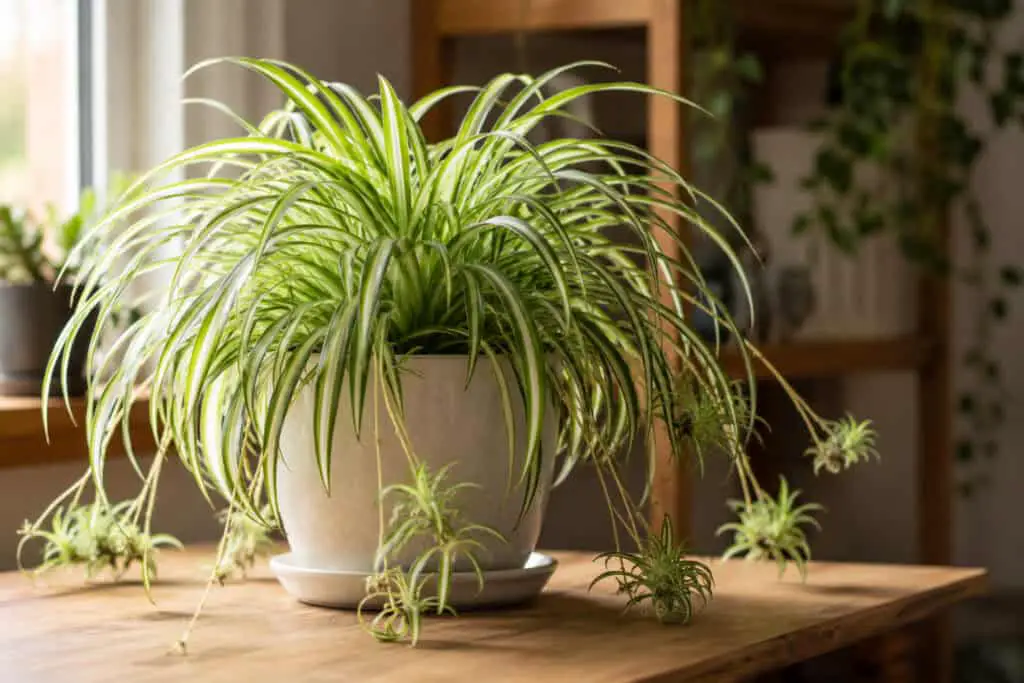
Spider plants (Chlorophytum comosum) live between 20 and 50 years with proper care, making them one of the longest-lived common houseplants.
Lifespan depends heavily on light quality, watering consistency, pot size, and whether the plant receives occasional repotting.
A single neglected plant can decline within a few years, while a well-managed specimen can outlive the decade with ease. Root rot from overwatering is the most common cause of premature death.
You buy a spider plant, stick it on a shelf, water it when you remember, and then wonder why it looks half-dead a couple of years later. It is supposed to be easy. The internet said so.
The thing is, spider plants are genuinely tough, but tough does not mean invincible. There is a wide gap between a spider plant that survives and one that truly thrives for decades.
That gap comes down to a handful of conditions most guides mention briefly and then never fully explain. For the full day-to-day routine, our complete spider plant care guide covers watering, light, and feeding in one place.
This guide focuses specifically on the lifespan question: what determines it, how to tell natural ageing from a fixable problem, and exactly what extends a spider plant’s healthy years.
How Long Do Spider Plants Live?
The honest answer is: it depends on which plant you are asking about.
A spider plant grown from a spiderette cutting, kept in a small pot, and grown indoors in dim light might start showing signs of decline after five to eight years.
That same plant’s offspring, potted up correctly, placed near a bright window, and repotted every two years, could easily reach 20 to 30 years or beyond.
The 20 to 50 year figure you see across most gardening sites is accurate but misleading because it implies any spider plant will hit that range.
In practice, the upper end of 50-plus years is achievable but requires consistency over a very long time.
The lower end of five to ten years reflects what happens when care is inconsistent but not terrible.
The key variable most guides skip is what counts as a single plant. Spider plants produce spiderettes on long stems, and those plantlets are genetically identical to the mother.
When a mother plant eventually declines, those babies carry the same lineage forward.
Families have passed spider plant cuttings down through multiple generations, which is how the plant gets described as practically immortal.
Biologically, the individual plant has a finite lifespan. The genetic line does not.
Spider Plant Lifespan at a Glance
| Care Level | Realistic Lifespan | Key Factor |
| Minimal / neglected | 3 to 7 years | Root rot or root crowding |
| Average household care | 8 to 15 years | Inconsistent watering or low light |
| Consistent good care | 20 to 30 years | Regular repotting, bright indirect light |
| Optimal conditions | 30 to 50+ years | All conditions met consistently over time |
The Real Lifespan Debate: Why Numbers Vary So Much
If you search spider plant lifespan, you will find numbers ranging from five years to over 50.
The reason for the confusion is that different sources are measuring different things, and some are repeating figures they found elsewhere without checking them against real growing experience.
Sites citing five to ten years are often describing individual plants grown indoors without repotting or attentive care.
Sites citing 20 to 50 years are often describing plants grown under consistently good conditions or plants that have been regularly propagated and replaced.
Neither figure is wrong. They just describe very different situations.
The species also matters more than most guides acknowledge.
The two most common varieties of spider plant grown as houseplants are Chlorophytum comosum ‘Vittatum’ (green leaves with a white stripe down the centre) and Chlorophytum comosum ‘Variegatum’ (white or cream edges with a green centre).
Both share the same general lifespan range, but solid green varieties grown in lower light tend to be slightly more durable over time because they have more chlorophyll available to produce energy.
| The honest takeaway Aim for the 20-year mark as your baseline goal. It is achievable for most indoor growers without exceptional effort. Anything beyond that is a bonus earned through consistent care. |
What Actually Determines How Long a Spider Plant Lives
Lifespan is not just about whether the plant is alive. It is about whether the plant is genuinely healthy year after year. These are the factors that make the biggest real-world difference.
Light Quality
Spider plants are marketed as low-light plants, and they do survive in low light. But survival and longevity are different things.
For a closer look at exactly how little light is too little, see our guide on whether spider plants can grow in low light.
A spider plant in deep shade will grow slowly, produce fewer spiderettes, and exhaust itself trying to reach adequate light. Over years, this chronic stress shortens its life.
Bright, indirect light near an east or west-facing window is the sweet spot. If the leaves are a rich, deep green with clearly visible stripes, the light is working.
If the variegation looks washed out or the plant seems stretched and floppy, it is not getting enough.
| Worth remembering Do not mistake ‘tolerates low light’ for ‘thrives in low light.’ The difference shows up over years, not weeks. |
Watering Consistency
Overwatering kills more spider plants than any other single cause. The roots are thick and fleshy, which means they store moisture efficiently but also rot quickly when they sit in waterlogged soil.
Our full spider plant watering guide covers seasonal adjustments in more depth, but the core principle is below.
The sign that most beginners miss is yellowing leaves that appear healthy from a distance but are soft and slightly translucent at the base.
The correct approach is to let the top inch or two of soil dry out between waterings, then water thoroughly until it drains from the bottom.
Dump out any water sitting in the saucer within 30 minutes.
In winter, when growth slows, you may only need to water once every ten to fourteen days. In summer, during active growth, once a week is typical.
| Common mistake Following a fixed weekly schedule regardless of season. In winter, that schedule will almost certainly overwater, because evaporation and uptake are both slower even though the soil feels moist. Check the soil with your finger, not the calendar. |
Pot Size and Repotting
Spider plants grow fast and develop dense, fleshy root systems. A plant that has been in the same pot for three or more years is almost certainly root-bound, even if it looks fine from the top.
When roots fill the pot completely, they cannot access enough water or nutrients regardless of how often you water.
The result is stunted growth, yellowing leaves, and a plant that looks vaguely stressed for no obvious reason.
Repot every one to two years into a container one size up, using a well-draining soil mix suited to spider plants.
Look for roots circling the inside of the pot or pushing out through drainage holes.
When you remove the plant, the roots should be white or cream-coloured and firm. Black, mushy roots mean overwatering. Brown, papery roots mean the plant has been too dry for too long.
| Hanging baskets vs pots for long-term health Spider plants in hanging baskets dry out faster than those in standard pots, which can actually reduce overwatering risk. If your plant tends to stay too wet, a basket with better airflow and a fast-draining mix is worth considering. As the plant matures and trails further, check how much it has filled out using our guide to how big spider plants get, which helps judge whether a hanging basket still has room to grow or whether it is time to divide the plant instead. |
Water Quality
Tap water contains fluoride and chlorine in amounts that accumulate in soil over time. Spider plants are more sensitive to fluoride than most common houseplants.
The symptom is brown leaf tips, not the light-tan browning that comes from low humidity, but a sharper, darker brown that starts at the very tip and progresses slowly down the leaf edge.
We cover this distinction in detail in our dedicated guide to spider plant brown tips.
If your tap water is heavily treated, switch to filtered water, rainwater, or let tap water sit overnight before using it. The chlorine dissipates.
The fluoride does not, which is why filtered or rainwater is the better long-term option for plants showing persistent tip browning despite good care.
Temperature and Drafts
Spider plants are comfortable in the same temperature range most homes are kept: 15 to 27 degrees Celsius (60 to 80 degrees Fahrenheit).
Cold drafts near windows in winter are a more common problem than temperature alone.
A plant placed near a single-pane window in a cold climate may experience regular exposure to temperatures below 10 degrees Celsius (50 Fahrenheit) at night, which stresses the roots over time.
If you notice the outer leaves of a window-side plant turning yellow or slightly soft in winter, move it a foot or two away from the glass.
That small adjustment often solves a problem that looks like a watering issue.
How to Tell Whether Your Spider Plant Is Ageing or Struggling
This is where most guides fall short. They list care problems without helping you distinguish between a plant in normal decline at the end of its natural life and a plant that is struggling due to something fixable.
Here is how the two look in practice:
| Natural end-of-life signs | Signs of a fixable problem |
| Fewer spiderettes produced each year despite good care | Sudden drop in spiderettes during or after a cold spell or repot |
| Gradual thinning of overall foliage over several years | Rapid yellowing of multiple leaves over days or weeks |
| New leaves emerge smaller and paler over time | Leaves pale uniformly after a sudden change in light |
| Roots remain white but growth has simply slowed | Roots are black, mushy, or smell unpleasant |
| Brown tips spread slowly despite using filtered water | Brown tips start suddenly after switching to tap water |
A plant showing natural end-of-life signs after 15 or more years of good care does not have a solvable problem.
The right response is propagation, not intervention. Take healthy spiderettes now and root them in fresh potting mix. Your next spider plant lineage begins there.
A plant showing the fixable-problem signs is worth troubleshooting regardless of age, especially if it is under ten years old.
How to Extend Your Spider Plant’s Lifespan
These are the actions that make a measurable difference over the long term, not just tips that sound useful but rarely change outcomes.
Repot on a Regular Schedule
Mark your calendar every 18 months and check whether the plant needs a larger pot. This single habit prevents the most common long-term decline cause: root binding.
A fresh pot with new potting mix also restores the mineral balance that gets depleted over years of watering.
When you repot, use a well-draining mix with added perlite at roughly a 70/30 ratio. P
ure potting mix tends to retain too much moisture for spider plants over time, while perlite keeps air pockets in the soil as it compresses and breaks down, which protects roots between waterings.
Propagate Regularly
Do not wait until the mother plant is declining to take spiderettes. Propagate every year or two from healthy, established plantlets that have already developed visible roots at their base.
Our step-by-step spider plant propagation guide covers the full process, including when each spiderette is actually ready to come away from the parent stem.
Plant spiderettes directly into moist potting mix rather than rooting in water first.
Water-rooted cuttings develop softer root structures that sometimes struggle to transition to soil, a difference we look at more closely in our piece on propagating spider plants in water.
Keeping two or three generations of plants going at once means you always have a healthy plant regardless of what happens to any individual one.
This is how houseplant collectors maintain spider plant lines across decades without ever losing the original strain.
| Rooting spiderettes for best results Spiderettes with small, cream-coloured nubs at their base are ready to propagate. Those nubs develop into roots within one to two weeks in moist soil. |
Fertilise Lightly and Seasonally
Spider plants do not need heavy feeding. Over-fertilisation is a surprisingly common cause of long-term decline because salt deposits build up in the soil and gradually damage fine root hairs.
Our guide to fertilising spider plants sets out feeding amounts in more detail, but the seasonal rule is straightforward.
Use a balanced liquid fertiliser at half the recommended strength, applied once a month from April through September. Stop completely from October to March.
If the leaf tips are brown despite using filtered water and correct humidity, check when you last fertilised. Salt buildup from over-fertilisation looks identical to fluoride sensitivity.
Flush the soil thoroughly with plain water to clear the salt deposits before assuming a different cause.
Give It the Right Light Over the Long Term
As your spider plant matures and produces more foliage, its light needs increase.
A plant that thrived in a bright east-facing spot at two years old may start showing slow growth and faded variegation at seven years old simply because it has outgrown that position.
Reassess light placement every few years rather than assuming it is fixed.
North-facing windows in most UK homes do not provide enough consistent bright indirect light for long-term health unless supplemented with a grow light during the darker winter months.
See our full breakdown of spider plant light requirements for placement by aspect.
| UK Reader Note: Hardiness and Winter Care The RHS classes Chlorophytum comosum as hardiness rating H1c, meaning it is best grown as a houseplant or under glass and ideally kept above 10°C. It is not hardy outdoors through a UK winter and must be brought inside before autumn frosts. The RHS also recommends repotting or dividing the plant every two to three years, or replacing it with a young plantlet, to keep it looking healthy. (Source: RHS plant profile) In heated UK homes, the main winter risk is low humidity from central heating combined with cold air near single-glazed windows. Grouping plants together or placing pots on pebble trays with water helps maintain moisture levels. |
If you are considering moving plants outdoors over the British summer, our guide on whether spider plants can live outdoors covers what conditions they tolerate and when to bring them back in.
Troubleshooting: Common Problems That Cut Lifespan Short
Brown Leaf Tips
The most common complaint about spider plants is brown tips, and it almost never means the plant is seriously ill.
The two most common causes are fluoride accumulation from tap water and low humidity.
You can tell them apart by checking when it started: gradual browning that appeared over months and affects only the very tip of each leaf is almost always fluoride.
Browning that started after winter heating turned on and affects more of the leaf length is usually a humidity drop.
Fix: switch to filtered or rainwater and increase humidity around the plant. If you already use filtered water and the browning continues, check whether you are over-fertilising.
Our dedicated guide to spider plant brown tips walks through each cause in more depth.
Yellowing Leaves
Yellow leaves mean the plant is dropping old growth or experiencing root stress. If the yellowing affects older, lower leaves only and the new growth looks healthy, it is normal turnover.
If the yellowing is widespread and the new growth is also pale, overwatering is the likely cause.
Our full troubleshooting guide on spider plant leaves turning yellow covers each pattern with photos and fixes.
Pull the plant from its pot and examine the roots. White or cream roots are healthy. If the roots are brown and mushy with a sour smell, root rot has started.
Cut away all damaged roots with clean scissors, let the roots air dry for an hour, then repot into dry fresh mix and do not water for the first week.
No Spiderettes
Spider plants produce spiderettes in response to mild stress, particularly being slightly root-bound and receiving long-day light periods.
A plant in perfect conditions with plenty of pot space and consistent water may actually produce fewer babies than one that is slightly crowded.
If your plant has not produced any spiderettes in over a year and is more than two years old, check whether it needs more light rather than better care. Moving it to a brighter spot is often the trigger.
Wilting Despite Regular Watering
Wilting in a plant that is being regularly watered is almost always a sign of root rot or root binding.
Rotted roots cannot transport water even when it is present, which creates the confusing situation of a wilting plant in wet soil.
If the leaves themselves are curling or drooping rather than the whole plant wilting, it is worth checking our separate guides on spider plant leaves curling inwards and spider plant leaves drooping, since the two have slightly different causes.
A plant that wilts between waterings but recovers quickly after watering is likely root-bound rather than rotting. Repot it into a larger container with fresh mix.
Troubleshooting Summary
| Problem | Likely Cause | How to Confirm | Solution |
| Brown tips | Fluoride or low humidity | Check water source and heating schedule | Use filtered water; raise humidity |
| Yellow leaves | Overwatering or root rot | Check roots for mushy texture | Reduce watering; repot if roots are damaged |
| No spiderettes | Insufficient light | Check light hours and intensity | Move to brighter indirect light |
| Wilting in wet soil | Root rot | Pull plant and inspect roots | Remove damaged roots; repot in dry mix |
| Pale, washed-out leaves | Too much direct sun or low light | Check light direction and distance | Move to bright indirect light |
| Slow growth, few new leaves | Root binding or low light | Check for roots at drainage holes | Repot up one size; improve light |
| Warning: Spider Plants and Pets Spider plants are listed as non-toxic to humans by the ASPCA. However, they contain compounds that are mildly hallucinogenic to cats, which is why cats are often attracted to the leaves. Ingestion typically causes mild gastrointestinal upset in cats, including vomiting or diarrhoea. While not dangerous, keeping the plant out of reach of cats that chew plants is advisable. The plant is generally considered safe around dogs. If in doubt, consult your veterinarian. |
The Right Way to Think About Spider Plant Longevity
Most people approach spider plant lifespan as a fixed number. It is not.
It is a range shaped almost entirely by the quality of care the plant receives over time, the frequency of repotting, and whether the grower propagates regularly to refresh the genetic line.
The biggest mistake in thinking about lifespan is treating a declining parent plant as a failure. It is not.
A mother plant that has grown for 12 years, produced dozens of spiderettes, and now shows signs of decline has had a full and productive life.
The appropriate response is not to panic and try to save it but to have already taken cuttings a year earlier. That is the actual long game with spider plants.
If you are growing spider plants alongside other long-lived houseplants, the same principles apply: repot regularly, do not overwater, and keep consistent light.
Building a rotating propagation habit across your collection means no single plant’s decline leaves you starting from scratch.
It is also worth knowing how fast a healthy plant should be growing in the first place; our guide to how fast spider plants grow gives a useful baseline for spotting when growth has genuinely slowed versus when it is just a seasonal dip.
Frequently Asked Questions
How long do spider plants live indoors?
Spider plants grown indoors typically live between 20 and 30 years with consistent care, though some reach 50 years under optimal conditions.
The lower figure of five to ten years applies to plants grown without regular repotting or in poor light.
The single biggest factor for indoor lifespan is how often the plant is repotted: plants left in the same container for many years without a size increase will decline far sooner than those given fresh mix and more space every one to two years.
Can a spider plant live forever?
No individual spider plant lives forever, but the genetic lineage can continue indefinitely through propagation.
Spider plants produce spiderettes that are clones of the mother plant, and those offspring can be rooted and grown on as new plants.
A family can maintain the same spider plant strain across decades by propagating from healthy plantlets before the original plant declines.
In that sense, the plant line is essentially immortal even though each individual plant has a natural lifespan of a few decades.
What kills spider plants most often?
Overwatering is the single most common cause of spider plant death indoors. It leads to root rot, which cuts off the plant’s ability to absorb water and nutrients even when both are present in the soil.
The early signs are yellowing leaves and a slightly sour smell from the soil, but by the time the plant wilts visibly, the root system has often suffered significant damage.
The second most common cause is root binding from being left too long in a pot that is too small, which causes slow decline over several years rather than sudden collapse.
How do I know if my spider plant is dying of old age vs a care problem?
Natural end-of-life signs appear gradually over several years and include a slow reduction in new growth, smaller and fewer leaves over time, and a decline in spiderette production despite no change in care routine. These signs typically appear in plants that are 15 or more years old.
A care problem, by contrast, tends to show up more suddenly: rapid yellowing, wilting despite wet soil, brown roots, or a dramatic change in appearance that coincides with a change in season, watering routine, or position.
If your plant is under ten years old and showing decline, it is almost certainly a care issue, not old age.
Does propagating spider plants extend their life?
Propagating does not extend the life of the original plant, but it preserves the genetic line when the parent eventually declines.
The spiderettes are genetically identical to the mother and, when given good care from the start, will themselves potentially live for 20 or more years.
The practical benefit of regular propagation is that you always have a healthy young plant ready to take the mother’s place.
Many experienced houseplant growers treat the cycle of propagation and replacement as the normal spider plant life cycle rather than a fallback for when things go wrong.
How often should I repot a spider plant to keep it living longer?
Repot every one to two years while the plant is young and growing fast, then every two to three years once it reaches full size.
The cue to repot is roots circling inside the pot or emerging from drainage holes, not a fixed calendar date.
When you repot, choose a container only one size larger than the current one. Going too large creates excess soil volume that retains moisture and increases the risk of root rot.
Use a well-draining mix with added perlite and water thoroughly after repotting, then allow the surface inch to dry before the next watering.
Do spider plants grow back after going dormant?
Spider plants are perennials and do not go fully dormant in the way that bulb plants do, but they do slow down significantly in winter.
During this period, growth almost stops, spiderette production pauses, and the plant needs far less water. This is normal and not a sign of decline.
The plant will resume active growth when light levels and temperatures rise in spring.
If the plant looks weak entering winter, the usual culprit is insufficient light over the summer rather than anything that happens during the cool months themselves.
Can a spider plant survive in low light long-term?
Spider plants can survive in low light but will not thrive in it over the long term.
Low light reduces photosynthesis output, which forces the plant to draw on stored energy reserves over time.
This shows up as paler leaf colour, reduced variegation, slower growth, and fewer spiderettes.
A plant grown consistently in low light will have a noticeably shorter productive lifespan than one kept in bright indirect light.
If your space has limited natural light, a full-spectrum grow light running for eight to ten hours a day is a practical solution that significantly extends the plant’s healthy years.
Key Takeaways
| At a glance • Spider plants live 20 to 30 years under good care, with the potential to reach 50 years or more when conditions are consistently optimal. • Overwatering is the single most common cause of early death. Let the top inch of soil dry before watering and never leave standing water in the saucer. • Repot every one to two years while young and every two to three years at maturity. Roots circling the pot or emerging from drainage holes are the signal to act. • Use filtered or rainwater if your tap water is heavily treated. Fluoride accumulates in soil and causes brown tips that no amount of adjusting humidity or watering frequency will fix. • Bright, indirect light near an east or west-facing window produces the healthiest, longest-lived plants. Low light keeps plants alive but reduces their productive lifespan. • Propagate spiderettes before the mother plant shows any signs of decline. Rooting them directly into moist potting mix produces stronger plants than water-rooting. • Natural end-of-life decline appears gradually over years in older plants. Sudden or dramatic changes in appearance in plants under ten years old are almost always fixable care problems. • Fertilise at half strength once a month from April through September only. Salt buildup from over-fertilisation mimics fluoride damage and stresses roots over time. |
Final Thoughts
There is a reason spider plants are handed down through families. They are not just hardy for a houseplant: they are genuinely capable of long, healthy lives with fairly modest effort.
The gap between a spider plant that fades after five years and one that is still producing spiderettes at thirty is rarely about talent or a green thumb.
It is mostly about repotting consistently, using clean water, and giving the plant enough light to actually thrive rather than just survive.
If you started reading this wondering whether your spider plant was worth trying to save or whether it was simply old, the answer probably came somewhere in the middle.
Plants in normal decline after a long life deserve a good send-off in the form of healthy cuttings carried forward.
Plants showing early signs of stress deserve a second look at the pot, the water, and the light before being written off.
Spider plants are forgiving, but they do keep score over the years. The ones that make it to 30 usually had someone paying quiet, consistent attention the whole time.
| What’s Next: Check Your Plant’s Root Health Today If your spider plant is more than two years old and has never been repotted, that is the single most useful thing you can do right now. Gently remove it from its pot and look at the roots. White and firm means healthy. Circling or tightly packed means it is time for a pot one size up. This one check will tell you more about your plant’s long-term prospects than any other assessment. |
Related Reading
- Spider Plant Care: The Complete Guide
- How to Propagate a Spider Plant
- Spider Plant Light Requirements
- Spider Plant Brown Tips: Causes and Fixes
- How Big Does a Spider Plant Get?
- Spider Plant Air-Purifying Benefits
Mariel is a plant enthusiast and writer based in the UK with a passion for houseplants and indoor growing.
She has spent the last few years building an ever-growing collection of indoor plants and learning the hard way which ones will survive her busy schedule.
At Bean Growing she writes about houseplant care, common plant problems, and outdoor gardening.