
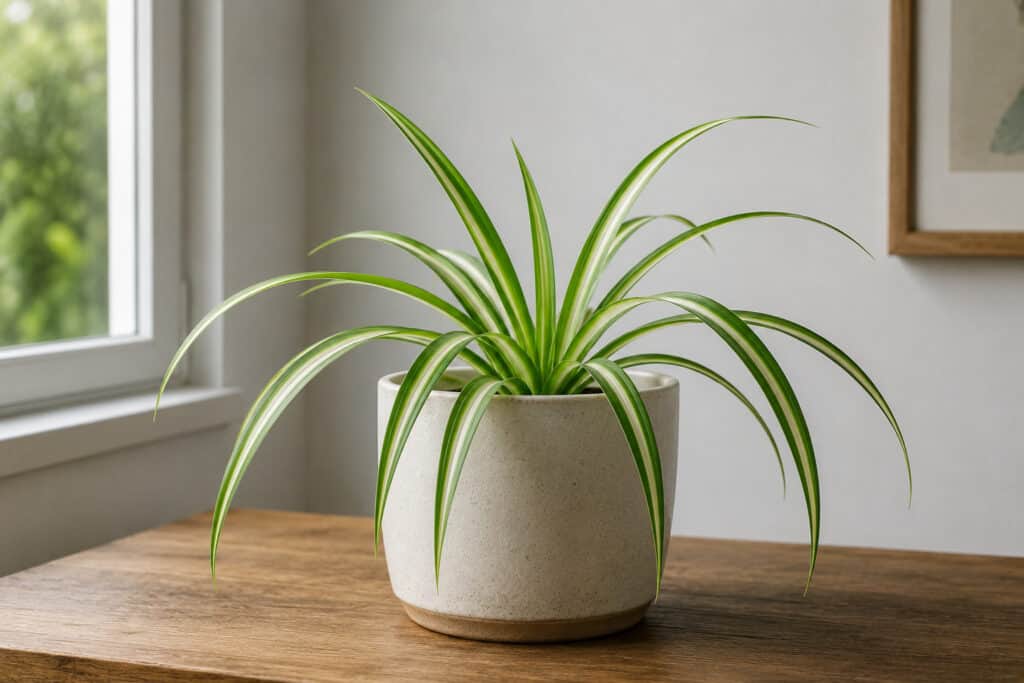
Spider plants (Chlorophytum comosum) absorb small amounts of volatile organic compounds (VOCs) such as formaldehyde, xylene, and benzene through their leaves and roots.
This process, called phytoremediation, is real but limited. In a typical home, a single spider plant has a negligible effect on air quality.
Meaningful impact requires multiple healthy plants in low-ventilation spaces. Spider plants do not filter particulate matter, allergens, or replace mechanical air purifiers.
You probably bought a spider plant because someone told you it cleans the air.
Maybe it was a friend, a nursery tag, or an article breathlessly citing a NASA study. And now you’re here, wondering whether there’s any truth to it or whether you’ve been sold a very pretty myth.
Here’s the honest answer: the air-purifying reputation is real, but it has been wildly overstated for decades.
Spider plants do remove certain indoor pollutants. The mechanism is genuine. But the scale matters enormously, and most of what you’ll read online skips that part entirely.
This article covers what spider plants actually do to indoor air, what they cannot do, where they genuinely help, and how to get the most from them if air quality is your goal.
There’s also a section on the NASA study that started it all and why its results look so different from real-world outcomes. No fluff, no plant-store marketing copy.
What Spider Plants Actually Do to Indoor Air
The short version: spider plants absorb small amounts of airborne chemicals through their leaves.
Those chemicals travel down to the roots, where soil microorganisms break them down into less harmful compounds.
The plant acts as a kind of passive delivery system, and the microbial community in the soil does most of the actual detoxification work.
The process is called phytoremediation. It is not unique to spider plants. Most leafy houseplants do it to some degree.
What spider plants have going for them is a relatively high leaf surface area, a fast transpiration rate, and the ability to tolerate a wide range of indoor conditions, which means they stay alive and functional in places other plants might struggle.
The specific compounds spider plants are documented to absorb include:
- Formaldehyde – found in pressed wood furniture, flooring adhesives, and some cleaning products
- Xylene – emitted by paints, varnishes, rubber, and leather
- Benzene – present in cigarette smoke, synthetic fibers, and some plastics
- Carbon monoxide – produced by gas appliances and combustion
- Toluene – released by adhesives, paints, and nail products
These are genuinely harmful compounds at elevated concentrations. The fact that spider plants can absorb them is not a fiction.
The question is always: how much, under what conditions, and does it actually matter in your home?
The NASA Study: What It Proved and What It Did Not
The 1989 NASA Clean Air Study is where the spider plant’s air-purifying reputation was born.
The research, led by scientist Bill Wolverton, placed plants inside sealed Plexiglas chambers containing high concentrations of specific VOCs, then measured how much remained after 24 hours.
The results were striking. Spider plants removed around 95% of formaldehyde from the sealed chamber within 24 hours.
That number made headlines and has been repeated in every houseplant article ever written since.
What those articles almost never mention is the critical limitation: the chambers were small, sealed, and contained concentrations of VOCs far higher than anything found in a typical home.
There was no ventilation, no air exchange, no open windows, no one cooking or cleaning or coming in from outside.
The conditions were almost the opposite of a normal living space.
A 2014 review of the research concluded plainly that while plants can absorb VOCs in laboratory conditions, the effect in real buildings requires between 10 and 1,000 plants per square meter of floor space to match what standard ventilation already achieves. That is not a typo.
| Tip: Understanding the Lab-to-Home Gap The NASA study was designed to find solutions for space stations, which are sealed environments with no natural air exchange. The results were never meant to suggest that a pot on your windowsill would meaningfully clean a suburban living room. Every time you open a window or door, you refresh far more air than any number of houseplants could process in hours. |
This does not mean the research was wrong. It means the conclusions were misapplied, and the houseplant industry did not rush to correct the misunderstanding.
The Real-World Impact: Where the Numbers Land
A 2015 study placed spider plants in five different real occupied rooms for two months, then measured how much particulate matter had accumulated on their leaves.
The environments included a dental clinic, a perfume-bottling room, a suburban house, an apartment, and an office.
The plants did accumulate particles. They consistently collected more than aluminum plates placed in the same rooms.
But the amounts were measured in micrograms per square centimeter of leaf. A microgram is one millionth of a gram.
To put that in context: a single spider plant has roughly 2,000 square centimeters of leaf surface.
At the upper end of the study’s findings, a plant might accumulate around 50,000 micrograms of particles over two months.
A standard aspirin tablet weighs 300,000 micrograms. Meanwhile, a moderate-pollution day introduces millions of micrograms of inhalable particles into a typical room every hour through normal ventilation.
The math does not favor the spider plant as a meaningful air filter. But this is where most articles stop, and it is worth going further.
Where Spider Plants Do Make a Difference
The picture changes in specific circumstances that most guides never distinguish from general use:
- Low-ventilation, energy-efficient buildings: Modern airtight construction dramatically reduces the natural air exchange that normally dilutes indoor VOCs. In these environments, houseplants have more meaningful impact because the competition from ventilation is reduced.
- Near specific pollution sources: Placing a spider plant directly beside a new piece of pressed-wood furniture, a freshly painted wall, or a gas stove provides localized absorption of outgassing chemicals before they disperse into the larger room volume.
- In small enclosed spaces: A bathroom, a small home office, or a closet approaches the confined conditions of the original NASA chambers far more closely than a large open-plan living room does. One healthy plant in a 40-square-foot space will do more than ten plants in a 400-square-foot room.
- In groups: A cluster of 8 to 15 large spider plants in a single room begins to create a measurable effect on local VOC concentrations. This is impractical for most people, but it is worth knowing that number.
The Benefits That Hold Up in Any Home
Here is what I find frustrating about how spider plant air purification gets discussed: the fixation on VOC removal distracts from benefits that are genuine, well-supported, and practically useful for any grower.
Humidity Contribution
Spider plants have an unusually high transpiration rate compared to many other houseplants.
They pull water from their roots and release moisture vapor through their leaves continuously.
Research has measured this and found that three large spider plants in a 10-inch pot can increase the humidity of a single interior room by a measurable amount.
This matters in dry climates and during winter heating months. Low indoor humidity contributes to dry skin, irritated airways, and worsened allergy symptoms.
A cluster of spider plants near a heating vent will not replace a humidifier, but it does contribute to a more comfortable humidity baseline, especially in smaller rooms.
Chlorophytum comosum also uses a form of photosynthesis called Crassulacean Acid Metabolism (CAM) under certain light conditions, which allows it to continue converting carbon dioxide to oxygen through the night rather than only during daylight hours.
This makes it one of the more practical bedroom plants from an air quality standpoint.
Particulate Accumulation on Leaf Surfaces
Even if the amounts are small, spider plants do physically trap airborne particles on their waxy leaves.
Their leaves are slightly textured and accumulate dust, pollen, and fine particles over time.
This is why dusty leaves on any houseplant are worth wiping down periodically: a clogged leaf surface absorbs less, breathes less efficiently, and contributes less to the local air environment.
A quick wipe with a damp cloth every few weeks restores leaf function and gives you a visible reminder that the plant is doing something, even if it is modest.
Psychological and Wellbeing Benefits
This one gets dismissed as soft, but the evidence for it is actually stronger than the evidence for VOC removal.
Exposure to indoor greenery is associated with reduced stress markers, lower perceived fatigue, and improved concentration in controlled studies.
In workplace settings, the presence of plants is linked to reported improvements in air freshness and comfort even when measured air quality is unchanged.
These effects are real. They are not the same as chemical purification, but they are not nothing either.
A spider plant in your home office creates a different environment than the same desk without one, and that difference has value.
Where to Place Spider Plants for Best Air Quality Results
Placement matters more than most guides acknowledge. A spider plant on a shelf across a large room contributes very little to air quality.
The same plant positioned thoughtfully can do significantly more.
| Location | Why It Works | What to Watch For |
| Beside new furniture | Absorbs outgassing formaldehyde directly at the source before it disperses | New furniture off-gases most heavily in the first 30 to 90 days |
| Small home office or study | Confined space means higher plant-to-air-volume ratio, closer to lab conditions | Low light may slow growth; use a grow light if needed |
| Bathroom | Humidity supports plant health; plant returns moisture; near ventilation targets cooking and cleaning VOCs | Ensure some indirect light; bathrooms without windows stress the plant |
| Kitchen (near cooking area) | Absorbs combustion gases from gas stoves; captures cooking VOCs | Keep away from direct heat sources; rotate regularly |
| Bedroom | CAM photosynthesis provides overnight oxygen; transpiration adds gentle humidity during sleep | Avoid overwatering; damp soil in a closed room can encourage mold |
| Freshly painted room | Absorbs xylene and VOCs from paint fumes at peak outgassing stage | Remove after 4 to 6 weeks once heaviest outgassing subsides |
Keeping Your Spider Plant Healthy Enough to Actually Help
A stressed, yellowing spider plant sitting in waterlogged soil is not purifying anything.
The leaf surface area and transpiration rate that make spider plants useful both depend on the plant being actively healthy and growing.
This is a point almost every air quality article skips entirely.
Light Requirements
Spider plants perform best in bright, indirect light. This is not the same as low light.
They will survive low light, but their growth slows significantly, their leaf mass reduces over time, and their transpiration rate drops.
A slower-growing plant with fewer leaves contributes less to air quality.
The most common mistake beginners make is placing a spider plant in a corner far from any window and expecting it to thrive.
If the leaves are pale green rather than deep green, or if growth has essentially stopped, the plant is light-stressed.
Move it closer to a bright window or add a simple grow light. You will see new growth within two to three weeks.
Watering Correctly
Overwatering is the fastest way to kill a spider plant and simultaneously the most common mistake.
The signs are subtle at first: the leaf tips go brown, then the base of the plant turns soft and mushy.
By the time you see root rot, the plant is often beyond recovery.
The correct approach is simple: water thoroughly when the top inch of soil feels dry to the touch, then allow it to drain completely.
Never leave a spider plant sitting in a saucer of standing water. The roots need oxygen as much as moisture, and waterlogged soil suffocates them.
In winter, when growth slows, you may only need to water every 10 to 14 days.
Spider plants are sensitive to fluoride in tap water. Brown leaf tips that appear on otherwise healthy plants, without any sign of overwatering, are often caused by fluoride accumulation in the soil.
Switching to filtered water or letting tap water sit uncovered overnight before watering will resolve this in most cases.
Soil and Repotting
A pot-bound spider plant in compacted, depleted soil has reduced root function and slower microbial activity in the rhizosphere.
Since the soil microbiome is responsible for breaking down the VOCs the plant absorbs, soil health matters directly to the plant’s air-quality contribution.
Use a well-draining potting mix. Repot every one to two years, or when you see roots emerging from the drainage holes.
When you repot, a small amount of perlite or coarse sand mixed into the potting mix will improve drainage and aeration around the roots.
| Tip: Healthy Leaves = More Surface Area = More Absorption The single most effective way to improve a spider plant’s air-purifying contribution is to keep it actively growing. A mature, bushy specimen in bright indirect light with healthy, deep-green leaves has several times more leaf surface area than a struggling plant half its size. Invest in proper care before worrying about how many plants you need. |
Spider Plants vs. Mechanical Air Purifiers: An Honest Comparison
This is a comparison most houseplant articles avoid because the answer is uncomfortable: mechanical air purifiers are dramatically more effective for measurable air quality improvement.
If you have serious air quality concerns, a HEPA air purifier is the right tool.
| Factor | Spider Plant | Mechanical Air Purifier |
| VOC removal | Absorbs small amounts passively | Active filtration of measurable quantities |
| Particulate matter (PM2.5) | Negligible; surface trapping only | HEPA filter captures 99.97% of particles |
| Allergens | No meaningful effect | Highly effective with HEPA |
| Humidity | Adds moisture through transpiration | Many models reduce humidity (desiccating effect) |
| Wellbeing effect | Strong; proven psychological benefit | None |
| Cost | Very low; propagates freely | Ongoing filter replacement costs |
| Noise | None | Audible fan noise at higher settings |
| Toxicity risk to pets | Mildly toxic if eaten in quantity (see warning) | None |
The honest conclusion is that spider plants and air purifiers are not really in competition. They do different things.
A mechanical purifier handles particulate matter and allergens far better than any plant ever will.
Spider plants contribute moisture, a small VOC reduction, and a documented wellbeing effect that no machine replicates.
In a home where allergies or asthma are a concern, a HEPA purifier is essential. Spider plants are a complement, not a substitute.
| Warning: Spider Plants and Pets Spider plants are often listed as non-toxic, and they are not considered seriously harmful to cats or dogs. However, they do contain compounds that can cause mild gastrointestinal upset, including vomiting and diarrhea, if eaten in significant quantities. Cats are particularly attracted to the dangling spiderettes and may chew on them. The plant is not dangerous in small amounts, but it is not completely risk-free either. Keep plants out of reach of pets that regularly chew on foliage. Consult your veterinarian if your pet consumes a large amount. |
| UK Reader Note: Chlorophytum comosum in British Homes Spider plants are widely available across the UK and perform well in British homes year-round. The RHS rates them as suitable for indoor cultivation with a minimum temperature of around 7 to 10 degrees Celsius, making them appropriate for most centrally heated UK homes even in rooms that cool overnight. UK winters with their shorter daylight hours often push spider plants into slower growth, reducing their contribution to air quality during the months when indoor air quality is typically poorest. Supplementing with a simple LED grow light from October through February makes a meaningful difference to plant health and leaf mass. |
Frequently Asked Questions
Do spider plants actually purify air, or is it a myth?
Spider plants do absorb certain airborne chemicals through their leaves and roots, and soil microorganisms break those compounds down.
The process is real and documented in laboratory studies, including the well-known 1989 NASA Clean Air Study.
What is often described as a myth is not the process itself but the scale of the effect in a typical home.
In real living spaces with normal ventilation, the air-purifying contribution of one or even several spider plants is modest at best.
They are a genuine but limited tool, not a replacement for ventilation or mechanical filtration.
How many spider plants do I need to clean the air in a room?
For a meaningful effect on VOC levels in a typical room, estimates range from 8 to 15 large plants in a standard-sized room, and that assumes relatively limited ventilation.
For particulate matter such as dust and pollen, no practical number of spider plants will make a significant difference because the plants cannot actively pull air through their leaves the way a HEPA filter does.
The figure that is often cited online, that two plants per 100 square feet is sufficient, comes from a recommendation by the original NASA researcher but has not been validated in real-world conditions.
If air quality is your primary concern, use plants as one layer of a broader strategy that includes good ventilation and filtration.
What specific pollutants do spider plants remove?
Spider plants have been documented to absorb formaldehyde, xylene, benzene, toluene, and carbon monoxide.
Formaldehyde is the most studied and the one for which spider plants show the strongest laboratory results.
Formaldehyde is commonly off-gassed by pressed wood products, certain insulation materials, and some household cleaners.
Xylene comes from paints and adhesives. Benzene is found in cigarette smoke and synthetic materials.
The plants absorb these chemicals through their leaves and transport them to the root zone, where soil microbes complete the detoxification process.
They do not remove allergens, dust, pollen, mold spores, or particulate matter in any meaningful quantity.
Are spider plants good for bedrooms?
Spider plants are a reasonable choice for bedrooms for two reasons.
First, under low-light conditions they can use CAM photosynthesis, which means they continue producing oxygen during the night rather than switching off when darkness falls, as most plants do.
Second, their transpiration rate adds gentle humidity to the air overnight, which can be particularly beneficial in dry climates or during winter when indoor heating desiccates the air.
The effect on air quality from one or two bedroom plants is small, but the humidity and nighttime oxygen production are genuine advantages in an enclosed sleeping space.
Keep the soil just barely moist in a bedroom setting to avoid encouraging mold in a low-ventilation room.
Can spider plants help with allergies?
Spider plants do not filter airborne allergens like pollen, dust mites, or pet dander in any meaningful way.
These are particulate matter concerns, and the plant’s leaf surface can only passively trap tiny amounts of particles that physically settle on the leaves.
If you have allergies, the most effective plant-related action is to keep your houseplants free of dust by wiping the leaves regularly, which prevents them from becoming a surface on which allergens accumulate.
For genuine allergy management indoors, a HEPA air purifier is significantly more effective than any houseplant.
Do spider plants produce oxygen at night?
Under certain low-light and moisture conditions, spider plants shift to a modified photosynthetic process called Crassulacean Acid Metabolism (CAM), which allows them to fix carbon dioxide at night and release oxygen rather than waiting for daylight.
Not all spider plants will do this under all conditions, and the amount of oxygen released by a single plant is too small to meaningfully change the oxygen concentration in a room.
The practical value is more about sustained biological activity than oxygen supply.
Snake plants and certain succulents also use CAM photosynthesis and are often marketed on the same basis for bedroom use.
Where is the best place to put a spider plant for air purification?
The most effective placements are small, enclosed, or low-ventilation spaces where the ratio of plant to air volume is highest.
A small home office, a bathroom, or a bedroom performs better than a large open-plan living area.
Placing a spider plant directly beside a specific pollution source, such as new furniture, freshly painted walls, or a gas cooking area, gives it the best chance of capturing VOCs before they dilute into the wider room volume.
Bright, indirect light near a north- or east-facing window in a reasonably enclosed room is the ideal combination for both plant health and air quality contribution.
Are spider plants safe for cats and dogs?
Spider plants are generally considered mildly toxic rather than seriously harmful to cats and dogs.
They are not on the ASPCA’s list of plants that cause severe toxicity, but they do contain compounds that can cause mild vomiting, diarrhea, or gastrointestinal discomfort if eaten in quantity.
Cats are particularly attracted to the arching spiderettes, which dangle invitingly.
If you have a cat that regularly chews on plants, keeping spider plants in hanging baskets or elevated positions out of reach is the practical solution.
Small accidental nibbles are unlikely to cause serious harm, but large amounts should prompt a call to your vet.
Key Takeaways
- Spider plants absorb formaldehyde, xylene, benzene, toluene, and carbon monoxide through their leaves and roots. The process is real, but the scale in a typical ventilated home is modest.
- The 1989 NASA Clean Air Study was conducted in sealed chambers with high VOC concentrations, conditions very different from a normal home. Do not extrapolate its results directly to your living room.
- Meaningful air quality impact from spider plants requires 8 to 15 large, healthy plants in a single room with limited ventilation. One or two plants in a large open space contribute very little measurable benefit.
- Small enclosed spaces, low-ventilation rooms, and placement beside specific pollution sources (new furniture, painted walls, gas stoves) are where spider plants contribute most effectively.
- Keep leaves clean by wiping them with a damp cloth every few weeks. A dusty leaf absorbs less and contributes less.
- Provide bright, indirect light for maximum leaf mass and transpiration rate. Low-light spider plants grow slower, produce fewer leaves, and contribute less to air quality.
- Water correctly: drench, then allow to drain fully. Never let the pot sit in standing water. Fluoride-sensitive plants benefit from filtered water or overnight-rested tap water.
- Spider plants add genuine humidity through transpiration and can produce oxygen overnight via CAM photosynthesis, making them a practical bedroom plant regardless of their VOC removal capacity.
- For serious air quality concerns such as allergies, asthma, or high-VOC environments, a HEPA air purifier is far more effective. Use spider plants as a complementary layer, not a substitute.
- A healthy, actively growing plant always contributes more than a stressed one. Prioritize proper care over plant quantity.
A More Honest Way to Think About Spider Plants
You came here probably because you heard that spider plants clean the air and wanted to know if it was worth believing.
The answer is: partially, conditionally, and in ways that most articles do not bother explaining honestly.
Spider plants do absorb certain airborne chemicals. They do add humidity. They do produce oxygen overnight.
Those are real contributions. But they are not the chemical powerhouses their marketing suggests, and treating them as a substitute for good ventilation or mechanical filtration is a mistake that the original research never actually supported.
What I have found, keeping spider plants for years in different rooms and conditions, is that the clearest benefit is the one that is hardest to measure: the room simply feels different with them in it.
That is not a placebo. It is a documented psychological and physiological response to the presence of plants that has held up in research far more consistently than the VOC removal claims have.
Grow them because they are resilient, because they propagate freely, because they add genuine greenery and moisture to dry indoor air, and because a well-lit, healthy specimen on a shelf beside your desk creates an environment that most people find noticeably more comfortable.
The air cleaning is a bonus, not the headline.
| What’s Next If air quality in your home is your main concern, the next practical step is to assess your ventilation first. Open windows for at least 15 to 20 minutes each morning when outdoor air quality is good to flush accumulated indoor pollutants, which is more effective than any number of houseplants alone. Then consider grouping 3 to 5 spider plants in your most used, lowest-ventilation room as a complement. If you have allergy or asthma concerns, pair that with a HEPA air purifier sized for the room. For more on growing spider plants well, check out our complete guide to spider plant care, which covers light, watering, repotting, and propagation in full. |
Mariel is a plant enthusiast and writer based in the UK with a passion for houseplants and indoor growing.
She has spent the last few years building an ever-growing collection of indoor plants and learning the hard way which ones will survive her busy schedule.
At Bean Growing she writes about houseplant care, common plant problems, and outdoor gardening.