
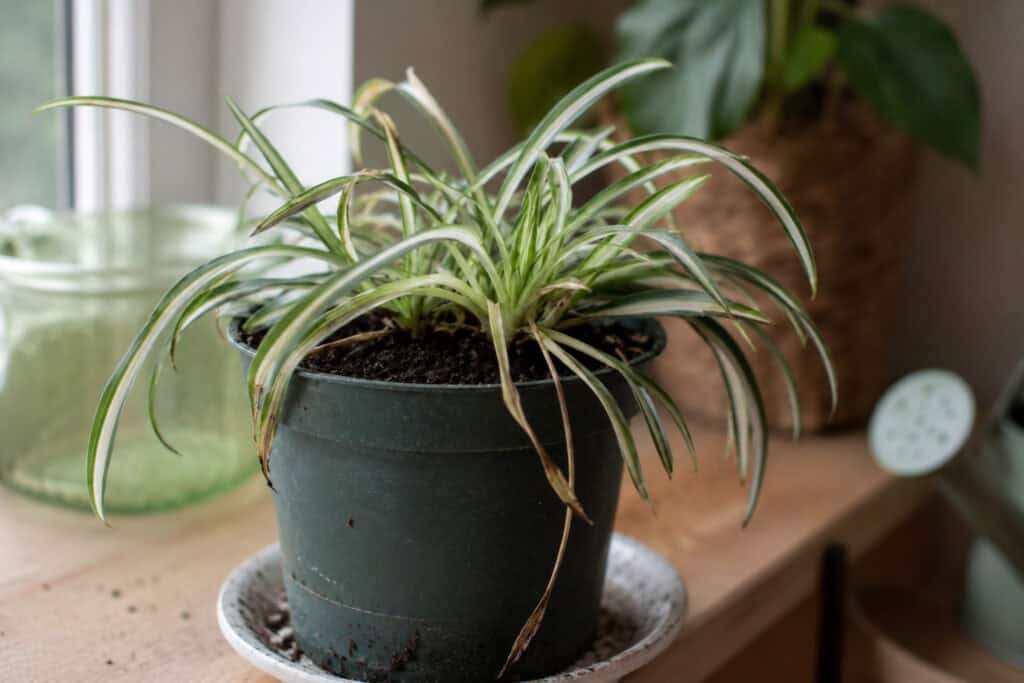
Spider plants (Chlorophytum comosum) stop growing when one or more key conditions fall outside their preferred range.
The most common causes are insufficient indirect light, inconsistent watering, fluoride in tap water, depleted soil, and temperature fluctuations above or below the 65-to-75-degree Fahrenheit range.
A healthy plant in good conditions produces new leaves every few weeks during spring and summer, and slows considerably in autumn and winter.
Warning: winter dormancy is normal; treating it as a problem often leads to overwatering damage.
You set up your spider plant near a window, water it regularly, and wait. Weeks pass. Nothing.
No new leaves, no runners stretching out over the pot, no cascading babies. It just sits there looking perfectly fine but completely stuck.
This is one of the most common frustrations spider plant owners run into, partly because the plant looks healthy enough to be growing and partly because the cause is almost never what you first suspect.
Most guides will tell you to check your watering, move the plant closer to a window, and fertilize more. That advice is not wrong exactly, but it is incomplete, and in some cases it makes things worse.
This guide goes deeper. It covers not just what causes a Chlorophytum comosum to stall, but why each cause actually stops growth at a biological level, what the real warning signs look like when you know where to look, and which pieces of commonly repeated advice are worth following versus which can quietly set your plant back further.
| Why Trust This Guide This guide draws on established horticultural knowledge of Chlorophytum comosum in household growing conditions, cross-referenced with guidance from the Royal Horticultural Society. It focuses on distinguishing genuine growth problems from normal seasonal slowdown, which most generic care advice fails to do. |
What Normal Spider Plant Growth Actually Looks Like
Before troubleshooting, it helps to know what healthy growth looks like in practice because spider plants are often accused of not growing when they are in fact growing exactly as expected.
In spring and summer, a well-established spider plant in good conditions will push out new leaves from the center rosette every few weeks.
These emerge as pale yellow-green spears from the center, darkening and broadening as they mature.
If the plant is mature enough and the conditions are right, it will eventually send out long arching runners, stolons, with small plantlets, called spiderettes, developing at the tips, which can then be propagated into new plants.
In autumn and winter, this slows down significantly. Growth may appear to stop altogether for several months.
This is not a problem. It is the plant responding normally to reduced light levels and cooler temperatures.
Many first-time growers respond to this seasonal slowdown by watering more and fertilizing to kick the plant back into action, which often leads to root rot or fertilizer burn, problems that then cause genuine growth failure the following spring.
The threshold worth investigating: if your plant has shown no new growth for more than 8 to 10 weeks during spring or summer, something is genuinely off.
If it has been sitting still from October through February, that is almost certainly normal.
8 Reasons Your Spider Plant Is Not Growing
1. Not Enough Indirect Light
Light is the single biggest driver of growth rate in spider plants, and this is where most stalled plants have their root problem.
Chlorophytum comosum needs bright, indirect light for most of the day, not a dim corner, not a shelf set back from a window, and not a room that gets a couple of hours of weak morning sun.
The reason light matters so much here is photosynthesis rate. Spider plants use light energy to produce the glucose that fuels new cell growth.
A plant sitting in low light is photosynthesizing slowly, which means it has less energy available for producing new leaves and runners. It is not dead or dormant; it is just idling.
You might notice the leaves in low light conditions become narrower and a slightly darker green as the plant attempts to maximize chlorophyll exposure.
The white or cream striping on variegated varieties will often fade or disappear entirely, which is not just an aesthetic issue, it signals the plant is genuinely light-starved.
Direct sun is the other extreme and causes a different problem.
Harsh direct rays, especially through south-facing glass from late spring onward, will bleach the leaves to a washed-out yellow-green and scorch the tips to papery brown.
A plant dealing with sun scorch is spending energy on damage repair rather than new growth.
The fix: Position the plant within 3 to 5 feet of a bright east- or north-facing window. If your home gets limited natural light, a full-spectrum LED grow light running for 10 to 12 hours daily is highly effective.
Set it on a timer so the plant gets consistent day length, which also helps trigger flowering and baby production later.
| Tip: The Light Sweet Spot Test Hold your hand 12 inches above the soil in the plant’s current position at midday. If you see a sharp, distinct shadow, the light level is adequate. A faint, blurry shadow means the light is too low for active growth. |
2. Watering Problems: Both Directions
Watering is cited as the most common cause of spider plant issues across almost every guide, and that is accurate, but the advice that follows is often oversimplified in ways that lead growers to keep making the same mistake in a different direction.
Overwatering does not just mean watering too often. It means the roots are sitting in saturated soil long enough to be deprived of oxygen.
Spider plant roots need air gaps in the soil to function. When soil stays waterlogged, the roots suffocate and begin to decay, a process called root rot. You will not see this happening from above.
The first visible signs are yellowing leaves that look almost normal at first, not crispy brown tips, but a general yellowing from the base upward, combined with a slight softening of the lower stems.
By the time the smell of rot is detectable from the pot, the damage is already significant.
Underwatering shows differently: the leaves become limp and slightly papery, and the tips turn brown and crispy rather than soft and yellow, and may also start curling inwards.
The soil will feel bone dry an inch or more below the surface. Unlike root rot, underwatering is usually reversible fairly quickly with a thorough soak and drainage.
The fix: Insert a finger into the soil to the second knuckle, roughly 1.5 inches. Water when the soil at that depth feels dry.
In summer this might be every 5 to 7 days; in winter it could be every 10 to 14 days.
Always water thoroughly until it drains from the bottom, then let it drain fully before returning it to any tray or cache pot.
| Tip: The Root Check That Most Guides Skip If you suspect overwatering but the leaves are not showing obvious signs yet, tip the plant gently from its pot. Healthy spider plant roots are thick, white, and firm almost like small tubers. Roots starting to rot will be brown, mushy, and may smell faintly sour. Catching this early, trimming the affected roots, and repotting into fresh dry soil can save a plant that would otherwise fail over the following months. |
3. Tap Water Fluoride and Chemical Sensitivity
This is one of the most consistently underestimated causes of poor spider plant health, and it rarely gets the emphasis it deserves.
Spider plants are notably sensitive to fluoride, chlorine, and dissolved salts, all of which are present in most municipal tap water at levels that will not affect most houseplants but accumulate to problematic concentrations in spider plants over time.
The most visible symptom is brown leaf tips. These appear on otherwise healthy-looking leaves and are often mistaken for underwatering.
The difference is that fluoride-induced tip burn is almost always confined to the very tip and travels up the leaf margins slowly over weeks, rather than appearing quickly across the whole leaf as drought stress does.
The soil may also develop a white crusty residue on the surface from salt buildup. The fix: Switch to rainwater, distilled water, or a reverse osmosis filtered supply.
If tap water is the only option, leaving it in an open container overnight allows chlorine to dissipate, but it does not remove fluoride or dissolved salts.
For plants already showing tip burn, flush the soil thoroughly with several passes of distilled water to leach out accumulated minerals.
4. Pot Size: The Root-Bound Paradox
The relationship between pot size and spider plant growth is genuinely more nuanced than most guides explain, and getting it wrong in either direction causes problems.
A plant in a pot that is too large for its root system will often stall on leaf and runner production because it redirects energy into root expansion.
The vast volume of soil also stays wet for longer after watering, increasing root rot risk.
On the other hand, a plant that is severely root-bound, roots circling the entire base of the pot, or emerging from drainage holes in thick coils, will also slow down because there is no longer room for new root growth, and what little soil remains dries out extremely quickly between waterings.
The nuance most guides miss: spider plants that are moderately root-bound actually tend to produce more runners and spiderettes than those in spacious pots.
This appears to be a stress response, a plant experiencing mild root constriction will put energy into reproduction.
A specialist grower confirmed this directly: a slightly snug pot signals to the plant that conditions are becoming less favorable, which triggers it to produce offspring.
The goal is not a roomy pot but a just-right one.
The fix: Choose a pot 1 to 2 inches larger in diameter than the current root ball when repotting.
If your plant is moderately root-bound and healthy, there is no urgency to repot, as covered in our guide to how big a spider plant gets, unless the roots are genuinely blocking drainage or the plant is drying out within 24 hours of watering.
Repot into fresh, well-draining compost with added perlite at a ratio of roughly 3 parts compost to 1 part perlite; our guide to the best soil for a spider plant covers the exact mix in more detail.
5. Nutrient Depletion in Old Soil
Spider plants are not heavy feeders, and this often leads growers to under-fertilize rather than over-fertilize, but a plant that has been in the same potting mix for two or more years is almost certainly growing in depleted soil.
Potting compost contains a finite amount of nitrogen, phosphorus, and potassium. Over time, roots absorb these nutrients, and the remainder gets flushed out with each watering.
By the end of the second growing season in the same soil, there may be very little left. The plant does not die, it just slows down and produces increasingly pale, narrow leaves.
The fix: During spring and summer, feed with a balanced liquid houseplant fertilizer at half the recommended strength once per month; our dedicated guide to fertilising a spider plant walks through the full schedule.
A 3:1:2 ratio fertilizer (such as 9-3-6 or 24-8-16) is particularly well matched to the nutrient ratios spider plants actually use.
Do not fertilize in autumn or winter. Crucially, avoid high-nitrogen fertilizers when you want the plant to produce runners and babies, excess nitrogen drives leafy foliage growth at the expense of flowering, and spider plants only produce spiderettes after flowering.
| Tip: Fertilizer and Babies; The Overlooked Conflict If your spider plant is growing well but not producing any runners or plantlets, excess fertilizer is a common but rarely discussed culprit. High nitrogen levels encourage the plant to keep producing foliage rather than switching to its reproductive phase. Cut back to half-strength feeding or stop entirely for 6 to 8 weeks, and ensure the plant is getting at least 12 hours of uninterrupted darkness each night, spider plants are short-day plants that flower and produce runners in response to longer nights. |
6. Temperature and Air Quality Stress
Spider plants prefer a stable temperature range of 65 to 75 degrees Fahrenheit during the day, with a slightly cooler night.
What they cannot tolerate is fluctuation, and this is where many indoor environments cause invisible, ongoing stress.
Common culprits include: a plant placed directly on a windowsill where it drops below 50 degrees Fahrenheit against the cold glass on winter nights; a shelf positioned above a radiator that blasts hot dry air when the heating comes on; proximity to an air conditioning vent that delivers periodic cold drafts.
None of these situations will kill the plant outright, but each causes a stress response that diverts energy away from growth and into survival management.
You will not always see a dramatic symptom. Sometimes the plant just sits still for weeks at a time, producing no new leaves, and recovers slowly once the temperature stabilizes.
In more severe cases, lower leaves will yellow and drop, and the growing tips may develop a faint tan discolouration.
The fix: Move the plant away from external walls, cold windows, radiators, and air vents. Consistent ambient room temperature matters more than hitting a specific degree.
If your home drops significantly at night, a position on an interior shelf or table rather than a windowsill will make a measurable difference to winter growth.
7. Pest Damage Masking as Slow Growth
Spider mites, mealybugs, and scale insects can all cause a spider plant to stall in growth, and because the damage often develops slowly, it is frequently overlooked or attributed to something else.
Spider mites are the most common and the hardest to spot early. Look for very fine, faint stippling on the upper leaf surface, tiny pale dots that look almost like dust or light scratches.
In heavy infestations you will see fine webbing between leaves and along the underside of the leaf.
The plant’s growth slows because the mites are draining cell contents from leaves faster than the plant can replace them.
Mealybugs appear as small white cottony clusters, usually at leaf joints or in the center rosette.
Scale insects look like small flat brown bumps along leaf undersides and stems. Both secrete honeydew, which can cause a faint sticky residue on lower leaves.
The fix: For spider mites, increase ambient humidity and wipe down all leaf surfaces with a damp cloth before treating with neem oil spray or insecticidal soap.
For mealybugs, dab each cluster with a cotton swab dipped in rubbing alcohol, then follow with a neem oil spray.
Treat every 5 to 7 days for three cycles to break the egg cycle. Isolate the plant from others during treatment.
8. Plant Maturity: It Simply Is Not Ready Yet
This is the cause that gets the least coverage relative to how often it applies, particularly to growers who have recently received a rooted spiderette from a friend or bought a small division from a garden center.
A newly established spider plant cutting is not yet physiologically mature.
It needs to develop its root system, establish itself in the pot, and reach a threshold of maturity before it will produce runners.
This can take anywhere from 6 to 18 months depending on conditions.
The plant may look healthy; it may even be producing new leaves at a reasonable rate, but it will not produce babies until it is ready.
No amount of adjusting light, water, or fertilizer will rush this stage.
The distinction that matters: if a young plant is producing new leaves regularly and looks healthy, it is growing.
It is just not yet mature enough to reproduce. If a mature plant (one you have had for over a year) is producing no new leaves at all, then the environmental causes above apply.
Do not conflate the two situations.
What the Most Common Advice Gets Wrong
Several pieces of guidance circulate widely about spider plants that either simplify the situation to the point of being misleading or actively lead growers to cause new problems.
Here are the ones most worth flagging.
“Keep the soil consistently moist.” This appears in several care guides and will cause root rot in most indoor environments.
Spider plant roots need to partially dry between waterings. “Consistently moist” describes the wrong target.
The correct target is “moist at watering, allowed to partially dry before the next watering.”
“Repot as soon as you see roots at the drainage holes.” A root or two appearing at a drainage hole is not an emergency.
Spider plants tolerate and even benefit from mild root congestion. Only repot when roots are densely circling the base of the pot, blocking drainage, or the plant is drying out within a day of watering.
“Fertilize every two weeks during the growing season.” For most indoor spider plants, once a month at half strength is more appropriate.
Twice monthly feeding at full strength is a fast route to fertilizer salt buildup and brown tips, which then get mistaken for a watering problem.
The plant will not grow faster with more fertilizer; it will just accumulate salt stress.
Troubleshooting Quick Reference
| Problem | Likely Cause | How to Confirm | Solution |
| No new leaves, spring/summer | Insufficient light | Shadow test at midday gives faint result | Move within 3-5 ft of bright window or add grow light |
| Yellowing leaves at base | Overwatering / root rot | Soil wet below 1.5 in; roots brown and soft | Remove, trim rotten roots, repot in fresh dry compost |
| Brown crispy leaf tips | Fluoride/tap water or over-fertilizing | White crust on soil surface | Switch to distilled or rainwater; flush soil |
| Limp, pale, drooping leaves | Underwatering or temperature stress | Soil dry 1.5 in down; check proximity to vents | Water thoroughly; relocate away from heat/cold sources |
| No babies despite healthy foliage | Excess nitrogen / too much light / not mature | Heavy feeding history; plant under 12 months old | Reduce fertilizer; ensure 12 hrs dark; allow plant to mature |
| Very slow growth all round | Depleted soil or low light | Soil 2+ years old; position far from windows | Repot with fresh compost; improve light |
| Stippling or webbing on leaves | Spider mites | Fine dots on upper leaf surface; webbing underneath | Neem oil spray every 5-7 days for 3 cycles |
| White cottony clusters at joints | Mealybugs | Visible white fluff at leaf joints | Alcohol-dipped cotton swab; follow with neem spray |
| Warning: Spider Plants and Pet Safety Spider plants (Chlorophytum comosum) are mildly toxic to cats and dogs. While not life-threatening, ingestion can cause vomiting, diarrhea, and mild hallucinations in cats due to compounds that act similarly to opioids. Keep the plant out of reach of pets, particularly cats, which are attracted to the foliage. Dogs are less commonly affected but can experience digestive upset. This information applies to all common varieties including ‘Vittatum’, ‘Variegatum’, and ‘Bonnie‘. |
| UK Reader Note: Spider Plants in British Homes In the UK, spider plants are grown exclusively as houseplants; they cannot survive outdoors through winter in any part of Great Britain. The RHS rates Chlorophytum comosum as tender (H1C), equivalent to USDA Zone 10 to 11. UK homes often present a specific challenge: central heating running through autumn and winter creates very dry air, which stresses spider plants and contributes to brown tips. A pebble tray with water placed beneath the pot improves humidity without overwatering. UK tap water hardness varies significantly by region, households in hard water areas (much of southern England and the Midlands) will see tip burn develop faster due to higher dissolved mineral content. Collecting rainwater is particularly easy in the UK climate and is the best low-cost solution. |
Frequently Asked Questions
Why has my spider plant stopped growing in summer?
A spider plant that stalls during summer is almost always dealing with a light, watering, or water quality issue.
Summer is the plant’s most active growth period, so a pause during these months points to something genuinely limiting.
Start by checking light levels, is the plant still in the same position it was in winter, when the sun angle was lower?
Southern hemisphere sun in late spring and summer may now be hitting the plant with direct rays that were indirect earlier in the year, causing leaf scorch that stalls growth.
Check water quality next, as fluoride sensitivity tends to show up most dramatically during the active growing season when the plant is processing more water.
Finally, assess watering frequency, summer warmth dries soil faster, and a plant that was watered at the right interval in April may now be chronically underwatered by June with no change in routine.
How long does it take for a spider plant to produce babies?
Most spider plants take at least 12 to 18 months from the point of being established in a pot before they begin producing runners and spiderettes.
Plants propagated from cuttings start this clock from the point of successful rooting, not from when the original parent began growing.
The exact timing varies with growing conditions, a plant in bright indirect light with consistent care may produce its first runners before 12 months, while a plant in lower light may take two years or more.
Beyond timing, the plant also needs to have flowered first. Spider plants produce small white flowers on the stolons before the spiderettes develop, and this flowering is triggered by short-day conditions, specifically 12 or more hours of uninterrupted darkness per night.
A plant near a lamp that is left on in the evenings may not flower at all, regardless of how healthy it looks.
Should I repot my spider plant to make it grow faster?
Repotting is not always the solution and can sometimes slow growth rather than accelerate it.
If the plant is in old, depleted soil it will benefit from being moved into fresh compost, which can noticeably improve growth within 4 to 6 weeks.
But if the soil is relatively fresh and the plant is moderately root-bound, repotting into a larger container may cause a temporary growth pause as the plant focuses energy on expanding its root system to fill the new space.
The sweet spot is a pot 1 to 2 inches wider than the current root ball, with fresh well-draining compost. Repotting in spring gives the plant the entire growing season to recover and establish.
Can overwatering stop a spider plant from growing?
Yes, overwatering is one of the most common causes of completely stalled growth in spider plants.
When roots are consistently sitting in waterlogged soil, they are deprived of oxygen and begin to rot.
Rotting roots cannot absorb water or nutrients, so the plant effectively loses its ability to feed itself even though there is plenty of water available.
The insidious aspect of root rot is that the earliest symptoms, mild yellowing, slightly soft base, a faint earthy smell, are subtle enough to be dismissed.
By the time the plant looks obviously sick, the root system may be severely compromised. If you suspect overwatering, tip the plant out and examine the roots directly.
Firm white roots are healthy. Brown, mushy, sour-smelling roots confirm rot.
Why does my spider plant have green leaves instead of white stripes?
Loss of variegation, the cream or white stripes reverting to solid green, is almost always a light deficiency response.
Spider plants produce the pale striping in their variegated varieties as a genetic trait, but under low light conditions the plant ramps up chlorophyll production across the entire leaf surface to maximize photosynthesis, which effectively masks or suppresses the white and cream pigmentation.
Moving the plant to a brighter position with consistent indirect light will usually restore the variegation within one or two new growth cycles, as the new leaves emerge with the proper stripe pattern.
Old leaves that have already turned solid green will not revert; only new growth reflects the improved conditions.
Does misting help a spider plant grow?
Misting has a limited effect on spider plant growth and is often recommended more enthusiastically than it deserves.
It temporarily raises humidity around the leaves, which can reduce tip browning caused by dry air, but the effect lasts only minutes before the moisture evaporates.
For consistent humidity improvement, a pebble tray filled with water placed beneath the pot is significantly more effective because it provides ongoing evaporation throughout the day.
Misting also risks leaving water sitting in the crown of the plant, particularly in poor air circulation, which can lead to fungal issues.
If humidity is genuinely the problem, a small room humidifier near the plant or grouping several houseplants together is more reliable than misting.
Why is my spider plant not growing new leaves?
A spider plant producing no new leaves at all during spring or summer is dealing with at least one significant limiting factor.
The most common single cause is inadequate light, a plant that cannot photosynthesize efficiently enough simply does not have the energy reserves to build new cell tissue.
After light, check the roots: if the plant has been in the same pot for over two years, root-bound conditions combined with exhausted soil may be preventing new growth.
Temperature inconsistency is another underappreciated cause, a plant experiencing frequent swings between warm days and cold nights near a window may effectively stay in a kind of low-energy holding pattern rather than investing in new growth.
Run through each of the causes in this guide methodically before concluding the plant is simply slow.
Can I grow a spider plant in water if it has stopped growing in soil?
Spider plants can survive in water, as our guide to propagating spider plants in water explains, but they will not thrive long-term without additional nutrients.
A plant moved to water will typically show a short burst of root adjustment, but without fertilizer specifically formulated for hydroponics, it will quickly deplete any stored nutrients and growth will stall.
If you are troubleshooting a plant with suspected root rot, a temporary transition to clean water can help you assess and regrow damaged roots, in this context it can be genuinely useful.
But if the goal is long-term growth, soil with appropriate drainage and occasional feeding will always produce better results than plain water.
If you want to try a water setup long-term, use a diluted hydroponic nutrient solution at low concentration and change the water every 7 to 10 days to prevent stagnation.
Key Takeaways
- Place the plant within 3 to 5 feet of a bright east- or north-facing window. Low light is the single most common cause of stalled growth.
- Water when the soil is dry at 1.5 inches below the surface. Overwatering causes slow, invisible root rot; underwatering causes quick, visible stress.
- Switch to distilled, filtered, or rainwater if you see brown tips creeping up otherwise healthy leaves. Tap water fluoride accumulates over time.
- Use a pot that is 1 to 2 inches larger than the root ball. Too large a pot redirects energy to roots; severely root-bound plants dry out too fast.
- Feed with balanced liquid fertilizer at half strength once a month during spring and summer only. Stop in autumn and winter.
- Keep the plant away from radiators, cold windows, and air vents. Temperature consistency matters more than hitting a specific temperature.
- Check for spider mites early by looking for faint stippling on upper leaf surfaces. Treat with neem oil spray over three cycles.
- If the plant is under 12 to 18 months old and producing healthy leaves, it is growing. Baby production requires maturity and short-day conditions.
- Do not treat winter dormancy as a problem. Attempting to force growth through the colder months with extra water or fertilizer causes more damage than the slowdown itself.
Final Thoughts
Spider plants have a reputation for being nearly indestructible, which is mostly earned, but it can also make diagnosing a growth problem harder, because growers assume the plant should be thriving under almost any conditions.
The truth is that a spider plant will survive a lot, but it will only thrive when light, water, soil, and temperature are all working together within a reasonable range.
If your plant has been sitting still for months, the answer is almost always one of the eight causes in this guide, and more often than not, it is light. Start there.
Get the plant into genuinely bright, consistent indirect light before changing anything else, and give it four to six weeks to respond before making additional adjustments.
Trying to fix multiple variables at once makes it impossible to know what actually worked.
The growers who end up with lush, overflowing spider plants cascading babies onto every shelf are not doing anything mystical.
They are usually just keeping the plant in a bright spot, watering with filtered water, and leaving it mostly alone; our wider spider plant care guide covers the same fundamentals if you want a single reference point.
| What’s Next Check your plant’s light position first, use the shadow test described in this article to assess whether the current spot provides enough indirect light for active growth. If the shadow is faint or absent, move the plant to a brighter location before adjusting any other variable. Once the light is right, reassess watering frequency for the new position, as brighter conditions dry out soil more quickly. |
Mariel is a plant enthusiast and writer based in the UK with a passion for houseplants and indoor growing.
She has spent the last few years building an ever-growing collection of indoor plants and learning the hard way which ones will survive her busy schedule.
At Bean Growing she writes about houseplant care, common plant problems, and outdoor gardening.