
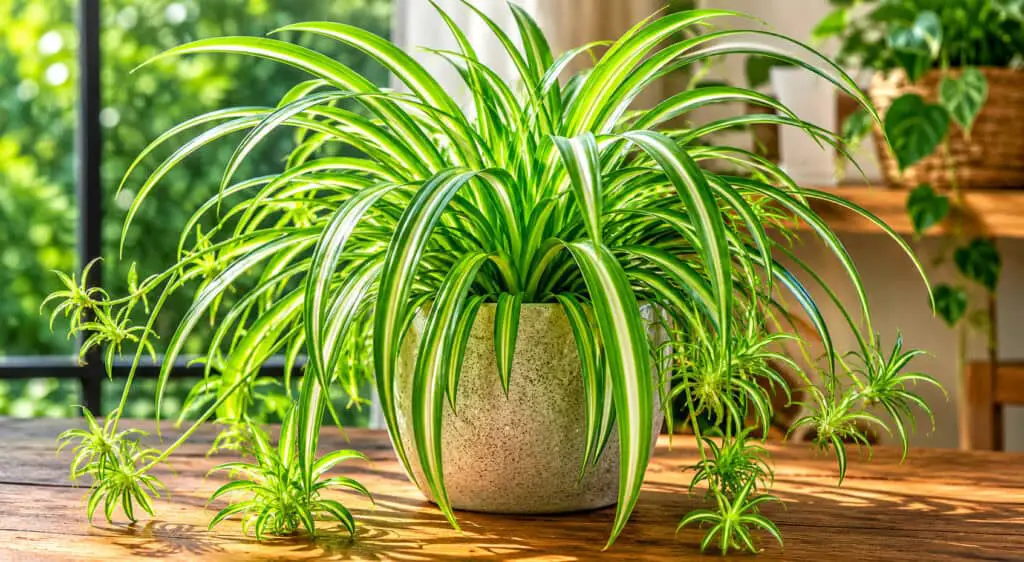
Spider plants (Chlorophytum comosum) need fertilising once every two to four weeks during spring and summer using a balanced, water-soluble fertiliser at half the recommended strength.
Feed monthly in early autumn, then stop entirely through winter when growth slows. Liquid formulas are most reliable because they distribute evenly through the root zone.
Never fertilise dry soil, as direct salt contact burns the fleshy roots instantly.
If you have been feeding your spider plant on a strict schedule and the leaf tips are still going brown, you are not alone.
That browning is one of the most misread signals in houseplant care, and the most common response, cutting back on water or reaching for more fertiliser, usually makes things worse, not better.
The frustrating truth is that spider plants are more likely to suffer from too much feeding than too little.
They are moderate feeders that grow vigorously in spring and summer, slow right down in autumn, and genuinely need a rest period in winter.
When you fertilise through that rest period, salt builds up in the soil faster than the roots can process it, and the damage shows up weeks later as browning tips that look like a watering problem.
This guide covers exactly when to feed, what to use, how to apply it correctly, and how to diagnose the signs your plant is sending when something is off.
If your spider plant is already showing brown tips or pale, limp leaves, the troubleshooting section further down will tell you what to look for and what actually fixes it.
Does a Spider Plant Actually Need Fertiliser?
Spider plants are native to southern Africa, where they grow in well-drained, moderately fertile soils with seasonal rainfall.
They are not heavy feeders by nature, but they do run through the nutrients in potting mix faster than you might expect.
Potting compost loses most of its available nutrients within three to six months of being opened.
Once that supply is exhausted, a spider plant growing in the same pot year after year will start to show it.
The leaves lose their bright, upright quality and begin to look a little washed out, pale green rather than the saturated colour you see on a well-fed plant.
The runners slow down, and the plantlets that do appear will be noticeably smaller.
That said, a spider plant in a small pot that was recently repotted with fresh compost may need very little added feeding for the first growing season.
The question is not simply whether to fertilise, but when and how much.
What Kind of Fertiliser Works Best
The most consistently good results come from a balanced, water-soluble liquid fertiliser with an NPK ratio of around 10-10-10 or 20-20-20, always applied at half the label rate.
The reason for halving the dose is not timidity. Spider plants have fleshy, tuberous roots that are unusually sensitive to salt concentration.
At full label strength, most houseplant fertilisers push the salt level in the root zone above what these roots tolerate comfortably, even when the plant looks healthy.
Liquid fertilisers are the better choice over granules for spider plants specifically, because they distribute evenly through the root zone when you water.
Granules sit in the top layer of soil and dissolve unevenly, creating pockets of higher concentration right where the roots sit closest to the surface.
Those concentrated pockets are exactly what causes the root tip burn that shows up as browning on the leaves weeks later.
| Fertiliser Type | Best For | Key Advantage | Watch Out For |
| Balanced liquid (10-10-10 or 20-20-20) | Regular growing season feeding | Even distribution through root zone | Always dilute to half strength |
| Slow-release granules | Low-maintenance growers | Less frequent application needed | Salt pockets near sensitive roots |
| Organic liquid (seaweed or fish) | Sensitive or recently repotted plants | Very low salt, gentle on roots | Lower NPK so results take longer |
| Worm castings top-dressing | Slow background nutrition | Almost impossible to overdo | Works alongside, not instead of liquid |
One thing worth noting: some guides recommend high-phosphorus fertilisers to encourage flowering or plantlet production.
In practice, spider plants produce runners and babies in response to light changes and maturity, not phosphorus spikes.
Chasing this with extra feeding more often leads to salt stress than extra babies.
How Often to Fertilise a Spider Plant
The feeding schedule that works best in the real world is slightly different from what most guides suggest. Here is how to think about it across the year.
| Season | Feeding Frequency | What the Plant is Doing | Notes |
| Early spring | Once every 3 to 4 weeks | Waking up, new growth beginning | Start cautiously, watch leaf response |
| Late spring and summer | Once every 2 weeks | Active growth, runners forming | Peak feeding period, half strength only |
| Early autumn | Once a month | Growth slowing, plantlets developing | Begin tapering off at this point |
| Late autumn and winter | Stop entirely | Dormant or very slow | Feeding now causes salt buildup |
One thing many guides get wrong is the autumn transition. They say to feed monthly in autumn as if that applies from September through December.
In practice, if your plant is sitting in lower light from mid-October onwards and barely producing new leaves, it does not need feeding at all.
The soil holds the fertiliser it cannot use, salt concentrations climb slowly, and by January the roots are showing the damage even though the plant looked fine six weeks ago.
The honest calibration is to watch the plant rather than the calendar. If it is still pushing out new leaves in September, give it one more feed.
If growth has clearly stalled, stop there.
| Tip: Read Your Plant Before You Feed Active growth is the clearest signal that feeding is useful. A spider plant putting out new leaves, extending runners, or producing plantlets is a plant that can absorb and use nutrients. A plant sitting still in dim autumn light cannot, and fertilising it simply loads the soil with salts it has no way to process. |
How to Fertilise a Spider Plant Step by Step
The method matters as much as the frequency. These steps reduce the risk of root burn and salt buildup, the two most common consequences of well-intentioned but slightly off fertilising.
Step 1: Water the Plant First
Always water your spider plant thoroughly before adding any fertiliser. When fertiliser solution hits dry soil, the concentrated salts make direct contact with the roots before the liquid can distribute.
The fleshy, tuberous roots of a spider plant absorb this concentrated dose faster than thinner-rooted houseplants, and the damage appears quickly as browning tips and a limp, slightly yellowed look.
Watering first dilutes the incoming nutrients as they move through already-moist soil, protecting the root tips.
Step 2: Mix at Half the Label Rate
Whatever the fertiliser label says, use half. If the label says one teaspoon per litre, use half a teaspoon.
This is not just a general caution. Spider plants sit in relatively small pots with limited soil volume, and the roots are in constant close contact with the solution.
At full label strength, even once a fortnight, salt can accumulate faster than regular watering flushes it out.
You will not see a difference in leaf colour or growth speed between half-strength and full-strength feeding, but you will see a difference in long-term root health.
Step 3: Apply to the Soil, Not the Leaves
Pour the diluted solution directly into the soil at the base of the plant until it starts to drain from the bottom.
Keep it away from the crown of the plant and off the leaves. Fertiliser sitting on foliage can cause localised scorch, particularly on the variegated varieties where the pale white stripes have less protective pigmentation.
Step 4: Allow the Excess to Drain
Let the pot drain completely into the saucer, then empty the saucer after about fifteen minutes. Do not let the pot sit in that drained liquid.
The runoff contains dissolved salts, and if the soil pulls it back up through the drainage holes, those salts return to the root zone.
This is a small but consistent source of root stress that most guides never mention.
Step 5: Flush the Soil Every Four to Six Weeks
Run plain, room-temperature water through the pot slowly and generously, about twice the pot volume, every four to six weeks during the growing season.
These washes accumulated salts down and out through the drainage holes.
You can often see the effect of salt buildup before you flush: a white or pale grey crust forming on the soil surface or around the inner rim of the pot.
That crust is largely mineral and salt deposits. It does not look alarming but it is a sign the soil is accumulating more than it is losing.
The Water You Use Matters More Than Most Guides Admit
This is the area where a lot of spider plant advice falls short. Brown leaf tips are frequently blamed on over-fertilising when the actual cause is fluoride in tap water.
Spider plants are specifically sensitive to fluoride and chlorine, both of which are present in most municipal water supplies in the US.
The problem is compounded when you mix your fertiliser solution using tap water.
You are adding salt stress from the fertiliser on top of fluoride sensitivity from the water, and the roots and leaf tips take the combined hit.
The tips turn brown and crispy, starting at the very ends and working inward, often before the tips of other houseplants in the same room show any reaction at all.
If you switch to distilled or rainwater for both regular watering and for mixing your fertiliser, and the brown tips stop progressing over the following few weeks, you have your answer. It is not always the fertiliser.
Sometimes it is the water.
| UK Reader Note: Water Quality and Seasonal Timing Tap water hardness varies significantly across the UK. If you are in a hard water area such as London or the South East, the combination of chalk minerals, fluoride, and fertiliser salts makes over-accumulation more likely, especially in smaller pots. Collecting rainwater for spider plant watering is straightforward in most of the UK and avoids this issue entirely. UK growing season timing also runs slightly different. Begin feeding in April rather than March, and taper off by early September rather than late September, as light levels in much of the UK drop earlier and more sharply than in most US growing regions. |
Signs Your Spider Plant Actually Needs Feeding
Not every struggling spider plant needs more fertiliser. In fact, the reverse is more common.
But there are genuine signs that a plant is running low on nutrients and would benefit from a regular feeding routine.
Pale or faded foliage is the clearest one. A well-fed spider plant has leaves with a specific quality, bright, slightly waxy, and upright even on a hanging plant.
When nitrogen becomes limited, the leaves lose that brightness and take on a flatter, more yellowish-green tone across the whole leaf surface rather than just at the tips.
If the tips are browning but the body of the leaf is still a saturated green, that is more likely to be fluoride or salt stress than a nutrient deficiency.
Slow or absent runner production on a mature plant during summer is another genuine signal.
A healthy, well-fed spider plant in its active season will typically be extending several runners with plantlets attached.
If yours is not doing this by midsummer and the light conditions are reasonable, a consistent feeding routine through the growing season often prompts a response within four to six weeks.
Roots crowding visibly through the drainage holes and pushing the plant up in the pot suggest the plant has outgrown its current soil as much as its container.
This is a repotting signal, but refreshing the compost and adding a light feeding routine together often produces a noticeably more vigorous plant within a few weeks.
Common Fertilising Mistakes and What Actually Goes Wrong
Most mistakes with spider plant feeding come from applying advice that is technically correct but incompletely explained. Here are the ones that cause the most damage in practice.
Fertilising in Winter
This is the most common mistake, and it typically comes from advice that says to reduce feeding in winter rather than stop altogether.
A spider plant in a north-facing room from November to February is barely growing. The roots are not actively absorbing much of anything.
Fertiliser applied during this period stays in the soil, accumulates, and the salt concentration climbs with each application.
By the time spring arrives and the plant starts growing again, it is pushing new roots into over-salted soil.
The new growth often comes through pale and slightly limp even though light conditions have improved.
Feeding a Newly Purchased or Recently Repotted Plant
A plant bought from a nursery or garden centre was almost certainly fertilised commercially before sale.
The potting mix will still contain nutrients. Adding more in the first four to six weeks overloads the root zone.
Wait until the plant shows genuine signs of active new growth before starting any feeding routine.
After repotting into fresh compost, the same principle applies. Fresh compost has available nutrients.
Give it two to three months before adding anything extra.
Using Full-Strength Fertiliser to Fix a Slow Plant
When a spider plant looks sluggish, the instinct is to feed it more generously. This is the opposite of what helps.
A plant growing slowly in winter or poor light cannot process a full-strength dose of fertiliser.
The nutrients stay in the soil rather than being taken up by the roots, salt accumulates, and the plant comes under additional stress.
The fix for a slow plant is almost always more light, a better watering rhythm, or patience, not a larger dose of food.
Fertilising Plantlets Still Attached to the Mother
This one is often overlooked. Plantlets hanging on runners get their nutrition from the mother plant through the runner.
They do not have independent root systems until after they have been separated and potted on.
Feeding the mother at the right rate is what supports them. Do not increase feeding frequency because your plant has babies.
Once a plantlet has been separated and potted on its own, wait two to three weeks before starting any feeding routine, giving the new roots time to establish before they encounter concentrated nutrients.
Troubleshooting Fertiliser Problems
Brown Leaf Tips
This is the symptom that causes the most confusion because it has multiple causes.
Before adjusting your fertiliser routine, work through the possible causes in order.
Brown tips that are dry and crispy and start at the very tip of the leaf are most commonly caused by fluoride in tap water, salt accumulation from fertiliser, or low humidity.
If the browning is spreading from the tips inward and the affected tips feel dry rather than soft, try switching to distilled water for four to six weeks before changing anything else.
If the browning stops progressing, water quality was the issue.
Yellowing Leaves
Whole leaves turning yellow, starting from the older lower leaves, usually points to overwatering rather than fertiliser issues.
But pale yellowing across the whole plant with no obvious relationship to leaf age can indicate either a nitrogen deficiency or salt-damaged roots that can no longer absorb nutrients efficiently.
Flush the soil thoroughly with distilled water, wait two weeks, then restart feeding at half strength with a liquid fertiliser and assess over the following month.
White Crust on the Soil Surface
A pale white or greyish crust on the top of the soil, or a chalky line around the inside of the pot near the soil surface, is a sign of mineral and salt accumulation.
This happens in hard water areas or when fertiliser has been used regularly without periodic flushing.
It does not cause immediate damage but left long enough it creates a barrier that affects water penetration and root health.
Flush the soil generously with distilled water two or three times over a few days, letting it drain fully each time.
Soft, Wilting Growth Despite Correct Watering
If a spider plant is wilting but the soil is neither bone dry nor waterlogged, and watering does not restore firmness within a few hours, root damage is likely.
This can result from salt burn after prolonged over-feeding. Tip the plant out and inspect the roots.
Healthy spider plant roots are thick, firm, and white to pale cream.
Roots that have suffered fertiliser salt damage are often brown or grey, soft to the touch, and may have a faintly unpleasant smell.
Trim off any damaged roots, repot into fresh compost, and do not feed for at least six weeks.
| Problem | Likely Cause | How to Confirm | Solution |
| Brown crispy leaf tips | Fluoride in water or salt accumulation | Tips dry and crispy, browning from tip inward | Switch to distilled water, flush soil |
| Pale yellowing across whole plant | Nitrogen deficiency or root salt damage | Even yellowing not linked to leaf age | Flush soil, restart at half-strength liquid |
| White crust on soil surface | Salt and mineral buildup | White or grey crust visible on soil | Flush with distilled water several times |
| Wilting despite correct watering | Root burn from over-feeding | Roots brown, soft, or malodorous when inspected | Trim damaged roots, repot, no feeding for 6 weeks |
| No runners or plantlets in summer | Nutrient deficiency or insufficient light | Healthy leaf colour but no runners forming | Begin regular feeding and assess light levels |
| Warning: Spider Plants and Pet Safety Spider plants (Chlorophytum comosum) are considered non-toxic to dogs and cats according to the ASPCA. However, cats in particular are often attracted to the plants and may chew the leaves. Large quantities can cause mild gastrointestinal upset, including vomiting. Keep this in mind if you have cats that like to chew foliage, and place hanging plants out of reach as a precaution. |
Frequently Asked Questions
How often should I fertilise my spider plant?
During spring and summer, fertilise every two weeks using a balanced liquid fertiliser at half the recommended strength.
In early autumn, reduce to once a month and watch whether the plant is still producing new growth.
Once growth has clearly slowed or stopped, usually by mid to late autumn, stop feeding entirely and do not resume until you see active new growth returning in spring.
The key variable is the plant, not the calendar. An actively growing plant in a warm, well-lit room can be fed through October without issue.
A plant sitting still in lower autumn light should stop being fed much earlier.
What is the best fertiliser for a spider plant?
A balanced, water-soluble liquid fertiliser with an NPK ratio of 10-10-10 or 20-20-20, applied at half the label rate, gives the most consistent results.
Liquid is preferable to granules because it distributes evenly through the root zone and allows more precise control over concentration.
Avoid fertilisers with high fluoride content, as spider plants are specifically sensitive to fluoride and it causes brown leaf tips even at levels that would not affect other houseplants.
If you prefer organic options, a diluted liquid seaweed feed works well during the growing season and carries very low salt risk.
Worm casting top-dressings are an excellent supplement but should not be used as the sole source of nutrition during active growth.
Why does my spider plant have brown tips even though I fertilise correctly?
Brown tips on a spider plant that is being fed at the right rate and frequency are most commonly caused by fluoride in tap water rather than fertiliser issues.
Spider plants are unusually sensitive to fluoride, and most municipal water supplies in the US contain fluoride at levels that do not affect other plants but do affect spider plants over time.
Try mixing your fertiliser solution with distilled water or rainwater and using the same water for regular watering.
If the browning stops progressing over four to six weeks, water quality was the cause. Other possible contributors include low humidity, cold air from nearby windows or vents, and physical damage from handling.
Can I use banana peels to fertilise my spider plant?
Banana peels are often suggested as a potassium source for houseplants, but they do not work well in practice for spider plants specifically.
Banana peels break down very slowly in potting soil, releasing nutrients over a long and unpredictable timeline rather than at the pace a growing plant needs.
Buried or placed on the soil surface, they also attract fungus gnats, which become a persistent problem in indoor pots.
The potassium content released is also modest relative to what a proper liquid fertiliser provides.
Stick to a diluted liquid fertiliser during the growing season for reliable, manageable results.
Should I fertilise spider plant babies still on the mother plant?
No. Plantlets attached to the mother plant via a runner receive their nutrition through that runner.
They do not have independent root systems at that stage and cannot take up nutrients from the soil directly.
Feeding the mother plant correctly is what supports the plantlets. Increasing feeding frequency because your plant has babies attached will over-fertilise the mother without benefiting the babies.
Once a plantlet is cut from the runner and potted on its own, wait two to three weeks before starting any fertiliser routine.
This gives the new roots time to establish before they encounter dissolved salts in the watering solution.
Can I use slow-release granules instead of liquid fertiliser?
You can, but liquid fertiliser is the better choice for spider plants for a specific reason. Spider plants have fleshy, tuberous roots that sit close to the surface of the soil.
Slow-release granules dissolve unevenly and can create pockets of concentrated salt close to where those roots are most dense.
Liquid fertilisers distribute evenly through the root zone when applied to already-moist soil, giving much more consistent results and significantly lower risk of salt damage.
If granules are your only practical option, apply at no more than half the recommended rate and flush the soil with plain water every four to six weeks during the growing season.
Is it possible to under-fertilise a spider plant?
Yes, though it is much less common than over-feeding.
A spider plant that has been in the same pot with the same compost for two or more years without any feeding will eventually exhaust the available nutrients in the soil.
The signs are gradual: the leaves lose their saturated green colour and take on a pale, slightly washed-out appearance across the whole leaf rather than just at the tips, runner production slows noticeably, and new leaves come through smaller than the established ones.
The fix is straightforward: begin a regular feeding routine at half strength every two weeks through spring and summer.
Improvement is usually visible within four to six weeks.
Can I fertilise a spider plant that is already stressed or unwell?
No. Fertilising a stressed or struggling plant is one of the most common mistakes in houseplant care and the consequences are disproportionately bad for spider plants.
When a plant is stressed, whether from overwatering, root rot, very low light, or pest damage, its roots are not functioning efficiently.
Fertiliser applied at that point sits in the soil and raises salt concentration without being taken up, which creates additional stress on roots that are already compromised.
The correct approach is always to identify and address the underlying problem first, whether that means adjusting watering, improving light, or treating for pests.
Wait until the plant shows clear signs of recovery and new growth before reintroducing any feeding routine.
Key Takeaways
- Feed every two weeks during spring and summer using a balanced liquid fertiliser at half the recommended strength.
- Stop feeding entirely in late autumn and winter. Do not taper gradually through December. Growth has stopped and the soil cannot process nutrients.
- Always water the plant thoroughly before applying fertiliser. Dry soil and concentrated fertiliser solution is the fastest way to burn spider plant roots.
- Use distilled or rainwater to mix your fertiliser solution if you are in a fluoridated water area. Brown tips are more often a water quality problem than a fertilising problem.
- Flush the soil with plain water every four to six weeks during the growing season to wash out accumulated salts before they damage the roots.
- Do not increase feeding frequency because your plant is producing babies. Feed the mother correctly and the plantlets will follow.
- Wait two to three weeks after potting on a new plantlet before feeding it. Let the roots establish first.
- If your plant is stressed, wilting, or recovering from root damage, do not feed it. Fix the underlying problem first and wait for clear new growth before restarting any fertilising routine.
Final Thoughts
The frustration most people feel about spider plant brown tips and slow growth almost always comes from the same place: doing a little too much.
One extra feed in October. Slightly too much fertiliser in the mix. Tap water week after week in a hard water area.
None of these feel-like mistakes in the moment, and that is what makes them so persistent.
Spider plants reward a lighter touch.
Feed them consistently during the months when they are actually growing, use distilled water when you can, flush the soil regularly, and leave them alone through winter.
That combination, applied consistently over a full growing season, produces the kind of plant that fills its pot, sends out long trailing runners, and turns heads on a shelf or hanging in a window.
If yours is not there yet, the troubleshooting section will tell you what to look for.
The good news is that spider plants are genuinely resilient, and most problems caused by fertilising mistakes are reversible within one growing season if you catch them early.
| What’s Next Check your spider plant’s roots. Tip the plant gently out of its pot and look at the root ball. Healthy roots are thick, firm, and white to pale cream. If what you find looks good, start your feeding routine at half-strength liquid fertiliser next time you water in spring. If the roots look brown, soft, or sparse, repot into fresh compost first and give the plant six weeks to recover before introducing any fertiliser at all. |
Mariel is a plant enthusiast and writer based in the UK with a passion for houseplants and indoor growing.
She has spent the last few years building an ever-growing collection of indoor plants and learning the hard way which ones will survive her busy schedule.
At Bean Growing she writes about houseplant care, common plant problems, and outdoor gardening.