
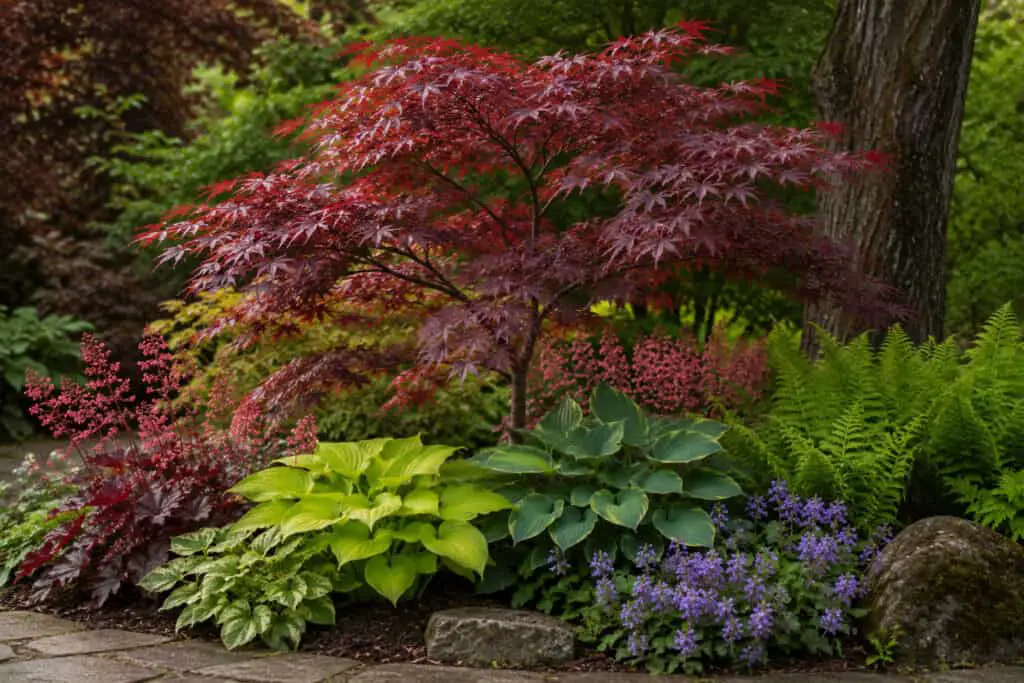
Working out what to plant with Acer trees is one of the more satisfying puzzles in garden design, because a well-placed Japanese maple is really only half of a picture.
The other half is everything planted around its feet and beneath its canopy.
An Acer palmatum grown in isolation on a bare patch of lawn or mulch can look slightly stranded, however beautiful its foliage, while the same tree underplanted with the right shade-tolerant, acid-loving companions can look as though it has always belonged exactly where it stands.
The good news is that Japanese maples are genuinely easy trees to plan around once you understand what they need.
If you are still getting to grips with the tree’s own care, my Acer tree care guide is worth reading alongside this one, since the conditions that suit the maple are exactly the conditions that dictate which companions will thrive.
Because Acer palmatum evolved as an understorey tree in cool, moist, acidic forest conditions, its companion planting needs follow a fairly consistent set of rules: shade tolerance, a preference for slightly acidic, humus-rich soil, and a dislike of being crowded too closely at the trunk.
This guide covers acer tree companion plants in detail, working through the best planting combinations for shade, colour, texture, and seasonal interest, along with the plants and practices that are best avoided near a Japanese maple.
Quick Guide: Best Companion Plants for Acer Trees at a Glance
Use this table as a fast starting point before reading the detailed sections below.
| Companion Type | Examples | Why It Works With Acer | Best Position |
| Shade-loving perennials | Hostas, hellebores, heuchera, astilbe | Tolerate the dappled shade cast by the canopy; similar moisture needs | Beneath the canopy edge to mid-border |
| Ferns | Japanese painted fern, autumn fern, hart’s tongue fern | Thrive in the same cool, moist, humus-rich soil as Acer roots | Directly under the canopy |
| Acid-loving shrubs | Azaleas, rhododendrons, camellias, pieris | Share identical soil pH and moisture preferences | Mid-border, around the drip line |
| Groundcovers | Epimedium, sweet woodruff, ajuga, pachysandra | Suppress weeds without competing for root space | Directly beneath the canopy |
| Spring bulbs | Snowdrops, dwarf daffodils, crocus, wood anemone | Flower and fade before the maple’s canopy closes over | Scattered under the canopy |
| Ornamental grasses | Japanese forest grass (Hakonechloa), sedges | Echo the maple’s fine texture without competing visually | Canopy edge, part shade |
| Structural evergreens | Dwarf conifers, box, Skimmia | Provide winter structure once the maple is bare | Background or flanking positions |
| Companion trees | Dogwood, magnolia, other Acer varieties | Layer canopy height without excessive root competition | Several metres from the trunk |
Understanding Why Companion Planting Matters for Acer Trees
Before choosing individual plants, it helps to understand the growing conditions a Japanese maple actually creates around itself, because this is what any successful companion has to tolerate.
The canopy of an established Acer palmatum casts moderate to fairly dense dappled shade, particularly from mid-summer once the leaves are fully out.
Very few sun-loving plants will perform well directly beneath it, which immediately narrows the field to shade and part-shade specialists.
My Japanese maple light requirements guide covers how much light the tree itself needs, which is the same starting point for judging how much reaches the ground beneath it.
The tree also has a shallow, fibrous root system that spreads wide rather than deep, and it competes vigorously with anything planted too close to the trunk for both moisture and nutrients.
This means the healthiest companion planting schemes tend to favour plants with their own shallow, non-competitive root habits, rather than deep-rooted or thirsty plants that will fight the maple for resources.
Finally, because Acer palmatum prefers slightly acidic soil with a pH of roughly 5.5 to 6.5, the most reliable companions are plants that share this same acid to neutral preference.
Planting acid-loving companions around an Acer also means a single feeding and mulching regime can look after the whole planting bed at once, rather than trying to manage clashing soil requirements in the same small area.
Best Acer Tree Companion Plants for Shade and Underplanting
Hostas
Hostas are one of the most popular and reliable acer tree companion plants, and for good reason.
Their broad, often variegated or blue-green leaves provide a strong textural contrast against the finely dissected foliage of a Japanese maple, and they are entirely happy in the dappled shade the tree produces.
Hostas prefer the same moisture-retentive, humus-rich soil that suits Acer roots, and a generous mulch applied for the maple’s benefit will suit the hostas equally well.
The main practical consideration is slug and snail protection, since hostas are a favourite target, and grit mulch or copper tape around the crowns is worth using in a bed that already carries an investment in a mature maple.
Hellebores
Hellebores, particularly the Lenten rose (Helleborus orientalis), are an excellent choice for planting beneath or around an Acer because they flower in late winter and very early spring, before the maple’s own leaves have emerged and while the ground beneath the tree still receives useful light.
Once the maple leafs out, hellebores are entirely content in the resulting shade for the rest of the year, and their leathery, evergreen foliage provides useful winter interest at exactly the time a deciduous Japanese maple has none.
Ferns
Few plants suit the naturalistic, woodland character of a Japanese maple planting scheme better than ferns.
Japanese painted fern, autumn fern, and hart’s tongue fern all share the cool, moist, acidic soil conditions the maple itself prefers, and their fine, feathery texture, in the case of Japanese painted fern in particular, echoes the dissected foliage of the maple without directly competing with it visually.
Ferns are shallow-rooted and undemanding once established, making them one of the lowest-maintenance options for underplanting directly beneath the canopy, even in the driest shade close to the trunk.
Heuchera and Heucherella
Heuchera, commonly known as coral bells, offers some of the widest colour range available in shade-tolerant foliage plants, from deep purple-black through amber and lime to silvery mottled forms.
Planted in drifts around an Acer, heuchera provides low, mounding colour that works well at the front of a border where the maple forms the centrepiece.
Heucherella, a hybrid between heuchera and the native foamflower (Tiarella), offers similar foliage interest with the addition of taller, more prominent flower spikes in late spring.
Astilbe
Astilbe brings feathery plume-like flowers in shades of pink, red, and white through summer, at a time when many shade perennials have finished flowering.
It performs best in consistently moist soil, which makes it a good match for a well-mulched Acer planting bed, though it will need more regular watering than some other companions during dry spells, since it is less drought-tolerant than ferns or epimedium.
Acer Tree Planting Combinations for Structure and Seasonal Interest
Azaleas and Rhododendrons
Azaleas and rhododendrons are arguably the classic planting combination with Japanese maples, and the pairing has been used in Japanese garden design for centuries.
Both plants share an identical preference for acidic, free-draining, humus-rich soil, which means a single soil preparation and mulching routine will suit both.
Azaleas flower in spring, often before or as the maple’s new leaves are emerging, providing a strong burst of colour at a time when the tree itself is still developing its full canopy.
Their naturally rounded, mounding habit also complements the more upright or weeping form of most Japanese maple varieties.
Camellias
Camellias share the same acidic soil preference as Acer and provide a valuable evergreen structural presence, which is particularly useful given that Japanese maples are deciduous and leave a noticeable gap in the winter garden.
My Acer winter care and frost protection guide covers how to manage that gap and protect young trees over the colder months.
Camellias flowering from late winter into spring also extend the season of interest in a bed that would otherwise be dominated by the maple’s late spring to autumn display.
Position camellias so they receive some shelter from harsh morning sun after a frost, as rapid thawing of frozen flower buds is what typically causes bud browning, a consideration that applies equally to the maple itself.
Pieris
Pieris japonica offers a genuinely useful combination of evergreen foliage, spring flowers, and, in many cultivars, brightly coloured red or bronze new growth that echoes the reds and burgundies found in many Japanese maple cultivars.
It shares the same acidic soil and part-shade requirements, making it one of the most straightforward acid-loving shrubs to combine with Acer.
Skimmia
Skimmia is a compact, shade-tolerant evergreen shrub valued for its glossy foliage, fragrant spring flowers, and, on female plants, a long-lasting display of red berries through autumn and winter.
It tolerates the same acidic, moisture-retentive soil as Acer and provides low, structural evergreen bulk that works well planted in groups toward the front of a Japanese maple bed.
Dwarf Conifers
Dwarf conifers are a useful companion for providing year-round structure and colour, particularly in a planting scheme where the maple’s own display is strongest in spring and autumn.
Golden or blue-toned dwarf conifers create a striking backdrop against red or purple maple cultivars, while green conifers work well behind gold or variegated maple foliage.
Keep dwarf conifers positioned outside the maple’s main root zone where possible, as most conifers prefer slightly less consistently moist soil than an Acer, and planting them a reasonable distance from the trunk avoids competition for both light and moisture.
Plants That Go With Japanese Maple for Groundcover and Weed Suppression
A well-chosen groundcover layer beneath a Japanese maple does more than add visual interest: it suppresses weeds that would otherwise compete with the tree’s shallow roots, and it helps retain the soil moisture the maple relies on.
- Epimedium (barrenwort) is one of the best groundcovers for dry shade beneath a mature Acer, tolerating root competition and low light better than almost any other flowering groundcover, with attractive heart-shaped leaves and delicate spring flowers.
- Sweet woodruff (Galium odoratum) spreads readily in cool, moist shade and produces a carpet of small white star-shaped flowers in late spring, though it can be vigorous enough to need occasional restraint in smaller beds.
- Ajuga (bugleweed) offers low, glossy, often bronze or variegated foliage with blue flower spikes in spring, and tolerates both the shade and the root competition found beneath an established maple canopy.
- Pachysandra provides dense, evergreen groundcover that copes well with the dry shade found close to the trunk, though it is best planted a little distance out from the immediate root flare to avoid smothering surface roots.
Spring Bulbs and Woodland Companions
Because Acer palmatum is deciduous and leafs out relatively late compared with many trees, there is a useful window in very early spring when the ground beneath the canopy still receives good light.
My guide to whether Acer trees lose their leaves explains this seasonal cycle in more detail if you want the full picture of when the canopy is bare and when it closes over.
This makes woodland spring bulbs an excellent companion planting choice.
Snowdrops, dwarf daffodils, crocus, and wood anemone all flower and complete most of their above-ground growth before the maple’s canopy closes over for summer, after which the dying bulb foliage is conveniently hidden beneath the tree’s own developing leaf cover.
This layered timing, sometimes called succession planting, allows a single planting bed to provide interest across a much longer season than either the bulbs or the maple could manage alone.
Ornamental Grasses and Fine-Textured Companions
Japanese forest grass (Hakonechloa macra) is one of the most frequently recommended acer tree companion plants among garden designers, and for good reason.
Its cascading, fine-bladed foliage echoes the delicate, dissected form of many Japanese maple cultivars without competing with it, and the golden-leaved cultivar ‘Aureola’ in particular provides a striking colour contrast against red or purple maple foliage.
Sedges (Carex species) offer a similarly fine, grass-like texture and tolerate the shaded, moisture-retentive conditions beneath an Acer canopy better than most true ornamental grasses, many of which prefer full sun.
Companion Trees and Larger-Scale Planting Combinations
For gardens with space for a layered planting scheme, combining a Japanese maple with other small trees creates a more naturalistic, woodland-edge effect than growing the maple as an isolated specimen.
Dogwoods (Cornus varieties) pair well with Acer both structurally and seasonally, offering their own spring flower display and, in stem-colour varieties, striking winter bark colour once both trees have dropped their leaves.
Magnolias provide an early, dramatic flowering display that finishes before the maple’s canopy has fully developed.
Underplanting one Acer palmatum cultivar with a contrasting one, such as a green-leafed variety beneath or beside a purple-leafed cultivar, is also a well-established technique in Japanese garden design, creating layered colour without introducing an entirely different genus.
If you already own a maple you love, this is also a good reason to try propagating an Acer tree from cuttings or seed, since a second, contrasting tree grown from your own stock costs nothing but time and patience.
When combining Acer with other trees, allow enough distance between trunks, generally at least three to four metres for two mature small trees, so that root systems and canopies do not compete too heavily for light, water, and nutrients as both mature.
If you are planning a new tree from scratch rather than working around an established one, my guide to planting a Japanese maple tree covers siting and spacing from the outset, and the best Acer trees for small gardens is worth checking first if space is limited, since a compact cultivar leaves far more room for a genuinely layered companion scheme.
What Not to Plant with Acer Trees
Just as important as choosing the right companions is avoiding a small number of combinations and practices that reliably cause problems.
- Avoid thirsty, sun-loving bedding plants directly beneath the canopy, since most annual bedding requires far more sun than the dappled shade under a Japanese maple provides, and will perform poorly or fail outright.
- Avoid alkaline-loving plants such as lavender, most Mediterranean herbs, and many alliums in the immediate planting bed, since these prefer a higher soil pH than the acidic conditions an Acer needs, and amending the soil to suit one will work against the other.
- Avoid vigorous, deep-digging, or aggressively spreading plants close to the trunk, including plants like mint, bamboo, or aggressive ground elder relatives, which can physically damage the maple’s shallow surface roots during their own spread and establishment.
- Avoid planting anything directly against the trunk or root flare, regardless of species. A gap of at least 15 to 20 centimetres between any companion planting and the trunk itself prevents excess moisture retention against the bark, which can encourage crown rot, and avoids physical root disturbance close to the tree’s most sensitive zone.
- Avoid heavy annual digging or cultivation in the bed once companions are established, since repeated disturbance of the topsoil damages the fine, shallow feeder roots an Acer depends on for much of its water and nutrient uptake.
Companion Planting for Container-Grown Japanese Maples
Many Japanese maples, particularly compact cultivars, are grown successfully in containers, and companion planting in a container setting requires a slightly different approach than an open garden bed.
My guide to growing an Acer tree in a pot covers the compost, feeding, and repotting routine that container-grown trees need, which is worth getting right before adding any companions to the same pot.
In a single large container, it is generally best to underplant sparingly, if at all, since competition for the limited soil volume and moisture reserve in a pot is far more significant than in open ground.
Low, shallow-rooted groundcovers such as a small planting of ajuga, or spring bulbs such as dwarf crocus tucked around the container’s edge, are usually the most successful options, since they add seasonal interest without meaningfully competing with the maple’s own root system for the confined space available.
An alternative, and often more reliable, approach in a container setting is to group separate pots of complementary plants, such as a container-grown hosta, a low evergreen like Skimmia, or a pot of Japanese forest grass, around the base of the maple’s own container, achieving a layered companion planting effect without any direct root competition at all.
Seasonal Planning for an Acer Companion Planting Bed
Thinking through the calendar helps ensure a Japanese maple bed offers interest across as much of the year as possible, rather than being dominated only by the tree’s own spring and autumn display.
| Season | What Is Happening | Suggested Companions in Flower or Feature |
| Late winter | Ground beneath canopy still receives good light; maple dormant | Snowdrops, hellebores, camellias, witch hazel nearby |
| Early spring | Maple buds swelling; bulbs finishing | Dwarf daffodils, crocus, wood anemone, azaleas beginning to flower |
| Mid to late spring | Maple leafing out; canopy beginning to close | Azaleas, pieris new growth, hellebores in leaf, astilbe emerging |
| Summer | Full canopy shade; maple foliage at its most striking | Hostas, ferns, heuchera, astilbe in flower, Hakonechloa grass |
| Autumn | Maple foliage colouring before leaf drop | Skimmia berries forming, ferns and evergreens providing backdrop |
| Winter | Maple bare; structure and evergreens carry the bed | Dwarf conifers, camellia flowers, Skimmia berries, hellebore foliage |
Frequently Asked Questions
Can I plant flowers directly under a Japanese maple?
Yes, provided they are shade-tolerant and not planted hard against the trunk.
Hostas, hellebores, astilbe, and heuchera are all reliable choices for planting within the canopy’s shade, as long as a clear gap is left around the root flare and the soil is not disturbed excessively during planting.
What grows well at the base of an Acer tree?
Low, shallow-rooted groundcovers and shade perennials are the best options at the base of an Acer.
Epimedium, ajuga, ferns, and spring bulbs are all well suited to this zone, since none of them compete aggressively with the maple’s own surface roots, and all tolerate the dry shade often found closest to the trunk.
Do Japanese maples need acid-loving companion plants?
Not strictly, but choosing companions with a similar preference for slightly acidic, humus-rich soil, such as azaleas, rhododendrons, camellias, and pieris, makes ongoing care considerably simpler, since a single mulching and feeding regime will suit the whole bed rather than requiring separate treatment for plants with conflicting soil preferences.
How far from the trunk should companion plants be positioned?
As a general guide, leave a clear gap of at least 15 to 20 centimetres immediately around the trunk and root flare, and be cautious about heavy planting within the first 30 to 40 centimetres, since this is where surface roots are typically most concentrated.
Beyond this zone, companion planting can be denser, extending out toward the tree’s drip line.
Can I combine two different Japanese maple varieties in the same bed?
Yes, and this is a well-established design technique. Combining contrasting leaf colours and forms, such as a green-leafed upright cultivar with a purple-leafed weeping dissectum, creates a layered effect without introducing a different genus that might have conflicting soil or moisture requirements.
My Acer dissectum care guide is worth reading if you are considering one of the weeping forms, since they have slightly different care needs to upright cultivars.
Allow adequate spacing between the two trees as they mature to avoid excessive canopy and root competition.
Key Takeaways
| At a Glance Shade tolerance is the first filter for any Acer companion. The dappled to moderate shade cast by a mature canopy rules out most sun-loving plants, so start with shade and part-shade specialists. Matching soil pH simplifies long-term care. Acid-loving companions such as azaleas, rhododendrons, camellias, and pieris share the same soil preferences as Acer, allowing a single feeding and mulching routine to suit the whole bed. Shallow-rooted companions avoid competition. Ferns, epimedium, hostas, and similar shallow-rooted plants coexist with an Acer’s fibrous root system far better than deep-rooted or aggressively spreading species. Spring bulbs exploit a useful seasonal gap. Because Acer leafs out relatively late, woodland bulbs can flower and fade in the light available before the canopy closes over. Leave a clear gap around the trunk and root flare. No companion, however well suited, should be planted hard against the trunk, both to protect surface roots and to avoid encouraging crown rot. Layer for year-round interest. Combining evergreen structure, spring-flowering shrubs, summer perennials, and autumn berries ensures the bed offers something beyond the maple’s own spring and autumn peaks. |
Final Thoughts
Working out what to plant with Acer trees comes down to respecting the conditions the tree itself needs and building outward from there.
A Japanese maple planted among companions that share its preference for shade, moisture, and slightly acidic soil will always look more settled, and will always be easier to maintain, than one surrounded by plants fighting it for light, water, or the wrong soil chemistry.
Start with the shade-tolerant, acid-loving core of hostas, ferns, hellebores, and azaleas that has proven reliable in Japanese maple planting schemes for generations, then layer in seasonal bulbs, structural evergreens, and companion trees as space and interest allow.
Leave the ground immediately around the trunk undisturbed, mulch generously, and the result will be a planting combination where every element, the maple included, looks like it belongs exactly where it is standing.
Mariel is a plant enthusiast and writer based in the UK with a passion for houseplants and indoor growing.
She has spent the last few years building an ever-growing collection of indoor plants and learning the hard way which ones will survive her busy schedule.
At Bean Growing she writes about houseplant care, common plant problems, and outdoor gardening.