
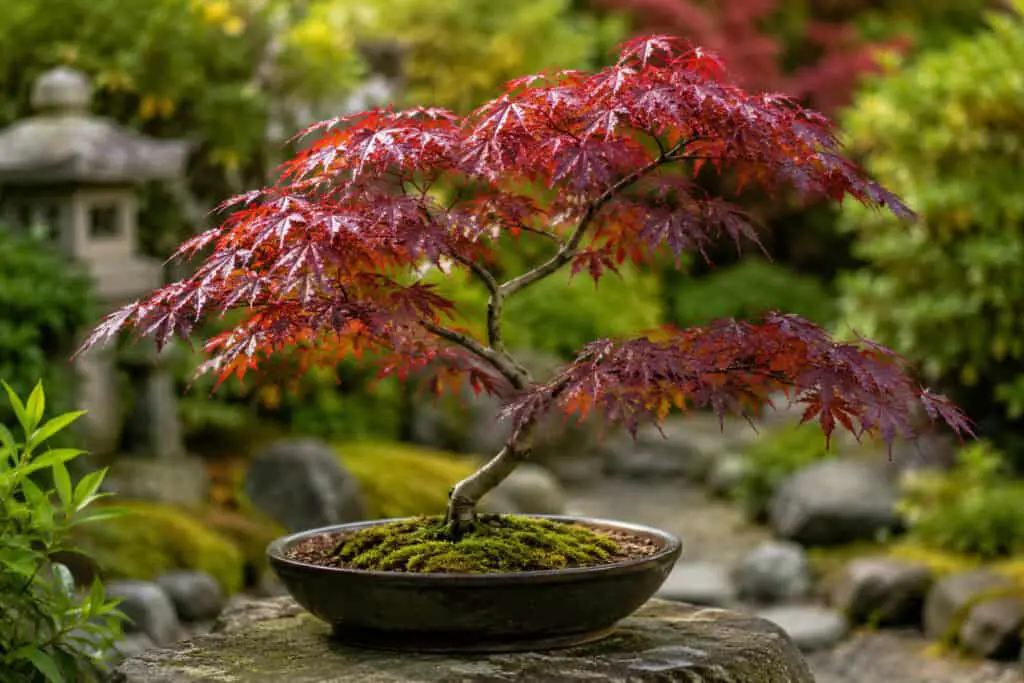
Acer palmatum is one of the most sought-after ornamental trees in cultivation, and with good reason.
Its deeply lobed, palmate leaves, elegant branching structure, and extraordinary autumn colour make it a focal point in any garden, from a large open border to a single container on a sheltered terrace.
Growing it well, however, requires an understanding of what this tree actually needs.
I have grown, diagnosed, and rescued acer palmatum in UK garden conditions for years, and almost every problem I am asked about traces back to the same handful of causes.
Acer palmatum originates as a forest understorey species in Japan, Korea, and China, growing in dappled shade, moist but freely-draining acidic soil, and shelter from drying winds.
Almost every care problem that arises in cultivation, whether leaves turning brown, a tree that fails to thrive, or dieback after winter, can be traced back to a growing environment that deviates from these natural conditions.
This guide covers every aspect of acer palmatum care in detail, including the right soil, watering, feeding, pruning, and positioning, as well as a thorough explanation of every common problem and how to fix it.
For a broader look at acer care across the whole genus, see my acer tree care guide.
Whether you are growing acer palmatum in the open ground or in a container, whether the tree is newly planted or well established, and whether you are based in the UK or another temperate climate, this guide will help you grow it successfully.
Quick Diagnosis: What Is Your Acer Palmatum Doing?
Use this table to identify your problem before reading the relevant section.
| What You Are Seeing | Most Likely Cause | Urgency |
| Brown leaf margins and tips, worst on outer canopy | Leaf scorch or sun scorch | Medium |
| Brown tips only; rest of leaf healthy | Drought stress or wind desiccation | Medium |
| Wilting despite moist soil; lower canopy yellowing first | Root rot | High |
| Random branch flagging; internal wood staining brown | Verticillium wilt | High |
| Overnight browning of whole canopy in April or May | Late frost damage | Low |
| Yellow leaves with green veins; progressive browning | Iron deficiency or high soil pH | Medium |
| Leaves not emerging or very slow in spring | Root damage, waterlogging, or late frost | High |
| Sticky residue, distorted tips, visible insects | Aphid infestation | Medium |
| Bumps on bark; sooty mould; branch dieback | Scale insect infestation | Medium |
| Thin canopy; weak growth; no autumn colour | Poor soil, wrong pH, or root restriction | Medium |
| Leaves smaller than usual after spring flush | Frost damage to first flush; second flush produced | Low |
| Premature leaf drop from August onwards | Normal early autumn colour; or drought | Low to None |
If your tree is dropping leaves earlier than expected in the growing season, my dedicated article on acer trees dropping leaves in summer walks through how to tell normal early colour change from genuine stress.
Understanding Acer Palmatum: What You Are Growing
Acer palmatum, commonly called Japanese maple, is a small to medium deciduous tree that in its native habitat grows as an understorey species in the humid, temperate forests of Japan, Korea, China, and south-east Russia.
In the wild it reaches heights of six to ten metres over many decades, developing an elegant, layered branching structure and deeply lobed leaves in shades of green, red, and purple depending on the genetic form.
The tree has been cultivated in Japan for centuries, and the result is an extraordinary diversity of named cultivars, with the Royal Horticultural Society currently recognising over 1,000.
These vary in leaf form from the broad-lobed palmatum types to the finely dissected feathery-leaved dissectum varieties, in habit from upright to strongly weeping, and in leaf colour from fresh green through chartreuse to deep burgundy and crimson.
Understanding the natural growing environment of acer palmatum is the single most useful thing a grower can do, because it immediately explains why the tree responds the way it does to the conditions it is placed in.
The cool, moist summers, freely-draining acidic soils rich in leaf-mould organic matter, and sheltered, dappled light of a Japanese mountain forest are the conditions this tree evolved for.
Direct sun, compacted clay, dry soils, and drying winds are the conditions that cause it to suffer.
Acer Palmatum Varieties and Their Care Requirements
Different cultivar groups have meaningfully different care requirements and problem vulnerabilities.
Choosing the right type for your garden conditions significantly reduces the likelihood of problems developing.
| Cultivar Group | Examples | Key Strengths | Main Vulnerability | Best Position |
| Dissectum (weeping, feathery) | Crimson Queen, Garnet, Waterfall | Spectacular form; excellent for containers | Highest scorch and wind risk; most delicate leaves | Sheltered; morning sun only; consistently moist |
| Palmatums (broad-lobed) | Bloodgood, Osakazuki, Sango Kaku | More robust; better wind and sun tolerance | Still susceptible to scorch in very hot positions | Partial to dappled shade; shelter from east wind |
| Upright large forms | Osakazuki, Senkaki, Shishigashira | Most robust overall; good autumn colour | Less tolerant of root restriction | Partial sun acceptable in UK; good soil depth |
| Compact container varieties | Katsura, Little Princess, Shaina | Well-suited to pot culture; slow-growing | Root-bound and waterlogging risk in pots | Sheltered; repot every two to three years |
If you are drawn to the finely dissected weeping forms, my dissectum care guide covers their extra shelter and watering needs in detail.
For a full rundown of one of the most reliable named cultivars for UK gardens, see the Bloodgood Japanese maple problem guide, and if space is limited, my article on the best acer trees for small gardens rounds up the most compact options.
Acer Palmatum Soil: What It Needs and Why It Matters
Soil is the most important element of acer palmatum care and the one that is most often overlooked.
Getting the soil right prevents most of the common problems associated with this tree, including iron deficiency, root rot, poor growth, and weak autumn colour.
Preferred Soil pH
Acer palmatum grows best in slightly acidic soil with a pH between 5.5 and 6.5.
Within this range, iron, manganese, and other micronutrients that the tree needs for healthy leaf colour and vigorous growth are freely available in the soil solution.
When the pH rises above 6.5, and particularly above 7.0, iron becomes chemically locked into the soil in forms the roots cannot absorb, producing the characteristic yellowing between the leaf veins known as iron chlorosis.
I cover this in full in my article on acer tree leaves turning yellow.
In the UK, many garden soils fall within an acceptable range for acer palmatum, but gardens on chalk or limestone, or in areas where the soil has been limed, may have a pH that is too high.
Concrete paths, walls, and foundations can also leach lime into the surrounding soil over time, raising the pH immediately adjacent to structures.
Always test soil pH before planting or before attempting to amend the soil for an established tree. Inexpensive test kits are widely available from UK garden centres.
Digital pH meters provide more accurate readings than paper strip tests.
Soil Structure and Drainage
Acer palmatum requires soil that retains adequate moisture but drains freely enough that the roots are never sitting in standing water.
The ideal soil structure is a moist but well-aerated loam or sandy loam with a good content of organic matter.
Heavy clay soils are the most problematic for acer palmatum, as they compact easily, retain water for extended periods, and warm up slowly in spring.
A Japanese maple planted directly into heavy clay without soil improvement is at serious risk of root rot, particularly in wet winters.
Improve clay soil by incorporating generous quantities of well-rotted leaf mould, garden compost, or composted bark at a rate of at least one part organic matter to three parts existing soil, and add coarse grit at around twenty per cent by volume to improve drainage and aeration.
Sandy or very free-draining soils at the other extreme can dry out too rapidly in summer.
Incorporate organic matter generously before planting and maintain a deep mulch layer to retain soil moisture.
Container-grown trees in very free-draining compost mixes will need more frequent watering than those in more moisture-retentive soils.
My guide to growing an acer tree in a pot covers compost choice and repotting schedules specifically for container culture.
Container Soil Guidance
For containers, use an ericaceous (acid) compost mixed with approximately twenty per cent coarse perlite for drainage.
Never use standard multi-purpose compost for acer palmatum, as most brands contain lime which raises pH.
Refresh the top five centimetres of compost annually in spring to maintain nutrient levels and organic matter content.
Watering Acer Palmatum: Depth, Frequency, and Method
Incorrect watering, whether too much or too little, causes more acer palmatum problems in cultivation than any other single factor.
Understanding what the tree actually needs, and why, will help you avoid the most common mistakes.
How Much Water Acer Palmatum Needs
Acer palmatum needs consistently moist but never waterlogged soil. Its naturally shallow, fibrous root system makes it more vulnerable to drought than many trees of comparable size, because the roots do not penetrate as deeply into the subsoil where moisture reserves are more stable.
During dry periods, particularly on free-draining soils, a Japanese maple can begin to show drought stress within five to seven days of the last significant rainfall.
Newly planted trees are significantly more vulnerable than established ones, as their root system has not yet spread into the surrounding soil.
A newly planted acer palmatum should be watered deeply at least twice a week during its first two growing seasons and weekly during dry spells thereafter until fully established, which typically takes two to three years.
Watering Technique: Deep and Infrequent
Deep, infrequent watering is far more effective for acer palmatum than frequent shallow watering.
The goal is to wet the soil to a depth of at least thirty to forty centimetres, which encourages roots to grow deeper and reach more stable moisture reserves.
Frequent shallow watering wets only the surface, encourages shallow rooting, and actually increases drought susceptibility over time.
In practice, apply water slowly at the base of the tree, using a soaker hose or a slow-flowing hose left in place for twenty to thirty minutes, once or twice a week during dry periods in summer.
In the UK, supplementary watering is typically needed from June through to September in most years.
Check soil moisture at a depth of five to eight centimetres before watering. If the soil is still moist at this depth, watering can wait. If it is dry, water immediately.
Watering Container-Grown Acer Palmatum
Container trees require more frequent watering than garden-grown trees, as the limited compost volume dries out much faster and has less thermal buffering.
In hot summer weather, a container-grown Japanese maple may need watering daily.
The soil should feel moist but not waterlogged at all times.
Check drainage holes are not blocked. A pot with poor drainage will waterlog quickly in wet weather, even if it appears to dry out fast in summer.
A saucer of standing water under a pot will cause root rot within days in warm conditions.
Feeding Acer Palmatum: What, When, and How Much
Acer palmatum is not a heavy feeder. In a reasonably fertile, well-prepared soil with a good content of organic matter, an established tree will often need little or no supplementary feeding.
Over-feeding is a more common cause of problems than under-feeding, and fertiliser applied at the wrong time or in excessive quantities can cause brown leaf tips, soft frost-susceptible growth, and increased susceptibility to Verticillium wilt.
Spring Feeding
The best time to feed acer palmatum is in early spring, just as the buds begin to swell, before the leaves emerge.
Use a slow-release granular fertiliser formulated for acid-loving plants, or a balanced slow-release fertiliser such as Growmore applied at the base rate shown on the label.
Slow-release granules are significantly safer than liquid feeds for Japanese maples, as the steady release of nutrients avoids the sudden concentration spikes that cause fertiliser burn.
A second, lighter application in early summer, no later than mid-June in the UK, can support the growing season.
Do not feed after mid-July, as late feeding stimulates soft new growth that does not harden sufficiently before the first autumn frosts.
What Not to Use
Never apply high-nitrogen lawn fertiliser to acer palmatum.
The excess nitrogen produces vigorous but soft, chlorotic growth, significantly increases susceptibility to Verticillium wilt, and does not improve the autumn colour that is one of the tree’s main ornamental qualities.
For established trees in good garden soil, an annual mulch of well-rotted leaf mould or garden compost is often sufficient to maintain fertility without any supplementary fertiliser at all.
Positioning Acer Palmatum: Light, Shelter, and Aspect
Choosing the right position is the most important decision you will make for an acer palmatum, and it is also the hardest to reverse once the tree is established.
Getting this right prevents the majority of the problems described in this guide.
Light Requirements
Acer palmatum grows naturally in dappled shade and performs best in a position that provides bright, indirect light or morning sun with protection from strong afternoon sun in summer.
I go into far more depth on this, including sun tolerance by cultivar, in my dedicated Japanese maple light requirements guide.
In the UK, a position in dappled shade, east-facing, or sheltered from the south-west by a wall or neighbouring tree is ideal for most varieties, particularly the finely dissected dissectum types.
The broader-leaved palmatum types are more tolerant of direct sun than the dissectums, and in the UK climate can be grown in a position that receives full sun for most of the day, provided soil moisture is maintained and there is some shelter from the hottest afternoon sun in July and August.
Red-leaved cultivars have slightly different sun needs to preserve their colour; see red maple light requirements for that detail.
In the US, where summer temperatures are significantly higher than in the UK across most of the country, partial shade in the afternoon is important even for the most sun-tolerant varieties in USDA Zones 7 and above.
Shelter from Wind
Shelter from wind is as important for acer palmatum as appropriate light, and it is an aspect of positioning that many gardeners underestimate.
Wind damages acer palmatum in two distinct ways: it dramatically increases the rate of water loss from the leaf surface, producing the same browning as drought stress even when the soil is adequately moist, and it physically abrades the delicate leaf tissue, causing mechanical damage particularly on the finely dissected leaves of dissectum varieties.
In the UK, cold, dry east winds in spring are particularly damaging, as they arrive when the newly emerged leaves are at their most delicate and have not yet developed the waxy cuticle that provides protection to mature summer foliage.
A sheltered position, protected from the windward side by a wall, fence, hedge, or other planting, is strongly recommended for all varieties of acer palmatum.
A permeable windbreak, such as a woven willow hurdle or a hedge, is more effective than a solid barrier such as a close-boarded fence, because solid barriers create turbulence on the lee side that can be more damaging than the original wind exposure.
Filter the wind rather than block it completely.
Frost Pockets
Avoid planting acer palmatum in a frost pocket, which is a low-lying area where cold air collects on still, clear nights and temperatures drop lower than in the surrounding ground.
A position on a gentle slope, or near a wall that retains and radiates daytime heat, provides much better natural frost protection than a hollow or the bottom of a slope.
For a full seasonal frost-protection routine, see acer tree winter care and frost protection.
Companion Planting: What to Grow With Acer Palmatum
Because acer palmatum shares its soil and light preferences with a specific group of woodland-edge plants, choosing the right companions makes ongoing care easier rather than harder.
Shade- and acid-loving perennials with similar watering needs, such as hostas, ferns, and heucheras, planted beneath the canopy help retain soil moisture, suppress weeds, and reduce the need for a bare mulched ring.
Avoid planting anything that requires regular digging or cultivation close to the trunk, since acer palmatum has a shallow, fibrous root system that is easily damaged by disturbance.
I have put together a full list of proven combinations, including which plants to avoid, in what to plant with acer trees.
Pruning Acer Palmatum: When, How, and Why
Acer palmatum requires less pruning than almost any other ornamental tree in cultivation, and unnecessary pruning is one of the most common mistakes made with this tree.
A Japanese maple that is correctly positioned and growing well should need almost no routine pruning at all.
For the complete seasonal timing calendar and cut-by-cut technique, see my dedicated guide on when and how to prune an acer tree.
When to Prune Acer Palmatum
The most important rule of acer palmatum pruning is timing.
Maples are notoriously susceptible to bleeding, which is the excessive flow of sap from pruning cuts that occurs when the tree is cut while actively in growth or just coming into growth in late winter and early spring.
The best time to prune is in mid to late summer, when the tree is in full leaf and the sap is not rising strongly.
Late autumn to mid-winter is also acceptable, when the tree is fully dormant and the risk of bleeding is lower.
Avoid pruning in late winter and early spring, from February to May, when sap is rising actively and bleeding is most severe.
How to Prune Acer Palmatum
Always use clean, sharp tools. Blunt secateurs crush rather than cut the wood, leaving ragged wounds that are slow to heal and vulnerable to disease entry.
Wipe the blades with a disinfectant such as diluted bleach or methylated spirits between cuts when removing diseased wood to avoid spreading pathogens.
Remove dead, damaged, crossing, and rubbing branches as the priority.
Cut back to a healthy bud or to the junction with a larger branch, leaving a clean cut as close as possible to the parent branch without leaving a stub.
A small raised collar of bark at the base of the branch should be left intact, as this contains the specialised cells that seal the wound.
For shaping, remove entire branches rather than shortening them, as shortening creates multiple new shoots that thicken the interior of the canopy and detract from the airy, open branching structure that is one of the main ornamental qualities of acer palmatum.
Step back and assess the whole tree after each cut rather than cutting continuously.
What Not to Prune
Do not prune acer palmatum heavily to reduce its size. The tree is slow-growing and any substantial reduction in size will both distress it and spoil its natural form.
If the tree is too large for its position, consider transplanting it in winter rather than cutting it back significantly.
Heavy pruning also stimulates vigorous but soft and weakly structured regrowth that is vulnerable to wind damage and frost.
| Pruning Summary Never prune in late winter or early spring. February to May is the highest-risk period for sap bleeding. Summer pruning, from late June to August in the UK, is the safest timing for most routine work. Remove dead wood in summer when it is easy to identify which stems are genuinely dead. Seal large wounds on acer palmatum with a proprietary wound sealant. Many arborists now question the value of sealants on most trees, but acer palmatum is one of the species where they provide genuine protection against disease entry. |
Acer Palmatum Problems: Diagnosis and Fixes
The following section covers every common acer palmatum problem in detail. Each cause is explained, the specific symptoms it produces are described, and a step-by-step fix is given.
Problem 1: Brown Leaves and Leaf Scorch
Leaf scorch is the most common cause of browning on acer palmatum in the UK and is responsible for the majority of queries about Japanese maple leaves turning brown.
It is a physiological disorder rather than a disease, meaning it is caused by environmental conditions rather than a pathogen.
Scorch occurs when the rate at which water evaporates from the leaf surface through transpiration exceeds the rate at which the roots can supply replacement water.
When this imbalance reaches a critical point, the cells at the leaf margins and tips begin to die.
These marginal cells are the furthest from the water-supplying veins and are therefore the most vulnerable.
The result is the characteristic brown, dry, papery scorching at the leaf edges that gives the condition its name. For a side-by-side comparison with other causes of browning, see my guide on acer leaves turning brown.
Sun scorch is a specific form of leaf scorch caused by intense direct sunlight.
Radiant heat and excessive UV radiation both damage the leaf tissue directly and simultaneously accelerate transpiration.
Sun scorch typically produces pale, bleached or brown patches on the upper surface of the leaves, concentrated on the most exposed parts of the canopy.
Identifying Leaf Scorch
The distinctive features that identify scorch rather than disease or pest damage are: the browning is dry and papery rather than soft or rotted; it is concentrated at the leaf margins and tips rather than in the interior of the leaf; the worst affected leaves are those on the outer canopy and upper canopy exposed to the most sun and wind; and the damage appears gradually through the season rather than suddenly overnight.
How to Fix Leaf Scorch
- Honestly assess whether the tree is in the right position. If it receives direct afternoon sun in summer, consider whether this can be reduced by repositioning the tree in winter or by establishing shade planting upwind.
- Apply a thorough mulch layer of seven to ten centimetres of well-rotted bark or leaf mould extending to the drip line of the canopy. This is the single most effective measure for reducing drought stress.
- Begin deep, infrequent watering during dry spells. Aim to wet the soil to thirty centimetres depth, once or twice a week.
- If the position cannot be changed, consider temporary shade cloth rated at thirty to forty per cent, positioned to intercept the strongest afternoon sun.
- Do not remove scorched leaves: the green tissue remaining on partially browned leaves is still photosynthesising. Leave the leaves to drop naturally.
- Do not apply fertiliser to a heat-stressed or scorched tree.
A Scorched Tree Is Not a Dead Tree
A Japanese maple that loses all its leaves to scorch in July or August is not dead.
Scratch-test the branches with a fingernail or penknife. If the tissue under the bark is green, the branch is alive.
The tree will almost certainly produce a second flush of leaves later in summer and return to full health the following spring.
Address the underlying cause, keep the tree watered and mulched, and be patient.
Problem 2: Acer Palmatum Dying or Failing to Thrive
The scratch test is the most important diagnostic tool for any acer palmatum that appears to be dying.
The same technique, along with a fuller recovery checklist, is covered in my flagship article on acer tree dying, which is the single most useful piece I have written on this subject.
Use your thumbnail or a penknife blade to scratch through the outer bark of a small branch. If the tissue beneath is bright or pale green, the branch is alive.
If it is brown, dry, and crumbly throughout, that branch is dead. Test multiple branches at different heights and positions around the tree.
A tree with at least some alive branches is not dead and has the potential to recover. A tree where every branch tests as brown and dry through to the centre is dead.
However, even then, the root system may still be alive, and some species of acer can regrow from the base.
Root Rot: The Most Common Cause of Acer Palmatum Death
Root rot, caused by the water mould Phytophthora and related pathogens, is the most common cause of a Japanese maple dying in cultivation.
The pathogens responsible thrive in waterlogged, oxygen-depleted soil and directly destroy the fine root tissue that the tree depends on for water and nutrient absorption.
The characteristic symptom of root rot is a tree that appears drought-stressed despite moist or wet soil: it wilts and browns because the destroyed root system can no longer absorb water, even when water is available.
Yellowing that begins in the lower canopy and progresses upward is also characteristic.
A distinct sour or unpleasant smell from the soil around the base of the tree, and discolouration at or below the base of the trunk, are strong indicators.
How to Address Root Rot
- Stop supplementary watering immediately.
- Assess whether the planting site has a drainage problem. Is water standing after rain? Is the soil dense clay with no amendment?
- For container trees: remove from the pot and inspect the roots. Healthy roots are firm and cream-white. Rotted roots are brown, soft, and collapse under gentle pressure. Prune away all affected roots, dust cut surfaces with sulphur powder, and repot into fresh free-draining compost in a clean pot with generous drainage holes.
- For garden trees: installing a French drain or rubble drain running away from the planting area is the most effective long-term solution. Planting on a raised mound even fifteen to twenty centimetres above surrounding ground level significantly reduces root rot risk.
- There is no reliable chemical treatment for established root rot. Recovery depends on removing the source of stress, which is the waterlogged soil, and giving the tree the conditions it needs to regrow healthy root tissue.
Verticillium Wilt
Verticillium wilt is caused by the soilborne fungi Verticillium dahliae and Verticillium albo-atrum, which infect the tree through its roots and colonise the vascular tissue, blocking the movement of water and nutrients through the tree.
It produces a characteristic pattern of sudden branch dieback known as flagging, where apparently healthy branches wilt and brown within days, often in a random pattern across the tree rather than concentrated in the lower canopy as in root rot.
Cutting through an affected branch reveals a distinctive greenish-brown staining within the wood, which is the diagnostic feature of Verticillium wilt. There is no cure.
Mildly affected trees can survive for many years with careful management: removing all affected branches promptly with clean, disinfected tools, avoiding root disturbance from cultivation near the tree, and keeping the tree as vigorous as possible through correct watering and mulching.
Severely affected trees are typically fatal and should be removed and disposed of rather than composted.
Problem 3: Late Frost Damage
Late frost is one of the most common causes of sudden browning on acer palmatum in the UK, and it is one that many gardeners do not immediately consider when they see damage in April or May.
The tree breaks dormancy and produces its new leaves relatively early in spring, and in a mild year the foliage can be well advanced by the time the last frost of the season arrives.
The new leaves are extremely sensitive to frost.
Even a light frost of minus one or minus two degrees Celsius will kill the newly emerged leaf tissue, which has not yet developed the cuticle or cellular structures that protect mature leaves.
The damage appears almost overnight: leaves that were healthy the previous evening are limp, brown, and wilted by morning, and may hang from the branches for several days before falling.
Frost damage differs from scorch in that it is uniform across the whole canopy rather than concentrated on the outer and upper canopy, it appears suddenly rather than gradually, and the leaves collapse and hang limply rather than remaining turgid with papery brown margins.
The good news is that late frost damage, while alarming in appearance, is rarely fatal to an established tree.
The tree will produce a second flush of leaves from dormant buds, which will be slightly smaller than the first flush but will carry the tree through the remainder of the growing season.
The tree returns to full health the following spring.
Protecting Against Late Frost
When a late frost is forecast after the leaves have emerged, cover the tree with two or three layers of horticultural fleece overnight.
This provides protection down to approximately minus three or minus four degrees Celsius.
Remove the fleece during the day to allow light and air circulation. For container trees, move the pot against a south-facing wall or into a cool garage overnight.
Do not remove frost-damaged growth immediately. Wait until all frost risk has passed, then cut back to healthy buds.
My full winter protection routine, including cultivar-by-cultivar hardiness notes, is in acer tree winter care and frost protection.
Problem 4: Iron Deficiency and Soil pH Problems
Acer palmatum prefers slightly acidic soil with a pH between 5.5 and 6.5.
When the pH rises above 6.5, and particularly above 7.0, iron and other micronutrients become chemically locked in the soil in forms the roots cannot absorb, even if the iron is physically present in adequate quantities.
The result is iron chlorosis: the leaves turn yellow between the veins while the veins themselves remain green, a pattern called interveinal chlorosis.
See acer tree leaves turning yellow for a full breakdown of this pattern versus other causes of yellowing.
If the deficiency continues, the yellow areas die and turn brown, leaves drop prematurely, and the tree becomes progressively weaker.
In the UK, iron deficiency is most commonly seen in gardens on chalk or limestone soils, in areas where builders lime has been used, or in containers where standard multi-purpose compost containing lime has been used.
Always test soil pH before taking action: several other causes of yellowing and browning look similar to iron deficiency, and the treatments are very different.
How to Treat Iron Deficiency
- For container trees: repot into an ericaceous compost specifically formulated for acid-loving plants.
- Apply chelated iron, sold under brand names such as Sequestrene in the UK, watered in at the label-specified rate. Chelated iron remains available to the plant even at higher pH levels and produces visible improvement within two to three weeks.
- For garden trees on alkaline soil, apply garden sulphur or sulphate of ammonia to gradually lower pH over several seasons. This is a slow process but effective long-term.
- Mulch annually with pine bark, leaf mould, or composted wood chip, all of which acidify the soil gradually as they break down.
Problem 5: Pests on Acer Palmatum
Aphids
Aphids are the most common pest on acer palmatum and are most likely to be seen in spring and early summer clustering on the undersides of young leaves and on growing tips.
Heavy infestations cause leaf distortion, curling, and yellowing, and the honeydew they excrete encourages secondary black sooty mould on the leaf surface.
If curling appears without visible insects, it is worth ruling out the other causes covered in why are your acer tree leaves curling.
On a healthy, established tree, aphids are generally more unsightly than damaging.
Control options include directing a strong jet of water at infested growth to dislodge the insects, encouraging natural predators such as ladybirds and lacewings, or applying insecticidal soap or diluted neem oil to affected areas.
Avoid systemic insecticides on acer palmatum, as the tree is sensitive to many chemical insecticides and can show phytotoxic reactions.
Scale Insects
Scale insects are a more persistent pest than aphids.
They attach permanently to stems and branches, appearing as small oval or circular bumps ranging from pale cream to dark brown, and feed by sucking sap.
Heavy infestations weaken the tree, cause branch dieback, and encourage sooty mould.
The most effective treatment is in early summer when the mobile juvenile crawlers have not yet formed their protective waxy coating, using a thorough application of horticultural mineral oil.
In winter, established scales on dormant wood can be treated with a tar oil wash. Individual scales can be removed by scrubbing with a stiff brush dipped in diluted neem oil.
| Important: Chemical Sensitivity Acer palmatum is notably sensitive to many chemical insecticides and fungicides. Phytotoxic reactions from incorrectly applied treatments are a common cause of additional leaf damage. Always test any new treatment on a small area and wait forty-eight hours before treating the whole tree. Apply all sprays in the early morning or evening, not in direct sun. A diluted neem oil solution (five millilitres per litre of water with a small amount of mild liquid soap) is the safest broadly effective treatment for most pest problems. |
Problem 6: Acer Palmatum Not Leafing Out in Spring
An acer palmatum that does not produce leaves in spring, or is very late and sparse in doing so, is a serious warning sign.
The most common causes are root damage from waterlogging or frost, complete root death from severe root rot, physical damage to the trunk or major roots, and in rare cases, late-emerging cultivars that simply take longer than expected.
If growth generally seems stalled rather than just delayed leafing, my article on acer tree not growing covers the wider set of causes.
Apply the scratch test to multiple branches. If branches are alive under the bark but the tree is not leafing out by mid-May in the UK, this suggests that the root system is damaged or has failed.
Carefully dig down beside the tree to inspect a small section of root at the edge of the root ball.
If roots are white to cream and firm, the root system is alive and the tree should eventually leaf out. If roots are brown, soft, and absent, root rot has progressed severely.
A tree that has failed to produce any leaves by early June in the UK is unlikely to recover in that season.
If branches scratch green and a few leaves do emerge late, maintain the tree in the correct conditions, keep it watered but not waterlogged, mulch generously, and reassess in the following spring before taking any drastic action.
All Problems at a Glance: Comparison and Action Summary
| Problem | Key Symptoms | Distinguishing Feature | Primary Fix | Urgency |
| Leaf scorch | Brown margins and tips; upper canopy first | Papery; dry; worst on outer leaves in summer | Shade; deep watering; mulch | Medium |
| Sun scorch | Bleached or brown patches on leaf upper surface | Bleached not papery; south-facing position | Afternoon shade; improve watering | Medium |
| Drought stress | Whole-canopy margin browning; wilting in heat | Dry soil at 5cm depth; may curl before browning | Deep watering; mulch; check schedule | Medium |
| Wind desiccation | Margins and tips; windward side worst | Slightly ragged browning; spring or coastal | Permeable windbreak; shelter | Medium |
| Root rot | Lower canopy yellowing then browning; wilts despite wet soil | Wet soil; sour smell; soft brown roots | Stop watering; improve drainage; repot | High |
| Verticillium wilt | Random flagging of branches; internal staining | Sudden single-branch dieback; greenish wood | Remove affected branches; keep healthy | High |
| Late frost | Uniform overnight browning; whole new canopy | Limp hanging leaves; appeared overnight in spring | Fleece protection; cut back after last frost | Low |
| Fertiliser burn | Tips and margins shortly after feeding | Recent heavy fertiliser application | Flush soil; no feeding for three months | Medium |
| Iron deficiency | Interveinal yellowing then brown | Yellow between veins; veins green; high pH soil | Test pH; ericaceous compost; chelated iron | Medium |
| Aphids | Distorted tips; sticky honeydew; sooty mould | Visible insects on undersides of young leaves | Jet of water; neem oil; insecticidal soap | Low |
| Scale insects | General weakening; branch dieback; bumps on bark | Oval bumps on stems; sooty mould | Horticultural oil; tar wash in winter | Medium |
| Not leafing out | No leaves or very sparse emergence in spring | Branches scratch green but tree dormant in May | Inspect roots; reassess drainage; scratch test | High |
Seasonal Care Calendar for UK Acer Palmatum Growers
Adjusting care through the seasons is one of the most effective ways to prevent problems before they develop.
| Month | Key Tasks and Watch Points |
| January to February | Check containers are not waterlogged. Do not prune. Plan any repositioning or transplanting. |
| March | Apply fresh mulch around the base if not done in autumn. Watch forecasts for late frosts as buds begin to swell. Do not fertilise yet. |
| April | New leaves emerging. Highest frost risk. Cover with fleece if frost forecast. Do not water unless soil is very dry. |
| May | Apply light spring feed if needed. Begin supplementary watering during dry spells. Watch for aphids on new growth. Harden off container trees moved outside. |
| June | Active growing season. Water deeply in dry weather. Check for scale insects on stems. Assess whether the tree is getting too much afternoon sun. |
| July | Peak risk for leaf scorch. Water deeply once or twice a week in dry weather. Do not fertilise after mid-July. Prune dead wood if needed. |
| August | Continue watering in hot spells. Do not prune or feed. Reduce watering as days shorten. Any new browning now is likely scorch or drought. |
| September | Excellent time to repot container trees. Plant new trees. Final light feed if needed. Begin reducing watering frequency. |
| October | Apply autumn mulch to all trees before leaf fall. Bring tender container varieties under cover if frosts likely. Begin planning any transplanting. |
| November to December | Rake and compost fallen leaves. Do not leave a deep layer of leaves around the base. Do not prune heavily. Check stakes and ties on newly planted trees. |
Planting Acer Palmatum: Step-by-Step Guide
This section covers the essentials; for a fuller step-by-step walkthrough with more detail on backfilling and staking, see plant a Japanese maple tree.
When to Plant
Container-grown acer palmatum, which is the form sold by most UK nurseries, can technically be planted at any time of year, but autumn planting, from October to November, is the best time.
The soil is still warm from summer, which encourages root establishment before the tree enters dormancy, and the shorter days and cooler temperatures reduce the risk of drought stress on a newly planted tree.
Spring planting is also acceptable, though the tree will need more careful attention to watering during its first summer.
Bare-root acer palmatum, which is less commonly sold but available from specialist nurseries, should be planted only during the dormant season from November to February.
Preparing the Planting Site
- Choose a position with appropriate light and shelter as described earlier in this guide.
- Dig a planting hole at least twice the diameter of the root ball and the same depth. Breaking up the soil at the base and sides of the hole improves early root penetration.
- If the soil is clay, incorporate one part well-rotted compost and twenty per cent coarse grit by volume into the excavated soil before replacing it.
- If the soil pH is above 6.5, incorporate a sulphur-based soil acidifier at the rate specified on the label.
- Water the container thoroughly before planting.
- Place the tree in the hole so that the root flare, the point where the trunk widens at the base, is at or very slightly above the surrounding soil level. Planting too deep is one of the most common causes of decline in newly planted trees.
- Backfill with the amended soil, firming gently in stages to eliminate air pockets. Do not compact heavily.
- Water thoroughly to settle the soil around the roots.
- Apply a mulch layer of seven to ten centimetres of well-rotted bark or leaf mould in a circle extending to the drip line. Keep mulch clear of the trunk itself.
Propagating Acer Palmatum
Most gardeners buy acer palmatum as a grafted or container-grown specimen rather than raising their own, but propagation is worth knowing about if you want to increase a favourite tree or grow from seed.
Named cultivars are almost always propagated by grafting or softwood cuttings, since seed-grown plants do not come true to the parent and can vary significantly in leaf colour and habit.
I cover the full process, including timing and success rates for each method, in how to propagate an acer tree.
Frequently Asked Questions
Why Does My Acer Palmatum Get Brown Leaves Every Summer?
Annual browning at a predictable time of year almost always points to a consistent environmental cause rather than a disease.
Browning every July or August, particularly during warm, dry spells, points to chronic drought stress and insufficient soil moisture, often combined with a position receiving too much direct afternoon sun.
Improving soil moisture retention through deeper mulching, adjusting the watering schedule, or providing additional shade in the afternoon are the most likely solutions.
Can I Move An Established Acer Palmatum To A Better Position?
Yes, but timing is critical. Acer palmatum can be transplanted successfully only when fully dormant, which in the UK means between November and February.
Moving it while in leaf is very likely to result in serious transplant shock.
Prepare the new hole before lifting the tree, enrich the soil with well-rotted compost, water thoroughly in the new position, and mulch generously.
Expect some browning in the first season after transplanting as the root system re-establishes.
Should I Remove Brown Leaves From My Acer Palmatum?
If browning is due to scorch, frost, or drought, there is no need to remove leaves. The remaining green tissue on partially browned leaves is still photosynthesising.
If leaves have browned due to disease such as Verticillium wilt, remove and dispose of them away from the garden to reduce pathogen spread.
Dead hanging leaves will drop naturally within a few weeks.
What Is The Best Acer Palmatum For A Small Garden Or Container In The UK?
For a small garden, Acer palmatum Bloodgood is one of the most reliable cultivars, with good drought resistance relative to other cultivars, attractive deep crimson leaves, and excellent autumn colour.
For containers, Acer palmatum Katsura and Acer palmatum Little Princess are compact, slow-growing varieties well suited to pot culture.
For exposed or windy gardens, the broader-leaved palmatum types are significantly more robust than the finely dissected dissectum varieties.
See the best acer trees for small gardens for a longer shortlist with pros and cons of each.
Why Is My Acer Palmatum Not Growing?
Acer palmatum is a genuinely slow-growing tree and what feels like poor growth is often simply the tree growing at its natural pace.
However, if growth is visibly much weaker than in previous years, the most common causes are incorrect soil pH preventing nutrient uptake, root restriction in a container that has become too small, waterlogged soil suppressing root growth, incorrect or insufficient feeding, or the early stages of root disease.
Assess each of these in turn before concluding there is a serious problem. My acer tree not growing guide works through each cause in the order most likely to apply.
Why Are The Leaves On My Acer Palmatum Turning Green Instead Of Staying Red?
Red and purple-leaved acer palmatum cultivars such as Bloodgood develop their colour from pigments called anthocyanins, which are produced most intensely in cool, bright conditions.
When temperatures are high, particularly during warm summer nights, the tree produces less anthocyanin and the red colouring fades to green or brownish-green.
This is a normal seasonal response and does not indicate a problem.
The red colour returns in autumn when temperatures cool. I cover this in more depth, including which cultivars hold their colour best, in why is your Japanese maple turning green.
Planting in a position with morning sun rather than full afternoon sun can help maintain colour intensity through summer.
Does Acer Palmatum Lose Its Leaves In Winter?
Yes. Acer palmatum is fully deciduous and drops all of its leaves in autumn after the display of orange, gold, and scarlet colour, remaining bare through winter before leafing out again in spring.
This is entirely normal and is not a sign of a problem. If you are unsure whether your tree’s leaf drop timing is normal for the season, my article on do acer trees lose their leaves sets out what to expect month by month.
Why Are My Acer Tree Leaves Curling?
Curling leaves on acer palmatum are most often caused by heat and water stress, aphid feeding, or wind exposure, and the correct fix depends on which of these applies.
A close look at whether the curl is accompanied by stickiness, visible insects, or browning at the margins will usually tell you which cause you are dealing with.
My dedicated article on why are your acer tree leaves curling covers the full diagnostic process.
Key Takeaways
| Takeaway | What This Means in Practice |
| Soil pH between 5.5 and 6.5 is essential | Test before planting and before amending. Use ericaceous compost in containers. |
| Deep, infrequent watering beats frequent shallow watering | Aim to wet the soil to 30 to 40cm depth. Mulching halves the watering burden. |
| Leaf scorch is not death | Scratch-test before assuming the worst. A brown tree in July is usually alive and will recover. |
| Position determines almost everything | Shelter from wind, partial shade from afternoon sun, and avoidance of frost pockets prevent most problems. |
| Prune only in summer or deep winter | Avoid February to May. Use clean, sharp tools. Remove whole branches, not stumps. |
| Never fertilise a stressed tree | Feed in early spring and early summer only. Avoid high-nitrogen products entirely. |
| Root rot requires removing the source of stress, not treating the symptoms | Improve drainage. Repot into fresh compost. There is no reliable fungicide treatment. |
| Verticillium wilt has no cure but can be managed | Remove affected branches promptly. Keep the tree healthy. Avoid root disturbance. |
| A permeable windbreak is more effective than a solid barrier | Filter the wind, do not block it. Reduce turbulence on the sheltered side. |
| Frost damage in spring is rarely fatal | The tree will produce a second flush. Cover with fleece when late frost is forecast. |
Final Thoughts
Acer palmatum is not a difficult tree to grow well when the fundamentals are right, but it is unforgiving of serious departures from its preferred conditions.
The trees that struggle are almost always those that have been planted in the wrong position, in poorly prepared soil, or that have been watered incorrectly or fed at the wrong time.
The trees that thrive, and this includes some extraordinarily long-lived specimens that have been growing in sheltered UK gardens for over a century, are those that have been given a position that approximates the cool, moist, sheltered, slightly acidic conditions of their native forest habitat.
Get the position, soil, and watering right, and an acer palmatum will require remarkably little ongoing care.
When problems do arise, the key is to read the symptom accurately before acting.
Brown leaf tips in summer, an overnight collapse in May, and a wilting tree with wet soil each require completely different responses, and applying the wrong treatment will make the situation worse.
This guide gives you the information to diagnose and act correctly, and links through to a deeper article on every individual problem if you need to go further.
Invest time in the preparation and positioning, be patient with a slow-growing tree, and an acer palmatum will reward you with decades of extraordinary seasonal spectacle: the delicate spring flush of red or chartreuse, the summer richness of deep crimson or layered green, and the autumn blaze of orange, gold, and scarlet that few trees in cultivation can match.
Mariel is a plant enthusiast and writer based in the UK with a passion for houseplants and indoor growing.
She has spent the last few years building an ever-growing collection of indoor plants and learning the hard way which ones will survive her busy schedule.
At Bean Growing she writes about houseplant care, common plant problems, and outdoor gardening.