
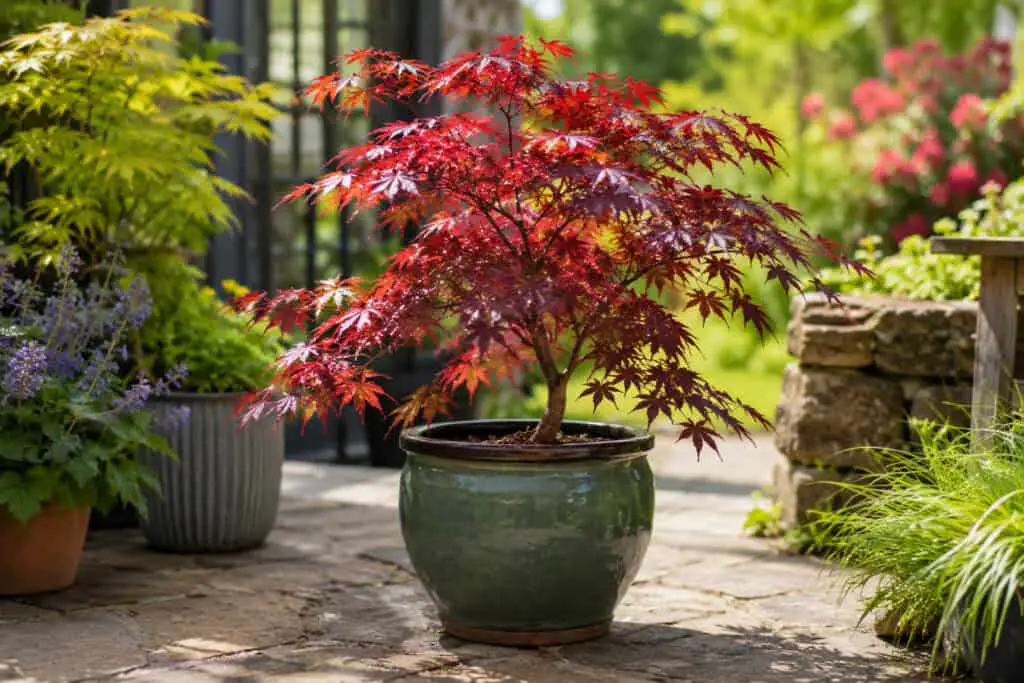
Growing an Acer tree in a pot is one of the most rewarding ways to enjoy these stunning ornamental trees, especially in smaller UK gardens, on patios, or in courtyards where there is no open border to plant into.
Acers, more commonly known as Japanese maples, are naturally well suited to container life.
In the wild, Acer palmatum grows as a relatively small understorey tree with a shallow, fibrous root system, which is exactly the kind of root structure that adapts well to life in a pot.
That said, a containerised Acer is entirely dependent on the gardener for everything it would otherwise get from the surrounding soil: drainage, nutrients, moisture retention, frost protection, and root space.
Get these things right and an Acer tree in a container can thrive for decades, often producing better, more controllable colour than a tree grown in the open ground.
Do it wrong, and problems such as leaf scorch, root rot, and stunted growth appear quickly, in much the same way that Acer leaves curling or Acer leaves turning brown often trace back to exactly these container-care basics.
This guide covers everything involved in growing an Acer in a pot in the UK: choosing the best pot for an Acer tree, working out the right Acer tree pot size at every stage of growth, selecting the best compost for an Acer in a pot, positioning and caring for an Acer tree in a container through the seasons, and the full process of repotting an Acer tree when the time comes.
According to the RHS growing guide for Japanese maples, these trees are widely sold as container-grown specimens and are well suited to smaller gardens precisely because most varieties stay compact and slow-growing.
Quick Reference: Container Acer Care at a Glance
| Care Aspect | Recommendation |
|---|---|
| Starting pot size | 30–40cm diameter for a young tree, with room to grow |
| Pot material | Frost-proof glazed ceramic, terracotta, or wood; avoid thin plastic |
| Compost type | Ericaceous (acidic) compost, never standard multi-purpose with lime |
| Drainage | Multiple large drainage holes, raised on pot feet |
| Position | Dappled or partial shade; sheltered from strong wind and midday sun |
| Watering | Daily checks in summer; never allow the compost to dry out fully |
| Feeding | Slow-release ericaceous or balanced feed, once in early spring |
| Repotting frequency | Every 2 years for young trees; every 3–5 years once mature |
| Best repotting time | Early spring (before bud break) or early autumn |
| Winter care | Insulate the pot; move to a sheltered spot in hard frosts |
Why Grow an Acer Tree in a Pot in the UK
Growing Acer in a pot gives UK gardeners a level of control that is simply not possible when a tree is planted directly into the ground.
The compost, the drainage, the soil pH, and the moisture levels are all entirely within your control, which matters enormously for a tree that is naturally fussy about all four.
Container growing is also the obvious solution for anyone gardening on heavy clay, chalky, or alkaline soil.
Acers need slightly acidic, free-draining conditions to thrive, and many UK gardens simply cannot offer that in the open ground.
A pot filled with the correct ericaceous compost sidesteps the problem entirely.
There are practical advantages too.
A potted Acer can be moved to catch more shelter in a cold spring, repositioned away from strong afternoon sun in a hot summer, or brought closer to a wall for frost protection in winter.
Acers in containers also tend to stay more compact and manageable than the same variety grown in open ground, which suits smaller gardens, courtyards, balconies, and patios well, and this same compact, manageable growth habit is one of the reasons potted Acers rarely develop the kind of small tree non-invasive root systems concerns that gardeners often raise about other ornamental trees near patios and paths.
The trade-off is that a container-grown Acer has no access to the buffering effect of surrounding garden soil.
It will dry out faster, heat up faster in summer, and freeze through more completely in winter than the same tree growing in a border.
Every section of this guide is built around managing that trade-off.
Best Acer Varieties for Container Growing
Not every Acer cultivar is equally suited to life in a pot.
Slower-growing, more compact varieties cope far better with restricted root space over the long term, and tend to need repotting less often.
| Variety | Mature Height in a Pot | Why It Suits Container Growing |
|---|---|---|
| Acer palmatum ‘Katsura’ | 1.5–2m | Slow-growing, compact, vivid orange spring colour |
| Acer palmatum ‘Shaina’ | 1–1.5m | Naturally dwarf, dense, deep red foliage all season |
| Acer palmatum ‘Little Princess’ | 1–1.5m | Very compact, ideal for small pots and patios |
| Acer palmatum var. dissectum ‘Crimson Queen’ | 1.5–2m | Weeping habit, stunning in a raised container, needs shelter |
| Acer palmatum ‘Sango Kaku’ (Coral Bark) | 2–3m | Slightly larger but tolerant of containers; striking winter bark |
| Acer palmatum ‘Orange Dream’ | 1.5–2m | Compact, bright gold-orange spring foliage |
Larger, more vigorous upright varieties such as Acer palmatum ‘Bloodgood’ can also be grown in pots, but they will need repotting into progressively larger containers more often and are usually best moved to open ground once they outgrow practical pot sizes; for more detail on this particular cultivar, see our guide to common Bloodgood Japanese maple problems.
If you are still deciding between varieties and want a broader overview before settling on a container specimen, our Acer tree care guide and our guide to planting a Japanese maple tree both cover the wider decision-making process in more depth.
Choosing the Best Pot for an Acer Tree
The pot itself is one of the most important decisions you will make, and it is worth getting right from the start rather than upgrading repeatedly through cheap, unsuitable containers.
Material matters more than people expect. Thin plastic pots heat up quickly in direct sun, which can cook the roots of an Acer in the height of summer, and they offer almost no insulation against frost in winter.
They are also lightweight enough to blow over in strong wind once the canopy fills out.
Glazed ceramic pots are an excellent choice for Acers.
They hold moisture well, look attractive, and provide reasonable thermal insulation, but it is essential to buy ones specifically rated as frost-proof for the UK climate, since standard glazed pots can crack and shatter after repeated winter freeze-thaw cycles.
Terracotta is a traditional and visually attractive option, but unglazed terracotta is porous and allows compost to dry out considerably faster than glazed alternatives, which means more frequent watering through summer.
Like glazed ceramic, only frost-proof terracotta should be used outdoors year-round in the UK.
Wooden containers, such as half-barrels or purpose-built wooden planters, offer excellent insulation for the roots in both summer heat and winter cold, and they tend to be very stable in wind.
They do eventually rot, although a wood treated with a plant-safe preservative, or one with a removable liner, will last many years.
Whatever the material, drainage is non-negotiable.
The pot must have several generous drainage holes, and it should always be raised slightly off the ground on proper pot feet or bricks, never left to sit flush on a patio or paving slab where water can collect underneath and block drainage.
What Pot Size Does an Acer Tree Need
Getting the Acer tree pot size right at each stage avoids two common mistakes: starting in too large a pot, which leaves compost wet and unused around the small root ball and encourages root rot, or leaving the tree in too small a pot for too long, which restricts growth and leads to a root-bound tree that dries out within a day of watering.
| Tree Stage | Recommended Pot Diameter | Pot Depth |
|---|---|---|
| Young tree, just purchased (1–2 years old) | 30–40cm | At least 30cm |
| Establishing tree (2–4 years in a pot) | 40–50cm | 35–40cm |
| Semi-mature tree (4–8 years in a pot) | 50–65cm | 45–50cm |
| Mature tree (8+ years, compact variety) | 65–80cm, or the largest practical size | 50–60cm or more |
As a general rule, each time you repot, move up one pot size rather than several sizes at once.
A jump that is too large leaves a significant volume of compost with no roots in it, which stays wet for far longer than the root ball itself, increasing the risk of root rot in the unused compost around the edges.
For most ornamental and compact varieties, a pot in the region of 60–70cm in diameter is large enough to support a healthy, well-proportioned tree indefinitely, provided the compost is refreshed regularly even if the pot itself is not increased in size further.
Best Compost for Acer in a Pot
The single most common mistake made when growing Acer in a pot is using ordinary multi-purpose compost.
Most multi-purpose composts sold in the UK contain added lime to raise the pH, which is the opposite of what an Acer needs and will quickly lead to iron deficiency, yellowing leaves, and poor growth, a pattern that is covered in more detail in our guide to Acer tree leaves turning yellow.
The best compost for an Acer in a pot is a dedicated ericaceous (acid-loving) compost, formulated for plants such as rhododendrons, camellias, and azaleas, which share the same preference for an acidic root environment with a pH between roughly 5.5 and 6.5.
Straight ericaceous compost on its own, however, can hold more moisture than is ideal for an Acer’s fine, fibrous roots, which are easily damaged by prolonged waterlogging.
The best results in a pot generally come from improving the drainage of straight ericaceous compost with the addition of coarse, lime-free materials.
A reliable mix for container-grown Acers uses seventy percent ericaceous compost as the base, providing the correct acidity and nutrient content, with twenty percent coarse horticultural grit or perlite added to improve drainage and prevent compaction, and the remaining ten percent made up of well-rotted leaf mould or composted bark, mimicking the organic forest-floor conditions Acers naturally grow in.
This combination gives a compost that drains freely enough to avoid waterlogging, while still retaining enough moisture and organic content to support healthy root growth between waterings.
A layer of broken crockery, gravel, or specialist drainage crocks at the base of the pot, beneath the compost, further improves drainage, although this is no substitute for adequate drainage holes in the pot itself.
It is worth checking compost freshness too.
Compost left in an open bag for more than a season, or compost that has already been used once and not refreshed, loses structure and nutrient content, and is best avoided or revitalised with fresh material at repotting time rather than reused indefinitely.
Positioning Your Acer Tree in a Container
A potted Acer needs a position that balances light, shelter, and protection from temperature extremes, and because the roots are above ground level inside the pot rather than insulated by garden soil, container-grown trees are more sensitive to all three than the same tree planted in a border.
Dappled or partial shade is ideal for most varieties.
A spot that receives gentle morning sun but is shaded from the strongest midday and afternoon sun, such as the east side of a house or beneath the high canopy of a larger deciduous tree, suits most Acers extremely well; our dedicated guide to Japanese maple light requirements goes into this in more depth if you want to fine-tune positioning for a specific cultivar.
Full, unbroken sun through a UK summer, particularly on a paved patio that radiates additional heat, is one of the most common causes of leaf scorch on potted trees.
Shelter from wind is just as important as shade.
A pot has no surrounding soil mass to anchor or insulate the roots, and the tree’s canopy, especially on finely dissected weeping varieties, is highly vulnerable to drying out in exposed, windy positions.
A spot against a wall, fence, or among other larger plants that breaks the worst of the wind, without creating a fully enclosed suntrap, is usually the best compromise.
It is also worth remembering that a pot can be moved.
Repositioning a container-grown Acer through the seasons, more shelter in early spring while new leaves are tender, slightly more light in midsummer if the canopy is dense, and a sheltered spot against the house in the depths of winter, is one of the biggest practical advantages of growing in a container rather than the open ground, and it is worth taking advantage of it.
Acer Tree Container Care: Watering, Feeding and Mulching
Ongoing acer tree container care comes down to three core tasks done consistently through the growing season: watering correctly, feeding lightly, and mulching the surface of the pot.
Watering is the single most demanding aspect of caring for an Acer in a container, because the limited volume of compost in a pot dries out far faster than open ground, particularly in summer.
During the growing season, check the compost daily in warm weather by pushing a finger into the top few centimetres.
If it feels dry at that depth, water thoroughly until water runs from the drainage holes.
In hot spells, a well-established potted Acer may need watering once a day; in cooler, wetter periods it may need water only once or twice a week.
Always allow excess water to drain away freely, and never let a pot sit in a saucer of standing water, which will quickly waterlog the roots.
Feeding should be light and infrequent.
Acers are not heavy feeders, and over-fertilising a container-grown tree causes far more problems than under-feeding it.
A single application of a slow-release ericaceous or balanced granular feed in early spring, just as the buds begin to swell, is generally sufficient for the whole season.
A light liquid feed in early summer can be added if growth looks weak, but feeding should always stop by midsummer to avoid encouraging soft, late growth that will not harden before autumn frosts.
Mulching the surface of the compost, leaving a small gap around the trunk itself, with a 2–3cm layer of composted bark, leaf mould, or fine bark chippings helps to slow evaporation from the pot in summer and gives a small amount of extra insulation to the surface roots in winter.
It also suppresses weed growth on the compost surface and looks considerably more attractive than bare compost.
It is worth noting that a container-grown Acer’s roots are considerably more exposed to cold than the same tree’s roots would be in open ground, where surrounding soil offers insulation.
In a hard UK winter, wrapping the pot itself, not the canopy, in horticultural fleece, bubble wrap, or hessian sacking, or moving it temporarily into an unheated greenhouse, porch, or sheltered position against the house, will protect the root system from freezing solid.
If your tree is dropping leaves unexpectedly despite otherwise good care, our guide to why an Acer tree might be dropping leaves in summer covers the most likely causes in more detail, and if the problem looks more serious, our wider guide to an Acer tree dying walks through how to diagnose and recover a struggling tree.
Repotting an Acer Tree: When and How
Repotting an Acer tree is unavoidable for any container-grown specimen, because compost breaks down and compacts over time, nutrients become depleted, and the root system will eventually fill the available space.
Signs Your Acer Needs Repotting
A few clear signs indicate that a potted Acer is due for repotting. Roots visibly emerging from the drainage holes at the base of the pot are the most obvious sign.
A compost surface that dries out within a day of thorough watering, rather than staying moist for several days, suggests the root system has filled the pot and left little free compost to hold moisture.
A tree that looks disproportionately large for its pot, or one that has not been repotted in three or more years, is also due a check, even without other obvious symptoms.
When to Repot an Acer Tree
The best times to repot an Acer in the UK are early spring, just before the buds break, or early autumn, once the worst of the summer heat has passed but before the first frosts.
Both windows allow the tree to settle into fresh compost while it is not under the stress of active leaf growth or hot weather.
Repotting in the middle of summer, while the tree is in full leaf, or in the depths of winter, while the compost is likely to be cold and wet, should both be avoided wherever possible.
How to Repot an Acer Tree Step by Step
Water the tree thoroughly the day before repotting, which makes it considerably easier to slide the root ball out of the old pot without damage.
Choose the next pot size up, following the sizing guidance above, and ensure it has ample drainage holes.
Add a layer of drainage material, such as broken crockery or coarse grit, followed by a base layer of fresh ericaceous compost mix.
Remove the tree from its old pot carefully, supporting the trunk rather than pulling on it, and gently loosen the outer edges of the root ball with your fingers or a hand fork.
Inspect and trim the roots, cutting away any that are brown, soft, or clearly dead, and teasing out any that are circling tightly around the outside of the root ball, as these will continue to grow in a circle and can eventually constrict the tree if left unaddressed.
Position the tree in the new pot so that the top of the root ball sits roughly 2–3cm below the rim of the pot, leaving room for a top layer of fresh compost and watering.
Backfill around the root ball with the fresh ericaceous compost mix, firming gently as you go to remove large air pockets, but without compacting the compost heavily.
Water thoroughly until water runs freely from the drainage holes, and place the repotted tree in a sheltered spot out of strong sun and wind for a couple of weeks while it settles in.
Repotting Schedule by Tree Age
| Tree Age in Container | Recommended Repotting Frequency |
|---|---|
| Young tree, first 1–4 years | Every 2 years |
| Semi-mature, 4–8 years | Every 2–3 years |
| Mature tree, 8+ years | Every 3–5 years, or top-dress annually between repots |
Once an Acer has reached the largest practical pot size for its position, full repotting can be replaced with an annual top-dressing: removing the top 5-8cm of old compost in early spring and replacing it with fresh ericaceous compost mix, which refreshes nutrients without the disturbance of a full repot.
Seasonal Care Calendar for Container-Grown Acers
| Season | Key Tasks for a Potted Acer |
|---|---|
| Early Spring | Repot if due; apply slow-release feed; watch for late frost and protect new growth with fleece overnight if needed |
| Late Spring | Increase watering as growth picks up; check for aphids on new leaves; reposition out of strong wind if needed |
| Summer | Water daily in hot spells; reposition out of intense midday sun if leaves show scorch; stop feeding by midsummer |
| Early Autumn | Excellent second window for repotting; reduce watering frequency as growth slows; apply fresh surface mulch |
| Late Autumn | Move pot to a sheltered position before hard frosts; rake away fallen leaves from the compost surface |
| Winter | Insulate the pot against freezing; check compost isn’t bone dry on mild days; avoid heavy frost pockets |
Frequently Asked Questions
Can an Acer tree live permanently in a pot?
Yes. Many compact and slow-growing Acer cultivars are perfectly happy spending their entire life in a container, provided the pot is sized up as the tree grows, the compost is refreshed through regular repotting or top-dressing, and watering and winter protection are managed correctly.
Acers in containers can live for many decades under good care.
Do Acer trees in pots need ericaceous compost?
Yes, this is one of the most important factors in successful container growing.
Standard multi-purpose compost is usually slightly alkaline and will lead to iron deficiency and yellowing leaves over time.
A dedicated ericaceous compost, ideally improved with extra grit or perlite for drainage, is strongly recommended for any potted Acer.
How often should you repot an Acer tree?
Young, actively growing trees generally need repotting every two years, while mature trees in their largest practical pot can often go three to five years between full repots, supported by annual top-dressing in between.
Roots emerging from the drainage holes and compost that dries out very quickly are the clearest signs that repotting is due.
What is the best position for an Acer tree in a container in the UK?
A spot with dappled or partial shade, sheltered from strong wind and from intense midday and afternoon sun, suits most Acer varieties best.
Morning sun with afternoon shade is generally ideal, and the ability to move the pot seasonally is one of the main advantages of growing in a container.
Will an Acer tree in a pot survive a UK winter outside?
Most Acer varieties are reasonably hardy and can survive a typical UK winter outdoors, but the roots in a container are far more exposed to freezing temperatures than roots in open ground.
Insulating the pot itself with fleece, bubble wrap, or hessian, and moving it to a sheltered position such as against a house wall or into an unheated greenhouse during hard frosts, gives the best protection.
What size pot does a young Acer tree need to start with?
A young tree should generally start in a pot around 30–40cm in diameter and at least 30cm deep. Starting in a pot that is too large for the current root ball leaves unused, wet compost around the roots and increases the risk of root rot.
UK Reader Note
These guidelines are written specifically with UK growing conditions in mind, including typical UK winter temperatures, the widespread availability of ericaceous compost from UK garden centres, and the timing of frost windows across the country, which can vary somewhat between milder coastal areas and colder inland or northern gardens.
Key Takeaways
Acers adapt well to container growing thanks to their naturally shallow, fibrous root system, but every condition has to be managed by hand rather than left to the soil.
Choose a frost-proof, well-draining pot with multiple drainage holes, sized appropriately for the current stage of the tree’s growth rather than its eventual mature size.
Always use ericaceous compost, ideally improved with extra grit or perlite for drainage, and never standard multi-purpose compost containing lime.
Position the pot in dappled or partial shade, sheltered from strong wind and the most intense summer sun, and take advantage of the ability to move it through the seasons.
Water consistently through the growing season, feed lightly only in early spring, and mulch the compost surface to retain moisture and protect surface roots.
Repot young trees roughly every two years and mature trees every three to five years, always moving up only one pot size at a time and refreshing the compost.
Protect the pot, not just the canopy, in winter, since container roots are far more exposed to freezing temperatures than roots in open ground.
Final Thoughts
Growing an Acer tree in a pot is a genuinely practical way to enjoy one of the most beautiful ornamental trees available to UK gardeners, particularly where garden soil is unsuitable, space is limited, or the flexibility to reposition the tree through the seasons is appealing.
The fundamentals are straightforward once understood: the right pot with good drainage, sized appropriately for the tree’s current stage of growth; an ericaceous compost mix that mimics the acidic, free-draining forest floor an Acer naturally grows in; a sheltered, dappled-shade position; and consistent, attentive watering through the growing season.
None of this requires advanced gardening skill, but it does require consistency, since a container-grown tree has no surrounding soil to fall back on if watering is missed or drainage is poor.
Get the basics right, repot on schedule, and protect the pot through winter, and a container-grown Acer will reward you with the same spectacular seasonal colour as a tree in open ground, often for decades to come.
If you are working through a wider range of Acer issues beyond container growing, our guides to Japanese maple turning green and Japanese maple turning brown cover two of the most common colour problems gardeners run into, a when and how to prune an acer tree and our Acer tree care guide ties everything together for a broader overview of looking after these trees year-round.
Mariel is a plant enthusiast and writer based in the UK with a passion for houseplants and indoor growing.
She has spent the last few years building an ever-growing collection of indoor plants and learning the hard way which ones will survive her busy schedule.
At Bean Growing she writes about houseplant care, common plant problems, and outdoor gardening.