
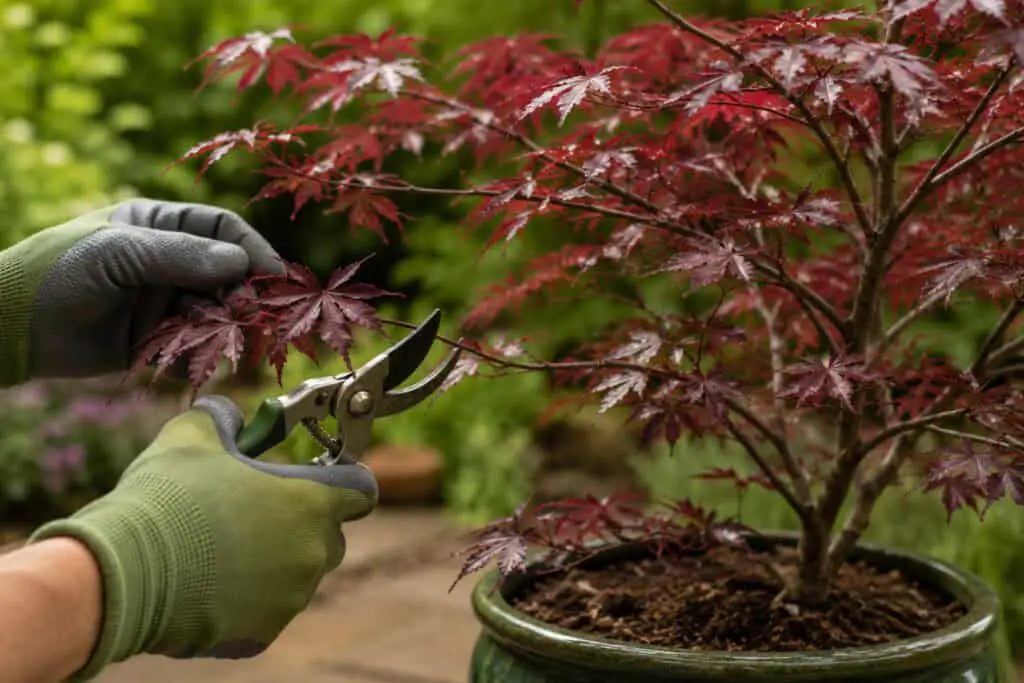
Pruning an Acer is one of the few garden jobs where doing it at the wrong time of year causes more damage than doing nothing at all.
Acers, which include Japanese maples (Acer palmatum), field maple, Norway maple, and the many ornamental cultivars grown for their foliage and shape, are known among gardeners as “bleeders”.
For general care guidance beyond pruning, the full Acer tree care guide covers everything from watering to feeding.
Cut into one at the wrong moment and sap will run from the wound for days, sometimes weeks, which can stress and weaken the tree far more than the pruning cut itself.
This is the single biggest reason people get acer pruning wrong, and it is why so many beautiful specimen trees end up lopsided, scarred, or in slow decline after a well-intentioned haircut.
The good news is that once you understand why acers bleed and which two windows in the year avoid it, pruning becomes straightforward.
This guide covers exactly when to prune an acer tree, a full step-by-step pruning guide, how technique differs between a young tree, a mature specimen, and a weeping dissectum variety, and the specific mistakes that cause the most damage, so you can prune with confidence rather than guesswork.
Why Trust This GuideThis article aligns with the RHS guidance on Japanese maple pruning and draws on established arboricultural practice for timing, technique, and wound management. All seasonal advice has been cross-referenced against the known sap-rise behaviour of Acer palmatum and related species to ensure it reflects conditions in the UK and comparable temperate climates. |
Quick Reference: When and How to Prune an Acer
| Question | Short Answer |
| Best time to prune | Mid-summer (July–August), once growth has hardened |
| Second-best time | Deep winter dormancy (November–January), on a dry, cold day |
| Worst time to prune | February to June, while sap is rising and the tree is in active growth |
| How much to remove | No more than 15–20% of the canopy in one session |
| Where to cut | Just outside the branch collar, or just above a healthy bud, at a slight angle |
| Should cuts be sealed? | Not usually needed; only consider it for large wounds over 2–3cm wide |
| Most common mistake | Pruning in spring, which causes heavy, prolonged sap bleeding |
Why Acer Pruning Is Different From Pruning Most Other Trees
Acers move sap earlier and more vigorously than most garden trees, often weeks before the buds visibly swell.
Once that sap is rising, any cut acts like an open tap: sugary sap pours out of the wound under pressure, sometimes running down the bark in visible streams.
This is why so much pruning advice for other trees, which often recommends winter as the universal safe season, does not transfer directly to acers.
As the RHS Japanese Maple Growing Guide confirms, Japanese maples are best pruned from July to January specifically because maples bleed sap from pruning cuts at other times, weakening the tree.
A second, related issue is that fresh pruning wounds on acers are an entry point for fungal problems, most notably coral spot (Nectria cinnabarina), a fungus that thrives on damp, dead, or stressed wood and can spread into healthy tissue from an infected cut.
Acers are also among the trees most associated with Verticillium wilt, a soilborne fungal disease that can enter through wounds and root damage, which is part of the reason tool hygiene matters more here than on many other species.
If your tree has already been affected by disease, see our guide to common Acer tree problems for further diagnosis help.
Get the timing and technique right, and an acer will heal cleanly and respond with the controlled, elegant new growth it is prized for.
Do it wrong, and the result is bleeding, dieback, weak regrowth, or a damaged silhouette that can take years to recover.
When to Prune an Acer Tree
The Best Time: Mid to Late Summer
For the large majority of acers, and particularly ornamental Japanese maples, mid-summer is the best and safest time to prune.
By July, the spring flush of new growth has hardened off and the tree’s sap flow has slowed considerably, which means cuts bleed far less and heal more cleanly.
There is also a practical advantage: the tree is in full leaf, so you can see exactly what the canopy looks like and shape it accordingly, rather than guessing at the structure from bare branches.
Aim to carry out most general maintenance, shaping, and thinning between July and the end of August, finishing major work before the end of summer so that wounds have time to begin callusing while the weather is still warm and dry.
The Second Window: Deep Winter Dormancy
The other acceptable time to prune is during full winter dormancy, ideally in November, December, or January, once the leaves have completely dropped and the tree is fully at rest.
This window suits structural and renovation work in particular, because with no leaves in the way you can see the branch architecture clearly and make better decisions about which limbs to remove.
Choose a dry, cold spell rather than a mild, damp one if you can; cold, dry conditions slow fungal activity, while mild, wet winter weather is exactly when coral spot and similar fungi are most active.
Sap is also at its lowest ebb during deep dormancy, before the lengthening days of late winter trigger it to start rising again.
The Time to Avoid: February to June
The period from late winter through to early summer is when acer sap is rising fastest, feeding the new season’s growth, and it is the worst possible time to prune.
Cuts made during this window can bleed heavily and for a prolonged period, the new soft growth nearby is highly attractive to aphids and other pests drawn to a wound, and the tree is investing its energy into leafing out rather than wound repair.
If you only remember one rule from this guide, it should be this: put the secateurs away between February and June, and only cut during this period if a branch is genuinely dead, diseased, or an immediate safety hazard.
Dead, Damaged, or Diseased Wood Is the Exception
Regardless of season, dead, damaged, or diseased branches should be removed as soon as you notice them.
A dead branch is not bleeding sap and poses no benefit from waiting, while a damaged or diseased branch left in place can be a route for infection or decay to spread further into the tree.
This is the one situation where season does not apply: safety and tree health come first.
If you notice branches turning brown or showing signs of dieback at any time of year, assess whether the wood is truly dead before cutting, using the scratch test described in the FAQ below.
How to Prune an Acer Tree: Step-by-Step Guide
Step 1: Gather the Right Tools
Use clean, sharp tools sized correctly for the cut: bypass secateurs for anything up to around 1.5cm in diameter, loppers for branches up to roughly 3–4cm, and a fine-toothed pruning saw for anything larger.
Blunt or oversized tools crush and tear the bark rather than making a clean cut, which slows healing and increases the risk of infection.
Wipe blades with surgical spirit or methylated spirit before you start, and again between cuts if you are working on more than one tree or suspect any disease, since dirty tools are a genuine route for spreading pathogens such as Verticillium wilt from tree to tree.
Step 2: Step Back and Assess Before You Cut
Walk around the tree and look at its overall shape before making a single cut.
Acers, and Japanese maples in particular, are valued for their natural form: an open, layered, slightly arching branch structure that lets light filter through the canopy.
Decide what you are trying to achieve and resist the urge to start cutting reactively without a plan.
Step 3: Remove the Three Ds First
Start with dead, damaged, and diseased wood, cutting back to healthy tissue or to the point of origin.
This immediately improves the health of the tree and often reveals the underlying structure more clearly, making the next decisions easier.
Step 4: Thin Crossing and Crowded Growth
Look for branches that cross, rub against each other, or grow back into the centre of the tree, and remove the weaker or less well-placed of the two.
On mature Japanese maples in particular, thinning out crowded clusters of twiggy interior growth opens the canopy to light and air, which both improves the tree’s health and enhances the tiered, layered look that makes the species so prized.
Work gradually and reassess often rather than removing everything you can see in one pass.
Step 5: Make the Cut Correctly
For a branch being removed back to the trunk or a larger parent branch, cut just outside the branch collar, the slightly swollen ring of tissue where the branch joins the trunk, rather than flush against the trunk itself.
The collar contains the cells the tree uses to seal the wound, so cutting flush removes this natural defence and leaves a wound that heals far more slowly.
For a heading cut, where you are shortening a stem rather than removing it entirely, cut a few millimetres above a healthy, outward-facing bud or side shoot, angling the cut slightly so that water runs off rather than collecting on the cut surface.
Never leave a stub: a short length of dead wood left above the bud will not heal over and can die back further into the branch.
Step 6: Limit How Much You Remove
Do not remove more than 15 to 20% of the canopy in a single pruning session, even if the tree appears to need more.
Acers respond poorly to hard, sudden pruning, often producing a flush of weak, leggy regrowth, excessive watershoots, or dieback from the stress of large wounds, rather than the controlled new growth you are hoping for.
If a tree genuinely needs significant reduction, plan to stage the work across two or three separate sessions over consecutive dormant or summer windows rather than doing it all at once.
An Acer that is also not growing well should not be pruned hard until you have identified and resolved the underlying cause, since pruning adds further stress to an already struggling tree.
Step 7: Decide Whether to Seal the Wound
Most general pruning advice, including from the RHS, advises against sealing pruning wounds on trees, since sealants can trap moisture against the wood and create conditions that favour rot.
Because acers bleed more than most species, some experienced growers do choose to apply a wound sealant to larger cuts, generally those over about 2 to 3cm in diameter, specifically to reduce sap loss while the wound closes.
Smaller cuts made at the correct time of year will typically callus over without any intervention.
A Note on Bleeding: Don’t Panic, But Do Take It SeriouslyIf sap does start running from a cut, particularly because the cut had to be made outside the recommended windows, do not assume the tree is dying. A single bleeding wound rarely kills an established acer, but repeated or heavy bleeding does stress the tree and slows healing, so avoid making any further cuts nearby until the wound has dried and begun to seal. |
Acer Tree Pruning Guide by Age and Type
Acer pruning is not one-size-fits-all: a young tree being trained, a mature specimen being maintained, and a weeping dissectum variety all need a different approach.
| Tree Type | Pruning Goal | Approach |
| Young tree (1–3 years) | Establish a balanced framework | Light formative pruning only; remove competing leaders; build an open, even branch structure |
| Mature specimen | Maintain health and shape | Three Ds annually; thin crowded interior twiggy growth; very light tip pruning to maintain outline |
| Weeping/dissectum varieties | Preserve natural cascading form | Minimal pruning; remove dead wood and any reversion shoots promptly; avoid shaping cuts |
| Container-grown acers | Control size; support root health | Light, more frequent pruning; combine with root pruning at repotting every 2–3 years |
| Overgrown/neglected tree | Restore shape without shock | Stage hard reduction over 2–3 winters; never remove more than a third of the crown in one session |
| Larger species used as hedging | Maintain a manageable hedge line | More tolerant of harder pruning than ornamental Japanese maples, but still avoid the spring sap-rise period |
Formative Pruning on a Young Acer
In the first few years, the goal is structure rather than size control.
For detailed guidance on getting the early stages right, see our guide to how to plant a Japanese maple tree, which covers correct planting depth and early establishment.
Identify and keep a leading shoot if you want a single-trunked standard, remove any competing leaders that are growing at a similar strength and angle, and select well-spaced branches radiating around the trunk to form the tree’s permanent scaffold.
Keep cuts minimal at this stage: young acers establish their character over several years, and over-pruning early on can produce a stunted or unbalanced shape that is hard to correct later.
Maintenance Pruning on a Mature Acer
Once the framework is established, most years require only light maintenance: removing the three Ds, taking out any branches that have started to cross or rub, and thinning a handful of the most crowded twig clusters to keep light and air moving through the canopy.
Resist the temptation to prune simply because a tree “looks busy”; a degree of dense interior twig growth is normal and is part of what gives a mature Japanese maple its characteristic dome or layered profile.
Weeping and Dissectum Varieties Need the Lightest Touch of All
Cascading, finely dissectum varieties such as Crimson Queen, Garnet, and Waterfall are usually best left largely unpruned beyond removing dead wood, since their natural weeping habit is the whole point of growing them.
The one job that should never be skipped on a grafted cultivar is watching for reversion shoots: strong, vigorous, often plain green shoots that emerge from the rootstock below the graft union rather than from the ornamental top growth.
These shoots grow faster than the grafted variety and, left unchecked, can take over the entire tree within a couple of seasons.
If your tree is producing unexpectedly green growth, reversion from the rootstock is one of the first things to check.
Remove reversion shoots at the point of origin as soon as you spot them, regardless of the time of year.
Renovating an Overgrown or Neglected Acer
If you have inherited an acer that has not been pruned in years and is significantly overgrown, resist any urge to bring it back to size in a single session.
Stage the work across two or three consecutive winters, removing no more than around a third of the canopy each time, and reassess the tree’s response before continuing the following year.
For large, mature specimens, particularly anything that would need a ladder or chainsaw work, consider bringing in a qualified arborist, and in the UK check whether the tree is covered by a Tree Preservation Order or sits within a conservation area before carrying out major work, since this can affect what you are legally permitted to do.
If the tree also appears to be in decline or dieback, address those health issues before beginning any renovation pruning.
Common Acer Tree Pruning Mistakes
Most acer pruning problems trace back to one of the mistakes below, and several of them are easy to make without realising the consequences until weeks or months later.
| Mistake | Why It Causes Problems |
| Pruning between February and June | Sap is rising fastest; cuts bleed heavily and for a prolonged period |
| Removing more than 20% of the canopy at once | Triggers stress, weak leggy regrowth, watershoots, and dieback |
| Flush cuts at the trunk | Removes the branch collar, slowing healing and increasing rot risk |
| Leaving stubs above a bud | The stub dies back, creating a route for disease into the live branch |
| Using blunt or oversized tools | Tears and crushes bark instead of cutting cleanly, slowing healing |
| Pruning in wet or humid weather | Increases the risk of coral spot and other fungal infections entering fresh cuts |
| Topping or heavily heading back the crown | Destroys the tree’s natural form and provokes weak, unsightly regrowth |
| Over-thinning the interior canopy | Loses the prized layered silhouette; can expose previously shaded bark to sudden sun scorch |
| Pruning a newly planted or stressed tree | Adds further stress when the tree should be focused on root establishment or recovery |
| Ignoring reversion shoots on grafted cultivars | Vigorous rootstock growth can outcompete and eventually replace the ornamental top growth |
| Not sterilising tools between cuts | Spreads soilborne and vascular pathogens, including Verticillium wilt, between branches or trees |
| Pruning without first standing back to assess the whole tree | Leads to lopsided, asymmetrical results that are slow to correct on naturally slow-growing acers |
| The single most damaging mistake on this list, and the one that catches out the most gardeners, is simply pruning at the wrong time of year. If you take nothing else from this guide, take the rule that spring is for watching your acer grow, not for cutting it. |
Tools Checklist
Gather the following before starting any pruning session:
- Bypass secateurs, kept clean and sharp, for stems up to around 1.5cm
- Loppers for branches up to roughly 3–4cm
- A fine-toothed pruning saw for anything larger
- Surgical spirit or methylated spirit for sterilising blades
- A sharpening stone or tool sharpener
- Sturdy gardening gloves
- A wound sealant, kept on hand only for larger structural cuts if you choose to use one
Seasonal Acer Pruning Calendar
| Month | What to Do |
| January | Good window for structural or renovation pruning while fully dormant; choose a dry, cold day; finish before any sign of bud swell |
| February | Avoid pruning; sap is beginning to rise; remove only dead, damaged, or hazardous wood |
| March–April | Avoid all but essential safety pruning; sap rise and new growth make this the riskiest period for bleeding |
| May–June | Continue to avoid pruning; the tree is in active growth and wounds heal poorly |
| July | One of the best months; growth has hardened and sap flow has slowed; ideal for shaping and maintenance while in full leaf |
| August | Continue light maintenance pruning; aim to finish major work by month’s end |
| September | Avoid major pruning; late cuts may push soft new growth that will not harden before frost |
| October | Generally avoid pruning; rising humidity increases fungal infection risk on fresh wounds; remove only hazardous deadwood |
| November–December | Begin the dormant pruning window once leaves have fully dropped; choose dry, cold spells for structural work |
Frequently Asked Questions
Will pruning my acer in spring kill it?
Usually not, but it is not a risk worth taking unnecessarily. Spring pruning causes heavy, prolonged sap bleeding that stresses the tree and slows wound healing, and repeated spring pruning over several years can weaken a tree noticeably over time.
If you have already made a cut in spring by accident, avoid any further cuts nearby, let the wound dry and seal naturally, and plan your next pruning session for the following summer or winter window.
Can I prune my Japanese maple to keep it permanently small?
To a degree, yes, but only with light, regular maintenance pruning rather than occasional hard cuts.
If a tree is significantly larger than the space allows, repeatedly hard-pruning it to restrict its size will eventually produce a stressed tree with poor shape and weak regrowth.
If size is a major concern, it is usually better to choose a naturally compact or dwarf cultivar from the outset, or to move a tree that has outgrown its position while it is fully dormant, rather than fighting its natural growth rate indefinitely.
For container growing as a size control strategy, see growing an Acer in a pot.
How do I prune a Japanese maple to keep its natural shape?
Use a thinning approach rather than shaping or shearing: remove whole branches back to their point of origin or to the branch collar, rather than cutting indiscriminately across the surface of the canopy.
Focus on opening up crowded interior growth and removing crossing branches, and avoid any cut that creates a flat, sheared, or topiary-style surface, which looks unnatural on a tree whose entire appeal is its informal, layered silhouette.
Do I need to seal pruning cuts on an acer?
Not for the majority of cuts. Small to medium cuts made at the correct time of year will callus over naturally without any sealant, and general arboricultural advice cautions against sealing most pruning wounds because it can trap moisture against the wood.
Sealant is something some growers reserve specifically for larger structural cuts, generally above 2 to 3cm in diameter, made during winter renovation work, purely to reduce sap loss while the wound closes.
Can I hard prune or renovate an old, overgrown acer?
Yes, but it needs to be staged rather than done in a single session.
Plan to remove no more than around a third of the crown in any one dormant season, spreading more significant renovation work across two or three consecutive winters, and monitor how the tree responds before continuing further.
For large or mature trees, or anything requiring climbing or chainsaw work, it is worth bringing in a qualified arborist, and checking for any tree protection restrictions that may apply in your area before starting.
What is sap bleeding, and how serious is it?
Bleeding is the loss of sap from a pruning wound, caused by internal pressure pushing sap out through the cut, and it is most severe when the tree’s sap is actively rising, which in acers happens from late winter through to early summer.
A single bleeding wound is rarely fatal on its own, but heavy or repeated bleeding draws on the tree’s energy reserves and slows wound closure, which is why correct timing matters so much more for acers than for many other garden trees.
My acer has dieback on some branches. Should I prune it now even if it’s the wrong season?
Yes, dead and diseased wood is the exception to the seasonal rule and should be removed promptly regardless of the time of year.
Use the scratch test to confirm the wood is truly dead (brown, dry tissue beneath the bark rather than green), cut back to clearly healthy tissue, and sterilise your tools before and after.
If the dieback is extensive or accompanied by other symptoms, see our guide on why your Japanese maple is turning brown and the Acer tree dying diagnostic guide to rule out a systemic problem before pruning further.
My acer has developed unusual leaf colour after pruning. Is this related?
Stress from pruning at the wrong time, or from a significant amount of tissue being removed at once, can affect leaf colour and vigour in the following season.
If the leaves are showing unexpected yellowing, browning, or a change in hue rather than the cultivar’s normal colour, cross-reference with our guides to acer leaves turning yellow and acer leaves turning brown to identify whether the cause is pruning stress, a watering or soil issue, or something unrelated to the pruning itself.
Key Takeaways
- Timing matters more than technique. Pruning an acer at the wrong time of year causes more damage than almost any cutting mistake. Stick to mid-summer or deep winter dormancy, and avoid February to June entirely.
- Dead, damaged, and diseased wood can be removed at any time. Safety and tree health override the seasonal rule for the three Ds.
- Little and often beats hard and infrequent. Never remove more than 15–20% of the canopy in one session, and stage any larger renovation work across multiple years.
- Cut location is as important as cut timing. Cut just outside the branch collar, or just above a healthy bud, and never leave a stub or cut flush into the trunk.
- Sealing wounds is optional, not essential. Reserve it, if used at all, for larger structural cuts on heavy bleeders.
- Reversion shoots on grafted cultivars need immediate attention. Vigorous rootstock growth left unchecked can overwhelm the ornamental top growth within a couple of seasons.
- Clean tools protect the whole tree. Sterilising blades between cuts reduces the risk of spreading fungal and vascular diseases such as Verticillium wilt.
- Less is usually more on a mature, well-shaped acer. The dense, layered look of a healthy specimen is normal and rarely needs heavy thinning.
Final ThoughtsPruning an acer well is largely a matter of restraint and timing rather than skill with a saw. Most of the damage seen on poorly pruned acers, from heavy bleeding to lost shape to slow dieback, comes from cutting at the wrong time of year or removing more than the tree can comfortably recover from in one go. Stick to mid-summer for general shaping and maintenance, reserve deep winter dormancy for structural work on bare wood, and avoid pruning altogether between February and June except where dead, damaged, or diseased wood needs to come out for safety. Acers are slow growers and long-lived trees, so a pruning mistake is rarely permanent, but it can take several seasons to grow out. A little patience and pruning at the right time are almost always the better investment. For further reading: |
Mariel is a plant enthusiast and writer based in the UK with a passion for houseplants and indoor growing.
She has spent the last few years building an ever-growing collection of indoor plants and learning the hard way which ones will survive her busy schedule.
At Bean Growing she writes about houseplant care, common plant problems, and outdoor gardening.