
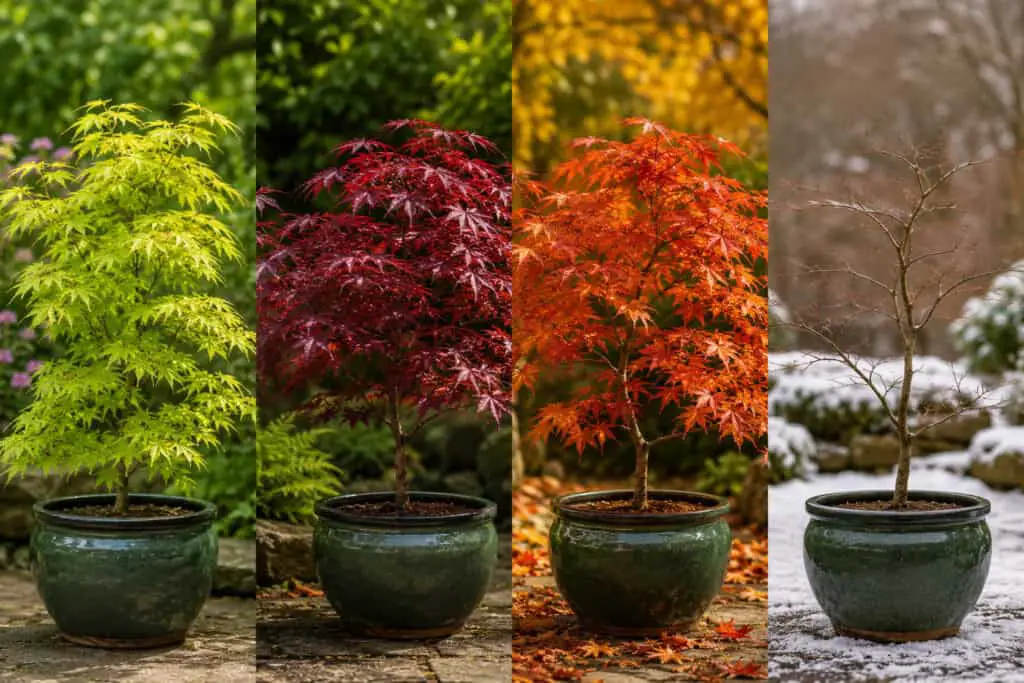
The most common question gardeners ask when they see an acer tree standing bare and leafless in winter is whether something has gone wrong. The answer, in the vast majority of cases, is no.
Most acer trees are deciduous.
They lose their leaves every autumn as part of a perfectly natural annual cycle, stand bare throughout winter, and then produce fresh new growth in spring.
A bare acer in December is almost certainly a healthy and dormant acer.
Understanding this cycle, and knowing what to expect from your acer at every point in the year, removes an enormous amount of gardening anxiety.
It also helps you recognise the rare situations where a bare acer in spring or summer might be cause for genuine concern.
This guide covers the complete seasonal leaf cycle of acer trees in detail.
It explains why acers lose their leaves, what triggers the process, what to expect month by month in the UK, how to identify spectacular autumn colour, and how to tell with confidence whether a leafless acer is dormant or dead.
For a full overview of ongoing care requirements, see our acer tree care guide.
| Why Trust This Guide This guide draws on established horticultural knowledge of Acer palmatum and related species in UK growing conditions, cross-referenced with guidance from the Royal Horticultural Society. It is written to help gardeners in England and Wales understand the normal seasonal behaviour of their trees without unnecessary alarm. |
Quick Answer: What to Expect From Your Acer Through the Year
| Time of Year | What the Acer Is Doing | Is This Normal? |
| March to April | Buds swell and first leaves emerge; leaf colour at its most vivid | Yes, completely normal |
| May to June | Full canopy in place; active growth season underway | Yes, completely normal |
| July to August | Leaves at their largest; some summer leaf drop possible in heat | Yes, can be normal |
| September to October | Leaves begin changing colour; spectacular autumn display begins | Yes, completely normal |
| October to November | Leaves fall; branches becoming bare | Yes, completely normal |
| November to February | Tree is fully bare; dormant; looks dead but is alive | Yes, completely normal |
| Late March onwards with no leaves | Possible cause for concern; apply scratch test | Investigate further |
Understanding Acer Trees: Deciduous Versus Evergreen
The genus Acer contains roughly 130 species of trees and shrubs, and the vast majority of those grown in UK gardens are deciduous.
Deciduous means a plant that sheds its leaves once a year, typically in autumn, and regrows them the following spring.
This is not a sign of poor health. It is a highly evolved survival strategy.
As the days shorten in autumn and temperatures fall, a deciduous tree gradually withdraws the valuable nutrients stored in its leaves back into its roots and woody tissue, then sheds the leaves to conserve water and energy through the cold months when photosynthesis would be largely impossible anyway.
The result is the bare, skeletal appearance that most acer owners see for four to five months of the year in the UK.
Which Acer Species Are Deciduous?
The most widely grown acer species in UK gardens are all deciduous. These include the following varieties.
Acer palmatum, the Japanese maple, is the most popular garden acer and covers hundreds of cultivars ranging from compact, container-sized plants to small trees. All are deciduous.
Acer japonicum, the full moon maple, is closely related to Acer palmatum and produces similarly spectacular autumn colour. It is also fully deciduous.
Acer griseum, the paperbark maple, is a deciduous species grown for both its peeling cinnamon-coloured bark and its reliable autumn colour.
Acer pseudoplatanus, the sycamore, is a large, vigorous deciduous native that is common across the UK and loses its leaves in autumn like any other deciduous tree.
Acer platanoides, the Norway maple, is another large deciduous species widely planted in parks and streets. It produces yellow or occasionally red autumn colour.
Acer campestre, the field maple, is the only maple native to England and is fully deciduous, turning butter yellow in autumn.
Are Any Acer Trees Evergreen?
A small number of acer species are evergreen or semi-evergreen, but these are not commonly grown in UK gardens and are rarely sold in mainstream UK garden centres.
The evergreen acers originate from subtropical and tropical regions and are not cold-hardy enough for outdoor cultivation in most of the UK.
If you have purchased a tree described as an acer or Japanese maple from a reputable UK nursery, it is almost certainly a deciduous variety.
A bare tree in winter is expected and normal.
The Acer Leaf Cycle: Month by Month in the UK
The timing of the acer leaf cycle varies depending on the variety, the location of the tree, local weather patterns, and whether the tree is in a container or in the ground.
The following guide describes the typical pattern for Acer palmatum and closely related species in most parts of England and Wales.
Scotland and northern regions may be two to four weeks behind these dates.
Late February and March: Bud Swell and the First Signs of Life
The first sign that an acer is waking from dormancy is bud swell.
The tiny, tightly compressed buds that have sat on the bare branches through winter begin to plump up and change colour as the sap begins to flow again.
In a mild year this can begin as early as late February. In a cold year it may not be visible until mid-March.
At this point the tree still looks essentially bare, but close inspection reveals the buds are no longer dry and static.
They are slightly swollen, often with a reddish or reddish-brown tinge depending on the variety, and they feel firm and moist rather than dry and brittle.
Bud swell is the most reliable early indicator that a dormant acer is alive and preparing for spring.
It is also the test to apply if you are worried about whether your acer survived the winter. If you are unsure whether slow bud development points to something more serious, our guide to acer tree not growing explains what to check.
Checking for Bud Swell in Late Winter
Look at the tips of the smallest twigs in late February or March.
- Healthy, dormant buds are firm, plump, and intact.
- They may show a slight reddish or purplish colour.
- Dead buds are dry, shrivelled, crumbly, and collapse when gently squeezed.
If you see firm, plump buds on most of the branches, your acer is alive and preparing to leaf.
April: Leaf Emergence and the Most Vivid Foliage of the Year
April is the month when most UK acers produce their new leaves, and it is when the foliage of many varieties is at its most spectacular.
The newly emerged leaves are typically smaller and more intensely coloured than they will be in midsummer.
Red and purple-leafed varieties such as Bloodgood, Atropurpureum, and Deshojo emerge in vivid shades of crimson and burgundy that often intensify as the leaves expand.
The dissectum varieties with their deeply cut, feathery leaves are particularly beautiful at this stage.
Green and variegated varieties produce their freshest, most vivid spring greens in April, with some varieties such as Katsura emerging in shades of orange and apricot before settling to their summer green.
The risk period for late frost damage is at its highest in April.
New acer leaves have essentially no frost tolerance and can be destroyed by even a light frost after they have emerged.
Cover the tree overnight with two or three layers of horticultural fleece if frost is forecast after the leaves have appeared.
For full seasonal protection advice, see our guide to acer tree winter care and frost protection.
May and June: The Active Growing Season
By May, most acers are in full leaf and the active growing season is underway.
The leaves have expanded to their full size and the tree is photosynthesising actively and building the energy reserves it will draw on through the dormant winter period.
Some of the vivid spring colour of red-leafed varieties may soften slightly in May and June as the leaves reach full maturity, particularly in varieties grown in shadier positions.
This is entirely normal and does not indicate a problem with the tree.
Container-grown acers will need regular watering from May onwards.
The root system in a pot has limited access to soil moisture, and in warm, dry weather a container acer can dry out quickly.
Check the compost at a depth of five centimetres: if it feels dry, water thoroughly.
For detailed container advice, see growing an acer tree in a pot.
July and August: Midsummer and the Risk of Summer Leaf Drop
In most years, an acer in July and August carries a full, healthy canopy and requires little more than adequate watering during dry spells.
However, hot and dry conditions can cause premature leaf drop in summer, and this is one of the situations that most alarms acer owners.
If an acer drops some of its leaves in a hot, dry July or August, it is not dying.
The tree is responding to drought stress by reducing its leaf area, which reduces the amount of water it loses through transpiration.
This is a survival mechanism, not a sign of terminal decline.
Our dedicated guide to acer tree dropping leaves in summer covers the full range of causes and remedies in detail.
A tree that drops leaves in summer due to drought stress will typically produce a second flush of smaller leaves later in the season once conditions improve, and will return to a full canopy the following spring.
| Caution: Summer Leaf Drop Is Not the Same as Autumn Leaf Drop Leaves falling in October and November are healthy, fully coloured, and dropping as part of normal dormancy preparation. Leaves falling in July and August are usually brown, scorched, or crisped at the margins and are dropping due to drought or heat stress. Summer leaf drop requires action: deep watering, mulching, and possibly moving a container acer to a shadier spot. Autumn leaf drop requires no action at all. It is completely natural. |
September and October: The Autumn Colour Display
September and October are the months when acer trees earn their reputation as the stars of the autumn garden.
The colour display of Acer palmatum and related species is among the most spectacular produced by any tree in cultivation in the UK, and the timing of peak colour varies depending on the variety, the weather, and the tree’s location.
In most parts of England, the leaves of Acer palmatum cultivars begin showing autumn colour from mid to late September onwards.
Cooler nights accelerate the colour change, while warm, settled autumn weather may delay it into October or even early November.
The colour change and leaf fall of acers can happen very quickly.
A tree that is still in full green or summer foliage one week may be a blaze of red and orange the next, and by the following week may have shed most of its leaves.
The window of peak colour is often only ten to fourteen days, so it is worth checking the tree regularly during October.
The Science Behind Acer Autumn Colour
The spectacular autumn colour of acers is produced by three pigments: chlorophyll, which gives leaves their green colour all summer; carotenoids, which produce yellow and orange shades; and anthocyanins, which produce red and purple shades.
Through spring and summer, the green chlorophyll dominates and masks the other pigments.
As days shorten in autumn, the tree begins withdrawing chlorophyll from the leaves.
As the green fades, the yellow and orange carotenoids are revealed.
Anthocyanins, which produce the reds and crimsons that make acers so striking, are actively produced in autumn as sugars accumulate in the leaf.
The intensity of red and crimson autumn colour is heavily influenced by weather conditions.
Cold nights combined with dry, sunny autumn days produce the most intense reds.
Mild, overcast autumns tend to produce less vivid yellows and oranges.
This is why acer autumn colour varies significantly from year to year even on the same tree.
| Acer Variety | Spring Colour | Summer Colour | Autumn Colour | Leaf Drop Timing |
| Bloodgood | Deep crimson | Dark burgundy-red | Bright red to scarlet | Late October to November |
| Atropurpureum | Red-purple | Purple-green in shade | Orange-red | October to November |
| Osakazuki | Bright green | Fresh green | Intense scarlet-red | Late October |
| Sango Kaku (Coral Bark) | Pale yellow-green | Green | Bright yellow to gold | November |
| Orange Dream | Orange-yellow | Yellow-green | Orange and gold | October to November |
| Dissectum Garnet | Deep red-bronze | Bronze-red | Crimson and red | Late October |
| Katsura | Apricot-orange | Lime green | Gold and orange | October to November |
| Fireglow | Bright red | Burgundy-red | Scarlet to orange-red | October to November |
How to Get the Best Autumn Colour From Your Acer
The position and growing conditions of an acer have a direct influence on the intensity of its autumn colour.
The following factors improve colour production. Good light levels are important.
An acer growing in deep shade may produce acceptable summer foliage but disappointing autumn colour, as the production of anthocyanins requires adequate light.
For specific advice on positioning, see our guide to Japanese maple light requirements.
An east-facing or dappled-shade position is ideal, providing protection from the most intense afternoon sun while still delivering enough light for strong colour production.
Slightly acidic soil encourages better colour in red and purple varieties.
Acers growing in neutral to alkaline soil may show less vivid colour and may also develop yellowing between the leaf veins due to iron deficiency.
Container-grown acers should be potted in ericaceous compost.
A warm, sunny September and October with cold nights consistently produces the most spectacular displays.
There is little a gardener can do to influence the weather, but positioning the tree where it benefits from maximum autumn sunshine will make the most of whatever the season provides.
Avoid late-season fertilising.
Feeding an acer after midsummer encourages it to put energy into new growth rather than preparing for dormancy, which can reduce the intensity of autumn colour and make the tree more vulnerable to frost damage.
November to February: Dormancy and the Bare Season
By November, the leaves of most UK acers have fallen and the tree stands bare.
This is the dormant period, when the tree has withdrawn its nutrients into its roots and woody tissue and essentially shut down until the following spring.
A bare acer in winter looks, to the untrained eye, completely dead. The branches are leafless and may appear grey and lifeless. There is no visible growth of any kind.
This appearance is entirely normal and is not cause for concern. During dormancy, the tree is not dead.
It is conserving energy, protected from the cold and desiccating winter winds by the fact that it has no leaves to lose water from.
The buds for the following spring’s leaves are already formed on the branch tips, waiting for the warmth of March to trigger their opening.
Winter is actually a good time to appreciate the architectural quality of an acer.
The graceful, layered branching structure that is partly hidden by the canopy in summer is fully visible in winter, and many acers are genuinely beautiful as bare skeletons against a pale winter sky.
| Tip: Winter Is the Best Time for Light Pruning If you need to remove any dead, crossing, or badly positioned branches, winter dormancy is the ideal time. Prune acers between November and February when the tree is fully dormant. For detailed technique and timing, see our complete guide to when and how to prune an acer tree. Use sharp, clean secateurs and cut at a 45 degree angle just above an outward-facing bud. Do not seal pruning wounds. Acers heal naturally and sealants can actually encourage rot. |
Is My Acer Tree Dead or Dormant? How to Tell
The question gardeners ask most urgently in late winter and early spring is whether a bare acer that has not yet leafed out is dormant or dead.
The two look almost identical from a distance, but there are several reliable tests that will give you a definitive answer.
Before applying any test, it is worth considering timing.
Japanese maples and related species are not among the earliest trees to leaf in spring. They typically begin showing bud swell in March and produce their first leaves in April.
If it is late February and your acer is still bare, that is not a cause for concern.
If it is late April and other acers of the same variety in your area are in full leaf and yours shows no sign of bud activity, that is the point at which to investigate further.
In the worst-case scenario, our guide to a dying acer tree covers what to do if you confirm the tree is in serious decline.
The Scratch Test: The Most Reliable Method
The scratch test is the single most reliable way to determine whether an acer tree or individual branch is alive.
It is quick, requires no tools, and gives an almost immediate answer.
To perform the test, use your thumbnail or a small penknife to scratch gently through the outer bark of a small branch.
You are looking at the layer of tissue immediately beneath the bark, which is called the cambium.
- If the cambium is green or yellowish-green and feels slightly moist, the branch is alive. The tree is dormant, not dead.
- If the cambium is brown, dry, and slightly crumbly or papery, that branch is dead.
Always test multiple branches from different parts of the tree before drawing conclusions.
A healthy tree can have a few dead twigs without being in serious trouble. If the majority of branches show green cambium, the tree is alive.
If the majority show brown, dry cambium throughout, the tree may be dead. Start at the branch tips and work inward.
If the tip is dead but the cambium is green a few centimetres further down, that branch may still be alive from that point.
The Bud Test: Quick and Easy in Late Winter
In late February and March, before the leaves have emerged, examining the buds on the branch tips is the fastest way to check whether an acer is alive.
- Healthy, dormant buds are firm, slightly swollen, smooth, and intact.
- They may show a reddish, brown, or purplish tinge depending on the variety and may feel slightly moist when pressed gently between finger and thumb.
- Dead buds are dry, shrivelled, crumbly, and may collapse or disintegrate when gently pinched.
- They have no firmness or moisture.
A tree with firm, plump buds on most of its branches is alive and preparing for spring, even if the branches are otherwise bare and apparently lifeless.
The Flexibility Test
Living branches retain moisture and are therefore flexible.
A small twig on a living acer will bend when gently flexed before it breaks, and when it does break there will be some moisture or green tissue visible in the break.
Dead branches have dried out and become brittle.
They snap cleanly and easily with very little force, and the break shows dry, colourless wood with no moisture.
Apply this test gently and to small twigs rather than major branches.
Test several twigs from different parts of the tree for a reliable result.
When to Worry: Signs That an Acer May Be Dead
| Observation | Most Likely Meaning | Action Required |
| Bare in winter (November to February) | Normal dormancy | None; tree is healthy |
| Bare in early spring (March) with no bud swell | Possibly still dormant; check buds | Apply bud test; wait until mid-April |
| Bare in April with no bud activity when other acers are in leaf | Possible problem; investigate | Apply scratch test on multiple branches |
| Scratch test shows green cambium on most branches | Alive; may be late to leaf | Be patient; check again in two weeks |
| Scratch test shows brown dry cambium throughout | That branch or section is dead | Apply scratch test lower down and to other branches |
| All branches fail scratch test; no buds visible | Tree is likely dead | Consult a local nursery or arborist for confirmation |
| Branches snap cleanly; no moisture in break | Dead wood | Remove dead branches; check living branches |
| No leaves by late May when same variety nearby is in full leaf | Strongly suggests tree has died | Apply all three tests; seek professional advice |
| Important: Late Leafing Does Not Mean Dead Acers are not always the first trees to leaf in spring. In a cold spring, or in a north-facing or sheltered position, leaf emergence may be delayed until late April or even early May. If a tree is bare in early April but the scratch test reveals green cambium and the buds feel firm and plump, the tree is alive. Be patient. A late-leafing acer that passes the scratch test will almost always produce leaves given a little more time. |
Why Acer Trees Lose Their Leaves: The Full Explanation
The leaf drop of a deciduous tree like an acer is a precisely coordinated biological process, not simply a response to cold temperatures.
Understanding why it happens makes it much easier to recognise it as normal when it occurs.
The Role of Daylight: Photoperiodism
Acer trees, like most deciduous trees, begin preparing for dormancy in response to the shortening days of late summer and early autumn.
The tree detects the decreasing ratio of daylight to darkness through pigments in its leaves and adjusts its internal chemistry accordingly.
This response to day length is called photoperiodism.
It is the primary trigger for dormancy preparation, which is why deciduous trees begin preparing to drop their leaves even during warm autumn weather.
The shortening days are a more reliable signal of approaching winter than temperature alone.
The Chemistry of Leaf Fall
As day length decreases, the tree begins producing less of a growth hormone called auxin in its leaves.
Auxin is the hormone that maintains the connection between the leaf stalk and the branch.
As auxin levels fall, a layer of specialised cells at the base of each leaf stalk, called the abscission layer, begins to weaken and break down.
At the same time, the tree is actively withdrawing valuable nutrients from the leaves back into its roots and woody tissue.
Nitrogen, phosphorus, and other minerals are reclaimed and stored for the following spring.
This is why fallen autumn leaves are relatively poor in nutrients compared with the green leaves of summer.
Once the abscission layer has broken down sufficiently, the leaf detaches.
It may fall under its own weight or be blown off by wind.
The process is complete, and the leaf scar that remains on the branch is sealed to prevent moisture loss.
What Makes an Acer Different from Other Deciduous Trees
The acer genus, particularly Acer palmatum and its cultivars, tends to hold its leaves slightly longer into autumn than many other deciduous trees when conditions allow, and the leaf colour change happens relatively quickly and dramatically once it begins.
A tree that appeared fully green in mid-September may be completely bare by early November.
Acers also respond more dramatically to environmental stress than many other deciduous trees.
A very hot, dry summer can trigger premature leaf drop in July or August, and a severe spring frost can destroy the entire new leaf flush in a single night.
Both of these events look alarming but are rarely fatal.
If your tree is showing brown or scorched leaves before they fall, our guides to acer leaves turning brown and acer tree leaves turning yellow can help identify the underlying cause.
Acer Autumn Colour: What to Expect and When
The autumn colour of acer trees is the most celebrated feature of the genus, and for good reason.
The range of colours produced by Acer palmatum cultivars in autumn is unmatched by almost any other garden tree available in the UK, and the display, even if brief, is genuinely spectacular.
When Does Acer Autumn Colour Peak in the UK?
In most of England, the peak of acer autumn colour falls between mid-October and early November, though this varies by several weeks depending on the variety, location, elevation, and the specific weather conditions of each year.
Cooler autumns, particularly those with cold nights and dry, sunny days, tend to produce the most intense colour and the longest display.
Mild, wet, overcast autumns may result in leaves yellowing and dropping quickly without the full crimson and scarlet display that the tree can produce in ideal conditions.
Early frosts can destroy the autumn colour display entirely, triggering rapid leaf drop before the colour has fully developed.
Late frosts after the leaves have begun to turn can cause the coloured leaves to blacken and drop within days, cutting the display short.
Autumn Colour by Position
The intensity of autumn colour in acers is partly determined by how much light the tree receives.
Trees in positions with good autumn sunshine tend to produce richer, deeper colours than trees in heavily shaded positions, where the display may be limited to yellows and pale oranges rather than the deeper reds and crimsons.
A position with morning sun and some afternoon shade is ideal for both the health of the tree through summer and the quality of its autumn colour.
Full shade suppresses colour intensity.
Full afternoon sun increases the risk of summer scorch.
Why Autumn Colour Varies From Year to Year
Even an established acer in a consistent position will produce noticeably different autumn colour from one year to the next.
This is entirely normal and reflects the sensitivity of the colour production process to weather conditions.
Years with a warm, sunny September followed by cold October nights tend to produce the best displays.
The warm September encourages sugar production in the leaves, while the cold nights convert those sugars into anthocyanins, the red and crimson pigments responsible for the most vivid colour.
Years with a warm, wet autumn may result in the chlorophyll breaking down before sufficient anthocyanins have been produced, giving a more yellow or brownish display rather than the vivid reds the variety is capable of.
How to Make the Most of Autumn Colour
- Position the tree where it receives good autumn sunshine, ideally with an east or south-east aspect.
- Avoid late-season nitrogen feeding, which encourages the tree to put energy into growth rather than colour production.
- Ensure the tree is well-watered through summer: a drought-stressed acer often produces poor autumn colour.
- Be aware that peak colour can last only ten to fourteen days, so check the tree regularly in October.
- The colour changes very quickly: what is green on a Tuesday may be crimson by the following weekend.
Seasonal Care Calendar for Acer Trees in the UK
The following calendar summarises the key tasks and watch points for acer trees through the year, with a focus on supporting the leaf cycle and ensuring the best possible spring display and autumn colour.
For breed-specific issues such as purple leaves greening over in summer, see our guide to why your Japanese maple is turning green.
| Month | What the Acer Is Doing | Key Care Tasks |
| January | Fully dormant; bare branches; buds in place | Check tree is not sitting in waterlogged soil; inspect for pest damage to bark; plan any repositioning |
| February | Still dormant; bud swell may begin at end of month in mild years | Apply a fresh layer of mulch around the base if not done in autumn; do not prune yet as sap may rise early |
| March | Bud swell visible; first leaf emergence possible by late March | Watch for late frost forecasts; cover with fleece overnight if frost is expected; do not fertilise yet |
| April | Leaves emerging; peak frost risk; most vivid spring foliage | Protect new leaves from frost with fleece; begin supplementary watering for container trees; do not feed |
| May | Full canopy in place; active growth underway | Begin supplementary watering during dry spells; apply a light spring feed if desired; watch for aphids on new growth |
| June | Tree in full leaf; peak growing season | Water deeply in dry weather; inspect for scale insects on stems; ensure container trees have not dried out |
| July | Midsummer; risk of drought and leaf scorch increases | Water deeply once or twice a week in dry spells; do not feed after mid-July; provide shade cloth if severe heat is forecast |
| August | Hottest month; some summer leaf drop possible in drought | Continue deep watering; do not feed or prune; watch for any premature yellowing or browning of leaves |
| September | Autumn colour beginning on some varieties; good time to move or plant | Reduce watering as days shorten; repot container trees if needed; plant new acers in the ground |
| October | Peak autumn colour; rapid leaf fall | Enjoy the display; do not feed; rake fallen leaves away from the base; apply autumn mulch as leaves fall |
| November | Most leaves fallen; tree entering dormancy | Apply a generous mulch layer; bring tender container varieties under cover if severe frosts are forecast; light pruning can begin |
| December | Fully dormant; bare branches | Continue light pruning if needed; check container trees are not waterlogged; no feeding, watering, or intervention required |
| Further Reading The Royal Horticultural Society provides detailed cultivation guidance for Japanese maples, including advice on pruning timing, soil requirements, and managing leaf scorch, in their Japanese Maples Growing Guide. |
Frequently Asked Questions
My acer is completely bare in January. Is it dead?
No. A bare acer in January is a dormant acer, and dormant is entirely different from dead.
January is one of the months when all deciduous acers should be bare.
The tree is conserving energy through the cold winter months and will produce fresh new leaves in spring.
If you want reassurance, apply the bud test. Look closely at the tips of the smallest twigs.
If you can see small, firm, intact buds, the tree is alive.
Apply the scratch test to a small twig: if the tissue beneath the bark is green or greenish-yellow, the tree is alive.
When do acer trees get their leaves back in spring?
In the UK, most Acer palmatum cultivars begin to show bud swell in March and produce their first leaves in April.
The exact timing depends on the variety, the local climate, and the weather in any given year. In a warm spring, leaves may appear by late March.
In a cold spring, emergence may be delayed until late April or even early May. Acers are not among the earliest trees to leaf in spring.
If other trees in the garden are in leaf but your acer is still bare in early April, this is not necessarily a cause for concern. Wait until late April before investigating further.
If your acer shows no sign of bud swell or leaf emergence by late April and other acers of the same or similar variety in your area are already in leaf, apply the scratch test to determine whether the tree is still alive.
Why did my acer lose its leaves in summer?
Summer leaf drop in acers is almost always a response to drought stress or heat stress, not a sign of disease or the onset of dormancy.
When an acer loses water through its leaves faster than its roots can supply it, the tree may drop some leaves to reduce water loss. This is a survival response.
Check the soil around the tree at a depth of five centimetres. If it feels dry, the tree needs deep watering immediately.
Apply a thick mulch around the base of the tree to help retain moisture, and if the tree is in a container, move it to a slightly shadier position during the hottest weeks.
A tree that drops leaves in summer due to drought stress will usually produce a second flush of smaller leaves later in the season and will return to a full canopy the following spring, provided the underlying cause is addressed.
Why is my acer’s autumn colour poor this year?
Acer autumn colour is highly sensitive to weather conditions and varies significantly from year to year.
The most common reasons for disappointing autumn colour are a warm, overcast autumn with insufficient cold nights to trigger anthocyanin production; a position that does not receive enough light for strong colour; a tree that has been stressed through summer by drought or heat; and late-season feeding with high-nitrogen fertiliser.
In many cases, a tree that produces poor colour in one year will produce a better display the following year if conditions are more favourable.
Ensuring the tree is well-watered through summer, positioned to receive adequate light, and not fed after midsummer will give it the best chance of a good autumn display.
My acer dropped all its leaves in August. Will it die?
Almost certainly not, provided the branches are still alive.
Apply the scratch test: if the cambium beneath the bark is green on most of the branches, the tree is alive and stressed but not dead.
A tree that loses all its leaves in August due to drought or heat stress has essentially gone into premature dormancy. Keep it watered, apply a generous mulch, and be patient.
It may produce a small flush of new leaves in late summer or early autumn, and it will almost certainly produce a full canopy the following spring.
Do not prune a tree that has dropped its leaves in summer. Do not apply fertiliser to a stressed tree.
The two most helpful things you can do are water it deeply and reduce its exposure to the conditions that caused the stress in the first place.
Should I rake up fallen acer leaves in autumn?
Yes, it is good practice to rake up fallen acer leaves from around the base of the tree and from containers.
Leaves left to pile up around the trunk can encourage crown rot and slugs, and in wet conditions they can harbour fungal spores.
Do not compost the leaves if the tree has had any fungal or bacterial problems during the growing season, as this can spread disease.
Healthy fallen leaves can be composted or added to a leaf mould pile where they will break down over the following year into a useful soil conditioner.
How long does an acer tree live?
Acer palmatum and related Japanese maple species are genuinely long-lived trees.
In sheltered, well-prepared positions with appropriate care, they are capable of living for one hundred years or more.
Even container-grown specimens, if repotted regularly and kept in good health, can thrive for many decades.
The key factors in longevity are choosing the right position, avoiding repeated drought stress, protecting from late frosts, and not over-pruning.
An acer that is stressed repeatedly by poor conditions will be shorter-lived than one in an appropriate site.
For guidance on establishing your tree successfully from the start, see our guide to planting a Japanese maple tree.
Key Takeaways
- Most acer trees are deciduous and lose their leaves every autumn. This is completely normal. A bare acer in winter is a healthy and dormant acer.
- Leaf drop is triggered by shortening days, not just cold temperatures. The tree detects decreasing day length in late summer and begins preparing for dormancy before the cold arrives.
- Bud swell typically begins in March and leaves emerge in April in UK gardens. Acers are not among the earliest trees to leaf. If yours is still bare in early April, do not panic.
- Autumn colour peaks between mid-October and early November in most of England. Cold nights combined with sunny autumn days produce the most vivid reds and crimsons. The display can last as little as ten days.
- A bare acer in winter is dormant, not dead. The scratch test is the most reliable way to confirm this: green cambium beneath the bark means the tree is alive.
- Summer leaf drop is a drought response, not the onset of dormancy. Address the underlying cause with deep watering and mulching, and the tree will almost certainly recover fully by the following spring.
- Autumn colour quality varies from year to year. Good light, adequate summer moisture, and avoiding late-season feeding give the tree the best chance of a vivid display.
- Winter is the best time for any light pruning. Prune acers between November and February using sharp, clean secateurs. Prune sparingly, as acers recover slowly.
Final Thoughts
The seasonal cycle of an acer tree is one of the most beautiful and clearly defined of any tree in the garden.
From the vivid emergence of spring leaves through the rich summer canopy, the spectacular and often brief autumn display, and the graceful bare skeleton of winter, an acer delivers something worth seeing at every point of the year.
The single most important thing to understand is that a bare acer is almost always a dormant acer.
The anxiety that most new acer owners feel in late autumn and winter, when the tree stands leafless and apparently lifeless, is entirely misplaced in the vast majority of cases.
If you are ever genuinely uncertain whether your acer is alive, apply the scratch test and the bud test before taking any action.
In most cases you will find the green cambium that tells you the tree is alive and simply waiting for spring.
Provide your acer with the right position, adequate water in summer, and an annual mulch, and it will reward you with decades of exceptional seasonal colour.
For ongoing care, you may also find it useful to read about Bloodgood Japanese maple tree problems and our guide covering why a Japanese maple turns brown for troubleshooting support through the seasons.
Mariel is a plant enthusiast and writer based in the UK with a passion for houseplants and indoor growing.
She has spent the last few years building an ever-growing collection of indoor plants and learning the hard way which ones will survive her busy schedule.
At Bean Growing she writes about houseplant care, common plant problems, and outdoor gardening.