
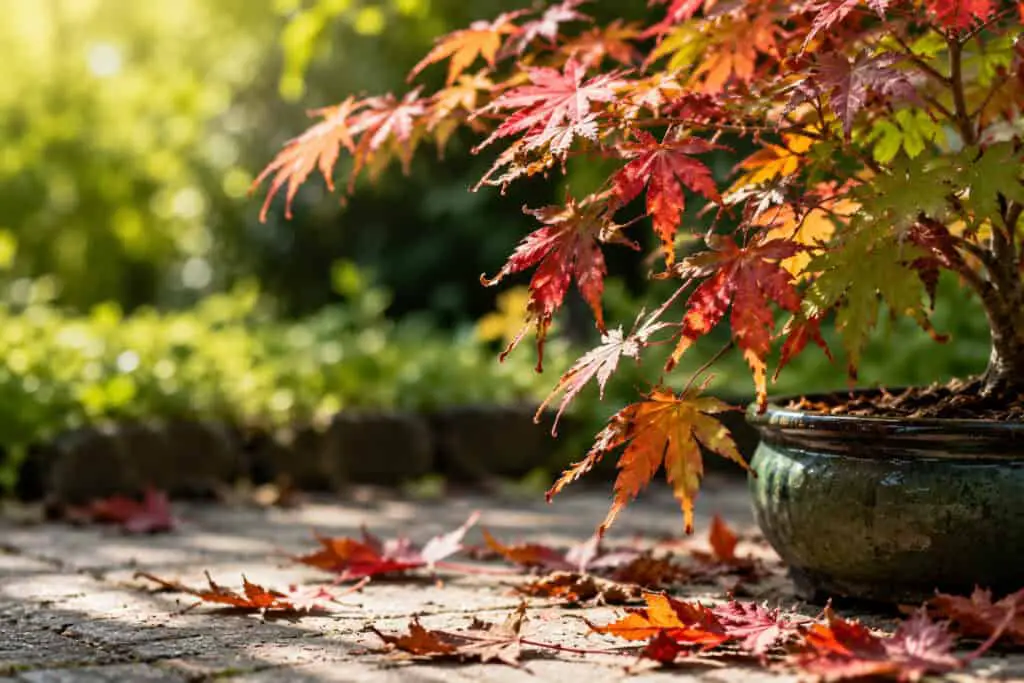
Every cause of premature summer leaf drop explained, from drought and scorch to root rot and wilt, with clear practical fixes for each one.
An acer tree dropping leaves in summer is one of the more unsettling sights a gardener can encounter, particularly when the tree looked perfectly healthy only a few weeks earlier.
Acer, or maple, trees are grown precisely for their foliage, so watching leaves curl, brown, and fall in June, July, or August feels like a far bigger problem than it usually turns out to be.
The encouraging news is that an acer tree losing leaves in summer, rather than in the expected autumn months, almost always points to one of a relatively small number of identifiable causes.
Most are correctable, and many acer trees that look alarmingly bare by midsummer go on to produce a full canopy the following spring.
This guide explains exactly why acer trees lose leaves in summer, including drought stress, leaf scorch, waterlogged roots, verticillium wilt, fungal disease, pest damage, transplant shock, and container problems.
If your tree is showing wider signs of deterioration beyond leaf drop, our guide to an acer tree dying covers those more serious symptoms in full, and our acer tree care guide sets out the growing conditions that keep these trees healthy year-round.
Each cause is described in detail, along with the specific pattern of leaf drop it produces and a practical fix.
It also covers what it means when an acer tree is completely bare in summer, and addresses a closely related but different problem: a Japanese maple that never leafed out at all in spring.
Quick Diagnosis: Identify Why Your Acer Is Dropping Leaves
Use this table to narrow down the likely cause before reading the full explanation below.
| What You Are Seeing | Most Likely Cause | Urgency |
|---|---|---|
| Leaves yellow, then brown, then drop gradually from the outer canopy inward | Drought stress | Medium. Water deeply and mulch |
| Brown, papery leaf margins before leaves drop, worst in full sun | Leaf scorch or heat stress | Medium. Provide shade and water |
| Leaves yellow and drop while the soil stays wet or waterlogged | Root rot | High. Inspect roots and improve drainage |
| Sudden wilting and leaf drop confined to one branch or one side of the tree | Verticillium wilt | High. Prune affected wood promptly |
| Dark spots or blotches on leaves before they drop | Fungal leaf disease | Low to medium. Remove fallen leaves |
| Sticky residue, curled leaves, or visible insects before drop | Aphid, scale, or spider mite infestation | Medium. Treat within days |
| Leaf drop within weeks of planting or moving the tree | Transplant shock | Low. Water consistently and be patient |
| Rapid wilting after watering; soil dries out within a day or two | Root bound container | Medium. Repot into a larger container |
| Entire tree bare with no leaves anywhere by midsummer | Severe drought, scorch, or wilt | High. Scratch test branches immediately |
| Leaf drop beginning gradually from late August onwards with colour change | Normal early autumn colour change | None. Completely normal |
Do Acer Trees Lose Leaves in Summer? Understanding Normal vs Abnormal Leaf Drop
Summer Leaf Drop vs Autumn Leaf Drop: How to Tell the Difference
All acer trees are deciduous, meaning they are genetically programmed to lose every leaf at the end of the growing season.
In most temperate climates, including the UK, this normal leaf drop begins gradually from late August or September, triggered by shortening day length and falling temperatures, and is usually accompanied by the leaves turning shades of red, orange, or gold before they fall.
This seasonal process is entirely healthy and requires no intervention.
Leaf drop that happens earlier, in June, July, or early August, while the days are still long and the leaves fall while still green or only partially discoloured, is a different matter.
This is described as premature or abnormal leaf drop, and it is the tree’s response to some form of stress rather than a natural seasonal process.
The earlier in summer the drop occurs, and the greener the leaves are when they fall, the more likely it is that an underlying problem needs addressing.
A useful rule of thumb is this: leaves that fall with rich autumn colouring after late August are almost always normal.
Leaves that fall green, yellow, or scorched brown any time from May through to early August are a sign that something in the tree’s environment or health needs attention.
Why Some Summer Leaf Drop Is Actually a Protective Response
It is worth understanding that not all premature leaf drop indicates a tree in serious trouble.
When an acer tree is under drought stress, one of its natural survival mechanisms is to deliberately shed a proportion of its leaves.
Each leaf is a site of water loss through transpiration, so reducing the total leaf area reduces the tree’s overall water demand.
A tree that drops twenty or thirty per cent of its leaves during a hot, dry spell, while keeping the remaining leaves and branches healthy, is often using this self protective strategy successfully rather than failing.
This distinction matters because the correct response depends on recognising it.
A tree using protective leaf drop generally needs more consistent watering and mulching, not drastic intervention, and will typically recover well.
A tree dropping leaves due to root rot, by contrast, needs less water and better drainage, the opposite response.
Misreading the cause and applying the wrong fix is one of the most common ways gardeners inadvertently make summer leaf drop worse.
Cause 1: Drought Stress and Insufficient Watering
How Drought Causes Acer Trees to Drop Leaves in Summer
Acer trees, particularly Japanese maples, have a naturally shallow and fibrous root system that does not penetrate deeply into the subsoil where moisture reserves are more stable.
During a hot, dry summer, especially on free draining sandy or gravelly soil, this means an acer tree can become measurably short of water within a week of the last significant rainfall.
The visible sequence is fairly consistent.
Leaves first lose their lustre and begin to droop slightly, particularly in the heat of the afternoon, then the margins and tips turn brown and papery, and finally the leaf detaches and falls.
If you are also noticing the leaves developing a brown colouration rather than dropping immediately, our detailed guide to acer leaves turning brown explains that progression and how to distinguish drought browning from other causes.
This can affect a handful of leaves on the most exposed branches or, in a prolonged drought, the majority of the canopy.
Newly planted acer trees are especially vulnerable, since their root system has not yet spread into the surrounding soil and they have no reserve capacity to draw on.
A newly planted tree can lose a significant proportion of its leaves within days of a dry, hot spell if not watered promptly.
How to Fix and Prevent Drought Related Leaf Drop
Deep, infrequent watering is far more effective than frequent shallow watering.
The goal is to wet the soil to a depth of at least thirty centimetres, encouraging roots to grow downward toward more stable moisture.
In practice this means a slow soak at the base of the tree, using a soaker hose or a slow running hose for twenty to thirty minutes, once or twice a week during dry spells.
Mulching is one of the single most effective preventive measures available.
A layer of well rotted bark or leaf mould, seven to ten centimetres deep, applied around the base of the tree and extending to the drip line, dramatically reduces evaporation from the soil surface and can cut supplementary watering needs by half or more.
Keep mulch clear of the trunk itself to avoid encouraging rot.
Check the soil at a depth of five to eight centimetres before watering. If it feels moist, watering can wait.
If it feels dry, water immediately rather than waiting for visible wilting, since by the time leaves are dropping the tree is already under significant stress.
Cause 2: Leaf Scorch and Heat Stress
How Heat and Sun Trigger Leaf Drop
Leaf scorch occurs when the rate of water loss from the leaf surface through transpiration outpaces the rate at which the roots can resupply it, even when the soil itself is not especially dry.
Intense, direct sunlight accelerates transpiration and can also damage leaf tissue directly through excessive heat and ultraviolet exposure.
The result is browning that typically begins at the leaf margins and tips, on the side of the canopy most exposed to direct afternoon sun.
This pattern of damage is also discussed in depth in the guide to why a Japanese maple turns brown, which covers how to distinguish scorch from cold damage and other causes of browning.
As the damage progresses, badly scorched leaves often curl, become brittle, and drop entirely, sometimes within a matter of days during a heatwave.
Leaf curling before drop is also covered separately in the guide to acer tree leaves curling, which explains the different curling patterns and what each indicates.
This is particularly common on finely dissected dissectum varieties, where the high surface area to volume ratio of each leaf segment makes them especially vulnerable.
In the UK, scorch related leaf drop is most likely on trees in south or south west facing positions with little afternoon shelter, and during the increasingly frequent UK heatwaves of recent summers.
How to Fix and Prevent Scorch Related Leaf Drop
Assess honestly whether the tree’s current position provides too much direct sun for its variety.
Most acer trees, and dissectum types in particular, perform best with some protection from the strongest afternoon sun, ideally from a wall, fence, or neighbouring planting that provides shade from around two in the afternoon onward.
The guide to Japanese maple light requirements explains exactly how much sun different varieties can tolerate and how to choose the best position to prevent scorch in the first place.
For red maple varieties specifically, the guide to red maple light requirements covers the same question for that species.
If moving the tree is not practical, temporary shade cloth rated at thirty to forty per cent can provide meaningful protection during the hottest weeks of summer.
Combine this with deep, consistent watering and a generous mulch layer, since heat stress and drought stress frequently compound one another.
A tree that has already dropped a significant number of leaves to scorch will often look sparse and stressed for several weeks.
Provided the branches remain alive, which can be confirmed with a scratch test, most acer trees will produce a second, smaller flush of leaves later in the season and recover fully by the following spring.
Do Not Feed a Stressed Acer Tree
It is tempting to reach for fertiliser when a tree looks unwell, but feeding a tree that is already stressed by drought or scorch will increase the damage rather than help recovery.
Wait until the tree has produced healthy new growth before resuming any feeding programme.
Cause 3: Root Rot and Waterlogged Soil
Why Waterlogging Causes Acer Leaves to Drop
It seems counterintuitive that too much water can cause the same leaf drop as too little, but root rot is one of the most common serious causes of summer leaf drop in acer trees.
Acer roots are adapted to free draining woodland soils and cannot tolerate extended periods in waterlogged, oxygen depleted ground.
When roots are starved of oxygen they begin to die and rot, most often due to Phytophthora fungi that thrive in saturated soil.
A tree with root rot looks paradoxically thirsty, with yellowing leaves, wilting, and leaf drop, even though the soil around it is wet or even standing with water.
If the leaves are turning yellow rather than brown, the guide to acer tree leaves turning yellow explains that symptom in full and helps distinguish waterlogging from nutrient deficiency and other causes.
This happens because the damaged roots can no longer take up water effectively, regardless of how much is available in the soil.
Leaf drop from root rot typically begins on the lower branches and progresses upward, and may be accompanied by discolouration or a sour smell at the base of the trunk.
How to Fix Root Rot and Improve Drainage
If root rot is suspected, stop watering immediately and assess drainage. Standing water visible around the base of the tree after rain is a clear warning sign.
For a container grown tree, remove it from the pot and inspect the roots. Healthy roots are firm and pale, while rotted roots are brown, soft, and collapse under light pressure.
Trim away affected roots with clean tools, then repot into fresh, free draining compost in a pot with ample drainage holes.
For a tree in the open ground, improving drainage is more involved. Installing a simple rubble drain leading away from the planting area, or replanting on a raised mound fifteen to twenty centimetres above the surrounding soil level, both significantly reduce the risk of waterlogging.
Incorporating coarse grit into heavy soil at around twenty per cent by volume will also improve drainage over time.
Catching root rot early gives the tree the best chance of recovery, so act as soon as the combination of wet soil and leaf drop is noticed.
Cause 4: Verticillium Wilt
Recognising Verticillium Wilt in Acer Trees
Verticillium wilt is a serious soilborne fungal disease that specifically targets the vascular tissue of acer trees, blocking the pathways that carry water and nutrients through the plant.
The fungus, Verticillium dahliae or Verticillium albo atrum, can persist in soil for many years before infecting a tree through its roots.
The RHS notes that acer is among the plants most commonly recorded with Verticillium wilt by their Pathology Laboratory, making it a diagnosis worth ruling out early when one branch or one side of a maple deteriorates suddenly.
The distinguishing feature of Verticillium wilt is its pattern.
Rather than affecting the whole canopy evenly, it typically causes sudden wilting, yellowing, and leaf drop on individual branches or on one side of the tree, a symptom often called flagging.
A branch that looked entirely healthy can wilt and drop its leaves within days.
Cutting through an affected branch usually reveals a distinctive ring of brown or greenish staining in the wood just beneath the bark, which is the clearest diagnostic sign.
Managing Verticillium Wilt
There is no chemical cure for Verticillium wilt. Management focuses on slowing its progress and supporting the tree’s own resistance.
Promptly prune out and destroy any branch showing flagging symptoms, cutting well back into healthy wood and disinfecting tools between cuts to avoid spreading the fungus elsewhere in the tree or garden.
Keep the tree as healthy as possible through correct watering and mulching, since a vigorous tree is better able to compartmentalise and resist the spread of infection than a stressed one.
Avoid wounding the roots through digging or cultivation near the base of the tree, as root damage provides an entry point for the fungus.
Some mildly affected acer trees survive for many years with the disease present but contained, losing occasional branches while the rest of the tree remains productive.
Severely affected trees, however, may decline steadily and eventually need to be removed.
Verticillium Wilt Has No Cure
If you suspect Verticillium wilt, do not replant another acer or another susceptible species, such as roses or strawberries, in the same spot, since the fungus remains active in the soil for years.
Choose a resistant species for that location instead.
Cause 5: Fungal Leaf Diseases
Anthracnose, Tar Spot, and Other Leaf Diseases
Several fungal leaf diseases can cause acer trees to drop leaves prematurely in summer, particularly during wet or humid weather.
Anthracnose is the most significant, producing irregular brown or purplish dead patches along the leaf veins that can expand to kill the whole leaf, giving it a scorched appearance.
Badly affected leaves frequently drop in late spring or early summer, and the disease is most severe following a wet spring.
Tar spot, caused by Rhytisma species, produces raised black spots on the upper leaf surface later in summer.
While mostly cosmetic, heavily affected leaves can yellow and drop earlier than they otherwise would.
Both diseases overwinter in fallen leaves and reinfect the tree the following spring when fungal spores are released during wet weather.
Treating and Preventing Fungal Leaf Disease
Good sanitation is the most effective long term control for fungal leaf disease.
Rake up and dispose of fallen leaves promptly, rather than leaving them to decompose around the base of the tree, since this removes the source of reinfection for the following year.
Avoid overhead watering and water at the base of the tree instead, as wet foliage encourages fungal spore germination.
Improving air circulation around the tree by thinning overcrowded branches reduces humidity within the canopy and helps leaves dry more quickly after rain.
In persistent or severe cases, a fungicide labelled for anthracnose control, applied as new growth emerges in spring, can reduce infection, though this is rarely necessary for an otherwise healthy, well sited tree.
Most acer trees tolerate even a fairly severe anthracnose infection without lasting harm, provided the underlying tree is healthy.
Cause 6: Pest Infestation
Aphids, Scale Insects, and Spider Mites
Several common pests can cause acer leaves to weaken and drop during summer.
Aphids cluster on new growth and the undersides of leaves, feeding on sap and causing curling, distortion, and yellowing, with heavy infestations sometimes leading to leaf drop on the most affected shoots.
Their sticky honeydew secretion also encourages black sooty mould on the leaf surface, further reducing the leaf’s ability to photosynthesise.
Scale insects attach permanently to stems and the undersides of leaves, appearing as small brown or cream bumps, and feed continuously on sap.
A heavy, established scale infestation can weaken a tree significantly over a season, contributing to yellowing and leaf drop.
Spider mites, which thrive in hot, dry conditions, cause fine stippling and a dusty or bronzed appearance on leaves, sometimes with faint webbing on the underside, and severe infestations can cause noticeable leaf drop.
How to Treat Pest Related Leaf Drop
For aphids, a strong jet of water directed at the affected growth will dislodge a large proportion of the population, and is often sufficient on its own for a light infestation.
Encouraging natural predators such as ladybirds and lacewings provides ongoing control.
For heavier infestations, an insecticidal soap or diluted neem oil spray applied directly to the affected areas is effective and carries a low risk of harming the tree.
Scale insects are most easily controlled in early summer, when the young crawler stage is active and has not yet formed its protective waxy coating, using a horticultural oil spray.
Spider mites are usually brought under control by simply improving the tree’s watering, since they thrive specifically in drought stressed plants, combined with a forceful water spray to physically remove them.
Acer trees are notably sensitive to some chemical treatments, so always test any new product on a small area first and apply in the cool of early morning or evening rather than in full sun.
Cause 7: Transplant Shock and Recent Planting
Why Newly Planted or Moved Acer Trees Drop Leaves
A degree of leaf drop is extremely common in the weeks following planting or transplanting an acer tree, even when the work has been done correctly.
The process of lifting and replanting inevitably damages some of the tree’s fine root hairs, the structures responsible for the majority of water uptake, temporarily reducing the tree’s ability to meet the water demands of its full canopy.
In response, the tree often sheds a proportion of its leaves as a protective measure, reducing its water demand to match its temporarily reduced root capacity.
This is usually most noticeable in the first six to eight weeks after planting, and is particularly likely if the tree was moved or planted during warm weather rather than the dormant season, or if it has experienced any period of dry soil since planting.
The guide to planting a Japanese maple tree covers the timing, depth, and aftercare that give newly planted trees the best chance of avoiding transplant shock in the first place.
Helping a Transplanted Acer Recover
Consistent watering is the single most important thing a newly planted acer needs.
Water deeply two to three times a week for the first few weeks, then reduce to once or twice weekly through the remainder of the first growing season, always checking soil moisture at root depth rather than watering to a fixed schedule.
A generous mulch layer around the root zone, kept clear of the trunk, helps maintain consistent soil moisture and moderates soil temperature while the root system establishes.
Avoid feeding a newly planted tree in its first season, as this encourages soft top growth at the expense of root establishment.
Some leaf drop in the first summer after planting is normal and does not indicate a failing tree, provided watering is consistent and the branches remain pliable and green beneath the bark.
Cause 8: Container and Root Bound Problems
Why Potted Acer Trees Drop Leaves in Summer
Acer trees grown in containers face a particular set of challenges that increase their likelihood of summer leaf drop compared with trees in open ground.
A container restricts the volume of soil available to the roots, meaning the compost can dry out far more quickly in hot weather, sometimes within a single day in a small pot during a heatwave.
Over time, an acer left in the same container for several years can become root bound, with the roots circling densely around the inside of the pot and leaving little free compost to hold moisture or nutrients.
A root bound tree typically wilts very quickly after watering, dries out again within a day or two, and develops leaf drop despite apparently regular care, because the compacted root mass simply cannot store enough water to meet the tree’s needs.
Repotting and Fixing Root Bound Trees
Check for root binding by examining the drainage holes for emerging roots, or by carefully removing the tree from its pot to inspect the root ball directly.
If a dense, circling mass of roots with little visible compost is present, repotting is needed.
Move the tree into a container at least two sizes larger, using a free draining, ideally ericaceous, compost mixed with around twenty per cent coarse perlite or grit to maintain drainage.
Gently tease out circling roots before repotting to encourage them to grow outward rather than continuing to circle.
The best time to repot is early autumn before leaf drop or early spring before new growth begins, though a severely stressed tree may need repotting in summer regardless of timing to prevent further decline.
Acer Tree Completely Bare in Summer: What It Means and What to Do
An acer tree that has become completely bare in summer, with no leaves remaining anywhere on the canopy, understandably looks like a dead or dying tree.
In most cases, however, a tree that was healthy earlier in the season and has lost its leaves rapidly to severe drought, scorch, or a sudden heatwave is not dead.
It has simply reached the point where shedding its entire leaf canopy became the only way to stop further water loss.
The full range of symptoms associated with a tree in serious decline, beyond leaf drop alone, is covered in the guide to acer tree dying.
The reliable way to assess a bare acer tree is the scratch test.
Use a thumbnail or the blade of a clean penknife to gently scratch through the thin outer bark of a few small branches in different parts of the tree.
If the tissue immediately beneath is green or pale green, that branch is alive. If it is brown, dry, and brittle all the way through, that branch has died.
Test several branches across the whole tree rather than relying on just one, since a tree can have a mixture of live and dead wood.
If the majority of branches show green tissue, the tree will very likely produce a second flush of smaller leaves later in the summer, and should return to a full canopy the following spring.
Continue watering deeply and consistently, apply a thick mulch layer, and avoid the temptation to prune heavily or to feed the tree while it is recovering.
If, on the other hand, most branches scratch brown and dry, and there is no sign of green tissue anywhere, the tree has likely died, and a local arborist can confirm before any decision is made about removal.
My Acer Never Leafed Out This Spring: A Different Problem
It is worth clearly separating an acer tree that leafed out normally and then dropped its leaves in summer from one that never produced leaves at all in spring.
These are different problems with different likely causes, even though both result in a bare looking tree during the growing season.
An acer, or Japanese maple, that fails to leaf out by late spring most often points to winter damage rather than anything happening during the summer itself.
Cold winter winds or an unusually severe winter can kill buds or whole branches over the dormant season, a condition known as winter dieback or winter burn, which only becomes visible when the rest of the tree leafs out and the damaged sections do not.
A hard, late spring frost striking just as buds are beginning to swell can also kill them before they ever open.
Verticillium wilt, described earlier in this guide, can also prevent a tree from leafing out at all if the infection is severe enough to block the flow of stored nutrients and water from the roots to the buds.
Less commonly, a tree that experienced significant drought stress the previous summer or autumn can fail to leaf out the following spring, since the damage to its root system or stored energy reserves only becomes apparent months later.
The approach is the same as for a bare summer tree: scratch test multiple branches to check for green, living tissue beneath the bark.
If buds are present but have not swollen or opened, be patient, since Japanese maples can sometimes leaf out several weeks later than expected, particularly after a hard winter, and secondary buds can take additional time to activate.
Prune out confirmed dead wood once the rest of the tree is in leaf and the full extent of the damage is clear, cutting back to a live bud or healthy branch union.
If you grow a Bloodgood Japanese maple specifically, the guide to common Bloodgood Japanese maple problems covers the most frequent issues with that variety, including the failure to leaf out normally.
You may also find the guide to why a Japanese maple turns green useful if the new foliage that does emerge lacks its expected colour.
Be Patient Before Assuming the Worst
Wait until early summer before concluding that a slow to leaf acer tree has died.
Many trees that appear completely bare in April or May go on to produce a full canopy by June or July, particularly after a difficult winter.
All Causes at a Glance: Comparison and Action Summary
| Cause | Leaf Drop Pattern | Key Distinguishing Feature | Primary Fix | Urgency |
|---|---|---|---|---|
| Drought stress | Margins and tips first; whole canopy in prolonged drought | Dry soil at root depth; leaves droop before browning | Deep watering; mulch | Medium |
| Leaf scorch / heat | Outer, sun exposed canopy worst | Papery brown margins; rapid in heatwaves | Shade; deep watering | Medium |
| Root rot | Lower canopy first; progresses upward | Wet or waterlogged soil; sour smell | Stop watering; improve drainage | High |
| Verticillium wilt | One branch or one side; sudden flagging | Green or brown staining inside cut wood | Prune affected wood; keep tree healthy | High |
| Fungal leaf disease | Spotted or blotched leaves before drop | Worse after wet spring weather | Remove fallen leaves; improve airflow | Low to Medium |
| Pest infestation | Curled or weakened leaves before drop | Visible insects; honeydew or stippling | Water jet; neem oil; horticultural oil | Medium |
| Transplant shock | Gradual; weeks after planting or moving | Coincides with recent planting date | Consistent watering; patience | Low |
| Root bound container | Rapid wilting after watering | Soil dries within one to two days | Repot into larger container | Medium |
| Complete bare canopy | Sudden, whole tree | Follows severe heat, drought, or wilt | Scratch test; water; wait for recovery | High |
| Winter dieback (not leafing out) | No leaves appear in spring at all | Buds fail to swell; visible at leaf out time | Scratch test; prune dead wood once confirmed | Medium |
Seasonal Care Calendar to Prevent Summer Leaf Drop
Adjusting care through the seasons is one of the most effective ways to prevent premature summer leaf drop before it develops.
| Month | Key Tasks and Watch Points |
|---|---|
| January to February | Check container trees are not waterlogged; avoid pruning live wood as sap rises early; plan any repositioning needed for shade or shelter |
| March | Apply mulch if not already done; watch for late frost as buds begin to swell; do not fertilise yet |
| April | New leaves emerging; highest frost risk period; cover with fleece if frost is forecast; water only if soil is genuinely dry |
| May | Apply a light spring feed if needed; begin supplementary watering during dry spells; watch for early aphid activity on new growth |
| June | Active growing season; water deeply during dry weather; check for scale insects on stems; assess whether the tree needs more shade |
| July | Peak risk period for drought and scorch related leaf drop; water deeply once or twice weekly in dry spells; avoid fertilising after mid July |
| August | Continue deep watering during hot spells; do not prune or feed; any green leaf drop now is most likely scorch or drought |
| September | Good time to repot container trees; plant new trees; final light feed of the year if needed; begin reducing watering frequency |
| October | Apply autumn mulch; rake and remove fallen leaves promptly to reduce fungal disease carryover; avoid disturbing roots |
| November to December | Tree enters dormancy; normal leaf drop with autumn colour is expected; check stakes and ties on young trees; do not prune heavily |
Frequently Asked Questions
Is it normal for an acer tree to lose leaves in summer?
A small amount of leaf drop during a hot, dry spell can be a normal protective response, but significant leaf drop in June, July, or August, especially while the leaves are still green, usually indicates an underlying problem worth investigating.
Leaf drop with autumn colouring after late August is entirely normal.
Will my acer tree recover from summer leaf drop?
In most cases, yes. Provided the branches are still alive, which can be confirmed with a scratch test, the majority of acer trees recover from summer leaf drop once the underlying cause, whether drought, scorch, or another factor, has been addressed.
Most will produce a second flush of leaves later in the season and return to full health the following spring.
How urgent is leaf drop caused by root rot compared with drought?
Root rot is generally more urgent than drought, since untreated waterlogging continues to damage the root system even after leaf drop has occurred, and the underlying cause, wet soil, is the opposite of what a drought stressed tree needs.
Inspect the roots and improve drainage as soon as root rot is suspected, rather than waiting to see if the tree improves on its own.
Should I water more if my acer tree is dropping leaves?
Not always. Increased watering helps if the cause is drought or heat stress, but will worsen the problem if the cause is root rot or waterlogging.
Check the soil moisture at root depth before deciding, since watering an already saturated tree is one of the most common mistakes gardeners make when trying to help a struggling acer.
Can I prevent my acer tree from dropping leaves every summer?
Consistent watering during dry spells, a generous mulch layer maintained year round, and a position that avoids the most intense afternoon sun are the most effective long term preventive measures.
A tree that drops leaves every summer in roughly the same pattern is usually responding to a consistent environmental factor, such as an overly exposed position or insufficient soil moisture retention, that can be addressed permanently.
Key Takeaways
- Autumn colour means normal leaf drop. Leaf drop with autumn colouring after late August is normal; green leaf drop from May through early August signals an underlying problem.
- Drought and scorch are the most common causes. Together they account for the majority of summer leaf drop cases, and both respond well to deep watering and mulching.
- Root rot needs the opposite treatment to drought. Less water and better drainage, not more watering, so correct diagnosis matters before taking action.
- A bare acer tree is not necessarily dead. The scratch test on multiple branches across the tree is the most reliable way to check before assuming the worst.
- Verticillium wilt has no cure but can be managed. Prompt removal of affected branches and maintaining overall tree health are the most effective strategies.
- A tree that never leafed out is usually a different problem. Most often winter dieback or late frost bud kill, rather than anything related to summer leaf drop.
- Never feed a stressed or leaf dropping acer tree. Fertiliser increases stress rather than aiding recovery; wait until the tree shows healthy new growth.
- Most acer trees recover fully. Whatever the cause of premature summer leaf drop, the majority of trees produce a second flush of growth and return to full health by the following spring.
Final Thoughts
An acer tree dropping leaves in summer is rarely the emergency it first appears to be.
The great majority of cases trace back to a small number of identifiable causes, most of which respond well to straightforward adjustments in watering, positioning, or general care.
The most useful habit is reading the pattern of leaf drop accurately before reacting.
Green leaves falling steadily through a hot, dry spell point toward drought or scorch.
Yellowing leaves dropping while the soil stays wet point toward root rot.
Sudden wilting confined to one branch or one side of the tree points toward verticillium wilt.
Each of these calls for a different, sometimes opposite, response, and applying the wrong one, particularly adding more water to a tree with root rot, will make matters worse rather than better.
Acer trees are resilient when grown in conditions that suit them.
Invest in finding a position that balances sun and shelter, water deeply and consistently through dry spells, and maintain a generous mulch layer, and a tree that looked alarmingly bare in July can be back to its full, characteristic colour by the following spring.
Hi, I'm Matt,
An amateur gardener with a houseplant habit that got slightly out of hand.
I started Bean Growing to share what I've learned from a few years of trial, error, and the occasional dead plant.
I grow a mix of houseplants and outdoor shrubs in the UK but try to expand my knowledge to the US. I try to write about what actually works