
Every cause of curling, rolling, and wilting leaves explained, with clear fixes for Acer palmatum and other ornamental maples
Meta Description: Acer leaves curling or rolling up? Find every cause, including drought, root rot, pests, frost and wilting, with clear easy fixes.
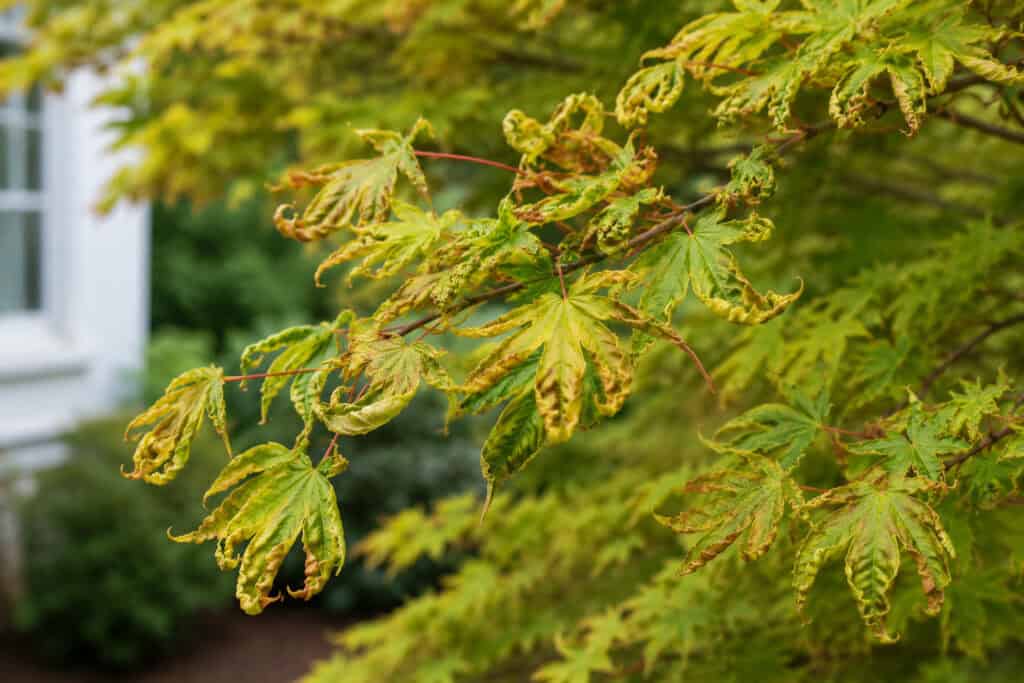
Acer tree leaves curling is one of the most common concerns reported by maple owners, and it can appear at almost any point in the growing season.
The deeply lobed, palmate foliage of Acer palmatum, better known as the Japanese maple, is the main reason people grow these trees, so any change in leaf shape is understandably worrying.
When acer leaves roll up, twist, or curl inward instead of lying flat, the cause can range from something as simple as a missed watering session to something more serious, such as root rot or a fungal disease.
Acer tree wilting alongside the curling often points towards a problem at the roots rather than a problem with the leaves themselves, and if the tree looks seriously unwell our guide to spotting a dying acer covers the warning signs worth ruling out first.
The reassuring truth is that japanese maple leaves curling rarely signals a dying tree.
In most cases, curling is the tree’s own defence response to a stress it is currently experiencing, and once that stress is identified and corrected, healthy new leaves usually follow within a few weeks.
This guide covers every common cause of acer leaves rolling up, including underwatering, overwatering, heat stress, wind exposure, frost damage, pest infestation, fungal and bacterial disease, transplant shock, and salt damage.
Each cause is explained in full, the exact pattern of curling it produces is described, and a clear, practical fix is given for each one.
Whether your acer is a young Japanese maple growing in a container or a mature specimen established in open ground, in a UK garden or a US one, this guide will help you work out exactly why the leaves are curling and what to do next, alongside our wider acer tree care guide for year-round upkeep.
Quick Diagnosis: Identify Your Curling Pattern
The direction of the curl and the conditions around it are the fastest way to identify the cause.
Use the table below to narrow things down before reading the detailed sections that follow.
| What You Are Seeing | Most Likely Cause | Urgency |
| Leaves curl upward and feel dry or brittle; soil is dry at root depth | Underwatering or drought stress | Medium; water deeply now |
| Leaves curl downward, turn yellow, and the soil feels wet or waterlogged | Overwatering or root rot | High; stop watering and check roots |
| Leaf edges curl and develop papery brown margins in hot weather | Heat stress or leaf scorch | Medium; provide shade and water |
| Leaves curl and crisp mainly on the side facing the prevailing wind | Wind exposure or desiccation | Medium; install shelter |
| Leaves curl suddenly overnight following a cold spell | Frost or cold damage | Low; tree will recover naturally |
| Leaves curl tightly with a sticky residue or visible insects | Aphid infestation | Low to medium; treat within days |
| Leaves curl with fine webbing and pale speckling in hot, dry weather | Spider mite infestation | Medium; treat promptly |
| Sudden wilting and curling affecting one side or one branch only | Verticillium wilt | High; inspect the wood immediately |
| Curling and leaf drop within days of planting or repotting | Transplant shock | Low; keep watered and sheltered |
| Curling and browning at the margins after feeding or near a salted path | Salt damage or fertiliser burn | Medium; flush the soil thoroughly |
| Leaves curl and wilt quickly between waterings on a container-grown tree | Root-bound or compacted container | Medium; repot into a larger pot |
Understanding Why Acer Leaves Curl
The Plant Science Behind Leaf Curling
An acer leaf is held flat by turgor pressure, the internal water pressure inside each leaf cell that keeps the cell walls rigid.
When a leaf receives enough water, turgor pressure stays high and the leaf remains open and flat.
Leaf curling happens when this balance is disrupted.
If water is lost from the leaf faster than the roots can replace it, the cells nearest the margins, which sit furthest from the leaf’s water-supplying veins, lose turgor pressure first.
As these cells soften and shrink slightly, the leaf edge curls inward or upward, often before any visible browning appears.
This curling response is not always a sign of damage.
By reducing the surface area exposed to sun, heat, and wind, a curled leaf actually slows its own rate of water loss, in much the same way many broadleaf trees respond to drought or intense heat.
Mild, temporary curling on a hot afternoon that relaxes again by evening is a normal protective response rather than a cause for concern.
A second type of curling is caused directly by pests rather than water stress.
Aphids and other sap-feeding insects inject saliva into the leaf as they feed, and this saliva disrupts the normal growth of the surrounding cells.
The result is a tighter, more distorted curl, usually concentrated on new growth, that does not relax once watered and does not follow the typical drought pattern described above.
Acer Varieties and Their Vulnerability to Curling
Some acer varieties are considerably more prone to curling than others, mainly because of differences in leaf shape and surface area.
| Category | Examples | Key Vulnerability | Best Position |
| Dissectum (finely cut, weeping forms) | Crimson Queen, Garnet, Waterfall | Highest risk of curling from wind, heat and drought | Sheltered position; partial shade; consistently moist soil |
| Palmatum (broad-leaf forms) | Bloodgood, Osakazuki, Sango Kaku | Moderate risk; more tolerant of brief stress | Partial to full sun in milder climates |
| Large upright forms | Osakazuki, Senkaki | Generally the most resilient to curling | Full sun acceptable in the UK; part shade in hotter US zones |
| Container-grown acers | Katsura, Little Princess | High risk from both drought and waterlogging | Sheltered position; frequent moisture checks; repot regularly |
Bloodgood is one of the most widely planted palmatum varieties, and our guide to common Bloodgood Japanese maple problems covers issues specific to this variety in more depth.
Cause 1: Underwatering and Drought Stress
Why Dry Soil Causes Acer Leaves to Curl
Acer palmatum has a naturally shallow, fibrous root system, which makes it considerably more sensitive to drought than trees with deeper roots.
When the soil around the roots dries out, the tree cannot draw up enough water to keep the leaves fully turgid.
As water becomes scarce, the tree prioritises its trunk and main branches, drawing moisture away from the outermost leaves first.
The leaf margins, being furthest from the main veins, lose turgor pressure before the rest of the leaf, and the leaf curls upward as a result.
Curling caused by drought is usually most visible during the warmest part of the day and may partially relax overnight as the tree rebalances its internal water.
If the dry spell continues, the curled margins eventually turn brown, dry, and papery, a sign that the leaf tissue at the edge has died completely.
Recognising Drought-Related Curling
The leaves curl upward, typically starting at the margins and tips.
The soil feels dry at a depth of five to eight centimetres.
Curling is more pronounced in the afternoon and may ease slightly by morning.
Acer tree wilting often accompanies this pattern, with the whole canopy looking limp and slightly faded rather than glossy and vivid.
Newly planted acers are at far greater risk of drought-related curling than established trees, simply because their root system has not yet spread into the surrounding soil.
How to Fix Drought-Related Curling
Water deeply at the base of the tree rather than lightly across the surface.
A slow soak for twenty to thirty minutes using a hose left at the base, or a soaker hose, encourages the roots to grow deeper and reach more stable moisture reserves.
Apply a generous mulch layer of seven to ten centimetres of well-rotted bark or leaf mould around the root zone, keeping it clear of the trunk itself.
This single step can reduce watering needs by half or more during a dry summer.
Newly planted acers should be watered deeply twice a week for their first two growing seasons, and weekly during any dry spell after that until fully established.
Always check the soil at root depth before watering rather than watering on a fixed schedule.
Cause 2: Overwatering and Root Rot
Why Acer Tree Wilting Often Means Too Much Water, Not Too Little
It is a common mistake to assume that a wilting, curling acer simply needs more water. In reality, overwatering and waterlogged soil are responsible for a significant share of curling and wilting cases, particularly in heavy clay or compacted ground.
When soil remains saturated for extended periods, the air pockets that roots rely on for oxygen are pushed out by water.
Without oxygen, the fine root hairs responsible for absorbing water begin to suffocate and die.
The tree then finds itself unable to take up water even though the surrounding soil is completely wet, which is why acer tree wilting can occur on a saturated root system just as easily as on a dry one.
As the damaged roots fail, the leaves typically yellow first, then curl downward, and eventually brown and drop, a progression covered in more detail in our piece on acer leaves turning yellow.
This pattern often begins on the lower branches before spreading upward through the canopy.
Phytophthora Root Rot
Phytophthora is a group of soilborne pathogens that thrives in wet, poorly drained soil and is one of the most serious causes of root rot in acers.
Once established, it attacks and destroys the fine feeder roots, then progresses into larger roots and the base of the trunk.
A tree affected by Phytophthora often shows discolouration or slight oozing at the base of the trunk, and the soil around the roots may develop an unpleasant, sour smell.
The combination of wet soil, a sour smell, and a wilting, curling canopy is a strong indicator of active root rot.
How to Fix Overwatering and Root Rot
Stop watering immediately and assess drainage at the planting site.
Standing water visible on the soil surface after rain or watering is a clear sign that drainage needs improving.
For a container-grown acer, remove the tree from its pot and examine the roots.
Healthy roots are firm and pale; rotted roots are soft, brown, and easily crushed.
Trim away all affected roots with clean, sharp secateurs and repot into fresh, free-draining compost in a clean container with ample drainage holes.
For a tree in open ground, improving drainage is essential for long-term recovery.
Planting on a slightly raised mound, incorporating coarse grit into the planting area, or installing a simple rubble drain leading away from the root zone will all help prevent water from sitting around the roots in future.
Cause 3: Heat Stress and Leaf Scorch
How Intense Heat Causes Acer Leaves to Curl
During periods of intense heat and strong sunlight, an acer leaf curls as a direct defensive response.
By rolling inward, the leaf reduces the surface area exposed to direct sun and hot air, slowing the rate at which water evaporates from its surface.
If the heat continues and the tree cannot draw up water quickly enough to compensate, this protective curling progresses into full leaf scorch, brown, papery patches and margins that represent dead leaf tissue rather than a temporary, reversible response; our guide to Japanese maple leaves turning brown covers this next stage in more detail.
Dissectum varieties, with their finely cut, feathery leaves, are particularly prone to heat-related curling and scorch because their leaf segments have a high surface-area-to-volume ratio, meaning they lose water far faster relative to their size than the broader leaves of upright palmatum varieties.
Where Heat Stress Is Most Likely
In the UK, acers positioned in south or south-west facing gardens, or in open spots without any shade from surrounding trees, walls, or fences, are most at risk during heatwaves; checking your tree’s light requirements against its actual position is a useful first step.
In the US, the risk is considerably higher across most regions, particularly in USDA zones seven and eight, where summer temperatures regularly exceed what this woodland species evolved to tolerate.
How to Fix Heat Stress and Leaf Scorch
Water deeply in the early morning or evening, never during peak heat, since water on warm soil can add to the stress rather than relieve it.
If the tree is small enough, temporary shade cloth rated at thirty to forty per cent can provide meaningful relief during the most intense days of summer.
For trees too established to move, consider planting fast-growing, shade-providing shrubs nearby to filter the harshest afternoon sun over time.
Mulching heavily will also help the soil retain moisture for longer between waterings.
Curled Leaves Are Rarely a Sign of a Dying Tree
An acer that curls its leaves during a heatwave or dry spell is responding exactly as it should, by protecting itself from further water loss.
This is rarely fatal, and the tree will usually produce healthy new growth once conditions improve.
Avoid the temptation to prune heavily or apply fertiliser to a stressed tree, as both add further strain at exactly the wrong time.
Keep it watered, mulched, and sheltered, and be patient.
Cause 4: Wind Exposure and Desiccation
Why Wind Causes Acer Leaves to Curl and Roll Up
Wind exposure is one of the most underappreciated causes of acer leaves rolling up, particularly in gardens that are otherwise well watered and well positioned for light.
Wind increases the rate of transpiration dramatically, pulling moisture from the leaf surface far faster than still air would.
This creates the same water deficit that drives drought-related curling, except the driving force is wind speed rather than soil dryness.
Strong or persistent wind can also physically damage the delicate leaf tissue, causing a slightly ragged, twisted curl at the margins that looks different from the smoother curl produced by heat or drought alone.
New spring growth is especially vulnerable, as the waxy protective cuticle on young leaves has not yet fully developed.
A cold, drying wind in April or May can curl and damage newly emerged acer leaves within as little as forty-eight hours.
How to Protect Acers from Wind Damage
Choose a planting position that is sheltered on the windward side by a wall, fence, hedge, or established shrubs and trees.
This level of protection significantly reduces curling without creating so much shade that the tree’s colour and growth suffer.
A temporary windbreak made from woven willow or hazel hurdles works well for protecting young trees during their most vulnerable early spring growth period, and can be removed once the new leaves have hardened off.
Avoid solid fencing or walls as a windbreak, as these create turbulence on the sheltered side that can be more damaging than the original wind exposure.
A permeable barrier that filters and slows the wind, rather than blocking it completely, gives far better protection.
Cause 5: Cold Damage, Late Frost, and Temperature Fluctuation
Why Frost Causes Sudden Curling in Acers
Acers begin producing new leaves relatively early in spring, often well before the last frost of the season has passed.
The new growth at this stage has essentially no frost tolerance, and even a light frost of minus one or two degrees Celsius can damage the leaf tissue overnight.
Frost-damaged leaves curl and become limp almost immediately, often within hours of the cold snap, and the damage is usually fairly uniform across the whole canopy rather than concentrated at the margins as it is with drought or scorch.
Temperature Fluctuation in Late Spring
A less obvious cause of acer leaves curling is a sudden swing between warm days and cold nights, which is common in late spring and early summer.
This kind of temperature swing places stress on young, tender growth, and the resulting curl can persist on the affected leaves for the rest of the season, even though the tree itself is not seriously harmed.
Young trees and container-grown specimens tend to be affected by temperature fluctuation more than established trees in open ground, as their root systems have less buffering capacity against rapid changes in conditions.
How to Manage Frost and Temperature-Related Curling
Avoid planting in frost pockets, which are low-lying areas where cold air settles overnight.
A position on a gentle slope, or near a wall that retains warmth, offers natural protection.
When frost is forecast after new leaves have emerged, cover the tree overnight with two or three layers of horticultural fleece, removing it again during the day for light and airflow.
Container-grown acers can simply be moved into a garage, porch, or sheltered spot against a south-facing wall overnight.
Resist the urge to remove frost-curled or damaged leaves straight away.
Wait until the risk of further frost has passed completely, since premature pruning can encourage new growth that is then exposed to a later frost.
Cause 6: Pest Infestation
Aphids
Aphids are the most common pest associated with acer leaves curling, particularly on soft new growth in spring and early summer.
These small, soft-bodied insects cluster on the undersides of young leaves and feed by piercing the tissue and extracting sap.
As they feed, aphids inject saliva that disrupts normal cell growth, causing the leaf to curl tightly and become distorted around the feeding site.
A sticky residue called honeydew, excreted as the aphids feed, often coats the curled leaves and nearby surfaces, and can encourage a black, sooty mould to develop.
A strong jet of water directed at infested growth will dislodge many aphids without any chemical treatment.
For more persistent infestations, an insecticidal soap or a diluted neem oil spray applied directly to the affected leaves is effective and low risk.
Encouraging natural predators such as ladybirds and lacewings also helps keep aphid numbers under control over time.
Spider Mites
Spider mites thrive in hot, dry conditions and are a frequent cause of acer leaves curling during prolonged summer heat.
These tiny pests are barely visible to the naked eye, but their feeding damage is unmistakable: fine webbing on the undersides of leaves, combined with pale, stippled speckling across the leaf surface.
As feeding damage accumulates, affected leaves dry out, curl, and eventually drop.
Because spider mites prefer dry conditions, an acer that is already drought-stressed is considerably more likely to develop a serious infestation.
Increasing humidity around the tree by misting the foliage regularly can help discourage spider mites, since they struggle to reproduce in damp conditions.
A targeted miticide, or a thorough application of neem oil covering the undersides of the leaves where mites concentrate, is the most effective direct treatment.
Avoid broad-spectrum insecticides, as these often kill the natural predators that would otherwise keep spider mite numbers in check.
Scale Insects
Scale insects attach themselves permanently to stems and branches rather than leaves, appearing as small, oval bumps ranging from pale cream to dark brown.
Heavy infestations weaken the tree gradually, and curling and yellowing of nearby leaves is often one of the first visible symptoms.
Scale is most effectively treated in early summer, when the young, mobile crawler stage is active and has not yet developed its protective waxy coating.
A thorough application of horticultural oil at this stage gives good control.
Established scale on dormant winter wood can be treated with a tar oil wash during the winter months.
Cause 7: Fungal and Bacterial Disease
Verticillium Wilt
Verticillium wilt is a soilborne fungal disease that can persist in soil for many years before infecting a susceptible tree through its roots.
Once inside, the fungus colonises the vascular tissue responsible for transporting water and nutrients, gradually restricting the flow through affected branches.
This typically produces a distinctive pattern: sudden wilting and curling on one branch or one side of the canopy, while the rest of the tree appears completely healthy.
This uneven pattern, known as flagging, is one of the clearest signs that distinguishes Verticillium wilt from drought- or heat-related curling, which usually affects the whole canopy more evenly.
Cutting through an affected branch often reveals a distinctive brown or greenish streaking within the wood itself, which is the most reliable way to confirm Verticillium wilt.
There is no cure once a tree is infected.
Affected branches should be removed promptly and disposed of away from the garden, and the tree should be kept as healthy as possible through correct watering and mulching to support its natural resistance.
Anthracnose and Leaf Spot
Anthracnose and other leaf spot fungal diseases are most common during cool, wet spring weather, when fungal spores spread easily between leaves via rain splash.
Affected leaves often develop dark spots or blotches alongside curling and distortion, particularly on new growth.
Improving air circulation around the tree by thinning crowded growth, removing fallen infected leaves promptly each autumn, and avoiding overhead watering all reduce the conditions that allow these fungal diseases to spread.
A fungicide labelled for ornamental trees can be used on severely affected specimens, applied according to the product instructions.
Cause 8: Transplant Shock and Root Disturbance
Moving an acer, whether transplanting it to a new spot in the garden or repotting a container-grown tree, inevitably disturbs at least some of the fine roots responsible for taking up water.
In the days and weeks that follow, the disturbed root system often cannot supply water as efficiently as it could before, and the leaves respond by curling, and sometimes dropping, as a stress response.
This is a normal and usually temporary reaction.
Provided the move was carried out at the right time of year and the roots were handled carefully, most acers recover fully within a few weeks as new root growth re-establishes contact with the surrounding soil.
Transplant acers only while they are fully dormant, which in the UK means from November through to February; our step-by-step guide to planting a Japanese maple tree covers the correct technique in full.
Moving a tree while it is in leaf significantly increases the risk of serious, lasting transplant shock.
Water the tree thoroughly immediately after the move, apply a generous mulch layer, and provide temporary shade for the first few weeks if the new position receives strong direct sun.
Cause 9: Salt Damage and Fertiliser Burn
How Excess Salts Cause Acer Leaves to Curl
Salt damage works through a process very similar to drought, even though the soil itself may be perfectly moist.
When the concentration of dissolved salts in the soil rises too high, whether from over-fertilising, from hard tap water building up in container compost, or from de-icing salt washing into the root zone near a path or driveway, osmosis begins to draw water out of the root hairs rather than into them.
The result is a leaf that curls and develops brown, scorched-looking margins despite the soil feeling damp, a pattern that often confuses gardeners who assume the tree simply needs more water.
How to Fix Salt Damage and Fertiliser Burn
If fertiliser burn is suspected, water the soil very thoroughly, applying at least two to three times the normal watering volume in one session, to flush excess salts away from the root zone.
Avoid applying any further fertiliser for at least three months afterwards.
Feed acers no more than once or twice a year, ideally with a slow-release fertiliser applied in early spring as the buds begin to swell.
Never use a high-nitrogen lawn fertiliser on an acer, as the resulting soft growth is both more prone to curling in heat and more vulnerable to frost damage later in the season.
For container-grown acers, use rainwater rather than tap water where possible, particularly in hard water areas, as the dissolved minerals in tap water gradually build up in the compost over time.
Keep de-icing salt well away from the root zone of any acer planted near a path, driveway, or road that is salted in winter.
Cause 10: Container and Root-Bound Issues
An acer that has outgrown its container shows a very particular pattern of curling.
The leaves curl and wilt quickly between waterings, often within a day or two of a thorough soak, because the compressed, circling root mass inside the pot can no longer hold enough moisture to sustain the tree.
Checking the drainage holes at the base of the pot will often reveal roots emerging through them.
Removing the tree from its container will show a dense mass of roots with very little free compost visible between them.
Repot into a container at least two sizes larger, using a free-draining, ericaceous or peat-free acidic compost mixed with around twenty per cent coarse perlite for extra drainage.
Gently tease out any circling roots before repotting to encourage them to grow outward rather than continuing to circle the pot.
The best time to repot is early autumn before leaf drop, or early spring before the buds break.
All Causes at a Glance: Comparison and Action Summary
| Cause | Curling Pattern | Key Distinguishing Feature | Primary Fix | Urgency |
| Underwatering / drought | Upward curl, dry margins | Soil dry at root depth; worse in afternoon | Deep watering; mulch | Medium |
| Overwatering / root rot | Downward curl, yellowing | Wet or waterlogged soil; sour smell | Stop watering; improve drainage | High |
| Heat stress / leaf scorch | Inward curl, then papery margins | Worst in direct afternoon sun | Shade; deep watering; mulch | Medium |
| Wind exposure | Ragged curl, windward side worst | Worse in spring on new growth | Install shelter; windbreak | Medium |
| Frost / cold damage | Uniform curl overnight | Sudden, after a cold spell | Fleece protection; be patient | Low |
| Temperature fluctuation | Persistent curl, little browning | Warm days, cold nights in late spring | Shelter; consistent watering | Low |
| Aphids | Tight curl on new growth | Sticky residue; visible insects | Water jet; neem oil | Low to medium |
| Spider mites | Curl with stippling | Fine webbing; hot, dry weather | Miticide; increase humidity | Medium |
| Scale insects | General weakening; nearby curl | Bumps on bark; sooty mould | Horticultural oil | Medium |
| Verticillium wilt | One-sided sudden wilting | Staining inside cut wood | Remove affected branches | High |
| Anthracnose / leaf spot | Curl with dark spotting | Cool, wet spring weather | Improve airflow; remove debris | Medium |
| Transplant shock | Curl and leaf drop after a move | Recent planting or repotting | Water well; provide shade | Low |
| Salt damage / fertiliser burn | Curl with scorched margins | Recent feeding; salted path nearby | Flush soil thoroughly | Medium |
| Root-bound container | Rapid curl between waterings | Roots from drainage holes | Repot into a larger container | Medium |
Seasonal Care Calendar for Acer Growers
Adjusting care through the seasons is one of the most effective ways to prevent curling before it develops.
| Month | Key Tasks and Watch Points |
| January to February | Check container-grown trees are not waterlogged; do not prune; plan any repositioning needed for shelter |
| March | Apply mulch if not already done; watch for late frost as buds swell; do not fertilise yet |
| April | New leaves emerging; highest frost risk period; cover with fleece if frost is forecast |
| May | Apply a light spring feed if needed; watch for aphids on new growth; begin watching for hot, drying winds |
| June | Water deeply in dry spells; check for spider mites in hot weather; check stems for scale insects |
| July | Peak risk for heat stress and drought-related curling; water deeply once or twice weekly; do not fertilise after mid-July |
| August | Continue deep watering in hot spells; watch closely for spider mites; do not prune or feed |
| September | Good time to repot container-grown trees; apply a final light feed if needed; reduce watering gradually |
| October | Apply autumn mulch; avoid disturbing roots; bring tender container varieties under cover if frost threatens |
| November to December | Best window for transplanting dormant trees; rake and remove fallen leaves; check stakes and ties |
| UK Reader Note Acer palmatum and its cultivars are rated RHS hardiness H5 to H6, tolerating UK winters down to around minus fifteen degrees Celsius once established. Frost damage to new spring growth, rather than winter cold, is the main cold-related risk covered in this guide. Heat stress is becoming a more frequent issue for UK growers during prolonged summer heatwaves, particularly for trees in south-facing gardens without natural shade. |
Frequently Asked Questions
My acer leaves are curling but still green. Is this serious?
Curling without browning is often an early, reversible response to mild stress such as heat, wind, or slight underwatering.
Check the soil moisture and the recent weather, address whichever factor seems most likely, and watch for improvement within a week or so.
If the leaves stay green and the curl relaxes once conditions improve, there is usually no lasting damage.
Why are only the new leaves on my acer curling?
New growth is consistently more vulnerable than mature leaves, since its protective cuticle has not yet hardened.
Late frost, aphid feeding, and fresh fertiliser application all tend to affect new growth first and most severely, while older, established leaves are often unaffected.
Will curled leaves go back to flat once the problem is fixed?
Leaves that have already curled and begun to dry rarely flatten out fully again, since the affected cells have lost their structure permanently.
However, once the underlying cause is corrected, any new growth the tree produces afterwards should emerge healthy and flat.
What is the difference between leaf curl and leaf scorch on an acer?
Curling is usually the first, reversible stage of water stress, where the leaf rolls inward to reduce water loss.
Scorch is the more advanced stage, where the leaf tissue at the margins has actually died and turned brown and papery.
Many acers move through both stages during a single period of stress if the cause is not addressed quickly.
Should I remove curled leaves from my acer?
There is usually no need to remove leaves that have curled due to weather stress, since the remaining green tissue still contributes to the tree’s energy reserves.
If curling is linked to a fungal or bacterial disease, however, removing and disposing of affected leaves away from the garden helps reduce the spread of disease.
Can overwatering and underwatering really cause the exact same symptom?
Yes, and this is one of the most common sources of confusion for acer owners.
Both extremes ultimately prevent the roots from supplying the leaves with adequate water, either because there is not enough water in the soil or because waterlogged roots have been damaged and can no longer absorb it.
Checking the actual soil moisture at root depth, rather than guessing from a dying-looking tree, is the only reliable way to tell the two apart.
Key TakeawaysUnderwatering and overwatering produce strikingly similar curling. Always check soil moisture at root depth before deciding which problem you are dealing with. Curling is often a protective response, not damage. A leaf that curls inward in extreme heat or wind is reducing its own water loss, and this is frequently reversible. Acer tree wilting combined with wet soil usually points to root rot, not underwatering. Adding more water in this situation will make things worse. Dissectum varieties curl more readily than broader-leafed types. Their finely cut leaves lose water faster, so they need more shelter from wind and intense sun. Aphids and spider mites cause a distinctly tighter, more localised curl than weather-related stress. Check the undersides of affected leaves for insects, webbing, or stippling. Verticillium wilt is the cause to rule out when curling affects only one branch or one side of the tree. Check for staining inside a cut stem. Never fertilise a tree that is already curling and stressed. Extra fertiliser adds further strain rather than helping recovery. Most curling, once the underlying cause is corrected, resolves through new growth rather than on the already-affected leaves. |
Final Thoughts
Acer tree leaves curling is one of the most common questions acer owners ask, and in nearly every case the cause is identifiable and correctable once the curling pattern and surrounding conditions are properly examined.
The single most useful habit is reading the direction and context of the curl before reaching for a solution.
An upward curl with dry soil points towards drought. A downward curl with wet soil points towards root rot.
A tight, localised curl with visible insects points towards a pest.
A sudden, uniform curl overnight points towards frost.
Applying the wrong fix, particularly adding more water to a tree already suffering from root rot, will make the underlying problem worse rather than better, so taking a moment to diagnose accurately before acting is always worthwhile.
Acers are not fragile trees when grown in the right conditions, with appropriate shelter, consistent moisture, and free-draining soil.
Address the cause behind the curling promptly, and most trees reward that attention with a full return to healthy, flat, vividly coloured foliage within a single growing season; for the bigger picture on keeping an acer thriving year-round, see our full acer tree care guide.
Hi, I'm Matt,
An amateur gardener with a houseplant habit that got slightly out of hand.
I started Bean Growing to share what I've learned from a few years of trial, error, and the occasional dead plant.
I grow a mix of houseplants and outdoor shrubs in the UK but try to expand my knowledge to the US. I try to write about what actually works