
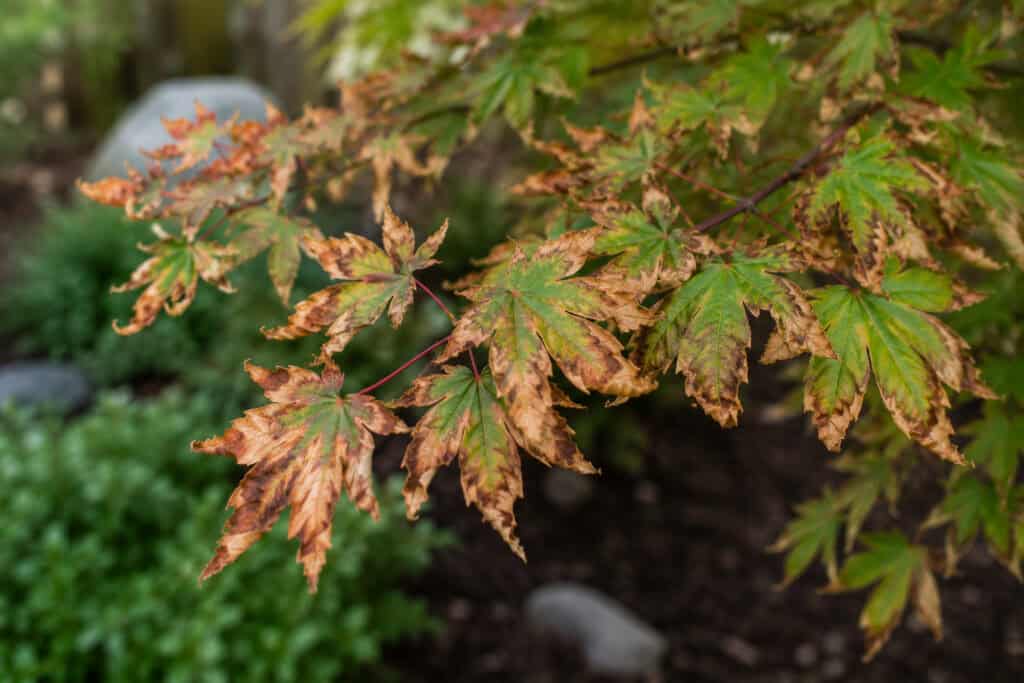
Acer tree leaves turning brown is most commonly caused by leaf scorch, a moisture imbalance where water evaporates from the foliage faster than the roots can supply it.
Acer tree leaves scorched at the tips and margins usually point to drought, hot sun, or drying wind.
Acer tree bark peeling alongside brown foliage can indicate sun damage to the trunk, a fungal canker, or natural shedding in certain species.
Acer tree sun damage affects both the leaf surface and, on young or recently transplanted trees, the trunk bark itself, and if curling leaves are your main concern rather than browning, our separate guide to why acer leaves curl covers that pattern in detail.
If you walked out to your Japanese maple one morning and found the foliage looking as if someone had held a lighter to the edges, you are in very familiar territory.
Most acer owners see this for the first time and assume the worst.
The damage looks serious, especially on varieties grown for their delicate, decorative foliage. In most cases it is neither a disease nor a sign that the tree is failing.
Brown leaves on an acer can come from several different causes, and the fix for each one is different.
This article covers the full picture: leaf scorch, sun damage, bark peeling, and the cases where browning signals something more serious than a dry week.
Some causes clear up on their own once the weather changes. Others need you to act within days, not weeks. Telling them apart is where we will spend the most time.
What Acer Leaf Browning Actually Means
Brown leaf tissue on an acer is dead or dying tissue. Once a section of leaf turns fully brown and crispy, it will not turn green again.
The colour change happens because the leaf cells have dried out and collapsed, and that specific tissue cannot recover.
What matters most is not the colour itself but the pattern of where the browning appears.
The pattern tells you far more about the cause than the colour does, and it determines which action you should take first.
Scorch tends to appear at the tips and margins of leaves first, working inward, and it affects the canopy fairly evenly because it is driven by weather from the outside.
Disease tends to be patchy, hitting one branch or one side of the tree while the rest looks normal.
This is because disease follows the tree’s water-conducting tissue rather than responding to weather evenly across the whole canopy.
Reading the pattern before you do anything else will save you time and prevent the very common mistake of treating the wrong problem.
Acer Tree Leaves Scorched: The Most Common Cause
Acer tree leaves scorched at the tips and edges is by far the most frequent complaint from acer growers, and it is almost always a moisture imbalance rather than a disease.
Leaf scorch happens when a leaf loses water through its surface faster than the roots can pull replacement water up from the soil.
It is not caused by a pest and it is not a fungal infection. It is a straightforward supply-and-demand problem, and it is the most common reason acer leaves turn brown.
Japanese maples (Acer palmatum) are particularly vulnerable because their thin, finely cut foliage has a large surface area relative to its thickness.
That same quality that makes the leaves so beautiful makes them efficient at losing water.
A few hours of hot, dry wind on an exposed afternoon can cause more damage than a full week of ordinary summer heat in a sheltered position.
The triggers for scorch rarely act alone. A hot afternoon on its own may not cause visible damage.
A hot afternoon combined with a dry breeze and a pot that dried out overnight almost certainly will.
This stacking of conditions is why the same tree can look fine for years and then scorch badly during one particular season.
Scorch damage is permanent on the leaves it affects, but it is almost never permanent for the tree.
The crispy leaves will not recover, but new growth the following spring is usually completely normal once the underlying cause is addressed.
Many acer owners remove a scorched tree believing it to be dying when it would have leafed out perfectly fine the following year; our guide to spotting a genuinely dying acer covers the signs that actually warrant concern.
| Tip: Browning at the tips and outer margins, concentrated on the side of the canopy facing afternoon sun or the prevailing wind, points to scorch from heat, wind, or drought. Browning limited to one branch or one side of the canopy, especially when leaves are wilting before they turn brown, points toward a vascular problem worth investigating further before changing any care routine. |
Why Acer Tree Leaves Turn Brown: The Main Causes
Several different problems produce brown leaves on an acer, and they do not all get fixed the same way. The table below separates the main causes by their browning pattern, trigger, and realistic fix.
| Cause | Typical Pattern | Common Trigger | Realistic Fix |
| Drought scorch | Tips and margins brown across most leaves; soil dry at depth | Underwatering during hot or windy spells | Deep, slow watering and a mulch layer to hold moisture |
| Wind scorch | Browning on the windward side of the canopy first | Exposed planting position; drying breezes | Add a windbreak or relocate before the next growing season |
| Sun scorch | Browning on leaves facing direct afternoon sun | Full sun exposure, especially in summer | Provide afternoon shade or relocate to a more sheltered spot |
| Frost damage | New spring growth blackens or browns after a cold night | Late frost on tender new leaves | Wait for recovery growth; avoid feeding heavily immediately |
| Verticillium wilt | One branch or side wilts and browns while the rest looks healthy | Soil-borne fungus, often after root disturbance or stress | Prune affected wood, improve drainage, monitor the rest of the tree closely |
| Root rot or waterlogging | Leaves curl, brown; tree shows little new growth | Compacted soil, waterlogging, or wrong compost type | Improve drainage, reduce watering, check soil pH matches acer needs |
Acer Tree Sun Damage: How to Identify It
Acer tree sun damage affects both the foliage and, on young or recently transplanted trees, the bark itself. The two forms look different and call for different responses.
On the leaves, sun damage looks very similar to drought scorch because the two usually happen together.
Direct afternoon sun increases the rate at which leaves lose water, pushing the tree past its tolerance on days when the root zone is already dry.
The browning tends to be concentrated on the side of the canopy facing the sun, on the outer edges of leaves rather than along the veins or in the centre of the blade, a pattern worth comparing against your tree’s light requirements to check whether its current position is appropriate.
On the trunk and branches, sun damage takes a different form.
Young acers with thin bark are vulnerable to sunscald, a process where bark on the south or south-west facing side heats up significantly on a sunny winter day and then refreezes overnight.
The cells underneath die, and the bark over that area eventually cracks and peels away the following season.
This is one reason bark peeling and leaf browning sometimes appear together on the same tree.
The most important thing to understand about sun damage on acers is that the positioning fix works in both directions.
A tree moved too abruptly from shade into more sun will scorch the leaves it grew under lower light conditions because those leaves were built for a different environment.
Always move acers gradually when repositioning into a sunnier spot.
Morning sun and afternoon shade is the combination most acers do best with.
This gives the tree enough light for healthy growth while avoiding the intense heat load of midday and afternoon sun in summer.
| Tip: If you need to move an acer into a sunnier spot, do it gradually. Move the pot into slightly more light for a few hours each day over one to two weeks before leaving it in its final position permanently. Trees moved abruptly into a technically correct but sunnier position very often scorch within days because the existing leaves were formed under lower light and cannot adjust instantly. |
Acer Tree Bark Peeling: What It Means and When to Worry
Acer tree bark peeling often alarms owners who have not seen it before, but in several species it is entirely normal and forms part of the tree’s ornamental appeal.
Bark is made up of layers. Only the innermost layer, the cambium, is alive. Everything outside it is dead tissue that cannot stretch as the trunk grows wider each year.
As the trunk expands, the outer dead layer has nowhere to go, so it lifts, cracks, and eventually peels away.
For most trees this process goes unnoticed because the pieces are small. A handful of maple species shed bark in large, visible curls or sheets.
Acer griseum, the paperbark maple, is the most well-known example.
Its cinnamon-coloured outer bark peels in papery curls that often stay attached to the trunk rather than dropping off, and this is considered one of its main ornamental features through the winter months.
If your tree is not one of the species known for exfoliating bark, or if peeling is concentrated on one side of the trunk, sudden in its appearance, or accompanied by wilting or dying foliage, the cause is more likely to be sunscald, mechanical damage, or a fungal canker.
Normal Acer Bark Peeling vs Problem Peeling
The most reliable way to tell the difference between normal bark shedding and a problem is to look at what is underneath the bark that has come away.
Two trunks can look almost identical from a distance and have completely different stories underneath the peel.
Normal peeling reveals smooth, evenly coloured, dry-to-slightly-damp wood underneath. On Acer griseum this is typically a warm orange or cinnamon tone.
There is no smell, no softness, and no sign of insect activity in the exposed area. Normal peeling develops gradually over months and tends to be fairly even across the trunk and older branches.
Problem peeling exposes wood that is dark, wet, discoloured, or soft, and may carry a sour smell.
You may also see fine white or grey threads, which are fungal mycelium, or small holes that look as if they were drilled by insects rather than created by natural growth.
The pattern around the trunk matters too. Natural exfoliation is distributed fairly evenly across the trunk and older limbs.
Bark loss concentrated on one side, near the base, or along a vertical split suggests a specific localised cause worth investigating.
Common Causes of Abnormal Bark Peeling on Acers
When bark peeling is not the natural exfoliation habit of the species, a small number of causes account for most cases.
Sunscald and bark splitting happen when bark on the south or south-west side of a young tree heats up during a sunny winter day and then refreezes overnight, a process the University of Minnesota Extension explains in more depth, since it affects a wide range of thin-barked young trees rather than acers alone.
The affected cells die, and the bark over that area eventually peels the following season.
This is far more common on recently transplanted acers than on established ones, because the trunk has not yet developed the thicker bark that comes with age and the canopy does not yet provide enough shade to protect the trunk, which is one reason our guide to planting a Japanese maple tree recommends easing young trees into their final position gradually.
Mechanical damage from tree ties, stakes, string trimmers, or mower decks causes a surprising amount of bark loss on younger trees.
Damage often starts as a small wound at the base and widens over a season or two as the injured area dries and the surrounding bark lifts.
If peeling is concentrated in a band near the base of the trunk, check for tight ties or strimmer marks before assuming disease.
Fungal and bacterial cankers cause localised dead patches that eventually sink, split, and peel. The bark over a canker becomes sunken and discoloured and may ooze sap.
Verticillium wilt, which also causes one-sided leaf dieback, can produce bark splitting on branches as part of the same infection.
Frost cracks are vertical splits that open during a rapid temperature drop on a cold, clear night following a mild day.
The crack may close again as temperatures rise, but the bark along the edges often dies and peels back over the following weeks.
| Problem | Likely Cause | How to Confirm | Solution |
| Even peeling on trunk, smooth wood beneath | Natural exfoliation in species like Acer griseum | Check species; look for uniform warm colour underneath | No action needed; photograph and monitor seasonally |
| One-sided peeling on south-facing trunk | Sunscald from winter sun and frost cycling | Pattern faces south or south-west; more common on young trees | Wrap trunk lightly in winter for first few years; remove wrap in spring |
| Peeling near base, ties or stakes present | Mechanical damage from ties, stakes, or strimmer | Inspect base for tight ties or rub marks | Loosen or remove ties; allow wound to dry naturally without sealing |
| Sunken discoloured patch with peeling edges | Fungal or bacterial canker | Sunken bark; possible sap ooze from affected area | Arborist assessment; clean tools between cuts; do not seal the wound |
| Vertical split with peeling along edges | Frost crack from rapid temperature drop | Straight vertical line, often on the trunk’s cold side | Allow natural callusing; avoid wrapping tightly; monitor for spread |
| Peeling plus uneven canopy wilting | Possible verticillium wilt | One-sided dieback in canopy above the affected bark area | Arborist assessment; bark scratch test on the affected branch |
| Tip: The Scratch Test for Living Tissue Use a clean pocket knife or fingernail to gently scratch a small, inconspicuous area of bark near the peeling section. If you see green or pale green tissue just under the surface, that part of the tree is alive. Brown, dry tissue at the same point suggests that section has died back and points toward a problem rather than normal shedding. This test works on both trunk bark and smaller twigs when diagnosing a browning or wilting branch. |
| Warning Two pieces of advice come up repeatedly and consistently make things worse. Removing scorched leaves forces the tree to spend stored energy producing replacement growth during summer, and those new leaves often scorch again under the same conditions. Applying wound paint or tar to peeling bark traps moisture against the wood rather than letting it dry, creating exactly the damp conditions that fungal pathogens prefer. The tree’s own callus tissue, formed gradually around the wound edge, is a far better seal than anything applied from a tin. |
How to Diagnose Brown Leaves on Your Acer
Working through the following steps in order will resolve most cases of acer leaf browning before any treatment is needed. Most cases resolve at step two or three.
Step 1: Check the pattern across the whole canopy
Walk around the tree and look at whether browning is spread evenly across most leaves or concentrated on one branch or one side.
Even and widespread points to an environmental cause such as scorch. Patchy and branch-specific points to a vascular issue such as verticillium wilt.
Step 2: Check the soil by touch
Push a finger two to three inches into the soil near the root zone. Dry, crumbly soil points to drought.
Soil that feels saturated, smells sour, or stays waterlogged after rain points to a drainage problem.
Both conditions can produce browning that looks identical on the leaves, which is why this step matters before adjusting watering.
Step 3: Look at the trunk and bark
If you are also seeing bark peeling, note whether it is even across the trunk or concentrated on one side.
Check whether your tree is a species that naturally exfoliates before concluding that peeling is a problem requiring treatment.
Step 4: Look for branch-specific symptoms
If one branch is wilting or dying back while the rest of the canopy looks healthy, take a small twig from the affected area, snap it, and look at the cut end.
Then scrape a small patch of bark on that branch and look for brown or greenish streaking in the wood underneath. That streaking is the key indicator of verticillium wilt.
Step 5: Assess new growth
If new growth at the branch tips still looks healthy and green, the tree is coping with its current conditions.
If new growth is also affected, sparse, or noticeably smaller than usual, the tree is under sustained stress and the underlying cause needs addressing promptly rather than monitored across another full season.
Getting Watering Right After Browning Starts
Once drought stress is identified as the likely cause, the instinct is to water heavily and immediately.
A better approach is a slow, deep soak that lets water penetrate down to where the main root system sits, rather than a quick surface watering that wets the top inch and runs off before reaching the deeper roots.
For trees in the ground, this means watering at the base over fifteen to twenty minutes with a slow trickle, ideally early in the morning so the moisture is available before the heat of the day increases demand on the leaf surface.
For potted acers, water until it runs freely from the drainage holes, then allow the pot to drain fully.
A pot that sits in a saucer of standing water afterward will create the same waterlogging problem you are trying to avoid.
Container-grown acers need checking daily during hot weather because pots can dry out within a single afternoon.
A tree planted in the ground can usually manage longer between checks, but a prolonged dry spell still requires attention before visible browning starts.
Adding a two-inch layer of organic mulch around the base, kept clear of the trunk itself, makes a measurable difference by slowing evaporation from the soil surface.
Soil, Light, and Position: Why the Basics Cause Most Problems
Acers, and Japanese maples in particular, do best in a spot that gets morning sun and afternoon shade, in soil that drains well but does not dry out completely between waterings, a combination set out in detail in our acer tree care guide.
This specific combination addresses both ends of the scorch equation at once.
Morning sun lets the leaves photosynthesise without the intense heat load of midday and afternoon sun.
Reliable moisture in the root zone keeps the supply side of the water balance topped up. Combining both gives the tree the best chance of avoiding scorch even during a warm spell.
Soil that is too heavy and stays waterlogged causes a different but related problem.
Roots sitting in saturated soil cannot take up oxygen properly, and over time they start to die back.
A tree with a damaged root system cannot move water efficiently even when soil moisture looks adequate, so you end up with browning that looks identical to drought stress even though the soil is wet, a confusion also covered from the yellowing angle in our piece on acer leaves turning yellow.
This is the single most common mix-up, and it leads to people watering an already waterlogged tree even more, making things worse.
A small acer planted against a south-facing wall will absorb and radiate heat from that wall well into the evening, effectively extending its exposure to high temperatures beyond what a thermometer reading alone would suggest.
This is one of the most common reasons a tree that should tolerate a sunny spot still scorches badly year after year.
A potted acer on an exposed balcony faces wind from multiple directions and has a much smaller soil volume to buffer against drying out.
Moving the pot to a position sheltered by a wall or fence on the windward side, even just for the hottest part of summer, often resolves recurring scorch without any other changes to the care routine.
Preventing Brown Leaves on Acers Before They Appear
Prevention is far more effective than treatment because, once leaf tissue dies, it stays dead for the season. A few adjustments made before the hottest weather arrives reduce the risk significantly.
Choose a position with morning sun and afternoon shade rather than full all-day exposure.
Group containers together or place them where a fence, hedge, or wall breaks the prevailing wind without fully blocking airflow.
Check container-grown acers daily during hot weather, since pots can dry out within hours when temperatures are high.
Water deeply and early in the morning during dry spells rather than frequently and lightly.
Frequent light watering wets only the soil surface and does very little for the deeper root zone where most uptake happens.
Avoid repotting or transplanting immediately before a forecast heatwave, since disturbed roots cannot keep pace with the demand placed on them by a full, intact canopy in hot conditions.
For newly transplanted acers, a temporary shade cloth on the most exposed side during the first summer reduces the risk of both leaf scorch and trunk sunscald while the root system establishes.
Recovery Timelines: What to Realistically Expect
How quickly an acer recovers from browning depends almost entirely on the cause. The ranges below reflect typical outcomes rather than best-case estimates.
A tree recovering from a single dry spell behaves very differently from one recovering from a fungal infection.
| Cause | Existing Brown Leaves | New Growth Recovery | Notes |
| Drought or sun scorch | Will not recover; may drop early | Next spring’s growth usually normal | Address cause promptly to limit further damage this season |
| Wind scorch | Will not recover | Improves once shelter is added | May take a full season to see clear improvement |
| Frost damage | Affected leaves drop within days | Second flush within 2 to 4 weeks | Second flush growth is usually unaffected by the original damage |
| Verticillium wilt | Affected branch unlikely to recover | Variable; tree may persist for years or decline | Outcome depends on infection extent and overall tree vigour |
| Root rot from waterlogging | Continues worsening until drainage improves | Slow; often a full season or more | Severe cases may not recover even with intervention |
Troubleshooting Summary
| Problem | Likely Cause | How to Confirm | Solution |
| Even browning across canopy | Drought or sun scorch | Soil dry several inches down; browning on sun-facing side | Deep watering; mulch; consider providing afternoon shade |
| Browning on windward side only | Wind scorch | Site is exposed; browning pattern matches wind direction | Add a windbreak or relocate the tree before next season |
| One branch wilting, rest healthy | Verticillium wilt | Streaking visible under bark on the affected branch | Prune affected wood; sterilise tools; monitor closely |
| New growth blackens after cold night | Frost damage | Damage appears only on recent growth after a cold spell | Allow recovery growth; avoid heavy feeding immediately |
| Leaves curl and brown, soil feels wet | Root rot from waterlogging | Soil saturated; roots soft or discoloured when checked | Improve drainage; reduce watering; consider relocating |
| Bark peeling on one side of trunk | Sunscald or mechanical damage | Pattern on south-facing side or concentrated near the base | Address the source of damage; allow wound to callus naturally |
| UK Reader Note In the UK, late spring frosts are a more frequent cause of browning on new acer growth than summer drought, particularly in northern and inland areas where cold nights can persist into May. A sharp frost following a warm spell that has already triggered new growth is one of the most damaging scenarios for Japanese maples. Summer browning in the UK is more often linked to drying wind than to sustained high temperatures. A single exposed position or a gap between buildings that channels wind can cause more scorch than weeks of ordinary summer warmth. |
The RHS provides detailed guidance on acer leaf scorch, and separately on verticillium wilt, including photographs of the streaking pattern described in this guide.
Bare root specimens are typically planted between October and March, giving the root system time to establish before the demands of summer growth begin.
| Warning If roots have turned soft, dark, and mushy with a sour smell, this indicates advanced root rot from prolonged waterlogging. At this stage there is little that can reliably reverse the damage. The most practical action is to remove the tree, improve the drainage of the site significantly, and assess whether the location is genuinely suitable for an acer before replanting. |
Frequently Asked Questions
Will brown leaves on my acer turn green again?
No. Once a section of leaf tissue has fully browned and dried out, that tissue is dead and will not recover its colour.
The leaf may eventually drop on its own or you can leave it in place until autumn.
New growth produced the following spring is typically unaffected if the underlying cause has been addressed in the meantime. The brown leaves themselves are not the problem to fix.
Why are my acer leaves turning brown and crispy in summer?
Brown, crispy leaves in summer are almost always leaf scorch, caused by the leaves losing moisture faster than the roots can replace it.
Heat, direct sun, drying wind, and dry soil all contribute, and they often combine on the same hot day to push a tree past its tolerance.
Checking soil moisture by touch at root depth and looking at the tree’s exposure to afternoon sun and prevailing wind are the first steps toward identifying the main driver for your specific tree.
Can overwatering cause acer leaves to turn brown?
Yes. Waterlogged soil damages roots by depriving them of oxygen, which reduces their ability to take up water even though the soil is saturated.
The leaves then show the same browning and curling as drought scorch despite the soil being wet.
Checking the soil directly by touch rather than relying on the appearance of the leaves is the only reliable way to tell the two situations apart.
How do I know if my acer has verticillium wilt?
The clearest sign is browning or wilting that affects one branch or one side of the tree while the rest of the canopy looks healthy.
The fungus spreads through the tree’s water-conducting tissue rather than affecting the whole plant evenly from the outside.
Scraping a small patch of bark on the affected branch and looking for brown or greenish streaking in the wood underneath can help confirm the diagnosis before any pruning.
What is causing my acer bark to peel?
For species such as Acer griseum, peeling bark is entirely normal and is considered one of the tree’s ornamental features.
For Japanese maples and other non-exfoliating species, peeling more often indicates sunscald on a young trunk, mechanical damage near the base from ties or strimmers, or a fungal canker.
Inspecting the wood underneath the peeled area is the fastest way to tell the difference between natural shedding and a problem that needs attention.
Should I cut off brown leaves on my acer?
In most cases, no. Removing scorched leaves forces the tree to spend stored energy producing replacement growth during summer, and those new leaves often scorch again under the same conditions that damaged the originals.
The tree will naturally shed badly damaged leaves on its own schedule, usually in autumn, without losing additional reserves.
If browning is part of a branch dieback pattern, pruning that branch back to healthy wood is more useful than removing individual leaves one at a time.
Why does my potted acer scorch more than one planted in the ground?
Pots have a much smaller volume of soil around their roots compared to trees planted in the ground, which means that soil heats up and dries out far more quickly during hot weather.
A pot sitting in direct sun can reach soil temperatures well above what the same tree would experience if its roots were insulated by surrounding ground.
This is why potted acers typically need daily watering checks during summer, while established trees in the ground may only need attention during prolonged dry spells.
How do I protect my acer from sun damage?
The most effective protection is choosing the right position from the start, with morning sun and afternoon shade.
For container-grown trees, moving the pot to a more sheltered position during the hottest part of summer is often sufficient.
For young or newly transplanted trees, a temporary shade cloth on the most exposed side during the first summer reduces the risk of both leaf scorch and trunk sunscald while the root system establishes itself.
Is bark peeling a sign that my acer is dying?
Not necessarily. On species like Acer griseum, bark peeling is a normal feature of a healthy tree that continues throughout its life.
On other species, the answer depends on what the exposed wood looks like underneath.
Smooth, evenly coloured wood underneath the peel points to a natural or self-correcting cause.
Dark, wet, or fungus-covered wood alongside canopy symptoms such as wilting or branch dieback is a more serious sign that warrants a professional assessment rather than a DIY treatment.
Do all acer varieties scorch the same amount?
No. Varieties with finely cut, lacy foliage tend to scorch more readily than acers with broader, more leathery leaves because the thinner tissue loses water faster relative to its size.
Some Norway maple cultivars also show better tolerance to certain stresses such as verticillium wilt compared to more susceptible varieties.
If scorch is a recurring problem in an exposed or hot garden position, selecting a more robust cultivar can reduce how often you encounter browning in that spot.
Key TakeawaysCheck soil moisture by touch at root depth before assuming drought is the cause, since waterlogging produces browning that looks identical to drought stress. Look at the browning pattern across the whole canopy first. Even and widespread points to scorch; patchy and branch-specific points to disease. Water acers with a slow, deep soak rather than frequent light watering, and add a two-inch mulch layer to reduce evaporation from the soil surface. Do not remove scorched leaves and do not apply wound sealant to peeling bark. Both actions cause more harm than the original damage. If one branch is wilting while the rest of the tree looks normal, scrape the bark and check for streaking in the wood before pruning. Acers do best with morning sun and afternoon shade, in soil that drains freely but does not dry out completely between waterings. Position potted acers away from exposed, windy spots and direct afternoon sun, particularly during the summer months. Bark peeling on Acer griseum and related species is entirely normal. On Japanese maples and other species, check what is underneath before drawing conclusions. New spring growth the following season is the real indicator of whether the underlying cause has been successfully fixed. Sterilise pruning tools between cuts on any tree showing signs of disease, since unclean tools are one of the most common ways fungal problems spread from branch to branch. |
Bringing It All Together
Coming back to where we started, that first sight of crispy brown leaves or peeling bark on an acer does not have to send you into panic mode.
In most cases the tree is telling you something specific about its water balance, its position, or the conditions it has recently been through. Once you read the pattern correctly, the fix is usually within reach.
The trees that struggle long term are almost always the ones where the underlying cause goes unaddressed rather than the ones that scorched once during a particularly hot or windy week.
A single difficult season followed by healthy new growth the following spring is a far more common outcome than most people expect the first time they notice the damage.
Most of the time, the tree is tougher than it looks.
What’s Next: Check Your Soil and Canopy Today
Take five minutes right now to push a finger into the soil near your acer’s root zone at a depth of two to three inches.
Then take a slow walk around the trunk and note the browning pattern across the canopy and any changes to the bark, referring back to our acer tree care guide if you want a fuller seasonal checklist.
Those two checks together will tell you more about which direction to take next than almost anything else in this article.
Mariel is a plant enthusiast and writer based in the UK with a passion for houseplants and indoor growing.
She has spent the last few years building an ever-growing collection of indoor plants and learning the hard way which ones will survive her busy schedule.
At Bean Growing she writes about houseplant care, common plant problems, and outdoor gardening.