
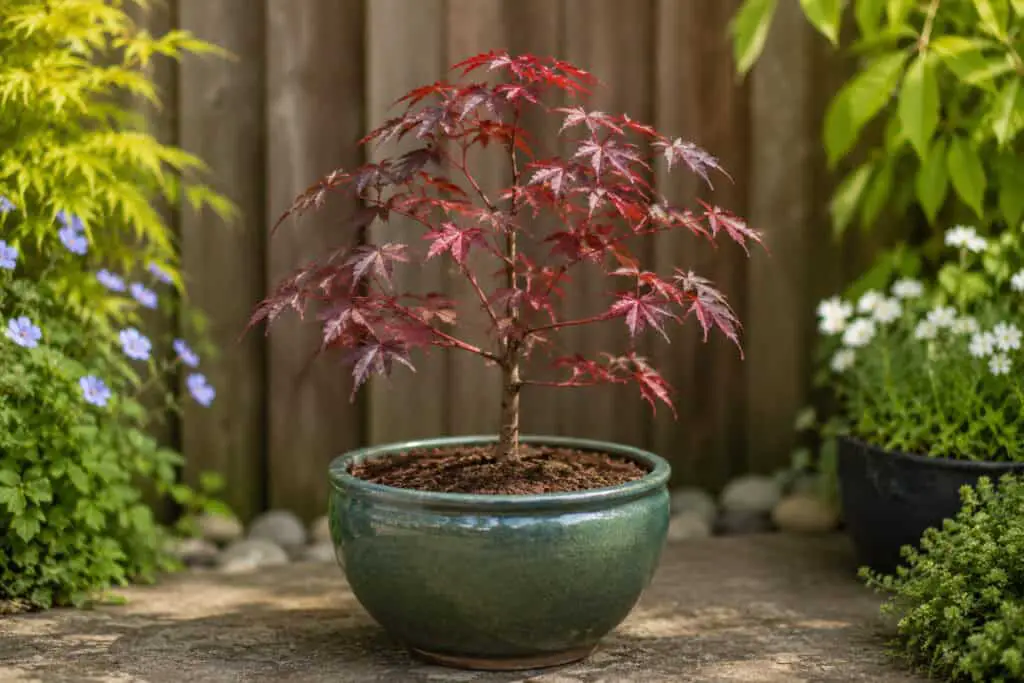
An Acer tree not growing is one of the more confusing problems a gardener can face, because unlike browning or dropping leaves, a lack of growth often comes with no dramatic symptoms at all.
The tree simply sits there, season after season, the same height it was last year, while everything else in the garden pushes on.
The good news is that a stalled Acer is very rarely a dying Acer. Acers, whether a Japanese maple (Acer palmatum), a red maple (Acer rubrum), or one of the hundreds of other Acer species and cultivars, are naturally unhurried trees.
Many varieties are bred specifically to stay small and grow slowly, so the first and most important question to answer is whether the tree is actually unwell, or whether it is simply behaving exactly as its genetics intend.
But genuine growth problems do happen, and they are almost always traceable to one of a small number of underlying causes: poor roots, the wrong soil, watering extremes, nutrient or pH problems, an unsuitable position, or a tree still recovering from being planted or moved.
This guide covers every common reason an Acer tree is not growing, including why is my Acer tree not growing at all, what genuine acer tree stunted growth looks like versus normal acer tree slow growing habits, and what to do about each cause.
Each section explains the mechanism behind the problem, how to recognise it, and a clear, step-by-step fix. For a broader overview of day-to-day care, see our full Acer tree care guide.
Why Trust This GuideThis article draws on established horticultural guidance, including the RHS Growing Guide for Japanese Maples, and reflects the practical experience of diagnosing slow or stalled growth in Acer trees across both garden and container settings. Every fix has been cross-referenced against known cultivar behaviour so you are not treating a healthy slow-growing tree as if it were unwell. |
Quick Diagnosis: Identify Your Growth Problem
Use this table to narrow down the likely cause before reading the full explanations below.
| What You Are Seeing | Most Likely Cause | Primary Fix | Urgency |
| No growth at all in the first year after planting | Transplant shock or root disturbance | Consistent watering and mulch; wait | Low |
| Tiny new leaves, short shoots, same size for 2+ years | Naturally slow cultivar, or root restriction | Check container and roots | Medium |
| Pale, small leaves; no extension growth despite watering | Nutrient deficiency or poor soil fertility | Test soil and feed correctly | Medium |
| Wilting, yellowing, no growth despite regular watering | Waterlogged or compacted roots | Check drainage urgently | High |
| No growth; soil very dry between waterings | Drought stress or insufficient watering | Increase watering depth | Medium |
| Roots visible at drainage holes; no growth | Root-bound container | Repot promptly | Medium |
| Yellow leaves with green veins; stunted overall | Iron deficiency or high soil pH | Test pH; apply chelated iron | Medium |
| One side growing; other stalled or dying back | Root damage or Verticillium wilt | Inspect roots and stems | High |
| Graft union buried; tree never thrived | Planting depth error | Lift and replant correctly | Medium |
| Branches feel dry; little regrowth after winter | Winter dieback or frost damage to buds | Scratch test; fleece young trees | Medium |
| Tree is a known dwarf or slow cultivar | Completely normal growth habit | No fix needed | None |
Understanding How Fast an Acer Tree Should Actually Grow
Before troubleshooting, it helps to know what normal growth looks like, because this is where a great many unnecessary worries begin.
The genus Acer contains well over 100 species and many hundreds of cultivars, and their natural growth rates vary enormously.
According to the RHS Japanese Maple growing guide, most Japanese maples are slow-growing trees that can take 50 years to reach their full height, and many named cultivars grow far more slowly than the species itself.
A vigorous species like Acer rubrum (red maple) or Acer platanoides (Norway maple) can put on 30 to 60 centimetres or more of new growth a year once established.
A typical Acer palmatum, by contrast, is a slow to moderate grower even under ideal conditions, often adding only 15 to 30 centimetres a year, and many dwarf and dissectum cultivars manage only a few centimetres annually even when perfectly healthy.
An Acer palmatum ‘Little Princess’ that has grown 5 centimetres in a year is not stunted; it is doing exactly what it was bred to do.
A vigorous species maple making the same 5 centimetres of growth in a year, on the other hand, is very likely showing a genuine problem.
Acers also grow in a distinct seasonal rhythm. Almost all of a deciduous Acer’s annual extension growth happens in a short window in spring and early summer, after which the tree shifts into a maintenance phase.
A tree that appears to have stopped growing in July is very often simply finished for the season, not unwell.
Why Is My Acer Tree Not Growing? Setting a Baseline
To answer why is my Acer tree not growing in your specific case, first establish three things: which species or cultivar you have, how old the tree is, and whether the lack of growth is genuinely abnormal for that variety or simply consistent with its known habit.
If you bought the tree as a named cultivar, a quick check of the typical annual growth rate for that specific cultivar against what your tree is actually doing will tell you within minutes whether you are dealing with a real problem.
If unsure of the variety, look at vigour signals: are the buds swelling normally in spring, are the leaves a healthy colour, and is the bark firm and pliable rather than dry and brittle?
A tree that is healthy in every other respect but simply slow is very unlikely to need intervention.
A tree that is pale or showing yellowing leaves alongside the lack of growth needs a cause identified and corrected.
Cause 1: Transplant Shock After Planting or Moving
Why Newly Planted Acers Often Appear Not to Grow
Transplant shock is the single most common explanation for an Acer tree not growing in its first one to two years in a new position.
When an Acer is planted, a significant proportion of its fine root hairs are damaged or lost in the process, regardless of how carefully the tree is handled.
The tree responds by directing almost all of its available energy into rebuilding this root system before investing anything in above-ground growth.
Visible top growth, new shoots, and height gain can be minimal or completely absent for the first full growing season, and sometimes for two seasons in a larger specimen.
A small, young Acer in a 2 to 3 litre pot may establish and resume visible growth within a single season.
A semi-mature tree moved as a root ball may show little or no top growth for two to three years while its root system catches up.
How to Support an Acer Through Transplant Shock
The most important action is consistent, correctly applied watering during the whole establishment period.
Water deeply once or twice a week during the growing season, soaking the root zone thoroughly rather than lightly sprinkling the surface, and continue through the first two full growing seasons even if the tree appears to be coping well.
Apply a generous mulch layer, 7 to 10 centimetres of well-rotted bark, compost, or leaf mould, over the root zone, keeping it clear of the trunk itself.
This conserves soil moisture, moderates temperature, and reduces competition from weeds and grass.
Avoid feeding a newly planted Acer with fast-acting, high-nitrogen fertiliser. This will not speed up root establishment and can in fact cause additional stress.
A light application of a slow-release, balanced fertiliser the following spring is more appropriate.
Avoid pruning a newly planted tree beyond removing damaged growth. Pruning removes stored energy reserves at a time when the tree needs every resource directed at root recovery.
Patience Is the Correct TreatmentA newly planted Acer that produces no visible growth in its first year is behaving completely normally. Resist the temptation to feed it heavily, prune it, or move it again. Consistent watering and mulching, combined with time, resolves the great majority of transplant-related growth stalls. |
Cause 2: Poor Soil Structure, Fertility, and Compaction
How Soil Quality Limits Acer Growth
Acer roots are naturally fine and fibrous, and they grow best through loose, well-structured soil rich in organic matter, similar to the woodland floor conditions most Acer species evolved in.
When the soil is heavy clay, compacted, or depleted of organic matter, root growth is physically restricted, and this directly limits above-ground growth.
Compacted soil also holds less oxygen in the pore spaces. In severely compacted ground, root growth can effectively stop even when water and nutrients are technically present, because the roots cannot physically penetrate it or breathe within it.
Signs that soil quality is limiting growth include a tree that has been in the ground for several years without any meaningful size increase, soil that is hard to dig even when not visibly dry, and pale or small leaves despite adequate watering.
How to Improve Soil Conditions for Acer Growth
Top-dressing the soil annually with 5 to 7 centimetres of well-rotted compost, leaf mould, or composted bark, spread over the root zone and gently worked into the top few centimetres, will progressively improve both structure and fertility over two to three seasons.
For compacted ground, avoid digging close to the trunk where major roots are likely to be, but loosening the soil surface around the wider root zone with a fork can relieve surface compaction.
Avoid walking on or driving over the root zone, as this is one of the most common causes of progressive soil compaction.
For severely compacted or poor soils where an Acer has been consistently stunted, the most effective long-term fix is often to lift the tree (during dormancy only) and fully prepare a new planting hole with generous organic matter incorporated through the surrounding soil.
Cause 3: Root-Bound or Restricted Roots in Containers
Acer Tree Stunted Growth From Container Restriction
Acer tree stunted growth in a pot is one of the most common and most fixable causes of a tree that has simply stopped getting any bigger.
Once the roots have filled a container and begun circling inside, the tree has no further capacity for root expansion, and growth above ground stalls correspondingly.
For a complete guide to container growing, see growing an Acer tree in a pot.
A root-bound Acer typically shows several recognisable signs together: the tree dries out very quickly after watering, sometimes within a day or two; the leaves may be smaller and slightly pale; and growth that was previously steady slows dramatically or stops over one or two seasons.
Left unaddressed for long enough, circling roots can eventually begin to constrict each other or even the base of the trunk itself, a condition known as girdling, which can cause permanent stunting or dieback even after the tree is moved to a larger container.
How to Fix a Root-Bound Acer
Repot into a container at least one, and ideally two, sizes larger than the current pot, choosing a free-draining compost appropriate to the species.
When repotting, gently tease apart any circling roots at the outer edge of the root ball and cut through any roots that are visibly constricting the trunk base.
The best time to repot is during dormancy, in early spring before bud break or in early autumn after leaf drop.
If the tree has reached the largest practical container size and continues to show signs of restriction, root pruning during dormancy, removing up to a quarter of the root mass from the outer edge and base of the root ball before returning the tree to the same pot with fresh compost, can provide several more years of healthy growth.
Cause 4: Watering Problems: Too Little or Too Much
Underwatering and Acer Tree Slow Growing Patterns
Acer tree slow growing as a result of underwatering is extremely common, particularly in free-draining sandy soils, in containers, and during hot, dry summers.
When an Acer does not receive enough water, it conserves energy and minimises new growth rather than producing leaves and shoots it cannot adequately support.
If your tree is also showing leaves curling inwards, underwatering is a very likely culprit.
The fix is straightforward: water deeply, to a depth of 30 centimetres or more at the root zone, once or twice a week during the growing season in dry conditions, rather than little and often.
Checking soil moisture at a depth of 5 to 8 centimetres before watering is the most reliable way to judge whether the tree actually needs water.
Overwatering and Waterlogged Roots
Overwatering causes a different but equally significant restriction on growth. Acer roots need oxygen, and in waterlogged soil the air spaces fill with water, effectively suffocating the root system.
Roots in these conditions cannot absorb nutrients efficiently and will in persistent waterlogging begin to rot.
An overwatered Acer often shows yellowing leaves and a general absence of new growth despite consistently wet soil.
This pattern is frequently mistaken for underwatering, leading to even more watering and a worsening cycle.
If the soil is consistently wet to the touch, or water visibly pools after rain or watering, suspect waterlogging rather than drought.
Reduce watering frequency, improve drainage, and check that container drainage holes are not blocked.
Cause 5: Nutrient Deficiency and Poor Soil Fertility
How a Lack of Nutrients Stops New Growth
New growth is built largely from nitrogen, phosphorus, potassium, and a range of micronutrients drawn from the soil.
When any of these are in short supply, the tree simply does not have the raw materials to build new tissue, regardless of how much water or light it receives.
Nitrogen deficiency in particular has a very direct relationship with growth rate.
A nitrogen-deficient Acer typically shows pale green to yellow older leaves, smaller than normal new leaves, and a marked slowdown or complete halt in extension growth, even in an otherwise well-watered, well-positioned tree.
Soil that has never been fed, soil in a container that has not been repotted or top-dressed in several years, and soil that has been heavily leached by frequent watering, are all common situations in which nutrient deficiency limits Acer growth.
How to Correct Nutrient Deficiency in Acer Trees
A slow-release, balanced fertiliser formulated for trees and shrubs, or one specifically designed for acid-loving plants for most Japanese maple cultivars, applied once in early spring as the buds begin to swell, is sufficient for the great majority of Acer trees in reasonable soil.
Avoid high-nitrogen lawn fertilisers, which can produce a burst of soft, weak growth more vulnerable to frost, wind, and disease, rather than the steady, well-structured growth a balanced feed encourages.
Annual mulching with well-rotted compost or leaf mould is often sufficient on its own to maintain adequate fertility in garden-grown Acers, reducing or removing the need for additional fertiliser altogether.
For container-grown trees, an annual application of slow-release granular fertiliser combined with periodic top-dressing every two to three years prevents the gradual nutrient depletion that container growing makes almost inevitable.
Cause 6: Wrong Light Levels: Too Much Shade or Too Much Sun
Insufficient Light and Stalled Growth
An Acer growing in deep, dense shade, particularly beneath the canopy of larger evergreen trees or close against a north-facing wall, often shows significantly reduced growth, smaller and sparser leaves, and a notably more open, leggy growth habit as the tree stretches toward whatever light is available.
See our detailed guide to Japanese maple light requirements for the full breakdown by cultivar type.
While many Acer species, especially Japanese maples, tolerate and benefit from partial shade, there is a meaningful difference between the dappled light of a woodland edge and the deep, low-light conditions beneath dense evergreen cover.
The latter genuinely limits photosynthesis and, with it, growth.
Excessive Sun and Heat Stress Limiting Growth
At the other extreme, an Acer positioned in full, intense, unshaded sun can also show reduced growth, not from a lack of light but because the tree diverts its energy into managing heat and water stress rather than producing new tissue, and may show leaf scorch and browning alongside the slowed growth.
The correct position varies by species and cultivar, but as a general guide, most Japanese maple cultivars perform best with morning sun and afternoon shade, or dappled shade throughout the day, while many of the larger, more vigorous Acer species tolerate considerably more direct sun.
How to Correct a Light Problem
If shade is limiting growth, consider whether overhanging branches from neighbouring trees can be thinned to admit more light, or whether the tree would be better moved during dormancy to a brighter position.
A gradual increase in light exposure over a season or two, rather than an abrupt move from deep shade to full sun, reduces the risk of leaf scorch during the transition.
If excessive sun and heat are the issue, providing afternoon shade, either by repositioning the tree or using temporary shade cloth during the hottest weeks of summer, allows the tree to redirect energy from stress management back into growth.
Cause 7: Pest and Disease Pressure
How Pests and Disease Suppress Growth
A tree fighting a significant pest infestation or disease is, almost by definition, a tree with reduced resources available for new growth.
Aphids and scale insects feeding on sap directly remove resources the tree would otherwise use for growth, and heavy infestations can measurably slow extension growth over a season.
For a full list of issues to watch for, see common Bloodgood Japanese maple problems.
More seriously, root-feeding pests such as vine weevil larvae, particularly common in container-grown Acers, can cause extensive root damage that directly and severely limits the tree’s ability to take up water and nutrients, producing stalled growth, wilting, and in severe cases tree death, often with very few above-ground symptoms until the damage is advanced.
Verticillium wilt, a soilborne fungal disease, blocks the vascular tissue that transports water and nutrients through the tree, and in its earlier stages can present primarily as poor, uneven growth and general lack of vigour rather than the more dramatic branch dieback seen in advanced cases.
How to Address Pest and Disease-Related Growth Problems
For sap-feeding pests such as aphids and scale, treat with a diluted neem oil or insecticidal soap solution, applied directly to affected growth in the early morning or evening to reduce the risk of leaf scorch from the treatment itself.
For suspected vine weevil damage in a container-grown tree, remove the tree from its pot and inspect the roots and surrounding compost for the characteristic C-shaped, cream-coloured larvae.
Discard affected compost, wash the roots, and repot into fresh compost, treating with a biological nematode drench if the infestation is confirmed.
For suspected Verticillium wilt, prune out any affected branches promptly using clean, sterilised tools, and focus on maximising the tree’s overall health through correct watering, mulching, and feeding. There is no direct cure for the disease itself.
Cause 8: Soil pH and Iron Availability
How the Wrong pH Limits Growth Even in Fertile Soil
Most Acer species, and Japanese maples in particular, prefer slightly acidic soil, generally in the range of pH 5.5 to 6.5.
Outside this range, particularly when soil pH rises above 7.0, several key nutrients, most notably iron, become chemically locked in the soil and unavailable to the tree’s roots, even when those nutrients are physically present.
The resulting iron deficiency, known as iron chlorosis, causes the leaves to develop a distinctive pattern of yellowing between the veins while the veins themselves remain green.
Left uncorrected, this directly suppresses growth, as a tree that cannot effectively photosynthesise has little spare energy to invest in new shoots and leaves.
This problem is particularly common in gardens with naturally chalky or limestone-based soils, in areas where building work has introduced lime into the soil, and in containers planted with standard, non-acidic multipurpose compost.
How to Correct pH-Related Growth Problems
Test the soil pH before taking any corrective action, since several other causes of yellowing and poor growth can look superficially similar to a pH problem. Simple soil pH test kits are inexpensive and widely available.
For container-grown trees, repotting into an ericaceous, acid-formulated compost is the most straightforward and effective solution.
For garden-grown trees in alkaline soil, applying a chelated iron product provides a faster-acting correction, typically showing improvement in leaf colour within two to three weeks of application.
In the longer term, regular mulching with naturally acidifying organic matter such as pine bark or leaf mould, combined where necessary with garden sulphur applied according to label instructions, will gradually lower soil pH and improve nutrient availability on a more permanent basis.
Cause 9: Planting Depth, Graft Unions, and Rootstock Problems
Why Planting Depth Affects Long-Term Growth
Many ornamental Acer cultivars, including the majority of named Japanese maple varieties, are grafted onto a separate rootstock.
The graft union needs to remain above soil level after planting.
If a grafted Acer is planted too deeply, with the graft union buried below the soil surface, growth is frequently poor from the outset, and the union itself becomes vulnerable to rot.
A tree that has never grown well since the day it was planted, regardless of how well it has otherwise been cared for, should always be checked for planting depth as one of the first diagnostic steps.
For a detailed walkthrough of this process, see our guide to how to plant a Japanese maple tree.
How to Correct a Planting Depth Problem
Inspect the base of the trunk at soil level to locate the graft union.
If it is buried, the tree should ideally be lifted during dormancy and replanted at the correct depth, with the graft union sitting 5 to 8 centimetres above the final soil level to allow for some natural settling.
If lifting the tree is not practical, carefully removing excess soil from around the base of the trunk to expose the graft union, without disturbing the surrounding root system any more than necessary, can improve the situation considerably even without a full replant.
Cause 10: Winter Dieback and Frost Damage to Buds
How Cold Damage Suppresses the Following Season’s Growth
Damage to dormant buds over winter, whether from a particularly hard frost, prolonged freezing temperatures, or repeated freeze-thaw cycles, can significantly reduce the following spring’s growth.
This is most likely to affect Acer trees in their first one to two winters after planting, and tender or marginally hardy cultivars grown outside their ideal climate range.
A tree affected this way typically shows patchy, sparse new growth concentrated on the parts of the tree that retained healthy buds, sometimes alongside areas of visible dieback.
If you can see sections of stem turning brown in spring alongside the lack of growth, frost bud damage is a strong candidate.
How to Protect Acer Trees From Winter Bud Damage
For young or newly planted trees in their first two winters, wrapping the main stems loosely with horticultural fleece during the coldest part of winter provides meaningful protection without restricting air circulation excessively.
Avoid late summer or autumn fertilising, which can encourage a late flush of soft growth that has not hardened sufficiently before the first frosts arrive.
For container-grown trees, moving pots into a sheltered position during the coldest weeks of winter reduces the risk of root and bud damage considerably.
All Causes at a Glance: Comparison and Action Summary
| Cause | Key Sign | Primary Fix | Urgency |
| Transplant shock | No growth in year 1-2 after planting; otherwise healthy | Consistent watering and mulch; wait | Low |
| Poor soil / compaction | Hard soil; no size increase over years | Top-dress with compost; relieve compaction | Medium |
| Root-bound container | Rapid drying; dense circling roots | Repot into larger pot; tease out roots | Medium |
| Underwatering | Slow growth; dry soil at depth | Deep, infrequent watering; mulch | Medium |
| Overwatering / waterlogging | Yellowing; consistently wet soil | Reduce watering; improve drainage | High |
| Nutrient deficiency | Pale, small leaves; no extension growth | Balanced slow-release feed; mulch annually | Medium |
| Too much shade | Leggy, sparse, slow growth | Increase light gradually | Medium |
| Too much sun/heat | Slowed growth with scorch | Provide afternoon shade | Medium |
| Pests / disease | Poor vigour; visible pests or staining | Treat pests; prune disease; support health | Medium-High |
| Wrong soil pH | Interveinal yellowing; poor growth | Test pH; chelated iron; ericaceous compost | Medium |
| Graft buried too deep | Never grown well since planting | Lift and replant at correct depth | Medium |
| Winter bud damage | Patchy spring growth; some dieback | Fleece protection; avoid late feeding | Low-Medium |
| Naturally slow/dwarf cultivar | Consistent but small annual growth | No fix needed; manage expectations | None |
Frequently Asked Questions
Why is my Acer tree not growing at all?
The most common reasons are transplant shock in a recently planted or moved tree, root restriction in a container, a watering imbalance in either direction, or nutrient and pH problems in the soil.
Start by checking how long the tree has been in its current position, whether it is in a container or open ground, and whether the soil is consistently wet, dry, or somewhere reasonable in between.
Is it normal for an Acer tree to grow slowly, or is mine stunted?
Many Acer cultivars, particularly Japanese maple varieties and most dwarf forms, are genuinely slow-growing by nature, sometimes adding only a few centimetres a year even in perfect health.
Acer tree slow growing is only a cause for concern when it is paired with other signs of poor health, such as pale leaves, dieback, or wilting.
Note also that a Japanese maple turning an unusual colour can sometimes be related to the same underlying soil or light issues causing slow growth.
How can I tell if my Acer’s stunted growth is permanent?
Genuine, long-term acer tree stunted growth caused by severe root restriction, girdling roots, a buried graft union, or chronic disease can usually be reversed once the underlying cause is corrected, though recovery is often gradual.
Scratch a small area of bark on a stem with your thumbnail: green tissue beneath indicates the branch is alive and capable of recovery, while dry, brown tissue throughout indicates that section is no longer viable.
How long does it take for a newly planted Acer to start growing again?
Most Acer trees show little visible top growth for their first full growing season after planting while the root system re-establishes, and many will produce only modest growth in the second season as well.
By the third growing season, a healthy, well-cared-for tree in suitable conditions should be showing clear, steady annual growth consistent with its variety.
Should I fertilise an Acer tree that is not growing?
Only once you have ruled out watering problems, root restriction, and waterlogging, since fertiliser applied to a tree struggling with one of these issues will not help and can sometimes make matters worse.
If the soil and roots are confirmed to be in reasonable condition, a light application of a slow-release, balanced fertiliser in early spring is appropriate and can support recovery.
Can an Acer tree drop leaves in summer and then fail to regrow properly?
Yes. If your tree dropped leaves in summer and then showed poor regrowth in the following season, this typically points to drought stress, scorch damage to the buds, or a significant pest or disease event during the growing season.
Follow the diagnostic table above and treat the underlying cause before the next growing season begins.
Key Takeaways
- An Acer tree not growing is rarely a sign the tree is dying. Stalled growth is most often explained by transplant shock, root restriction, a watering imbalance, or soil fertility and pH problems, almost all of which are correctable.
- Know your variety before assuming a problem exists. Acer tree slow growing is completely normal for many Japanese maple cultivars and dwarf forms; compare your tree’s growth against its known typical rate before treating it as unwell.
- Newly planted Acers commonly show little growth for one to two seasons. This reflects energy being directed into root recovery rather than a problem requiring intervention.
- Root-bound containers are one of the most common and most fixable causes of stalled growth. Repotting with care taken to release circling roots typically restores normal growth within a season. See: Growing an Acer in a pot
- Genuine acer tree stunted growth from girdling roots, a buried graft union, or chronic disease can often be reversed, but usually requires identifying and correcting the specific underlying mechanical or pathological cause rather than general care adjustments alone.
- Watering errors in either direction, too little or too much, are responsible for a large proportion of growth problems. Deep, infrequent watering and well-draining soil address the great majority of cases.
- Soil pH above 6.5 can stall growth even in fertile soil by locking up iron and other key nutrients; test before assuming a feeding problem.
Final ThoughtsAn Acer tree not growing is, in the great majority of cases, a tree responding sensibly to a specific, identifiable condition rather than a tree in serious trouble. Working through the cause systematically, starting with how long the tree has been in place, what its known variety and typical growth rate actually is, and the condition of its roots and soil, will resolve almost every case. Where a real, correctable problem exists, root restriction, waterlogging, poor soil, pH imbalance, or a planting depth error, addressing that specific cause typically restores normal growth within one to two growing seasons. For further reading, see our related guides: |
Mariel is a plant enthusiast and writer based in the UK with a passion for houseplants and indoor growing.
She has spent the last few years building an ever-growing collection of indoor plants and learning the hard way which ones will survive her busy schedule.
At Bean Growing she writes about houseplant care, common plant problems, and outdoor gardening.