
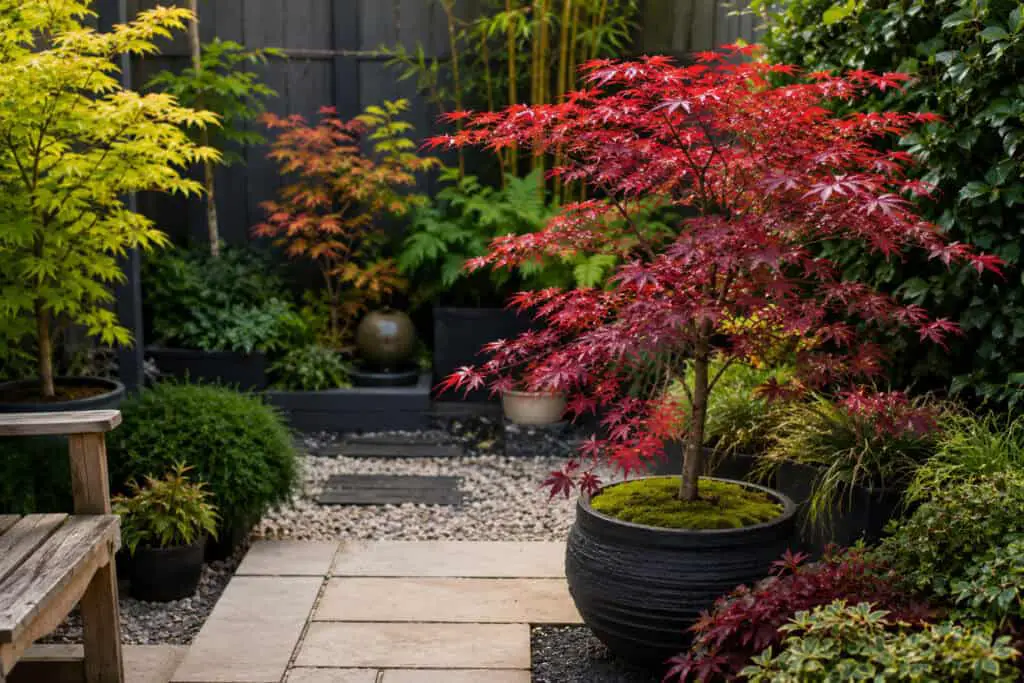
Choosing the right tree for a small garden is one of the most important decisions a gardener can make. Unlike a perennial or a shrub, a tree is a decades-long commitment.
It will define the shape, light levels, and character of the space for years to come.
Acers, commonly known as maples, are consistently among the most recommended trees for UK gardens with limited space. It is easy to see why.
The best acer trees for small gardens combine slow, manageable growth with exceptional multi-season interest.
They offer delicate spring foliage, rich summer colour, a spectacular autumn display, and in some varieties, ornamental winter bark.
The difficulty is that the genus Acer is enormous. It includes towering sycamores and Norway maples that will outgrow a small plot within twenty years.
It also includes compact Japanese maples that may never exceed two metres, even after decades in the ground.
Choosing well means understanding which types of acer trees UK gardeners actually plant in small spaces.
It also means knowing which are better suited to parks, avenues, and large country gardens.
This guide covers the best acer trees UK gardeners can choose for compact plots, courtyards, and containers. It includes small acer trees for small gardens, the main types of acer grown in Britain, and an honest look at which acer trees grow fastest.
It also covers which are genuinely slow enough to suit a modest border.
Whether you are planting your first specimen tree or replacing one that has outgrown its space, our complete acer tree care guide and this guide will help you choose with confidence.
Quick Picks: Best Acer Trees for Small Gardens at a Glance
Use this table to narrow down your shortlist before reading the full variety guide below.
| Variety | Height & Spread (20 years) | Habit | Best For |
| Acer palmatum ‘Bloodgood’ | 3-4m x 3m | Upright, bushy | Sunny borders; reliable purple-red colour |
| Acer palmatum ‘Sango-kaku’ | 4-5m x 4m | Upright, vase-shaped | Winter interest; coral-red bark |
| Acer palmatum var. dissectum ‘Crimson Queen’ | 1.5-2m x 2.5m | Weeping, mounding | Sheltered borders; container or focal point |
| Acer palmatum ‘Katsura’ | 1.5-2m x 1.5m | Compact, rounded | Containers; tiny gardens; patios |
| Acer palmatum ‘Little Princess’ | 1-1.5m x 1m | Dwarf, slow | Pots; rockeries; very small plots |
| Acer shirasawanum ‘Aureum’ | 2m x 2m | Bushy, spreading | Dappled shade; golden foliage |
| Acer griseum | Slow to 8-10m, but only ~3m after 10 years | Upright, oval | Winter bark; long-term specimen |
| Acer campestre ‘Nanum’ | ~3m x 3m (10 years) | Dense, rounded | Native planting; pollution-tolerant screening |
| Acer palmatum ‘Orange Dream’ | 2.5-3m x 2.5m | Compact, rounded | Spring and autumn colour; small specimen |
Types of Acer Trees UK Gardeners Can Choose From
Before picking a specific variety, it helps to understand the broad groups within the Acer genus. They behave very differently in a garden setting.
Japanese Maples (Acer palmatum)
Acer palmatum is the species behind the vast majority of small ornamental acers sold in the UK.
It is responsible for the deeply lobed, finely cut foliage that most people picture when they think of a “Japanese maple.”
The RHS notes that Japanese maples are widely sold as small, slow-growing trees. They rarely exceed one to two metres in height, even after many years.
A minority of older specimens can reach 8m after fifty years. This makes the species, as a whole, one of the safest choices for a small UK garden.
Within Acer palmatum there are hundreds of named cultivars. They range from upright, broad-leafed forms like ‘Bloodgood’ to finely dissected, weeping forms like ‘Crimson Queen’.
The broader, upright palmatums tend to tolerate sun and wind better. The dissectum (weeping, lace-leaf) types are more delicate and need a sheltered spot, and are worth checking against our notes on Japanese maple light requirements before you decide on a planting spot.
Full Moon Maples (Acer japonicum and Acer shirasawanum)
These two closely related species produce a rounder, less deeply cut leaf than Acer palmatum. The shape is often described as “full moon.” They are generally compact, slow-growing, and shrub-like.
This makes them very well suited to small gardens. Acer shirasawanum ‘Aureum’, the golden full moon maple, is the best-known example. It is prized for its glowing yellow-green foliage.
Paperbark and Snake-bark Maples
Acer griseum, the paperbark maple, belongs to a different group of acers. These are grown primarily for ornamental bark rather than leaf shape.
It is genuinely slow-growing. Its eventual height can reach 8-10m, but this typically takes many decades. Most specimens are still well under 3m after a full ten years in the ground.
Its peeling, cinnamon-coloured bark gives it outstanding winter interest. This makes it a popular choice as a single specimen tree, even in fairly compact plots.
The Native Field Maple (Acer campestre)
Acer campestre is the only maple native to Britain. The straight species is a substantial tree, capable of reaching 15-25m. That is far too large for most gardens.
However, the dwarf cultivar ‘Nanum’ (also sold as ‘Compactum’) was specifically developed to bring the toughness and wildlife value of the field maple into smaller spaces.
It reaches only around 3m after ten years. Its crown rarely spreads more than 3m, even at full maturity.
The straight species is also a genuinely valuable wildlife tree: the Woodland Trust notes that field maple supports caterpillars, aphids, and their predators, while tolerating air pollution better than most native trees, which is part of why the compact ‘Nanum’ form is such a useful choice for an urban or roadside-facing small garden.
Larger Acers to Avoid in Small Gardens
It is worth being explicit about which acers are not suitable for a small plot. They are widely available and easy to plant without realising the eventual scale.
Acer pseudoplatanus (sycamore), Acer platanoides (Norway maple), and the standard, ungrafted form of Acer campestre will all comfortably exceed 15-20m at maturity.
They are entirely unsuitable for a garden of typical UK suburban size.
If a label simply says “Acer campestre” or “Acer platanoides” without a named dwarf cultivar, assume it will grow large.
What Makes an Acer “Best” for a Small Garden
A handful of factors separate the acers genuinely suited to compact plots from those that will eventually overwhelm them.
Ultimate height and spread. This is the single most important figure to check before buying. It should always be considered alongside how long the tree takes to reach that size.
A tree that reaches 8m only after fifty years behaves very differently in practice from one that reaches the same height in fifteen.
Growth rate. Most small acer trees for small gardens are naturally slow-growing. This is precisely why they suit confined spaces.
A tree that adds only 15-30cm a year will take decades to outgrow a border. That gives you years of enjoyment before any pruning or removal decision becomes necessary.
Root system. Japanese maples and most ornamental acers have shallow, fibrous, non-invasive root systems.
They rarely cause problems for nearby drains, paving, or foundations, in contrast to larger forest acers and many other tree species.
This makes them a sensible choice for planting close to patios, paths, and boundary walls in a small garden, and puts them firmly on our list of small trees with non-invasive roots.
Season of interest. With limited space for more than one or two trees, it pays to choose a variety with more than one season of appeal.
Sango-kaku combines spring colour, summer green, autumn gold, and winter coral bark. Acer griseum offers autumn colour and year-round peeling bark.
Suitability for containers. Many of the most compact Japanese maples perform just as well in a large pot as in open ground.
This is particularly useful for courtyards, balconies, and front gardens with little or no border space.
The Best Acer Trees for Small Gardens: Full Variety Guide
Acer palmatum ‘Bloodgood’
‘Bloodgood’ is consistently named among the best acer trees for small gardens in the UK.
It is one of the more resilient cultivars available, tolerating full sun better than most other Japanese maples, provided it has consistent moisture.
Its deeply cut, deep purple-red leaves hold their colour through summer rather than fading to green (if yours does start to fade, our guide to why Japanese maples turn green explains the common causes).
They turn a brilliant crimson in autumn. It reaches around 3-4m in height with a similar spread over 15-20 years.
This makes it large enough to act as a genuine specimen tree while remaining entirely manageable in an average garden.
It is also a reasonably tough cultivar, though it is worth knowing the common Bloodgood Japanese maple problems to watch for before you buy.
Acer palmatum ‘Sango-kaku’ (Coral Bark Maple)
‘Sango-kaku’ is the variety most often chosen for year-round interest in a single tree. Spring growth emerges pink, maturing to green through summer.
In autumn it turns soft yellow with orange highlights. At that point the leaves drop to reveal the tree’s real party piece: bright coral-red young stems that glow through the winter months.
It carries the RHS Award of Garden Merit. It grows to an ultimate height and spread of around 4-5m x 4m. Most sources describe it as one of the comparatively quicker-growing Japanese maples while young, an advantage if you want results sooner rather than later.
Acer palmatum var. dissectum ‘Crimson Queen’ and Other Weeping Forms
The lace-leaf, weeping dissectum varieties include ‘Crimson Queen’, ‘Garnet’, and ‘Waterfall’. They form low, mounding shrub-trees with finely dissected, almost feathery foliage.
They typically reach only 1.5-2m in height but can spread up to 2.5-3m, making a wide, cascading dome rather than a tall tree.
This makes them ideal beside a path, water feature, or as a focal point in a border. They are also the most delicate group.
They need genuine shelter from strong wind and intense afternoon sun to avoid leaf scorch.
Acer palmatum ‘Katsura’
‘Katsura’ is one of the smaller and more dwarf-natured Japanese maple cultivars. It is regularly recommended for containers and very small gardens.
Its spring foliage emerges in warm apricot-orange tones, settles to green through summer, and returns to vivid orange in autumn.
At a mature size of roughly 1.5-2m, it is well suited to a large pot on a patio or balcony as much as a small border, and it follows the same principles as any acer grown in a pot.
Acer palmatum ‘Little Princess’
For the smallest acer trees for small gardens, ‘Little Princess’ is among the most compact named cultivars widely available in the UK.
It reaches only around 1-1.5m at maturity. Its green leaves carry attractive red margins in spring, turning yellow and orange in autumn.
Its slow, dense, compact habit makes it particularly well suited to rockeries, pots, and tightly bordered front gardens, where even a modestly sized tree would feel out of proportion.
Acer shirasawanum ‘Aureum’ (Golden Full Moon Maple)
This is one of the best choices for a small garden that wants colour without the deep red or purple shades that dominate so many Japanese maple varieties.
Rounded, buttery-yellow leaves emerge in spring. They mature to bright lime-green through summer, before turning a striking gold with red margins in autumn.
It has a bushy, spreading habit and reaches an estimated 2m x 2m after twenty years.
This makes it genuinely one of the smaller specimen options on this list. It performs best with some dappled shade to protect the foliage from scorch.
Acer griseum (Paperbark Maple)
If winter structure matters as much as summer foliage, Acer griseum is difficult to beat.
Its cinnamon-brown bark peels back in papery curls to reveal bright orange-red wood beneath. This feature becomes more pronounced with age.
It provides a genuine focal point through the leafless winter months, alongside rich red and orange autumn colour.
Its eventual height can reach 8-10m, but its growth is so slow, typically only 15-30cm a year, that most gardeners will never need to worry about it outgrowing a modestly sized plot within their own lifetime.
UK nursery figures put it at only around 3m after ten years. It also tolerates a wider range of soils, including chalk, than most Japanese maples.
Acer campestre ‘Nanum’ (Dwarf Field Maple)
For a small garden that wants a UK native tree with genuine wildlife value, ‘Nanum’ is the standout option among types of acer trees UK growers can choose.
It is a slow-growing, dense, rounded cultivar of the only maple native to Britain. It reaches around 3m after a decade and rarely spreads more than 3m even at full maturity.
Its small flowers support pollinators.
Its dense crown provides shelter for birds. It also tolerates drought, pollution, chalk, and clay alike, making it an unusually low-maintenance and resilient choice for an urban or exposed small garden.
Acer palmatum ‘Orange Dream’
‘Orange Dream’ bridges the gap between the very smallest dwarf cultivars and a genuine specimen tree.
It reaches a manageable 2.5-3m at maturity. Its spring foliage opens bright orange-tinged yellow, matures to lime green through summer, and returns to a rich orange-yellow in autumn.
This gives strong seasonal colour without the tree becoming too large for a courtyard or small border. It also performs well in a large container.
Fast Growing Acer Trees Explained
The phrase “fast growing acer trees” deserves a careful answer. Within this genus, fast growth and small-garden suitability often pull in opposite directions.
Among the true small-garden acers, almost all are properly described as slow to moderate growers. They typically add 15-30cm a year. This is, in fact, the main reason they are recommended for small plots at all.
A tree that grows slowly will take many years to outgrow its space. That gives you time to enjoy it at every stage. Acer griseum and Acer shirasawanum ‘Aureum’ are both genuinely slow.
Dwarf cultivars like ‘Little Princess’ and ‘Katsura’ are bred specifically to stay compact for decades.
Within this group, Acer palmatum ‘Sango-kaku’ is one of the closest things to a quicker-growing option while remaining suitable for a small garden.
Young trees can add up to 30-60cm in a good year before settling to a steadier pace as they mature, although this varies by source and growing conditions.
If genuine speed of growth is the priority, the larger acer species are considerably faster. There is a significant caveat.
Acer campestre (the full-sized field maple, not the ‘Nanum’ cultivar) can put on 30-60cm a year as a young plant.
It is regularly used for hedging for exactly this reason. But the species will ultimately reach 15-25m if left unchecked.
This makes standard field maple an excellent fast-establishing hedge, kept clipped to 1-5m with annual pruning.
It is a poor choice as an unpruned specimen tree in a small garden.
The same caution applies to sycamore and Norway maple. Both are genuinely fast-growing but entirely unsuitable for confined spaces.
The practical takeaway: for a small garden, choose a naturally compact variety from the lists above rather than a fast-growing species you intend to control through pruning.
Most acers resent heavy pruning and “bleed” sap heavily if cut while in growth, so it is worth learning when and how to prune an acer tree correctly before you pick up the secateurs.
Small Acer Trees for Containers and Patios
Several of the varieties above are particularly well suited to long-term container growing. This is useful for paved courtyards, balconies, and front gardens with little or no border soil.
‘Katsura’, ‘Little Princess’, and the dissectum weeping forms are the most consistently recommended for pots.
This is thanks to their naturally compact, slow growth. Grow them in a peat-free ericaceous or John Innes No. 2 compost.
Repot into a slightly larger container every two to three years as growth dictates, gently teasing out any circling roots at the same time.
Container-grown acers need more frequent watering than those in open ground, particularly in summer, since the limited soil volume dries out far more quickly.
Raise the pot on feet to ensure good drainage. Wrap it in fleece or hessian during hard frosts, since the roots are more exposed to cold in a container than they would be in the ground; see our full acer winter care and frost protection guide for more detail on protecting both potted and border-grown trees.
Comparison Table: Best Acer Trees for Small UK Gardens
| Variety | Type | Mature Size | Growth Rate | Best Position | Container Suitable |
| ‘Bloodgood’ | Acer palmatum | 3-4m x 3m | Moderate | Sun to part shade, sheltered | Yes |
| ‘Sango-kaku’ | Acer palmatum | 4-5m x 4m | Moderate, faster when young | Partial shade, sheltered | Yes |
| ‘Crimson Queen’ | Acer palmatum dissectum | 1.5-2m x 2.5m | Slow | Sheltered, partial shade | Yes |
| ‘Katsura’ | Acer palmatum | 1.5-2m x 1.5m | Slow | Sheltered, partial shade | Yes, ideal |
| ‘Little Princess’ | Acer palmatum | 1-1.5m x 1m | Very slow | Sun or partial shade | Yes, ideal |
| ‘Aureum’ | Acer shirasawanum | 2m x 2m | Slow | Dappled shade, sheltered | Yes |
| Acer griseum | Acer griseum | 8-10m eventual; ~3m at 10yrs | Very slow | Full sun to part shade | Less ideal long-term |
| ‘Nanum’ | Acer campestre | ~3m x 3m at 10yrs | Slow | Sun or part shade, tolerant | Possible in a large pot |
| ‘Orange Dream’ | Acer palmatum | 2.5-3m x 2.5m | Slow to moderate | Sun to part shade, sheltered | Yes |
Choosing the Right Position, Soil, and Aftercare
Getting the position and soil right at planting time will do more for the long-term health of an acer than almost any other decision.
Position. Most small Japanese maples, particularly red and purple-leafed cultivars, develop their best colour with some protection from harsh midday and afternoon sun.
An east-facing spot is ideal, or one shaded for part of the day by a wall, fence, or larger plant.
Check our guide to Japanese maple light requirements if you are unsure how much sun your spot receives.
Acer griseum and Acer campestre ‘Nanum’ are more tolerant of full sun. Shelter from strong, drying wind is just as important as shade.
This matters particularly for the dissectum weeping forms and for newly emerged spring growth, which has no frost tolerance and can be damaged by even a light, late frost.
Soil. Most Japanese maples and full moon maples prefer a slightly acidic, moisture-retentive but free-draining soil.
Acer griseum and Acer campestre are more adaptable. They will tolerate chalky or alkaline conditions reasonably well.
Whatever the variety, good drainage matters more than precise pH, since acer roots are intolerant of prolonged waterlogging.
Watering and mulching. Newly planted acers need regular watering through their first two growing seasons while the root system establishes.
After that, most varieties become reasonably self-sufficient outside of prolonged dry spells.
A generous mulch layer of well-rotted bark or leaf mould, kept clear of the trunk itself, will conserve soil moisture and reduce the watering burden significantly.
Persistent scorch or leaf drop despite good watering is usually a position or moisture issue rather than disease; our guide to Japanese maples turning brown runs through the likely causes.
Pruning. Acers bleed sap heavily if pruned in spring while actively growing. Any necessary pruning should be carried out during the dormant season between November and January.
This is generally limited to removing dead, crossing, or damaged branches. For full guidance on timing and technique, see when and how to prune an acer tree.
Planting and Care Calendar for Small Garden Acers in the UK
| Month | Key Tasks |
| November to February | Best time to plant bare-root or container-grown acers, while dormant; avoid pruning until late in this window. See our step-by-step guide to planting a Japanese maple tree for the full process. |
| March | Mulch around the base; do not fertilise yet; watch for late frost as buds begin to swell |
| April to May | New growth is highly frost-sensitive; cover young trees with fleece if frost is forecast; apply a light spring feed if needed |
| June to August | Water deeply during dry spells, especially containers; watch exposed positions for leaf scorch; avoid fertilising after mid-July |
| September | Good time to plant new container-grown trees; repot container specimens if needed |
| October | Apply autumn mulch; enjoy autumn colour; avoid disturbing roots |
| Hard frost periods | Wrap containers in fleece or hessian; move very tender container varieties to a sheltered spot |
| Spotting a Problem? Related Acer Troubleshooting Guides |
Frequently Asked Questions
What is the best acer tree for a small garden in the UK?
There is no single answer, since it depends on the size of the space and the look you want.
Acer palmatum ‘Bloodgood’ is one of the most consistently recommended choices for a small UK garden, thanks to its manageable size, reliable colour, and reasonable tolerance of sun.
For an even smaller plot or a container, ‘Katsura’ or ‘Little Princess’ are better suited.
Which acer trees grow fastest?
Within the small-garden group, Acer palmatum ‘Sango-kaku’ is among the quicker growers while young.
Outside that group, the standard, full-sized Acer campestre (field maple) is genuinely fast-growing and widely used for hedging.
But it will reach 15-25m if left unpruned, so it is not suitable as an unclipped specimen tree in a small garden.
For real speed combined with a manageable final size, no acer can compete with deliberately bred dwarf cultivars.
The trade-off for a small garden is always slow growth in exchange for a tree that stays in proportion.
What is the smallest acer tree you can buy?
Among widely available named cultivars, Acer palmatum ‘Little Princess’ and similar dwarf Japanese maples are among the smallest.
They typically remain at 1-1.5m even at full maturity, making them well suited to pots and very compact plots.
Do acer trees have invasive roots?
No. Ornamental acers, including all the Japanese maple types covered in this guide, have shallow, fibrous root systems.
These are not considered invasive. They rarely cause problems for nearby paving, drains, or foundations, unlike some larger forest tree species.
See our full roundup of small trees with non-invasive roots for other safe options to plant near hard surfaces.
Can acer trees be grown in pots long-term?
Yes. Many of the more compact Japanese maple cultivars thrive in containers for many years, provided they are repotted every two to three years and watered more frequently than they would need in open ground.
Choose a peat-free ericaceous compost and ensure the pot has good drainage.
Our dedicated guide to growing an acer tree in a pot covers container size, compost, and winter protection in more detail.
What is the best position for an acer tree in a small UK garden?
A sheltered spot with some protection from the strongest afternoon sun and from drying wind suits the majority of small Japanese maples, particularly red and purple-leafed cultivars, which colour well even with some shade.
Acer griseum and Acer campestre ‘Nanum’ are both more tolerant of full sun and exposed positions if your garden lacks shelter.
Key Takeaways
Most small acer trees for small gardens are naturally slow-growing, and that is an advantage, not a drawback.
A slow growth rate is precisely why these trees suit confined spaces. It takes decades for a well-chosen acer to outgrow a small border.
The species matters as much as the variety. Acer palmatum, Acer japonicum, and Acer shirasawanum cultivars are almost always small-garden suitable.
Standard Acer campestre, Acer platanoides, and Acer pseudoplatanus are not, regardless of how appealing they look as young plants.
For genuine compactness, look for named dwarf cultivars. ‘Little Princess’, ‘Katsura’, and ‘Nanum’ are bred specifically to remain small, rather than simply being young examples of a larger-growing type.
Fast growing acer trees and small-garden suitability rarely go together. The closest exception within the small-garden group is ‘Sango-kaku’.
True fast growth belongs to species that will eventually outgrow a small plot.
Acer roots are not invasive. This makes these trees a sound choice close to patios, paths, and boundaries, where root damage to hard surfaces would otherwise be a concern.
Position and shelter matter more than soil type for most varieties.
Protection from strong wind and the harshest afternoon sun will do more for a small acer’s health and colour than almost any other single factor.
Final Thoughts
A small garden does not mean settling for a small amount of seasonal interest. Acers prove this better than almost any other tree group available to UK gardeners.
The best acer trees for small gardens deliver spring colour, summer foliage, autumn fire, and in several varieties, genuine winter structure.
All of this comes from a single, slow-growing, well-behaved tree that will never threaten to outgrow its space within a normal gardening lifetime.
The key is matching the variety to the space rather than the space to the variety. A compact courtyard or container suits ‘Katsura’ or ‘Little Princess’.
A border with room for a proper specimen suits ‘Bloodgood’, ‘Sango-kaku’, or Acer griseum. A wildlife-friendly native screen suits ‘Nanum’.
Whichever you choose, the shallow, non-invasive root systems and naturally restrained growth rates of these trees mean one thing.
Once planted in a reasonably sheltered spot with decent drainage, the most demanding part of growing an acer is usually choosing which one to buy and, if it ever does show signs of stress, our guide to diagnosing and reviving a dying acer tree is there to help.
Mariel is a plant enthusiast and writer based in the UK with a passion for houseplants and indoor growing.
She has spent the last few years building an ever-growing collection of indoor plants and learning the hard way which ones will survive her busy schedule.
At Bean Growing she writes about houseplant care, common plant problems, and outdoor gardening.