
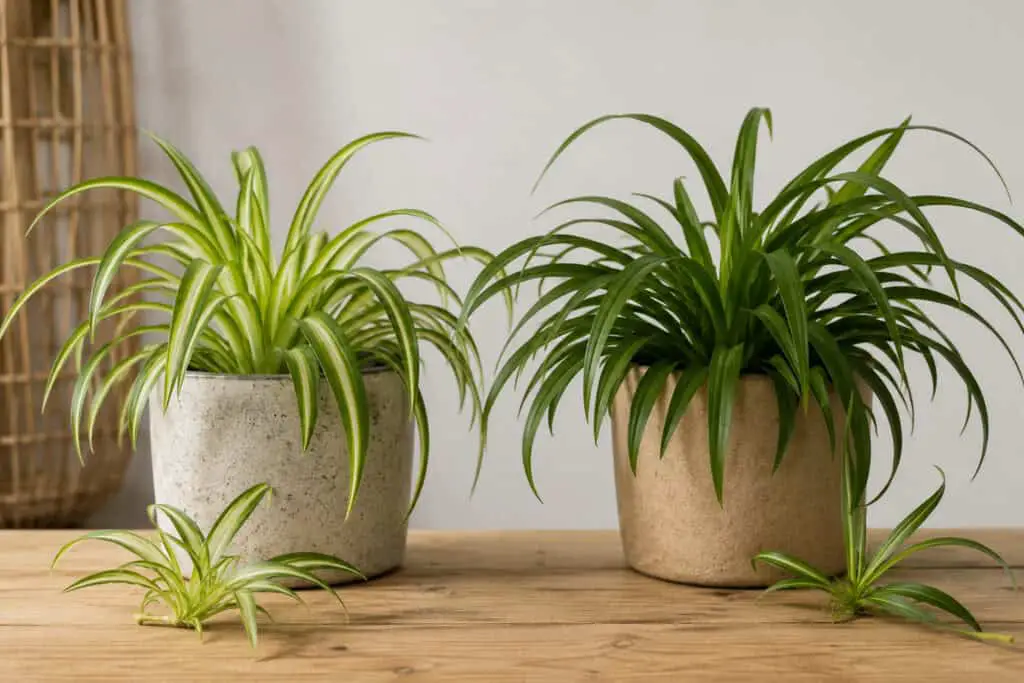
A spider plant (Chlorophytum comosum) loses its variegation and turns all green when it lacks the light needed to support chlorophyll-deficient leaf tissue, or when environmental stress triggers a survival response called reversion.
The primary causes are insufficient light, excess nitrogen fertilizer, overwatering, cold stress, and genetic reversion.
Reverted leaves never regain their stripes once they have fully formed, so the only real fix is to correct the underlying cause and give the plant time to grow new, better leaves.
You brought this plant home specifically for those clean white or cream stripes, set it on a shelf, and somewhere over the following weeks or months, the stripes quietly disappeared.
The new growth came in plain green. The older striped leaves still look fine, but every fresh leaf that unfurls is solid.
It can feel like the plant switched modes on you without warning, and it is one of the most common frustrations with variegated types of spider plants.
Most guides treat this as a one-sentence answer: just add more light. The reality is more nuanced than that. Sometimes light really is the whole story.
Other times you can move the plant six inches closer to a window and still watch it produce solid green leaves for months, because the real issue is in the fertilizer, the soil, the temperature, or the genetics of the plant itself.
This guide works through every genuine cause in detail, explains how to tell them apart in your own home, and sets out what actually works in practice, including the situations where no amount of care will bring the variegation back and what to do instead.
Why Spider Plants Lose Variegation: The Biology First
Understanding what variegation actually is saves a lot of guesswork later.
Variegated spider plants have leaves with sections that contain little or no chlorophyll, which is the green pigment responsible for photosynthesis.
Those white or cream stripes are essentially non-photosynthesizing tissue.
They look beautiful, but from the plant’s own perspective, they contribute nothing to energy production while still requiring structural resources to keep them alive.
This creates a permanent tension inside the plant. The green sections have to work harder to sustain the whole leaf, including the decorative white parts that cannot feed themselves.
When growing conditions are good and light levels are adequate, the plant manages this balancing act without any difficulty at all.
But when conditions deteriorate, whether that means too little light, inconsistent watering, depleted soil, or active stress from pests or temperature swings, the plant responds by shifting its resources toward survival rather than decoration.
That survival response often means producing new leaves with more green tissue.
More chlorophyll means more photosynthesis, and more photosynthesis means more energy available during a difficult period.
Botanists call this process reversion, meaning the plant is returning toward its original, more efficient, all-green form.
The key detail to hold onto is that reversion only ever shows up in new leaves. Existing variegated leaves will not suddenly turn green partway through their life.
This is precisely why the problem often appears gradually rather than all at once.
You keep the striped leaves you already have while every subsequent leaf comes in a little more solid than the last, and the overall effect creeps up on you over the course of a season rather than announcing itself in a single week.
There is also a second, entirely separate cause of variegation loss that has nothing to do with stress at all, and that is genetic drift.
Variegation in spider plants is maintained by something called a chimeric cell structure, which means two genetically distinct types of cells are coexisting side by side in the same leaf tissue.
Over time, and especially during periods of rapid growth, the plain green cells can simply outcompete the variegated ones and take over new growth points without any external trigger whatsoever.
This kind of reversion is irreversible regardless of what changes you make to care, and it is the explanation that most guides either skip entirely or explain so briefly that readers miss it.
When you are trying to diagnose a variegation problem, it helps enormously to ignore the existing striped leaves altogether and focus only on new growth.
If fresh leaves are emerging solid green while older leaves still show their stripes clearly, the problem is active and most likely environmental, which means it can probably still be corrected.
If new growth has always come in green since the day you brought the plant home, you may have purchased a plant that was already in early reversion at the nursery, or you may simply own a naturally green cultivar rather than a variegated one.
The Five Causes of Variegation Loss in Spider Plants
1. Insufficient Light
This is the most common cause by a wide margin, and it operates through fairly straightforward biological logic.
Variegated leaves produce less energy than fully green leaves because a portion of their surface area cannot photosynthesize at all.
To survive in low light, the plant needs every single cell it can get working at full capacity, which pushes it toward producing leaves with less white tissue and more green.
New growth under these conditions is often noticeably darker green and lacks the bright contrast of a healthy variegated leaf.
The stripes become narrower, less clearly defined, or absent entirely as the light deficit continues.
There is a critical distinction here that most articles on this topic miss completely: the difference between fading and going solid green.
Fading happens when the green parts of the leaf look washed out and pale, and the white parts turn a dull, slightly muddy cream rather than a crisp white.
This pattern typically signals too much direct light or overwatering rather than too little light. Going solid green is different again.
It means new leaves are emerging with no white at all, and this pattern points specifically to low light or over-fertilizing.
Confusing these two symptoms leads people to apply exactly the wrong fix, for example moving an overwatered plant into brighter light when what it actually needed was drier soil.
A spider plant sitting more than six to eight feet from a bright window in a typical home interior is almost certainly receiving insufficient light to maintain good variegation.
North-facing rooms, windowless offices lit only by overhead fluorescent tubes, and shelves positioned against interior walls away from any window are the most common culprits people run into.
The plant will generally survive in these spots because spider plants are genuinely tough and can even grow reasonably well in low light, but survival is not the same thing as maintaining variegation, and you will see the stripes fade over successive growth cycles.
What adequate light actually looks like in practice is a spot within three to four feet of a window that receives bright, indirect light for several hours a day.
East-facing windows are ideal in most climates because the morning sun is bright without being harsh enough to scorch the leaves.
South-facing windows also work well provided the plant is set back a little from the glass, or the light is filtered through a sheer curtain, particularly during the stronger sun of summer months.
2. Over-Fertilizing With High-Nitrogen Products
This is the cause that genuinely catches people off guard, and it is significantly underrepresented in most guides written on this topic.
Excess nitrogen pushes a plant into aggressive vegetative growth, meaning it produces a lot of green leaf tissue very quickly.
For a variegated plant, that rapid green-first growth often bypasses the delicate mechanisms that maintain the chimeric cell distribution responsible for the stripes in the first place.
The effect is most noticeable in spring and early summer, which is exactly when people tend to resume fertilizing after a winter break and apply generous doses to encourage strong new growth.
The plant responds precisely as intended, producing plenty of new growth, but the new leaves come in heavily green or completely solid rather than variegated.
The more nitrogen you apply, the more pronounced this effect becomes.
Spider plants are not heavy feeders by nature.
If you are fertilizing your spider plant more than once a month during the growing season, or you are using a high-nitrogen formula where the first number in the NPK ratio is above 10, you are very likely overfeeding the plant.
A balanced, diluted liquid fertilizer applied at half strength every four to six weeks from spring through early autumn is sufficient for most spider plants.
It is worth stopping fertilizer applications entirely once the plant slows down in autumn and winter.
Interestingly, this is the one cause on this list where scaling back tends to produce a noticeably fast improvement.
If you reduce or pause fertilizing and move the plant to better light at the same time, you will often see more clearly defined variegation returning in new growth within four to six weeks, which is a relatively quick turnaround compared to the other causes.
3. Overwatering
Chronic overwatering creates two separate problems that both work against variegation at once.
First, waterlogged soil limits the roots’ ability to take up nutrients efficiently, which effectively produces the same result as genuinely poor soil fertility.
The plant ends up struggling and shifts its growth toward energy-efficient green leaf production as a result.
Second, overly wet conditions place direct stress on the root system and trigger a broader stress response that spreads through the whole plant, not just the roots.
The visual signs of overwatering are distinct from the signs of variegation loss caused by low light, which makes them useful for narrowing down the cause.
An overwatered spider plant will often show pale, slightly translucent leaf colour across both the green and the white sections of the leaf, so the whole leaf looks washed out rather than simply having lost its stripe definition.
If you are seeing this pattern alongside consistently soggy soil, it is worth reviewing the fuller list of spider plant overwatering signs to confirm the diagnosis before you change anything about your routine.
Soil that stays wet for more than a week after watering, or a pot that feels unusually heavy and dense when you lift it, is a fairly reliable indicator of overwatering.
Spider plants have thick, fleshy white roots that are built to store water, which makes them genuinely drought tolerant and unhappy sitting in consistently wet conditions for extended periods.
A good baseline for watering a spider plant is to water thoroughly and then allow the top inch of soil to dry out completely before watering again.
In winter, this often means watering as infrequently as once every two to three weeks in cooler, less sunny homes.
Growing the plant in a mix that does not drain well makes it far harder to get this balance right, so it is also worth checking that you are using the best soil for a spider plant in the first place, since the wrong mix can undermine even a carefully managed watering schedule.
4. Genetic Reversion
This is the cause most guides either skip entirely or explain poorly, and understanding it properly matters because it can save you months of futile care adjustments on a plant that was never going to respond to them.
Some spider plants, particularly those that have been propagated from cuttings or spiderettes over many successive generations, gradually lose the cellular stability that maintains variegation in the first place.
When this happens, new leaves emerge green regardless of how good the light is, how carefully you fertilize, or how well you manage watering.
The plant is not stressed and is not being mistreated. It is simply expressing a genetic shift that cannot be reversed through any adjustment to care.
The most reliable way to identify genetic reversion versus environmental reversion is to improve every relevant condition at once, meaning bright indirect light, appropriate watering, and no excess fertilizer, and then wait six to eight weeks before drawing any conclusions.
If new growth during that window shows even faint streaks or partial variegation, the cause was environmental and you are on the right track toward a full recovery.
If new growth remains completely solid green despite genuinely improved conditions, the reversion is almost certainly genetic and further adjustments to care are unlikely to help.
One subtlety worth knowing here is that the Hawaiian spider plant cultivar naturally produces green adult leaves as a matter of course, while putting out spiderettes that are genuinely variegated and then revert to green themselves as they mature.
If you own one of these and are puzzled by adult leaves going green while the baby plants look variegated, this is entirely normal behaviour for the cultivar rather than a sign that something has gone wrong with your care.
If you plan to propagate a spider plant, choosing the right spiderettes will help you preserve better variegation in the resulting plant.
Look for babies with clear, well-defined variegation on both the leaf centre and the leaf edges.
Spiderettes produced while the parent plant was stressed or growing in low light often show poor variegation even after they are established and growing well, because the cellular distribution of the parent at that particular moment was already compromised.
The best spiderettes for propagation come from a well-lit, healthy parent plant that is in active growth during spring, and you can choose to root them in water or plant them directly into soil, depending on which method you find easier to manage.
5. Temperature Stress and Cold Drafts
This cause is less commonly discussed than the others but is still genuinely relevant.
Spider plants that are exposed to cold drafts, temperatures below 55 degrees Fahrenheit (around 13 degrees Celsius), or sudden fluctuations in temperature can respond by producing less clearly defined variegation in their new growth.
This works through the same underlying stress-response mechanism as overwatering, in that the plant prioritizes basic stability over maintaining decorative features like sharp stripe definition.
In most homes, the usual culprits are single-pane windows during winter, air conditioning or heating vents that blow directly onto a nearby plant shelf, and exterior doors in rooms where the plant happens to sit close to the entrance and is exposed to drafts every time the door opens.
Moving the plant away from these sources during winter often produces noticeably better leaf definition the following spring, provided that light levels are also being maintained at an adequate level throughout that period.
How to Tell Which Cause Is Actually Responsible
Listing five possible causes is useful, but it does not by itself help you work out which one applies to your specific plant.
The table below sets out a practical diagnostic approach you can work through at home.
| Symptom You Observe | Most Likely Cause | How to Confirm It | First Action to Take |
|---|---|---|---|
| New leaves solid green, old leaves still striped | Low light or high nitrogen | Check distance from window and check the date you last fertilized | Move the plant closer to a window and pause fertilizer |
| All leaves fading to pale cream or green, stripes washing out | Too much direct sun or overwatering | Check soil moisture and check for afternoon sun exposure | Move the plant back from direct sun and reduce watering frequency |
| New leaves solid green despite good light and minimal fertilizer | Genetic reversion | Improve every condition and wait six to eight weeks before assessing new growth | Propagate from any remaining variegated growth |
| Rapid lush green growth appearing after spring fertilizing | Over-fertilizing with high nitrogen | Check the NPK ratio and frequency of fertilizing | Switch to a half-strength balanced feed applied every five to six weeks |
| Leaf colour uniformly pale, plant somewhat droopy, soil consistently wet | Overwatering causing root stress | Check soil moisture two inches down and inspect the roots if repotting | Improve drainage and allow the soil to dry out fully between waterings |
| No variegation from the very beginning, but the spiderettes are clearly striped | Hawaiian cultivar, which is normal behaviour | Compare the adult leaves against the baby plant leaves | No action needed, since this is simply how the cultivar behaves |
How to Bring the Variegation Back
The honest answer has to come first: you cannot bring variegation back to leaves that have already reverted.
Once a leaf has fully grown in as solid green, that particular leaf will stay solid green for the rest of its life.
What you can do instead is address the underlying cause so that future leaves emerge with better stripe definition than the ones you are looking at now.
This is a forward-looking fix rather than a retroactive one, and it requires a certain amount of patience while you wait for genuinely new growth to appear.
Step one is to reposition the plant for better light. Move it to the brightest spot available in your home that still avoids direct afternoon sun.
A position within three feet of an east-facing or north-east-facing window is ideal for most homes.
If natural light is genuinely limited, for example in an interior room or a windowless office, a simple LED grow light positioned twelve to eighteen inches above the plant for ten to twelve hours a day works effectively.
Modern LED grow lights are far more affordable and far more practical than they were even five years ago, and small clip-on options work particularly well for individual plants sitting on shelves.
Step two is to prune the reverted growth. Cut back solid green leaves at the base using clean scissors or shears. This serves two purposes at once.
It removes the visual dominance of the green growth so the plant looks better immediately, and it also reduces the plant’s overall energy drain, which can encourage new growth that has a genuinely better chance of expressing variegation.
Try not to remove more than a third of the plant’s total leaves in a single session, since taking off too much at once can stress the plant further.
Removing reverted growth also helps prevent the plain green cells from continuing to outcompete the variegated tissue over successive growth cycles.
This step is the one that most casual guides skip entirely, and it makes a real, measurable difference when it is combined with improved light and reduced fertilizer.
Step three is to adjust your fertilizing routine. If you have been fertilizing regularly, pause completely for four to six weeks regardless of what season it is.
When you resume, use a balanced liquid fertilizer diluted to half the strength recommended on the label, applied no more than once a month during the growing season.
Avoid any product with a nitrogen value above 10 in the NPK ratio if you want to maintain good variegation going forward.
Step four is to check watering and drainage. If the soil has been consistently moist, allow it to dry out much more thoroughly between waterings than you have been.
Lift the pot to check its weight, since a pot that still feels heavy is still holding a significant amount of water even if the surface looks dry.
Spider plants growing in a properly fast-draining potting mix should dry out meaningfully within five to seven days in a warm, well-lit room.
If the drainage holes are blocked, or the pot is significantly oversized for the size of the rootball, address those structural issues before you try to fine-tune the watering schedule itself.
A plant that is badly pot bound or seriously overdue a repot often struggles to dry out evenly no matter how carefully you water it, which compounds the underlying problem rather than solving it.
Step five is simply to be patient. New growth takes time to appear and to fully develop.
After you make changes, the first two or three new leaves may still come in green, because they were already developing internally before you corrected the growing conditions and there was nothing you could have done to change that.
Give the plant six to eight weeks of consistently improved conditions before you try to evaluate whether the changes are actually working.
The leaves that appear after that initial window has passed are your real, reliable indicator of progress.
In practice, variegation loss is rarely caused by a single factor working in isolation.
A plant sitting in moderately low light that is also being fertilized at full strength and watered too frequently will lose its variegation much faster than a plant experiencing only one of these issues on its own.
Correcting all of the relevant factors at the same time produces faster and more reliable results than addressing them one at a time and waiting to see what happens after each individual change.
When the Best Fix Is to Start a New Plant
If a spider plant has undergone genetic reversion across the majority of its growth points, the most practical solution is often to propagate from whatever variegated tissue still remains rather than trying to reverse the reversion in the parent plant itself, which simply is not possible once the cause is genetic.
Look for spiderettes, which are the small plantlets produced on the trailing runners, that show clear, well-defined white striping.
These babies, even if they were taken from a plant that has otherwise reverted almost entirely to green, may carry better cellular stability for variegation than the parent plant does, particularly if the parent’s reversion was triggered by past environmental stress rather than being deeply genetic.
Root the spiderette in moist potting mix or in water, and once it is established, give the new plant the best possible conditions from the very start of its life, meaning bright indirect light, minimal fertilizer, and consistent watering.
A young plant established under genuinely good conditions from day one has a significantly better chance of maintaining stable variegation over the long term than an older plant that is being rehabilitated after years of suboptimal care.
This is not the same thing as giving up on the plant. It is working with its underlying biology rather than fighting against it.
Many experienced indoor growers refresh their spider plant collections this way every few years, propagating from the best-looking babies available to them and retiring the parent plant once its variegation has declined significantly.
For a full walkthrough of rooting techniques and the timing involved, see the guide on how to propagate a spider plant, which covers both water and soil methods in detail along with the specific signs that tell you when a spiderette is genuinely ready to be separated from the parent plant.
Cultivar Differences Worth Knowing
Not all variegated spider plants behave the same way when placed under the same growing conditions, and understanding which particular type you own changes how you should interpret its behaviour.
According to the RHS growing guide for spider plants, several distinct cultivars are commonly sold to home growers, and each one has a slightly different variegation pattern and slightly different light requirements.
| Cultivar | Variegation Pattern | Notes on Reversion Tendency |
|---|---|---|
| Chlorophytum comosum ‘Vittatum’ | Green edges with a white or cream centre stripe | Moderately stable and the most commonly sold variety; responds well to improved light |
| Chlorophytum comosum ‘Variegatum’ | White or cream edges with a green centre | Slightly more prone to reversion in low light than ‘Vittatum’; needs consistently bright indirect light |
| Chlorophytum comosum ‘Bonnie‘ | Curled leaves with a central cream stripe | Same reversion triggers as ‘Vittatum’; the curled leaf form can make early stripe loss less obvious |
| Chlorophytum comosum ‘Reverse Variegatum’ | Green centre with cream or white margins | Tends to need slightly more light than standard forms in order to hold its margin definition |
| Chlorophytum comosum (Hawaiian) | Adult leaves solid green, spiderettes genuinely variegated | Reversion of the adult leaves is expected and entirely normal, not a sign of a care failure |
If you would like a broader look at how these and other cultivars differ beyond just their variegation pattern, the full rundown of spider plant types covers growth habit, size, and general care differences between them as well.
Is a Solid Green Spider Plant a Sign of a Bigger Problem?
Losing variegation on its own is not harmful to the plant. It is a cosmetic and energetic shift rather than a health emergency, and a fully green spider plant can otherwise be completely healthy.
However, because the same stress conditions that trigger reversion, namely low light, overwatering, and poor drainage, can also cause other visible issues, it is worth ruling those out at the same time rather than assuming the variegation loss is happening in isolation.
If you are also noticing yellowing leaves, brown tips, drooping foliage, or leaves that are curling inward alongside the loss of stripes, it is best to treat the variegation loss as one symptom among several rather than the whole story on its own.
Work through the underlying care issue directly using the diagnostic table earlier in this guide, and the other symptoms will generally resolve alongside the variegation problem once the actual cause is addressed.
Toxicity Information for Households With Pets
Spider plants are widely recommended as a pet-friendly houseplant, and this reputation is well earned.
The ASPCA’s official plant database lists Chlorophytum comosum as non-toxic to both dogs and cats.
That said, cats in particular are sometimes drawn to chewing on the grass-like leaves, and eating a large quantity of any plant material can cause mild digestive upset such as vomiting or loose stools, even when the plant itself is non-toxic.
This is a mechanical response to eating plant fibre rather than a sign of a toxic reaction, so it is not usually a cause for serious concern.
If your cat is a persistent chewer, placing the plant in a hanging basket keeps the foliage out of easy reach without you having to avoid keeping the plant at all.
Light Levels and Winter Variegation for UK Growers
UK growers face a specific challenge that guides written for sunnier climates often underestimate.
Winter light levels in the UK are significantly lower than in much of the United States, particularly across northern England, Scotland, and Wales.
A spider plant sitting in a south-facing UK window in January is receiving far less usable light than the same placement would provide during the height of summer, or than an equivalent placement would provide in a naturally sunnier climate.
This means winter variegation loss is noticeably more common among UK growers than advice calibrated for brighter, more consistent year-round climates tends to suggest.
If your spider plant reliably loses stripe definition between October and February but recovers again in spring, a small LED grow light used during the shorter winter months is a genuinely practical and affordable solution.
The RHS growing guide notes that spider plants tolerate a wide range of indoor conditions but perform best with consistent bright light, and in northern UK conditions that often means supplementing natural daylight throughout the winter to keep variegation looking sharp.
Quick Troubleshooting Reference
| Problem | Likely Cause | How to Confirm It | Solution |
|---|---|---|---|
| New leaves solid green, older leaves still striped | Insufficient light or high nitrogen | Measure distance from window and check fertilizer NPK | Reposition the plant and reduce or pause fertilizing |
| All leaves pale and washed out, stripes fading rather than gone | Too much direct sun or overwatering | Check for afternoon sun exposure and feel the soil moisture | Move back from direct sun and reduce watering frequency |
| New leaves solid green despite six weeks of improved conditions | Genetic reversion | Consistent good care producing no improvement in new growth | Propagate from any variegated spiderettes |
| Lush green growth appearing after spring fertilizing | Excess nitrogen | High-nitrogen fertilizer applied at full strength | Switch to a balanced formula at half strength, applied monthly |
| Leaves pale, plant droopy, soil staying wet | Root stress from overwatering | Check soil two inches down and inspect roots if repotting | Improve drainage and allow the soil to dry out between waterings |
| Stripes fine on the main plant but babies are pale | Spiderettes underdeveloped or parent stressed | Assess the overall health of the parent plant | Ensure the parent gets good light and allow babies to mature before separating |
Frequently Asked Questions
Why is my spider plant suddenly losing its white stripes?
The most likely cause is a change in light, either because the plant has been moved to a dimmer spot or because seasonal light levels have dropped and the plant is no longer receiving enough indirect brightness to sustain its non-photosynthesizing white tissue.
Over-fertilizing with a high-nitrogen product is the second most common cause.
It is worth checking both at once: assess the plant’s distance from a window, and check the NPK ratio and frequency of any fertilizer you have applied over the last two to three months.
Addressing both possible causes at the same time produces faster results than tackling one and waiting to see what happens before trying the other.
Can a spider plant with green leaves grow variegated babies?
Yes, and this is entirely normal in some situations. The Hawaiian spider plant cultivar produces solid green adult leaves as a matter of course but routinely puts out spiderettes that are genuinely variegated.
Even a plant that has reverted from variegated to green through environmental stress may occasionally produce spiderettes with some stripe definition, particularly if growing conditions have started to improve.
If you notice variegated babies growing on an otherwise green parent, it is worth separating them and establishing them under ideal conditions of their own, since this gives them the best possible chance of holding onto their variegation as they continue to mature.
Will improving light bring the white stripes back to leaves that have already gone green?
No. Leaves that have already grown in as solid green will not develop variegation after the fact, because the cellular structure of each individual leaf is fixed at the moment it forms and cannot change afterward.
Improving light and correcting other contributing factors will only ever influence future leaves, meaning new growth that emerges after conditions have improved.
This is exactly why patience matters so much here. You may need to wait six to eight weeks before seeing any real change in the quality of new leaves, and several months can pass before the plant’s overall appearance shifts meaningfully toward being more variegated again.
Is it normal for spider plant babies to be less variegated than the parent plant?
It depends heavily on the condition the parent plant was in at the time the babies were produced.
Spiderettes formed while the parent plant was under stress, growing in low light, or producing predominantly green growth of its own tend to have less defined variegation even after they have been established for some time.
Spiderettes produced by a healthy, well-lit parent plant during active spring growth typically show cleaner and more stable variegation from the start.
If you want the best-quality propagations for your own collection, it is worth waiting until the parent plant is in good condition and actively producing well-defined, clearly striped leaves before separating any babies for rooting.
Does over-fertilizing really cause green leaves in spider plants?
Yes, and this is one detail that genuinely surprises many growers when they first encounter it.
Excess nitrogen drives rapid green leaf production and can disrupt the stable chimeric cell distribution that is responsible for maintaining variegation in the first place.
The effect is most obvious when a high-nitrogen fertilizer is applied at or above the rate recommended on the label during spring, which is exactly when the plant is already producing new growth quickly on its own.
The result is often a flush of lush, outwardly healthy-looking growth that turns out to be disappointingly solid green.
Scaling back to a balanced formula applied at half strength, and no more than once a month, usually resolves this within one to two growth cycles.
What type of light is best for keeping spider plant variegation vivid?
Bright, indirect light is the consistent answer across almost every source, but the specifics genuinely matter here.
East-facing window placement is ideal in most homes, since the plant receives direct morning sun that is bright without being harsh, followed by gentler indirect light for the rest of the day.
South-facing placement also works well provided the plant is positioned three to four feet back from the glass, or the light is filtered through a sheer curtain, particularly during the stronger sun of summer.
It is worth avoiding north-facing windows in northern latitudes if maintaining strong variegation is your goal, since light levels there are often too low, especially during winter.
Direct afternoon sun coming through a west-facing window should also be avoided, since it tends to bleach and scorch the foliage rather than enhance the stripe definition you are hoping for.
My spider plant was always variegated, but my new spiderette is coming in all green. Is something wrong?
Not necessarily. A single all-green spiderette appearing on an otherwise healthy, well-variegated parent plant is most likely a spontaneous genetic mutation rather than a sign of any care problem on your part.
Mutations affecting cell distribution can produce one entirely green runner while the rest of the plant continues to remain fully variegated as normal.
If the parent plant continues producing variegated growth elsewhere and only that one spiderette is solid green, simply remove it and allow the plant to produce new runners in its place.
If subsequent spiderettes also start coming in green, it is worth investigating light and fertilizer as genuine contributing factors at that point.
Should I remove green leaves from my variegated spider plant?
Yes, removing solid green leaves is generally beneficial for a plant you are actively trying to restore variegation to.
Green leaves are more vigorous than variegated ones because they can produce more energy, and if they are left in place, that green tissue can gradually outcompete the variegated growth points and accelerate the overall reversion process across the whole plant.
Trim all-green leaves cleanly at the base using sterilised scissors, and try not to remove more than a third of the plant’s total foliage in a single session, since doing so can stress the plant further rather than helping it.
Combining the removal of green growth with improved light and adjusted fertilizing gives you the best possible outcome overall.
How long does it take for a spider plant to fully recover its variegation after I fix the underlying cause?
Most growers start to see genuinely improved variegation in new leaves within four to eight weeks of correcting the underlying cause, provided the reversion was environmental rather than genetic.
However, the plant’s overall appearance often takes considerably longer to shift, sometimes several months, simply because older reverted leaves remain on the plant and continue to be visible until they are pruned away or naturally replaced by newer growth.
Pruning back the solid green leaves speeds this process up considerably, since it removes the visual dominance of the reverted growth and encourages the plant to direct more of its energy toward producing better-defined new leaves sooner.
Can a spider plant regain variegation after being fully green for a long time?
It can, provided the underlying cause was environmental rather than genetic, and provided there is still some variegated tissue somewhere on the plant for it to draw on.
A plant that has been solid green for a long period due to prolonged low light or heavy fertilizing can often begin producing striped new growth again once conditions are corrected, though it may take longer than it would for a plant that only recently started reverting.
If the plant has been fully green for a very long time and shows no response at all after eight or more weeks of genuinely improved conditions, genetic reversion becomes the more likely explanation, and propagating from any remaining variegated spiderettes is usually a more efficient path forward than continuing to wait.
Key Takeaways
Move the plant to a spot within three to four feet of a bright window with indirect light, since east-facing or north-east-facing positions work best in most homes.
Switch to a balanced liquid fertilizer at half strength, using an NPK ratio no higher than 10-10-10, applied once a month during the growing season only, and stop feeding entirely once winter arrives.
Allow the top inch of soil to dry out completely between waterings, and remember to lift the pot to check its weight rather than relying on how the surface looks alone.
Remove all-green leaves at the base to reduce competition from high-chlorophyll tissue and encourage the plant to direct its energy toward variegated growth instead.
Assess new growth only, and do not expect existing green leaves to develop stripes after the fact, since the real measure of success is the leaves that emerge six to eight weeks after you make your changes.
If improved conditions maintained for six to eight weeks produce no improvement at all in new leaf variegation, consider genetic reversion as the likely explanation and propagate from any remaining variegated spiderettes rather than continuing to adjust care on the parent plant indefinitely.
Finally, avoid high-nitrogen fertilizers marketed specifically for leafy growth, since they are the fastest way to push a borderline plant into full reversion.
Final Thoughts
A variegated spider plant going green on you is frustrating precisely because you cannot see it happening until several leaves in.
By the time you actually notice the change, the underlying cause has usually already been present for weeks or even months without your knowledge.
The good news is that most cases are genuinely fixable with fairly simple adjustments: better light, reduced fertilizer, and more careful watering, often applied together rather than one at a time.
The less welcome news is that once reversion has become genetic rather than environmental, no amount of improved care will ever produce a plant that looks exactly the way it once did.
Recognising the difference between these two situations early on is what separates growers who spend months troubleshooting a plant that genuinely cannot be recovered from growers who propagate intelligently instead and move forward with confidence.
Either way, the plant is telling you something real about its conditions, and it is always worth listening to what it is showing you.
Check the newest emerging leaf on your spider plant right now, not the older leaves, just the very newest unfurling growth at the tip of the plant.
Is it showing any white at all, even faintly? If so, your current conditions are already working in your favour.
If it is coming in completely solid green, use the troubleshooting table earlier in this guide to identify the single most likely cause based on your plant’s specific symptoms, make that one change first, and then watch how the next two growth cycles develop before drawing any firm conclusions about whether the reversion is environmental or genetic.
Mariel is a plant enthusiast and writer based in the UK with a passion for houseplants and indoor growing.
She has spent the last few years building an ever-growing collection of indoor plants and learning the hard way which ones will survive her busy schedule.
At Bean Growing she writes about houseplant care, common plant problems, and outdoor gardening.